Key takeaways
- All three vendors say they do more than report, but they act in different places: The Prompting Company publishes content on a subdomain, Relixir deploys an autonomous agent, and Evertune adds content plus paid ChatGPT ads.
- Evertune has the clearest public pricing ($60, $800, custom). The Prompting Company publishes tiers from $99 to $3,000. Relixir's pricing is quote-only and third-party figures conflict.
- Credit units are not comparable. Evertune counts samples, The Prompting Company counts responses, and 100 prompts on 4 engines daily eats 12,000 credits.
- Almost every result cited for these tools is vendor-reported. I found no independent head-to-head test of the three.
- If you want execution plus crawler logs, citation data and traffic attribution in one place, look at a broader platform like Promptwatch before you sign anything.
What "does more than report" should mean
Every AI visibility vendor now says it goes beyond monitoring. Most mean a recommendations tab. That isn't the same as doing the work.
A useful test has three parts. Does the tool produce or publish something (content, ads, fixes)? Does it show whether that output got crawled, cited, or clicked? And does it tell you how the measurement was made, so you can trust the number?
The ThriveStack landscape of 50+ vendors says engine coverage is "nearly commoditised", while crawler-log analytics, crawl-type separation and revenue attribution are rare. That matches what I see here. All three tools below track the major engines. The differences show up in what happens after the dashboard.
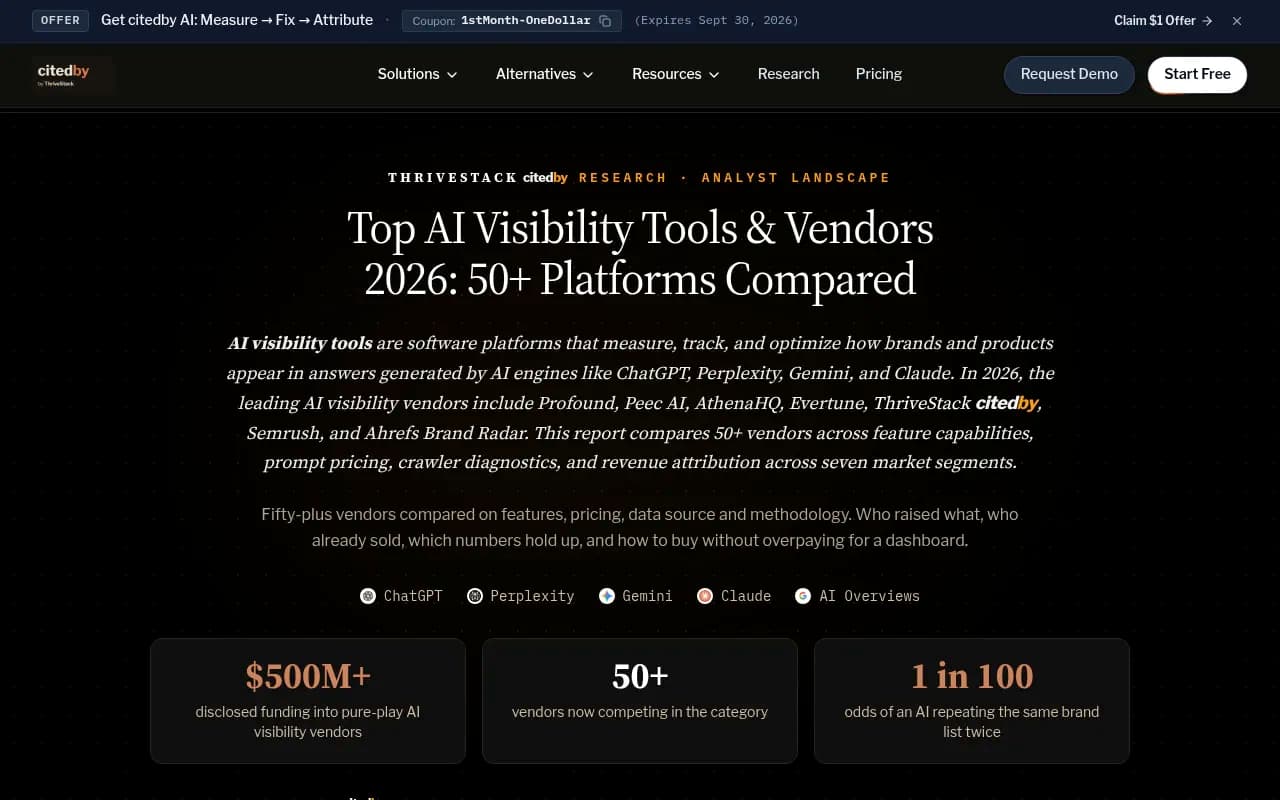
One caveat about my own sources. Most pricing and feature descriptions below come from vendor pages or from competitors writing comparison posts, and several authors disclose a conflict of interest. Treat everything as directional and confirm on the vendor's site.
The three tools at a glance
| The Prompting Company | Relixir | Evertune | |
|---|---|---|---|
| Positioning | "Agent experience": be named and be usable by AI agents | "Autonomous GEO Employee" (Rex) | Measure, act and advertise across the AI customer journey |
| Backing | YC S25, $6.5M seed (Oct 2025) | YC-backed | $15M Series A led by Felicis (Aug 2025), $19M total |
| Public pricing | $99, $299, $3,000, custom | Custom only on its site | $60, $800 annually, custom |
| Content output | Posts published to ai.yourdomain.com | Auto-published blog content, schema | 25 articles/mo on Pro, unlimited on Enterprise |
| Paid media | No | No | ChatGPT Ads Agent, retargeting |
| Best fit | Growth-stage B2B SaaS | Teams that want it done for them | Enterprise and category brands with budget |
The Prompting Company
The Prompting Company came out of Y Combinator's Summer 2025 batch and raised a $6.5M seed in October 2025 from Peak XV, Base10, Kearny Jackson and YC, per TechCrunch. The founders are Kevin Chandra, Michelle Marcelline and Albert Purnama. Named customers include Rippling, Rho, Motion, Vapi, Fondo, Kernel and Traceloop, which tells you who it is built for: B2B SaaS, mostly developer-adjacent.
What it does
Per its docs, as described by a competitor-authored review, the product suggests about 10 prompts a day, writes a post for each one, and publishes it to a subdomain like ai.yourdomain.com. Metrics include share of voice, rankings and AI crawler traffic. Developers get a CLI, an API and an MCP server.
That is genuinely execution. It is also a specific kind of execution: lots of purpose-built pages on a subdomain. One competitor post claims the strategy means 500k+ AI-optimized pages per brand. I could not verify that, so I wouldn't repeat it.
Pricing and the credit trap
Checked on October 2, 2026:
- Basic, $99/mo: 25 prompts and 1,000 credits
- Pro, $299/mo: 100 prompts, 4,000 credits and 8 articles
- White-glove, $3,000/mo: 12,000 credits and 50 articles
- Enterprise: custom
One response is one credit and one article is 20 credits. The page doesn't define "response", and the reviewer assumes it means one engine answering one prompt once. On that reading, tracking 100 prompts daily on 4 engines uses 12,000 credits a month. Only the $3,000 plan covers it. So the $299 plan with "100 prompts" is not 100 prompts tracked daily across engines. The engine lists also differ between the pricing table, plan card and FAQ, and the trial length isn't stated.
An older source quotes $300 to $1,500 per month per brand. That looks stale.
The case study
Hyperbrowser went from 3% to 58% share of voice, ranked second, and was a top recommendation in 7 of 7 categories. The "+55%" is percentage points. As a relative change it is roughly 19x. The page doesn't disclose prompts, engines, runs or dates. Good story, unauditable.
One more oddity: the reviewer found that ChatGPT, Perplexity and Claude didn't know the company by name as of August 2025, and Gemini returned a different company. Worth a smile, though not a verdict on the product.
Relixir
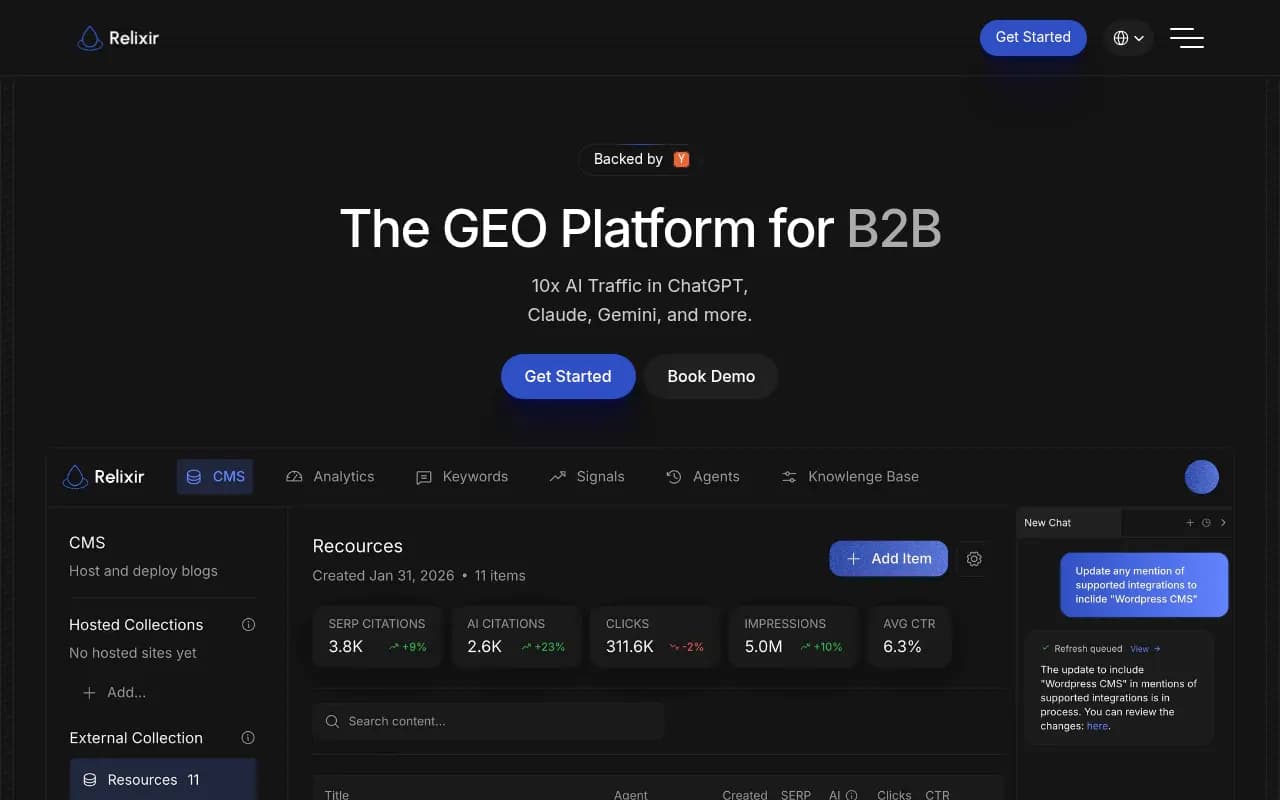
Relixir is the hardest of the three to evaluate. Its site positions "Rex" as an Autonomous GEO Employee and shows custom pricing only. The company deploys Rex for you. Third-party descriptions say it is YC-backed, auto-publishes content, embeds multimodal schema, and claims to flip AI rankings within 30 days. Those descriptions come from competitors.
Pricing is a mess
- Orion's guide lists $3,600/mo and $5,200/mo tiers, but dates from February 2026 and Orion is a competitor.
- Hikoo lists a $500/mo starter.
- Loudmink lists $199 to $499/mo.
- FlyRank says there are no published tiers.
Four sources, four answers. Treat Relixir as quote-only and get the number in writing. I did not scrape Relixir's own docs or pricing beyond its homepage, and I'd rather say so than guess.
What to ask before buying
Because Relixir publishes content on your behalf, the questions are practical. How many pages a month? Where are they hosted, your domain or theirs? Who maintains them when facts change? And what happens to the content if you cancel? The "30 days to flip rankings" claim needs a methodology: which prompts, which engines, how many runs.
Evertune
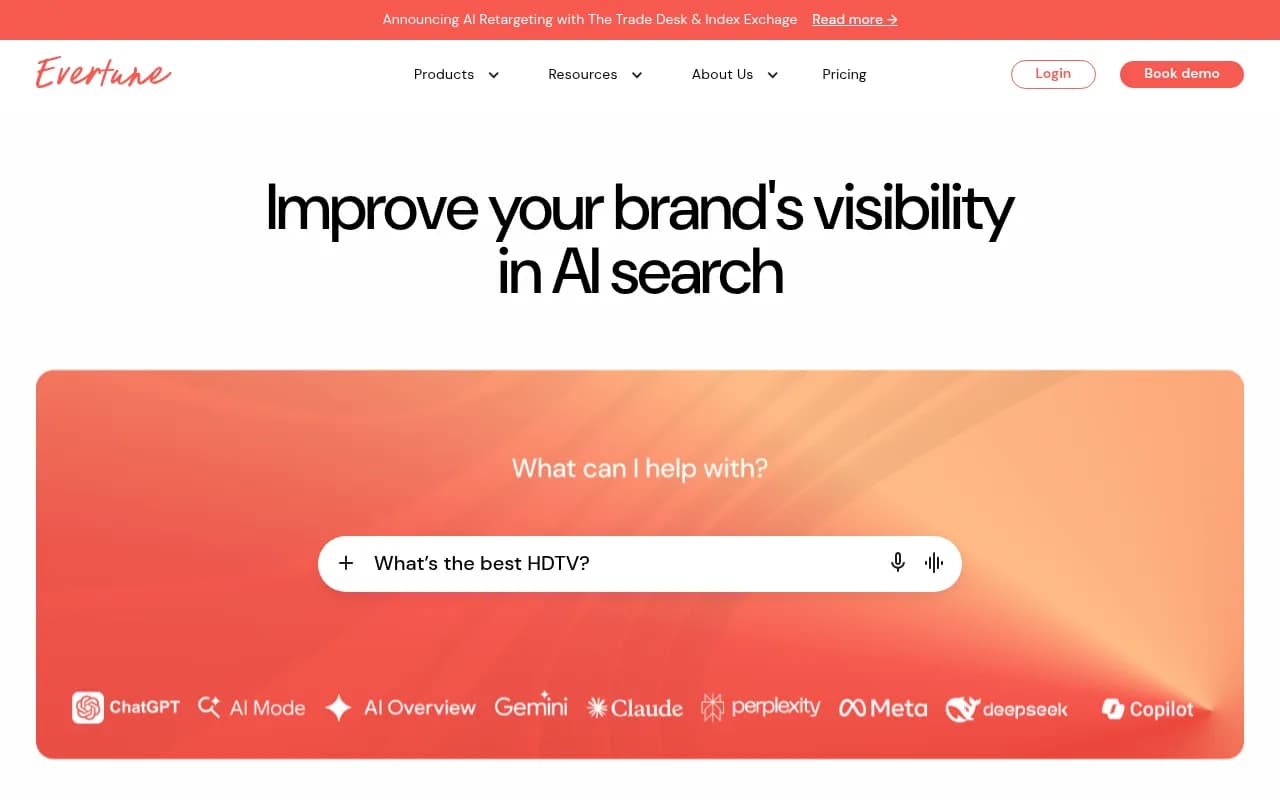
Evertune is the most expensive and the most measurement-heavy of the three. It raised $15M in Series A led by Felicis in August 2025, bringing total funding to $19M, and lists customers such as athenahealth, Miro, Roku and Virgin Voyages.
Pricing
From Evertune's pricing page:
| Plan | Price | Prompt credits | Models | Notable inclusions |
|---|---|---|---|---|
| Starter | $60/mo | 5,000/mo | 5 (ChatGPT Search, Gemini Search, AI Mode, AI Overview, Copilot) | Daily monitoring, Shopping Insights, GEO Manager Agent, Ads Agent at 10% of media spend |
| Pro | $800/mo billed annually | 100,000/mo | 11 | 100 samples per prompt, Content Agent (25 articles/mo), Prompt Volumes, Partner Connect, AI Retargeting, data MCP, Ads Agent at 8% of media |
| Enterprise | Custom | Custom | 11+ | Unlimited content, Fact Checker, Site Audit, Bot Analytics, SSO, data export |
Its own calculator shows the credit math: 50 prompts x 1 model x 3 samples a day x 30 days = 4,500 credits. So credits are samples, not prompts. That is why 100,000 credits does not mean 100,000 distinct prompts. A comparison from Canlah flags exactly this: verify whether the number counts unique prompts or sampled responses.
Note that bot analytics and site audit sit on Enterprise only. The crawler-side visibility that matters for diagnosing why you aren't cited is the part you pay most for.
Where it is strongest
Evertune's pitch is statistical rigour. It says it samples each prompt 100 times per model, and that a 150M+ conversation panel feeds its prompt discovery. ThriveStack's piece notes that the odds of an AI returning the same brand list twice are under 1 in 100, which is a strong argument for repeated sampling. Single-run scores are noisy.
It is also the only one of the three that sells paid placement from the same data. The Ads Agent builds ChatGPT campaigns around visibility gaps, with retargeting through partners like The Trade Desk and Index Exchange. Media spend is on top, plus the 8 to 10% agent fee.
The ads question
Is the ad channel worth building around? Promptwatch Data's ChatGPT ads report (May 20 to Aug 17, 2026) found ads in an average of 20.1% of ChatGPT responses that ran a web search. There were none until May 27, the daily rate peaked at 43.9%, and the 7-day average was 32.4%. Of ad-bearing responses in the last 7 days, 73.3% were organic prompts, 18.0% brand-specific and 8.6% competitor comparison. So the slot is real and growing, but it is under four months old as a channel. That is a reasonable reason to test it, and a poor reason to pick a platform on its own.
Security is the other gap. A competitor says Evertune advertises no SOC 2 or HIPAA certification, and I found none on the reviewed pages. Its credibility comes from analyst listings: Gartner's Market Guide for Answer Engine Visibility Tools (March 23, 2026) and Forrester's AEO landscape (September 17, 2026). If your procurement team needs certificates, ask.
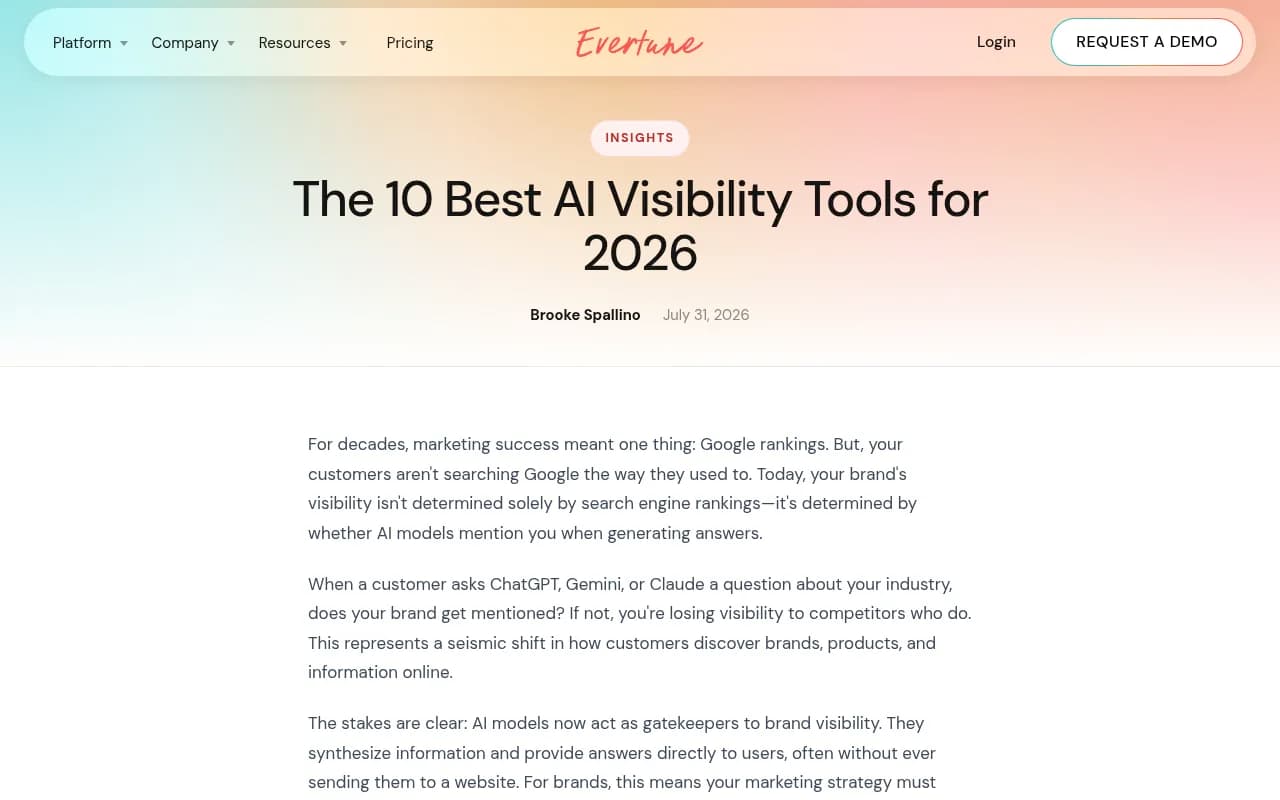
A note on that screenshot: Evertune's "10 best tools" article ranks Evertune number one and is the only listed tool with an "AI advertising: Yes". That is marketing, not a neutral ranking.
Head-to-head: who actually does more than report?
| Test | The Prompting Company | Relixir | Evertune |
|---|---|---|---|
| Publishes content | Yes, to a subdomain | Yes, auto-published | Yes, capped at 25/mo on Pro |
| Runs paid ads | No | No | Yes, ChatGPT Ads Agent |
| Pricing transparency | Good, but credits confusing | Poor, quote-only | Good |
| Measurement rigour disclosed | Not stated | Not stated | 100 samples per prompt (vendor claim) |
| Crawler analytics | Mentions AI crawler traffic | Unverified | Enterprise only |
| Developer tooling | CLI, API, MCP | Unverified | Data MCP on Pro |
| Independent proof | Unauditable case study | Competitor descriptions | Analyst listings |
My read: The Prompting Company is the most affordable way to try publish-at-scale, as long as you budget for credits. Relixir is the most hands-off but the least verifiable. Evertune is the best-documented on measurement and the only one with ads, and it is priced accordingly.
What none of them clearly shows is the full loop: this page was crawled, then cited, then sent a visitor who converted. ThriveStack notes that revenue attribution is rare in this category. If you are choosing on "does more than report", that loop is the real question.
How to choose
- Growth-stage B2B SaaS, small budget, comfortable with content on a subdomain: start with The Prompting Company, and model your credits first.
- You want someone else to run it and can tolerate opaque pricing: get a Relixir quote, and ask for page counts, hosting and exit terms.
- Enterprise or large category brand that wants rigorous sampling and paid ChatGPT placement: Evertune Pro at $800 is the entry, but budget for media and the agent fee.
- You need crawler logs, traffic attribution and execution together: widen the shortlist.
A wider option
If the loop matters most, Promptwatch is worth a look. It tracks real ChatGPT and Google AI interfaces, shows IP-verified AI crawler logs and AI visitor traffic, and its Content Agent publishes to WordPress, Webflow or Framer, then tracks whether each page gets crawled, cited and clicked. Plans start at $95/mo, so check promptwatch.com/pricing.

For other options, the GEO software directory at bestgeosoftware.com lists more vendors in this category. If you want to compare against Profound or Scrunch:

Questions to ask every vendor
- What does one "prompt", "response" or "credit" mean, and how many times is each run?
- Is tracking done through the real consumer interface or the API? Answers can differ.
- Where does published content live, and who owns it if you leave?
- Can you see crawler activity and AI referral traffic for the pages they publish?
- Is any case study backed by prompts, engines, run counts and dates?
- What is the total cost with media spend, agent fees and overages?
Run a trial or a small pilot on a fixed prompt set first. Running the same prompts through three tools returns three different answers, as agency /prompt's Paul Dyer has noted, so pick one baseline and compare against it over time.
Bottom line
All three do more than a bare dashboard, in different ways. The Prompting Company publishes, Relixir deploys an agent, Evertune publishes and advertises. None has independent evidence in the sources I could find, and Relixir's price is a coin flip until you get a quote. Decide by what you will verify, not by which landing page says "agentic" loudest.