Wicked Reports Review 2026
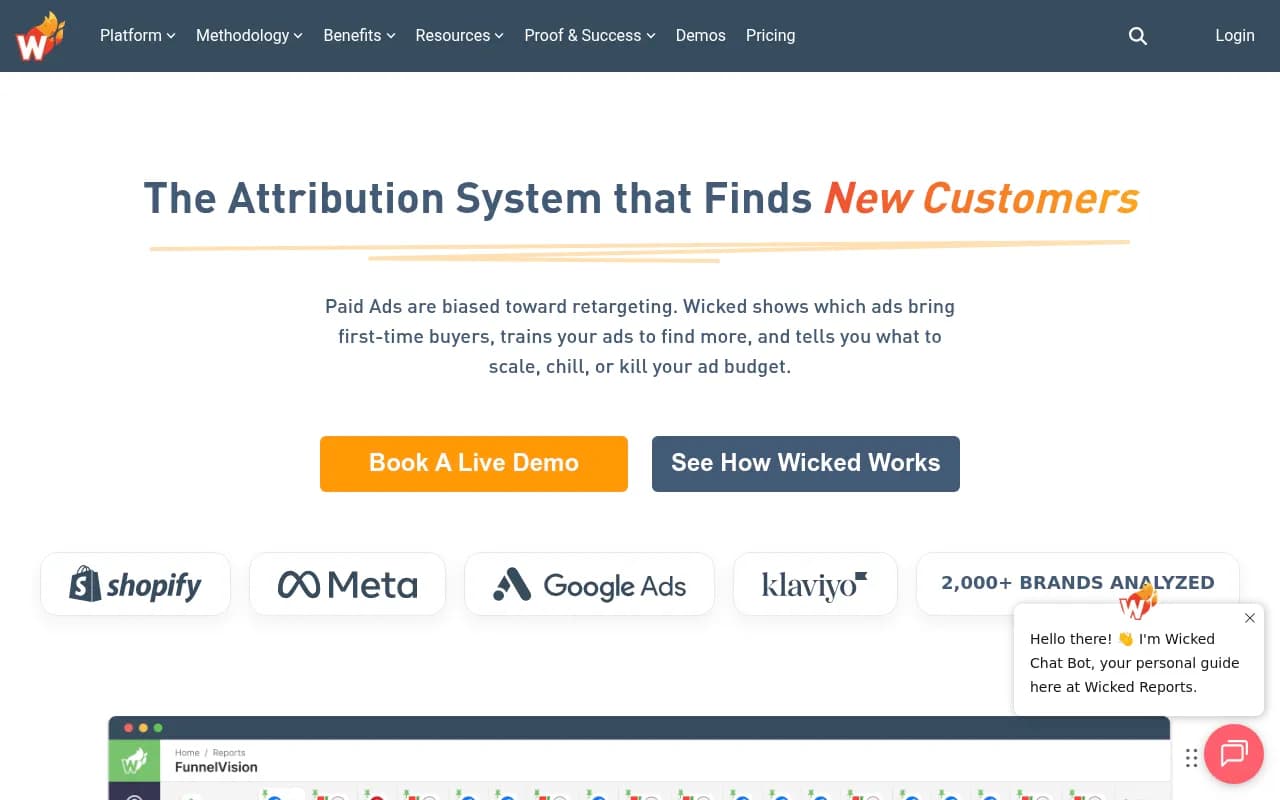
Wicked Reports is a first-party attribution platform for eCommerce brands and agencies that tracks which ads drive first-time buyers vs repeat customers. It trains Meta's algorithm with Advanced Signal events, delivers weekly Scale/Chill/Kill budget recommendations via 5 Forces AI, and connects reve
Summary
- Best for: eCommerce brands ($5M-$50M revenue) and agencies managing 5-50 clients who need to separate new customer acquisition from repeat buyer recycling
- Core strength: First-party attribution matched to order IDs and CRM IDs, plus Advanced Signal training for Meta that teaches the algorithm to find first-time buyers instead of retargeting existing customers
- Key differentiator: 5 Forces AI delivers weekly Scale/Chill/Kill budget decisions with reasoning -- not just dashboards, but actionable recommendations you can defend
- Proven results: Brands report 60-63% drops in new customer acquisition cost (nCAC) after enabling Advanced Signal and stopping wasted retargeting spend
- Limitation: Pricing not transparent on website -- requires demo to get quote. No self-service trial.
Wicked Reports is a first-party attribution and marketing intelligence platform built specifically for eCommerce brands and agencies tired of platform ROAS numbers that look great but don't translate to actual business growth. The company's core insight: paid ads platforms like Meta and Google are biased toward retargeting existing customers because those conversions are easier and cheaper. Wicked solves this by tracking which campaigns drive first-time buyers, training ad algorithms to find more of them, and delivering weekly budget recommendations grounded in real revenue data.
The platform serves two primary audiences. For eCommerce brands doing $5M-$50M in annual revenue, Wicked provides proof of which campaigns drive first orders, lowers new-customer CAC, and delivers budget decisions you can defend in 10 minutes. For agencies managing 5-50 clients, it offers client-ready proof of new-customer ROI, retainer defense with first-party accuracy, and a partner program with co-marketing perks. Over 2,000 brands have used the platform, with case studies showing 60-63% drops in new customer acquisition cost after implementation.
Core Features: Measure, Signal, Action
Wicked organizes its capabilities into three interconnected systems that work together to improve new customer acquisition.
Wicked Measure (First-Party Attribution): The foundation is order-level and lead-level attribution that ties every purchase and CRM record back to its source campaign. Unlike platform pixels that guess based on cookies and view-throughs, Wicked matches revenue to actual order IDs from Shopify or BigCommerce and CRM IDs from systems like Klaviyo. It automatically separates new customers from repeat buyers -- no manual tagging required. The platform mutes view-through attribution to stop inflated ROAS numbers and includes an Attribution Time Machine feature that gives accurate top-of-funnel measurement by looking at the full customer journey, not just last-click. This means you see the real story behind your revenue: which campaigns brought in first-time buyers vs which ones just recycled existing customers.
Advanced Signal for Meta: This is where Wicked moves from measurement to optimization. The platform sends server-side conversion events to Meta's Conversions API that distinguish between New Purchase and Repeat Purchase. It also passes product-level events so Meta's algorithm learns what you actually want: first-time customers buying specific products. This training data teaches Meta to stop chasing repeat buyers and start finding net-new customers. Brands report this is where the biggest nCAC drops happen -- one case study showed a 63% reduction in new customer acquisition cost after enabling Advanced Signal. The signal accuracy is validated during setup by Wicked's team to ensure Meta is learning from clean data.
5 Forces AI (Weekly Budget Recommendations): Instead of staring at dashboards and guessing what to do, 5 Forces AI analyzes your attribution data and delivers weekly Scale / Chill / Kill recommendations for each campaign. Each recommendation includes the reasoning behind it -- why this campaign should get more budget, why that one should be paused, why another should stay flat. The AI considers five factors (hence the name): new customer acquisition efficiency, repeat customer value, attribution confidence, trend direction, and budget utilization. This saves 10+ hours per week of manual analysis and gives you budget moves you can defend to your team or clients. It's not just "here's what happened" -- it's "here's what to do next."
Additional Capabilities
Platform Bias Correction: Wicked addresses the core problem with relying on Meta Ads Manager or Google Ads reporting: those platforms have an incentive to show high ROAS numbers because they want you to keep spending. Wicked's first-party data proves which conversions are actually new customers vs platform-claimed conversions that are just retargeting. One agency case study found 60% of their Meta spend was going to repeat buyers they didn't know they were retargeting.
Multi-Channel Attribution: The platform connects data from Meta, Google Ads, Pinterest, Amazon, Klaviyo email, and other channels into one view. You see cross-channel customer journeys -- someone clicks a Meta ad, joins your email list, then buys from a Google Shopping ad. Wicked credits all the touchpoints appropriately instead of giving 100% credit to the last click.
CRM and Order ID Matching: Unlike pixel-based attribution that relies on cookies (which break with iOS privacy changes and browser restrictions), Wicked matches conversions to actual CRM contact IDs and eCommerce order IDs. This first-party approach is privacy-compliant and survives iOS updates, including iOS 26 and beyond. The platform uses server-side events and deterministic matching instead of probabilistic guessing.
Integrations: Native integrations with Shopify, BigCommerce, Klaviyo, Meta, Google Ads, Pinterest, Amazon, and other eCommerce/ad platforms. Setup takes hours, not weeks, and Wicked's team helps validate signal accuracy during onboarding. The platform complements Google Analytics 4 rather than replacing it -- GA4 shows traffic and behavior, Wicked connects that to revenue and customer acquisition.
Agency Partner Program: For agencies, Wicked offers co-marketing opportunities, client-ready reporting templates, and partner perks. The platform's client-facing reports improve retention and win rate by proving which campaigns drive new customers -- a much stronger retainer defense than "we increased your ROAS."
Who Is It For
Wicked Reports is purpose-built for two groups.
eCommerce Brands ($5M-$50M Annual Revenue): If you're spending $50K+ per month on paid ads and your platform ROAS looks great but your profit isn't growing, Wicked is for you. You're likely recycling budget into retargeting existing customers without realizing it. The platform is especially valuable for brands with repeat purchase behavior (subscription boxes, consumables, fashion, supplements) where the line between new and repeat customers gets blurred in platform reporting. You need to know which campaigns drive first orders so you can scale new customer acquisition instead of just milking your existing base. If you're defending budget decisions to a board or investors, Wicked gives you the proof you need.
Agencies Managing 5-50 eCommerce Clients: If you're running paid ads for multiple eCommerce brands and struggling to prove your value beyond platform ROAS, Wicked solves that. You can show clients exactly which campaigns you're running that drive first-time buyers vs which competitor campaigns are just retargeting. The platform's client-ready reports and first-party accuracy make retainer renewals easier. The partner program offers co-marketing and revenue share opportunities. Agencies using Wicked report higher client retention because they can prove new customer acquisition, not just ad spend efficiency.
Who Should NOT Use This: If you're a small brand doing under $1M in revenue or spending less than $10K/month on ads, Wicked is likely overkill. The platform is built for brands with enough ad spend and customer data to make new vs repeat attribution meaningful. If you're a B2B SaaS company or lead-gen business (not eCommerce), the platform's eCommerce-specific features (order ID matching, Shopify integration, repeat purchase tracking) won't apply. If you need self-service onboarding and transparent pricing, Wicked requires a demo and custom quote, which may not fit your buying process.
Integrations & Ecosystem
Wicked Reports integrates natively with Shopify, BigCommerce, Klaviyo, Meta Ads, Google Ads, Pinterest Ads, and Amazon. The platform uses server-side events and API connections rather than just pixels, which makes it resilient to browser privacy changes. Setup involves connecting your eCommerce platform, CRM, and ad accounts -- Wicked's team validates signal accuracy during onboarding to ensure Meta is receiving clean conversion data. The platform complements Google Analytics 4 by adding revenue attribution and customer-level tracking that GA4 doesn't provide. There's a GitHub presence (WickedReports) and integrations via Formkeep and Integrately for connecting additional tools.
Pricing & Value
Wicked Reports does not publish transparent pricing on its website. Based on available information, the platform uses revenue-aligned pricing for eCommerce and subscription businesses. Plans are monthly with the option to cancel anytime, though annual pre-pay contracts are available and save up to 2 months on cost. One pricing reference mentions a $400 initial charge followed by monthly pricing based on CRM contact list size. The lack of transparent pricing means you need to book a demo to get a quote, which may be a barrier for brands that prefer self-service evaluation. However, given the reported results (60-63% nCAC reductions), the ROI can be substantial for brands spending $50K+ per month on ads. For agencies, the partner program offers revenue share and co-marketing opportunities that can offset the cost.
Strengths & Limitations
Strengths:
- Order-level and CRM-level attribution: Unlike pixel-based tools, Wicked matches revenue to actual order IDs and CRM contact IDs, which survives iOS privacy changes and browser restrictions
- New vs repeat customer separation: Automatic classification of first-time buyers vs repeat customers -- the core insight most brands are missing
- Advanced Signal training for Meta: Teaches Meta's algorithm to find new customers instead of retargeting existing ones, with proven 60-63% nCAC reductions
- 5 Forces AI recommendations: Weekly Scale/Chill/Kill budget decisions with reasoning -- not just dashboards, but actionable next steps
- First-party data approach: Server-side events and deterministic matching instead of cookie-based guessing
Limitations:
- No transparent pricing: Requires demo to get quote, which slows down evaluation for brands that prefer self-service
- No self-service trial: Can't test the platform yourself before committing to a sales conversation
- eCommerce-focused: Not built for B2B SaaS, lead-gen, or non-transactional businesses
- Requires meaningful ad spend: Platform is overkill for brands spending under $10K/month on ads
Bottom Line
Wicked Reports is for eCommerce brands and agencies that have outgrown platform ROAS reporting and need to know which campaigns drive first-time buyers. If you're spending $50K+ per month on ads and suspect you're recycling budget into retargeting without realizing it, Wicked proves where the waste is and trains Meta to find new customers instead. The combination of first-party attribution, Advanced Signal training, and weekly AI recommendations makes it more than a dashboard -- it's a system for lowering new customer acquisition cost. Best use case in one sentence: eCommerce brands doing $5M-$50M in revenue who need to separate new customer acquisition from repeat buyer recycling and defend budget decisions with first-party proof.
Tags:
Frequently asked questions
What is Wicked Reports and what does it do?
Who is Wicked Reports best for?
How much does Wicked Reports cost?
What is Advanced Signal training in Wicked Reports?
Does Wicked Reports offer a free trial?
What is 5 Forces AI in Wicked Reports?
How does Wicked Reports differ from Google Analytics or Meta's attribution?
What results can I expect from using Wicked Reports?
Similar and alternative tools to Wicked Reports