Spotrise Review 2026
AI SEO platform that benchmarks and compares top SEO tools with real performance data, while also offering its own tracking and optimization capabilities.
Key takeaways
- Spotrise is an early-stage AI SEO agent platform (currently in private beta) that lets you build custom automation agents for audits, reporting, and GEO workflows
- Competes with Promptwatch in the GEO/AI visibility space, but lacks core optimization features: no content gap analysis, no AI crawler logs, no traffic attribution, no Reddit/YouTube tracking, and no prompt volume or difficulty scoring that Promptwatch provides
- Pricing starts at $99/month (Starter) with a 20% annual discount, and a free trial is available (no credit card required)
- Still in private beta -- the product is not yet publicly accessible, which makes it hard to evaluate real-world performance
- Best suited for SEO agencies and small teams who want to automate repetitive workflow tasks rather than deeply optimize for AI search visibility
Spotrise is an AI-powered SEO automation platform that positions itself around one core promise: turning hours of manual SEO work into minutes. The platform is built around the concept of "AI agents" -- configurable automation workflows that can run site audits, generate client reports, track rankings, and connect to your existing SEO stack. It's currently in private beta, with access available through a waitlist or a booked demo call.
The company appears to be early-stage, with a founding team led by Nikita Silianov based on the demo booking links. The product targets a wide range of users -- from solo freelancers to enterprise teams -- and claims to save 20 to 40 hours per month through routine SEO automation. That's an ambitious claim for a platform that hasn't yet launched publicly, and it's worth keeping that context in mind throughout this review.
What makes Spotrise interesting is its framing around "GEO" (Generative Engine Optimization) alongside traditional SEO. The platform explicitly mentions AI traffic tracking and positions itself as relevant to the shift toward AI search. But the actual depth of its GEO capabilities, compared to dedicated AI visibility platforms, is thin based on what's currently disclosed.
Key features
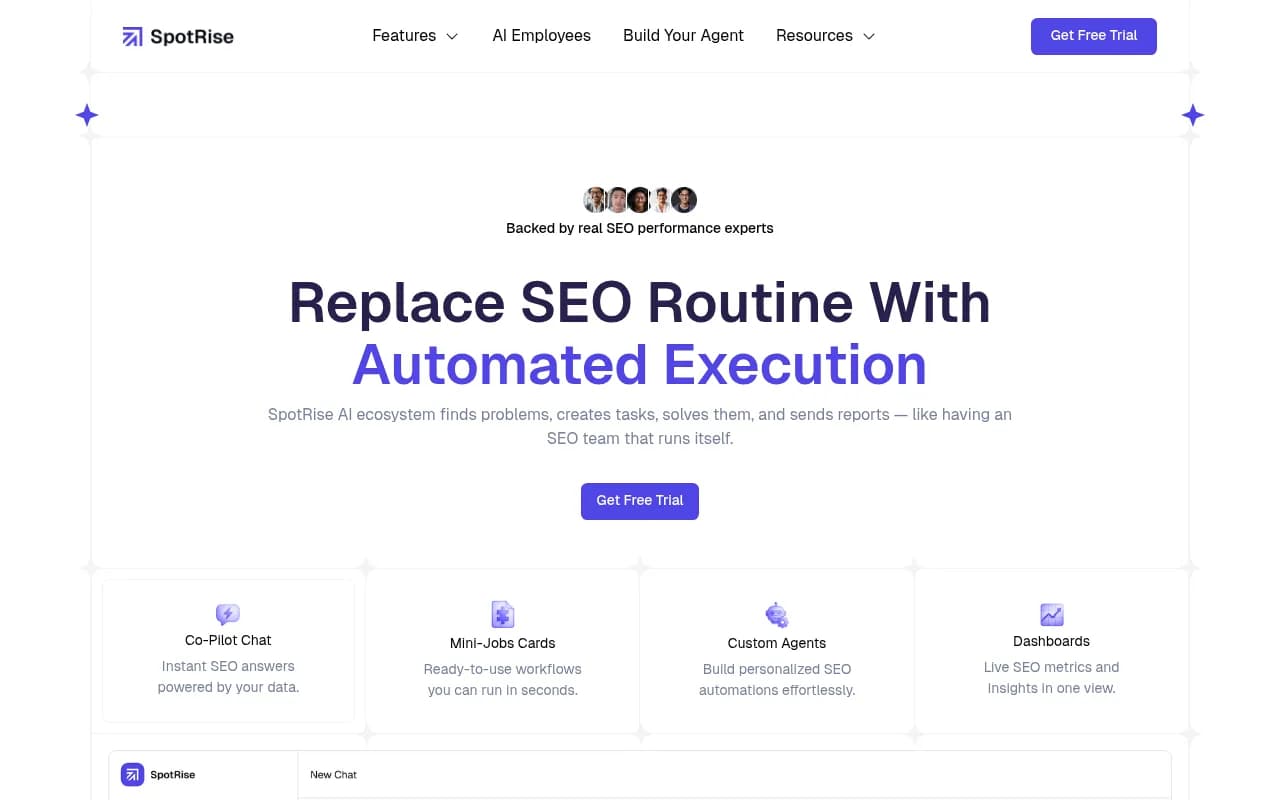
Custom AI agents The core mechanic of Spotrise is the agent builder. You describe what you want to automate in natural language -- "run a weekly audit and email me the results" or "pull GSC data and flag pages with declining impressions" -- and Spotrise builds an agent to handle it. The Starter plan allows 1 custom agent, Pro allows 5, and Scale allows 15. This tiered approach makes sense for agencies managing multiple clients, though the single-agent limit on Starter is restrictive for anyone with more than one site.
Integrations hub Spotrise claims "hundreds of integrations" covering GA4, Google Search Console, Bing, CMS platforms, CRMs, and various analytics tools. The website shows a grid of integration logos, though specific tool names aren't all legible from the marketing copy. The integration layer is described as the connective tissue between your existing stack and the automation agents -- which is the right approach. Whether the integration depth matches the breadth claim is something only beta users can verify.
Automated reporting One of the clearest use cases is client reporting. Spotrise auto-generates business-readable reports from SEO data, which is genuinely useful for agencies that spend hours building decks. The "Autonomous Visibility & Reporting Layer" is positioned as a way to upsell and retain clients without manual data assembly. This is a real pain point for agencies, and if the reports are actually good, this feature alone could justify the cost.
AI Co-Pilot The Co-Pilot is described as a conversational interface for diagnosing SEO issues. You ask it questions, it detects problems, explains them in plain language, and suggests fixes. Think of it as a chat interface layered on top of your connected data sources. This is similar in concept to what tools like Semrush's AI assistant or Ahrefs' AI features do, though Spotrise's agent-first architecture suggests it's meant to be more action-oriented than advisory.
Active dashboards Each plan includes a set number of "Active Dashboards" -- 1 on Starter, 5 on Pro, 15 on Scale. These appear to be customizable views of your SEO data, likely pulling from connected tools. The dashboard count being tied to plan tier is a common agency-tool pattern, where each dashboard maps to a client or domain.
Chat credits system Spotrise uses a credit-based model for AI interactions: 5,000 credits on Starter, 15,000 on Pro, 45,000 on Scale. This is a somewhat opaque pricing mechanism -- it's not immediately clear how many credits a typical audit or report consumes. Credit-based systems can create anxiety around usage, especially for agencies running frequent automated workflows.
Connections credits Separate from chat credits, "SpotRise Connections Credits" govern integrations usage: 1,000 on Starter, 5,000 on Pro, 15,000 on Scale. Again, the granularity of what consumes a connection credit isn't explained in the marketing materials. Two separate credit pools add complexity to cost estimation.
Enterprise security Spotrise claims SOC 2 compliance, HIPAA compliance, and AES-256 encryption. For an early-stage platform still in private beta, these are strong compliance claims. SOC 2 and HIPAA certification typically require significant audit processes, so if these are genuine certifications (not just aspirational), it's a meaningful differentiator for enterprise buyers in regulated industries.
AI templates The website references "AI Templates" as a section, though the scraped content doesn't detail what templates are available. Presumably these are pre-built agent configurations for common SEO tasks -- audit templates, reporting templates, and so on. This would lower the barrier to getting started without needing to configure agents from scratch.
Who is it for
The primary audience Spotrise is targeting is SEO agencies managing multiple clients. The Scale plan's structure -- 15 agents, 15 dashboards, 3 team workspaces -- maps directly to an agency running a portfolio of client sites. The automated reporting feature is particularly relevant here: agencies that bill for monthly reporting know how much time goes into building those decks, and anything that automates that process has real ROI.
Solo SEO consultants and freelancers are the Starter plan audience. At $99/month (or $79 with annual billing), it's accessible for someone who wants to automate one site's worth of SEO work. The single-agent limit is a real constraint, but for a freelancer managing one or two clients, it might be enough to handle the most repetitive tasks.
In-house SEO teams at growth-stage companies fit the Pro tier. Five agents and five dashboards suggest a team handling multiple properties or tracking multiple aspects of one large site. The team creation feature on Pro (1 team) means you can collaborate without everyone sharing a single login.
Who should probably wait: anyone who needs deep AI search visibility tracking right now. Spotrise mentions GEO in its positioning, but the disclosed feature set doesn't include the kind of AI citation tracking, prompt monitoring, or content gap analysis that dedicated GEO platforms provide. If your primary need is understanding how your brand appears in ChatGPT, Perplexity, or Claude responses, Spotrise isn't the right tool yet. Also, given that it's still in private beta, anyone who needs a production-ready tool today should look elsewhere.
Integrations and ecosystem
Spotrise's integration story is central to its value proposition. The platform connects to GA4 and Google Search Console natively, which covers the baseline for most SEO workflows. Bing integration is mentioned, which is less common and useful for markets where Bing has meaningful share.
The "hundreds of integrations" claim likely refers to a middleware layer (possibly similar to how tools like Make or Zapier work under the hood) rather than hundreds of native, deep integrations. The website shows a grid of logos but doesn't name all of them explicitly in the scraped content.
CMS and CRM integrations are mentioned broadly. For agencies, CRM integration is useful for tying SEO performance data to client accounts. CMS integration would allow agents to push content recommendations or fixes directly to the site, which would be a meaningful capability if it works as described.
There's no mention of a public API, browser extension, or mobile app. For a platform in private beta, this isn't surprising, but it's worth noting for teams that want to build custom workflows on top of the platform.
Pricing and value
Spotrise's pricing is structured across four tiers:
- Starter: $99/month ($79/month annually) -- 5,000 chat credits, 1 custom agent, 1 dashboard, 1,000 connections credits
- Pro: $199/month ($159/month annually) -- 15,000 chat credits, 5 agents, 5 dashboards, 5,000 connections credits, 1 team
- Scale: $299/month ($239/month annually) -- 45,000 chat credits, 15 agents, 15 dashboards, 15,000 connections credits, 3 teams, personal support manager
- Enterprise: Custom pricing -- unlimited everything, 1-hour turnaround support
A free trial is available with no credit card required, though access is gated through a demo call booking (via cal.com), which adds friction. The "get started" links all route to a 15-minute call with the founder, which is typical for early-stage SaaS but means you can't self-serve into the product.
Compared to traditional SEO tools, the pricing is competitive. Semrush's Pro plan runs $139.95/month and Ahrefs starts at $129/month, both without the agent automation layer. Against dedicated GEO platforms, Spotrise's pricing is lower than Promptwatch's Professional tier ($249/month), but the feature depth in the AI visibility category is also significantly lower.
The dual credit system (chat credits + connections credits) makes it hard to predict actual costs at scale. Agencies running frequent automated workflows could hit credit limits faster than expected, and the pricing page doesn't clarify credit consumption rates.
Strengths and limitations
What it does well:
- The agent-based automation concept is genuinely useful for repetitive SEO tasks. If the execution matches the pitch, agencies could save meaningful time on audits and reporting.
- The compliance claims (SOC 2, HIPAA, AES-256) are strong for an early-stage tool and would matter to enterprise buyers in healthcare or finance.
- Pricing is accessible relative to established SEO platforms, and the annual discount (20%) is straightforward.
- The natural language interface for building agents lowers the technical barrier -- you shouldn't need to write code to automate an audit workflow.
Honest limitations:
- It's in private beta. There's no public product to evaluate, no user reviews to reference, and no track record. Every claim on the website is unverified by independent testing.
- The GEO/AI visibility features are surface-level compared to dedicated platforms. There's no mention of prompt tracking, AI citation analysis, content gap analysis, AI crawler logs, or traffic attribution from AI sources. For teams serious about GEO, this is a significant gap. Platforms like Promptwatch offer all of these, plus AI content generation grounded in citation data -- Spotrise has none of that.
- The dual credit system (chat credits and connections credits) creates pricing opacity. It's difficult to estimate real monthly costs without knowing consumption rates.
- No self-serve onboarding -- every signup routes through a demo call, which slows down evaluation.
- No public API or developer documentation visible, limiting extensibility for technical teams.
Bottom line
Spotrise is an interesting early-stage bet on AI-driven SEO automation, particularly for agencies that want to reduce time spent on audits and client reporting. If the agent builder works as described and the integrations are genuinely deep, it could be a useful addition to an agency's stack at a reasonable price point.
That said, it's a private beta product with no public track record, and its GEO capabilities are minimal compared to what the category now demands. Teams whose primary goal is understanding and improving their visibility in AI search results -- ChatGPT, Perplexity, Claude, and the rest -- will find Spotrise underpowered. For that use case, Promptwatch is the more complete platform, covering everything from prompt monitoring and content gap analysis to AI crawler logs and traffic attribution that Spotrise simply doesn't offer.
Best for: SEO agencies and small teams who want to automate repetitive audit and reporting workflows and are willing to join a waitlist for a product still finding its footing.
Frequently asked questions
What is Spotrise?
How much does Spotrise cost?
Is Spotrise available to use right now?
Does Spotrise support GEO or AI search visibility tracking?
What integrations does Spotrise support?
Who is Spotrise best suited for?
Similar and alternative tools to Spotrise