Key takeaways
- Competitor benchmarking in AI visibility means more than knowing who's ahead -- it means understanding why and knowing what to do about it
- Scrunch AI offers solid monitoring across multiple LLMs with clean competitor comparison views, but stops at the data layer
- Searchable provides brand mention tracking and some competitive context, but its feature set is narrower than either alternative
- Promptwatch is the only one of the three that closes the loop: it finds where competitors outrank you, shows you the specific content gaps causing it, and generates content to fix them
Why competitor benchmarking became the hardest problem in AI visibility
Traditional SEO benchmarking was relatively simple. You checked keyword rankings, compared domain authority, looked at backlink profiles. The data was stable, the metrics were well-understood, and the gap between "knowing" and "doing" was manageable.
AI visibility benchmarking is messier. LLMs don't rank pages -- they cite sources, synthesize answers, and recommend brands based on patterns in their training and retrieval data. Your competitor might be getting cited in ChatGPT responses for 40 prompts you've never even thought to track. And the answer to "why are they cited and not us?" is rarely obvious from a dashboard.
This is the context in which Searchable, Scrunch AI, and Promptwatch all emerged. They're all trying to solve the same underlying problem: help brands understand their position in AI-generated answers relative to competitors. But they approach it very differently, and those differences matter enormously when you're trying to actually improve your standing.
What "competitor benchmarking" actually requires
Before comparing the tools, it's worth being specific about what good competitor benchmarking looks like in the AI visibility context. There are roughly four layers:
- Prompt coverage: Which prompts is your competitor appearing in that you're not? This requires tracking a shared set of prompts across both brands.
- Citation analysis: Which pages, sources, or domains are being cited when competitors appear? This tells you why they're winning.
- Model-level breakdown: Are they stronger on ChatGPT but weaker on Perplexity? Different models have different source preferences.
- Actionability: What do you actually do with this information? The gap between "they're ahead" and "here's how to close it" is where most tools fail.
With that framework in mind, here's how each tool performs.
Scrunch AI: strong monitoring, clean benchmarking views
Scrunch AI has earned a reputation as one of the more capable monitoring platforms in the space. It tracks brand mentions across multiple LLMs, gives you competitor comparison views, and surfaces prompt-level data that shows where rivals are appearing and you're not.
The competitor benchmarking experience in Scrunch is genuinely useful. You can set up competitor brands alongside your own and see side-by-side visibility scores across models. The interface is clean, and the data is reasonably comprehensive for a monitoring tool.
Where Scrunch runs into limits is at the action layer. It's built to show you the state of play -- and it does that well -- but it doesn't tell you what content is missing from your site, which topics you need to cover, or how to actually improve your position. Several independent reviews of AI visibility tools in 2026 have noted this pattern: Scrunch is a strong tracker but not an optimization platform.
For teams that just need the data and have in-house content capacity to interpret and act on it, Scrunch is a reasonable choice. For teams that need the full loop from insight to execution, it leaves a gap.
Searchable: capable but narrower in scope
Searchable sits in a slightly different position. It covers AI search visibility monitoring with some content optimization features, but its competitive benchmarking capabilities are less developed than Scrunch's.
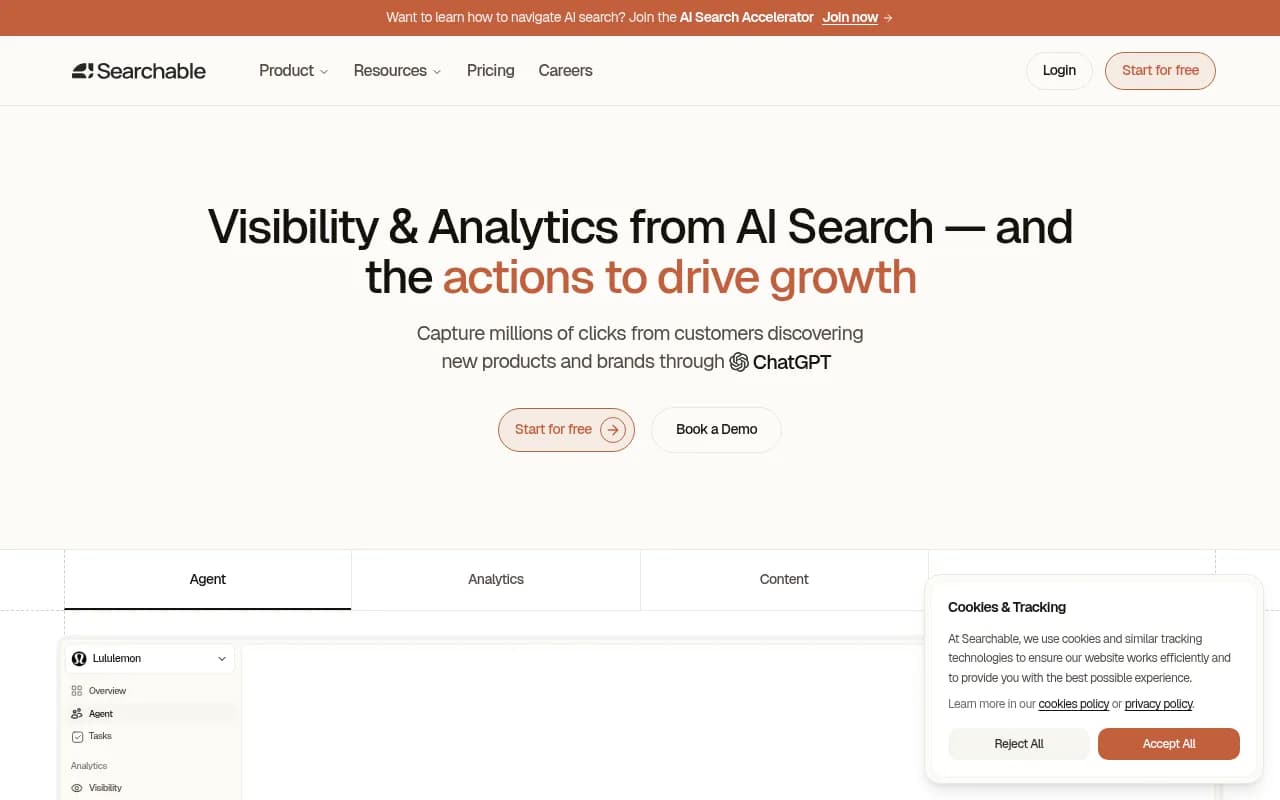
The platform does track brand mentions and can surface competitor data, but the depth of prompt-level competitor analysis is limited compared to what you'd get from either Scrunch or Promptwatch. It's a reasonable entry point for brands that are new to AI visibility and want a manageable starting point, but it's not where you'd go if competitor benchmarking is your primary use case.
One area where Searchable has some differentiation is content tooling -- it includes features for optimizing content for AI visibility, which puts it closer to the action layer than a pure monitoring tool. But the competitive intelligence side of the product hasn't kept pace with the monitoring-focused platforms.
Promptwatch: the only one that closes the loop
Promptwatch takes a different architectural approach to the problem. Rather than building a monitoring dashboard and stopping there, it's designed around a cycle: find gaps, create content, track results.

The competitor benchmarking story in Promptwatch starts with Answer Gap Analysis. You can see exactly which prompts your competitors are appearing in that you're not -- not just a count, but the specific prompts, the specific content gaps on your site causing the absence, and the topics AI models are looking for answers to but can't find on your pages.
That's a meaningfully different kind of competitive intelligence. It's not "they have 73% visibility and you have 41%." It's "here are the 28 prompts where Competitor X is being cited and you're not, here's why, and here's what you need to write."
From there, Promptwatch's built-in AI writing agent can generate content specifically engineered to close those gaps -- articles, listicles, comparisons -- grounded in citation data from over 880 million citations analyzed. This isn't generic content; it's built around the specific prompts and topics where your competitor is winning.
The tracking layer then closes the loop: as new content goes live, you can watch your visibility scores move at the page level, see which AI models start citing your new pages, and connect that back to actual traffic through GSC integration, a code snippet, or server log analysis.
A few other capabilities that matter specifically for competitive benchmarking:
- Competitor heatmaps show your AI visibility vs. competitors across different LLMs, so you can see model-specific patterns (maybe you're ahead on Perplexity but losing on ChatGPT)
- Prompt Intelligence includes volume estimates and difficulty scores, so you can prioritize the competitive gaps that are actually worth closing
- Reddit and YouTube insights surface the discussions influencing AI recommendations -- a channel most competitor analysis tools ignore entirely
- AI Crawler Logs show which pages AI crawlers are actually reading on your site, which helps explain why some content is getting cited and some isn't
Head-to-head comparison
| Feature | Searchable | Scrunch AI | Promptwatch |
|---|---|---|---|
| LLM monitoring coverage | Limited | 5+ models | 10+ models |
| Competitor tracking | Basic | Strong | Strong |
| Prompt-level benchmarking | Partial | Yes | Yes |
| Answer gap analysis | No | No | Yes |
| Content generation | Partial | No | Yes (AI writing agent) |
| Citation analysis | Basic | Yes | Yes (880M+ citations) |
| AI crawler logs | No | No | Yes |
| Reddit/YouTube insights | No | No | Yes |
| ChatGPT Shopping tracking | No | No | Yes |
| Prompt volume/difficulty scores | No | No | Yes |
| Traffic attribution | No | No | Yes (GSC, snippet, logs) |
| Pricing (entry) | Varies | Varies | $99/mo |
| Best for | New to AI visibility | Monitoring-focused teams | Teams that need to act on data |
The real question: monitoring vs. optimization
The core difference between these three tools isn't really about features -- it's about philosophy.
Scrunch and Searchable are built on the assumption that if you give teams good data, they'll figure out what to do with it. That's a reasonable assumption for large, well-resourced marketing teams with dedicated content strategists who can translate competitive gap data into a content roadmap.
Promptwatch is built on the assumption that the gap between data and action is where most teams get stuck -- and that the tool should help bridge it. The Answer Gap Analysis, the AI writing agent, the page-level tracking, the traffic attribution -- these are all designed to make the path from "we're losing to a competitor" to "we've closed the gap" as short as possible.
For most marketing teams in 2025 and 2026, that second approach is more valuable. Content teams are stretched. SEO budgets are under pressure. The ability to go from competitive gap to published, AI-optimized content in a single workflow is genuinely useful, not just a nice-to-have.
Which tool should you use?
The honest answer depends on where you are and what you need.
If you're just starting to understand AI visibility and want a lightweight way to see how you compare to competitors, Searchable is a reasonable starting point. It won't overwhelm you with complexity.
If you need solid, reliable monitoring with clean competitor comparison views and you have the internal capacity to act on the data yourself, Scrunch AI is a strong choice. The monitoring is genuinely good.
If competitor benchmarking is a priority and you need to not just see the gaps but actually close them, Promptwatch is the better fit. It's the only platform in this comparison that takes you from "here's where you're losing" to "here's the content that will fix it" to "here's proof it's working." For teams that need to show results, not just reports, that matters.
A note on the broader landscape
These three aren't the only options. The AI visibility tool market has expanded significantly, and there are platforms worth knowing about depending on your specific needs.
For teams that want strong competitive intelligence with a slightly different angle:



For teams focused on enterprise-scale monitoring:
The market is still maturing. Tools that were monitoring-only in 2024 are adding optimization features. Tools that started with content generation are adding tracking. The direction of travel is clear: the platforms that survive will be the ones that help teams take action, not just collect data.
Promptwatch is already there. The others are catching up.