Key takeaways
- Nightwatch is primarily a traditional rank tracker that added AI Overview monitoring -- solid if you already use it for Google rankings, but not purpose-built for LLM visibility.
- Searchable focuses on AI search monitoring with a clean interface, but sits in the "monitoring-only" category with limited ability to act on what you find.
- Promptwatch is the only one of the three that closes the loop: it shows you where you're invisible in AI search, then helps you create content to fix it.
- If your main question is "why isn't my brand appearing in ChatGPT answers?" -- and you want to actually do something about it -- Promptwatch is the most complete option.
- For teams that just need basic AI visibility data alongside traditional SEO tracking, Nightwatch is a reasonable starting point.
In 2025, a lot of marketing teams woke up to the same uncomfortable realization: their Google rankings were fine, but they were completely invisible in ChatGPT, Perplexity, and Google AI Overviews. That's where the money was moving. And they had no data on it.
Three tools kept coming up in conversations about fixing this: Searchable, Promptwatch, and Nightwatch. They all claim to track AI search visibility. But they approach the problem very differently -- and the gap between "useful data" and "data you can actually act on" turned out to matter a lot.
This is a breakdown of what each tool actually does, where it falls short, and which one makes the most sense depending on what you're trying to accomplish.
What we're actually comparing
Before getting into the tools, it's worth being precise about what "useful data" means in this context. For most marketers, useful AI search data means:
- Knowing which prompts your brand appears in (and which it doesn't)
- Understanding which competitors are getting cited instead of you
- Seeing which of your pages AI models actually read and reference
- Having some path forward to improve your visibility -- not just a dashboard showing how bad things are
That last point is where most tools fall apart. Monitoring is the easy part. Optimization is the hard part.
Nightwatch: the traditional SEO tool that learned new tricks
Nightwatch has been around for years as a rank tracker. It does that well -- accurate daily rankings, geo-level data, clean reporting. In 2025, it added AI Overview tracking, which lets you see when your brand appears in Google's AI-generated summaries at the top of search results.
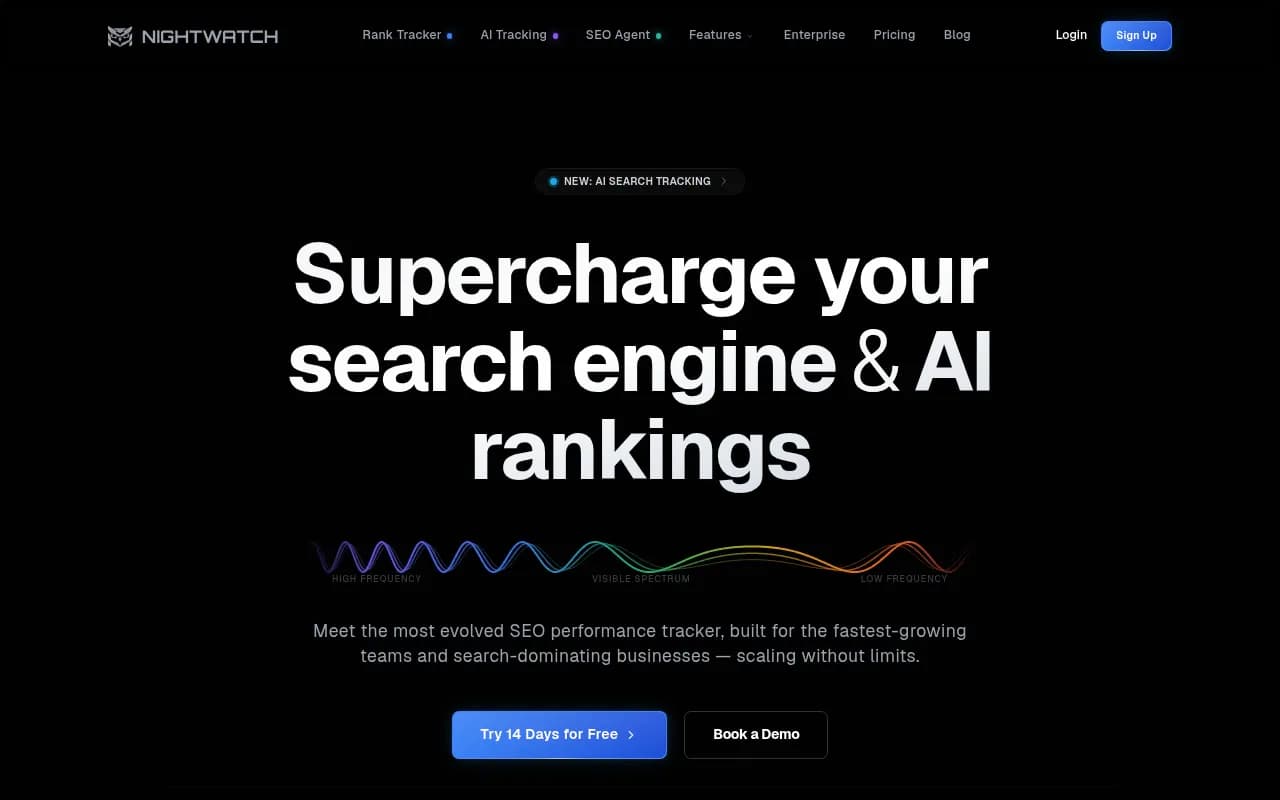
That's genuinely useful if Google AI Overviews are your primary concern. Nightwatch also added prompt research features, letting teams test queries and see which prompts surface their brand or competitors. For teams already using Nightwatch for traditional SEO, this is a natural extension.
The limitations are real, though. Nightwatch's AI monitoring is largely focused on Google AI Overviews -- it doesn't give you deep visibility into how ChatGPT, Claude, Perplexity, or Gemini are talking about your brand. It also doesn't tell you why you're not appearing, or what content you'd need to create to change that. You get the data. You figure out the rest.
If your team is already in Nightwatch and you want a quick read on AI Overview visibility without switching tools, it works. But it's not a GEO platform -- it's a rank tracker with AI features bolted on.
Searchable: clean monitoring, limited action
Searchable sits more squarely in the AI visibility space. It monitors how your brand appears across AI search engines and surfaces citation data -- which sources AI models are pulling from, how often your brand gets mentioned, and how that compares to competitors.
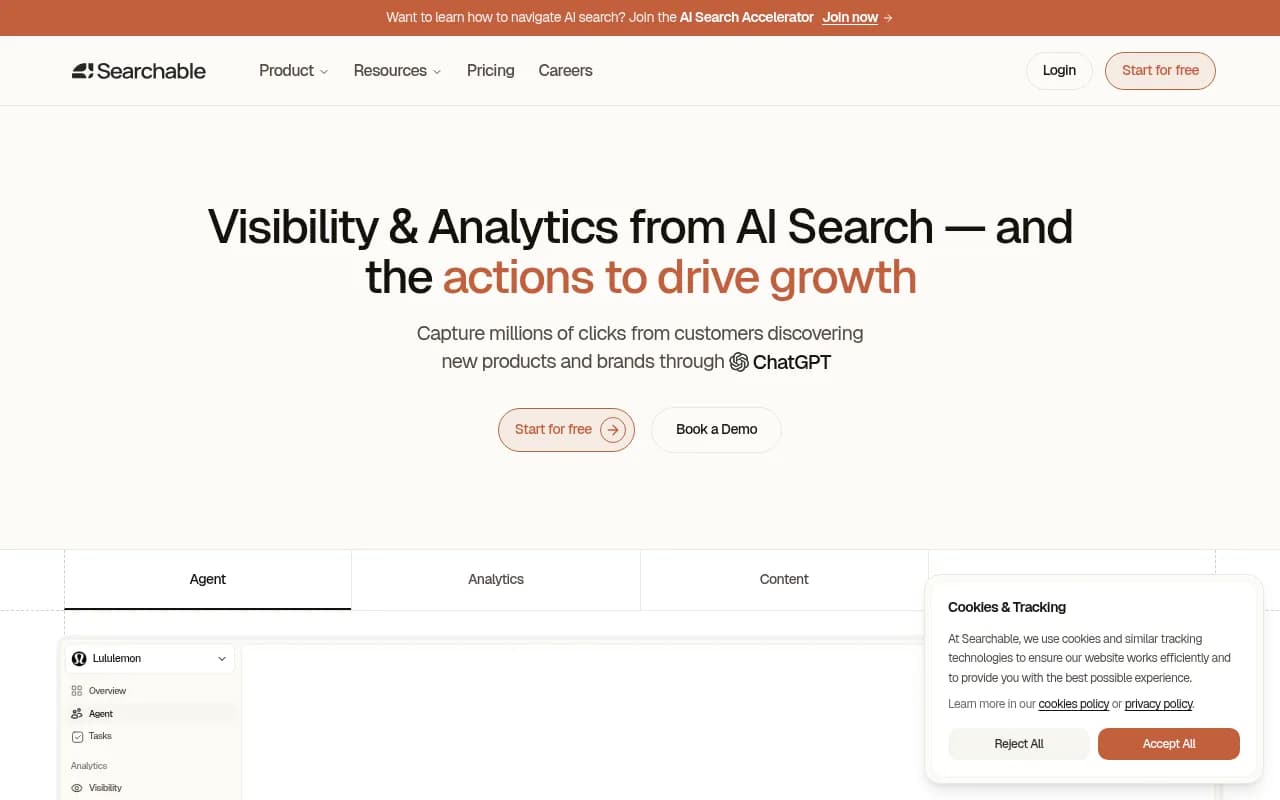
The interface is clean and the data is readable. For marketers who are new to AI search monitoring and want to get a baseline picture of their visibility, Searchable does that job without overwhelming you.
The honest limitation: Searchable is a monitoring tool. It shows you the gap. It doesn't help you close it. There's no content generation, no answer gap analysis that tells you which specific prompts you're losing, no crawler logs to diagnose why AI models might be ignoring your pages. You can see that competitors are getting cited more than you. What you do about that is entirely on you.
That's not a fatal flaw -- some teams just need the monitoring layer and have their own content processes. But for teams that want a platform to drive actual improvement in AI visibility, Searchable stops short.
Promptwatch: monitoring plus the action loop
Promptwatch takes a different approach. The core idea is that knowing you're invisible in AI search is only useful if you can do something about it.

The platform monitors visibility across 10 AI models -- ChatGPT, Perplexity, Claude, Gemini, Google AI Overviews, Google AI Mode, Grok, DeepSeek, Copilot, and Mistral. That's broader coverage than either Nightwatch or Searchable. But the more interesting part is what happens after you see the data.
Answer gap analysis
Promptwatch's Answer Gap Analysis shows you the specific prompts where competitors are getting cited but you're not. Not just "your visibility is lower than competitor X" -- but the actual questions and topics where AI models are recommending them and ignoring you. That's a content brief, essentially. You can see exactly what your site is missing.
Built-in content generation
From the gap analysis, you can generate articles, listicles, and comparisons directly inside the platform. This isn't generic AI writing -- it's grounded in citation data from 880M+ analyzed citations, prompt volumes, and competitor analysis. The goal is content that AI models will actually cite, not content that just sounds good.
Crawler logs and traffic attribution
Promptwatch also shows you real-time logs of AI crawlers hitting your site -- which pages ChatGPT, Claude, and Perplexity are reading, how often, and whether they're encountering errors. Most competitors don't have this at all. And on the attribution side, you can connect AI visibility to actual traffic and revenue through a code snippet, Google Search Console integration, or server log analysis.
This is the part that separates it from monitoring-only tools. You can watch your visibility scores improve as new content gets cited, and trace that back to real business outcomes.
Side-by-side comparison
| Feature | Nightwatch | Searchable | Promptwatch |
|---|---|---|---|
| Google AI Overviews tracking | Yes | Yes | Yes |
| ChatGPT / Claude / Perplexity monitoring | Limited | Yes | Yes (10 models) |
| Competitor visibility comparison | Basic | Yes | Yes + heatmaps |
| Answer gap analysis | No | No | Yes |
| AI content generation | No | No | Yes |
| AI crawler logs | No | No | Yes |
| Traffic attribution | No | No | Yes (GSC, snippet, logs) |
| Prompt volume & difficulty scoring | Basic | No | Yes |
| Reddit & YouTube citation tracking | No | No | Yes |
| ChatGPT Shopping tracking | No | No | Yes |
| Traditional SEO rank tracking | Yes (core feature) | No | No |
| Starting price | ~$39/mo | Custom | $99/mo |
| Best for | Teams already using Nightwatch for SEO | Basic AI monitoring | Teams that want to improve AI visibility, not just measure it |
What the Reddit community was saying in 2025
The frustration with monitoring-only tools came up repeatedly in marketing communities during 2025. The common complaint: "I can see I'm invisible. Now what?" Tools that showed dashboards full of red without any path to improvement were described as "glorified prompt trackers."
The teams that reported the most satisfaction were using platforms that connected visibility data to content action -- either by generating content directly or by giving specific enough gap data that their content team could act on it immediately.
That pattern matches what separates Promptwatch from the other two tools here. Nightwatch and Searchable tell you where you stand. Promptwatch tells you where you stand and gives you a mechanism to change it.
Which tool is right for your situation
There's no single right answer -- it depends on what you actually need.
Use Nightwatch if: You're already using it for traditional rank tracking and want to add Google AI Overview monitoring without switching platforms. It's a reasonable incremental addition, not a GEO strategy.
Use Searchable if: You want a clean, focused view of AI search visibility across multiple models and you have your own content team and processes to act on what you find. It's a monitoring layer, not an optimization platform.
Use Promptwatch if: You want to actually improve your AI search visibility, not just measure it. The combination of gap analysis, content generation, crawler logs, and traffic attribution makes it the most complete option for teams that need to show results -- not just reports.
For agencies managing multiple brands, Promptwatch's multi-site capabilities and Looker Studio integration also make it easier to build client-facing reporting around AI visibility improvements over time.
A note on what "useful data" actually means
One thing worth saying directly: a dashboard that shows your AI visibility score is only useful if you know what to do with it. In 2025, a lot of teams paid for monitoring tools and ended up with data they couldn't act on.
The tools that delivered the most value were the ones that connected the measurement to the work -- showing not just that you're invisible for a prompt, but what content would need to exist on your site for that to change. That's the difference between a report and a roadmap.
Promptwatch is the only one of these three tools that tries to be a roadmap. Whether that matters to you depends on where your team is in the AI search journey. If you're still trying to understand the problem, any of these tools will help. If you're ready to fix it, the choice gets clearer.
Other tools worth knowing about
If none of these three feel like the right fit, a few others are worth considering depending on your use case:
For deeper competitive intelligence across AI models, Profound has a strong feature set at a higher price point.

For teams that want affordable entry-level AI visibility monitoring, Otterly.AI covers the basics without a large commitment.

For enterprise teams with complex multi-brand needs, AthenaHQ covers a broad range of AI engines with solid monitoring depth.

The space is moving fast. Whatever tool you choose, the important thing is to start measuring -- because AI search visibility that you can't see is visibility you can't improve.