MarketMuse Review 2026
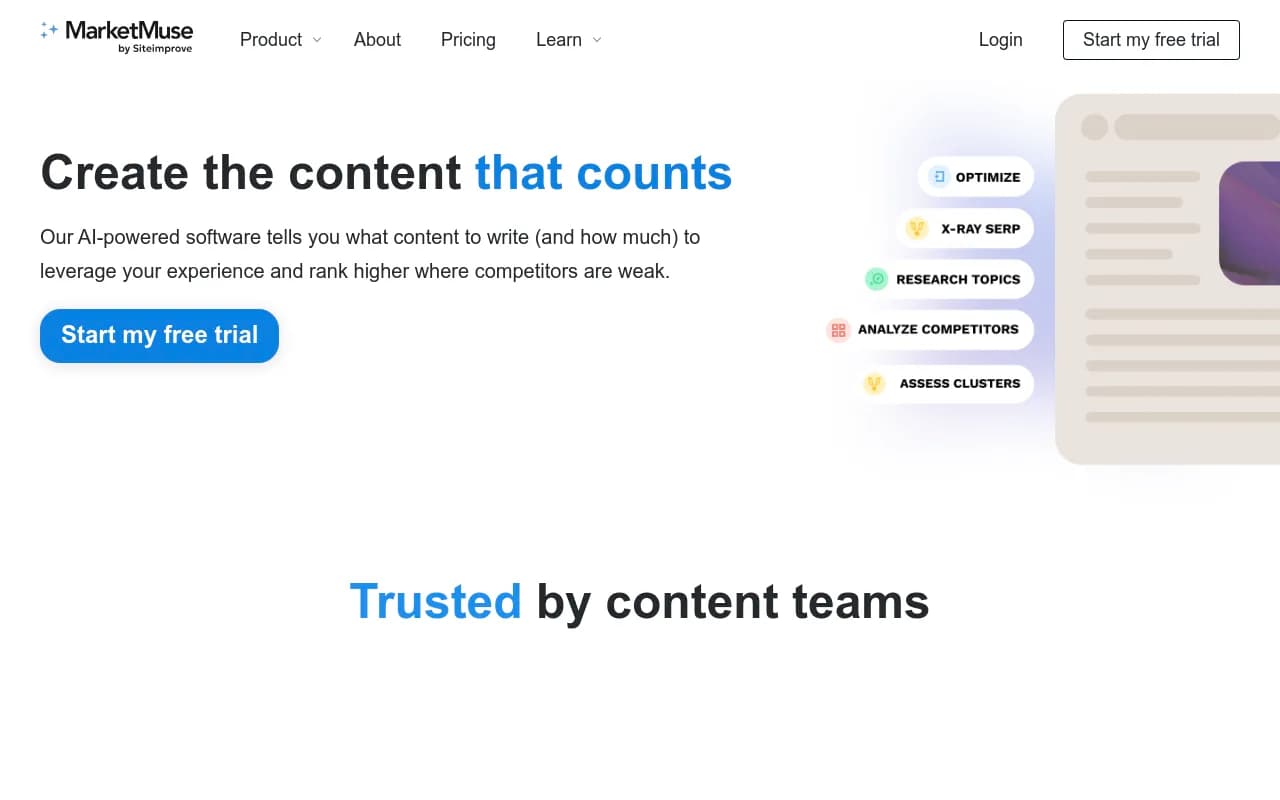
Content intelligence platform using AI to plan, optimize, and track content performance including visibility in AI search results.
Summary
- Best for content teams who waste time guessing: MarketMuse solves the "what should we write next?" problem by analyzing your entire site, finding topic clusters where you already have authority, and showing competitor gaps you can exploit
- Personalized difficulty scoring is the standout feature: Unlike tools that show generic keyword difficulty, MarketMuse calculates how hard a topic is for your specific site based on your existing authority—a game-changer for prioritization
- Steep learning curve and high price point: The platform is powerful but complex. Expect weeks to fully understand it. Pricing starts at $150/month minimum (some sources cite higher), which puts it out of reach for solo creators and small teams
- Strong for planning and auditing, weaker for execution: MarketMuse excels at telling you what to write and how to structure it, but the actual writing tools are basic compared to dedicated AI writing platforms
- Monitoring-only for AI search visibility: The platform recently added AI search tracking (ChatGPT, Perplexity, etc.) but it's a monitoring dashboard—no content gap analysis, AI crawler logs, or traffic attribution like Promptwatch offers for optimizing AI visibility

What MarketMuse is and who built it
MarketMuse is a content intelligence platform that uses AI and natural language processing to help content teams decide what to write, how much to write, and where they can win against competitors. Founded over a decade ago by SEO practitioners and content strategists who were tired of living in spreadsheets, the company has been using AI since before it was trendy—long before ChatGPT made "AI-powered" a marketing buzzword.
The platform is aimed squarely at mid-market and enterprise content teams: SEO managers, content strategists, editors, and agencies managing multiple client sites. If you're a solo blogger or a startup with one writer, this is probably overkill (and too expensive). But if you're a SaaS company publishing 20+ articles a month, a publisher with hundreds of pages to audit, or an agency juggling client content calendars, MarketMuse is built for your workflow.
The company has been featured in Fast Company, Forbes, Inc., Search Engine Journal, and Search Engine Land. It's won multiple G2 awards including High Performer and Easiest Setup in the content marketing category. The platform is used by brands like Sumo Logic, ON24, Orbit Media Studios, and Imprint.
How MarketMuse actually works (the features that matter)
Topic Authority Analysis: This is the foundation. MarketMuse crawls your entire site and builds a content inventory—not just a list of URLs, but a semantic map of what topics you cover and how deeply. It uses proprietary topic modeling (not basic TF-IDF or keyword density) to calculate your authority on specific subjects. The result: you see which topic clusters you dominate, which ones you're weak in, and where you have partial authority that could be expanded with one or two strategic pieces. This is way more useful than staring at a keyword list wondering "should we write about X?"
Personalized Difficulty Scoring: Here's where MarketMuse separates itself from commodity keyword tools. Instead of showing you generic difficulty scores based on domain authority or backlink counts, it calculates how hard a topic is for your specific site. If you already have strong authority in adjacent topics, a seemingly "hard" keyword might actually be easy for you to rank for. Conversely, an "easy" keyword could be a waste of time if you have zero topical relevance. This personalized scoring is patented and it fundamentally changes how you prioritize content. You stop chasing vanity metrics and start building on your strengths.
Competitor Gap Analysis: The platform analyzes your competitors' content and shows you topics they're covering that you're not—and more importantly, topics they're missing that you could own. It's not just "here's what they rank for"—it's "here's where they're vulnerable." You get a list of opportunities where the competition is weak or nonexistent, so you can differentiate instead of playing catch-up. This is especially valuable in crowded niches where everyone is targeting the same obvious keywords.
Content Plans (automated roadmaps): Feed MarketMuse a topic or keyword and it generates a full content plan in minutes: what to write, what to update, what to delete, and in what order. The plan is based on your authority, competitor gaps, search volume, and difficulty. It's not a generic template—it's a personalized roadmap. For teams that used to spend days in spreadsheets trying to figure out Q3's content calendar, this is a massive time saver. The output includes recommended word counts, subtopics to cover, and internal linking suggestions.
Content Briefs (Optimize application): Once you know what to write, MarketMuse generates detailed briefs that tell you how to write it. The brief includes recommended structure (H2s, H3s), topics and entities to cover, questions to answer, and a target word count. It also scores your draft as you write, showing you where you're missing depth or expertise. The brief isn't just an SEO checklist—it evaluates editorial integrity, differentiation, and comprehensiveness. The Optimize app has a generative AI component to help you draft faster, but it's not a full-fledged AI writer like Jasper or Copy.ai. Think of it as scaffolding, not a ghostwriter.
Link Recommendations: The platform suggests internal links to unify your content clusters and guide readers through related topics. It's not just "link to your homepage"—it's strategic linking based on topical relevance and user journey. This helps you build hub-and-spoke content architectures that signal authority to search engines.
Quality Analysis: After publishing, MarketMuse audits your content for expertise, comprehensiveness, structure, and differentiation. It flags thin content, keyword stuffing, and pages that don't meet quality thresholds. This is useful for large sites with legacy content—you can quickly identify what needs updating or pruning.
AI Search Visibility Tracking (new feature): MarketMuse recently added monitoring for AI search engines like ChatGPT, Perplexity, Claude, and Google AI Overviews. You can track whether your brand or content appears in AI-generated answers. However, this is a monitoring-only feature—it shows you where you're visible but doesn't help you optimize for AI search. There's no content gap analysis for AI prompts, no AI crawler logs, no traffic attribution from AI visitors, and no tools to generate content specifically for AI citation. For teams serious about AI search optimization, Promptwatch offers a more complete solution with Answer Gap Analysis, AI content generation, crawler logs, and visitor analytics that MarketMuse lacks.
Who should use MarketMuse (and who shouldn't)
MarketMuse is built for content teams at companies with serious content operations. Ideal users:
- SEO teams at SaaS companies publishing 15-50 articles per month and trying to build topical authority in competitive niches (e.g. marketing automation, cybersecurity, fintech). You need data-driven prioritization because you can't write about everything.
- Content strategists at publishers or media companies managing hundreds or thousands of pages. You need to audit what's working, find gaps, and plan updates without drowning in spreadsheets.
- Agencies managing 5-20 client sites. You need a repeatable process to analyze each client's authority, find quick wins, and justify your recommendations with data.
- Enterprise content teams with multiple stakeholders (writers, editors, SEO, product marketing) who need a single source of truth for content decisions. MarketMuse gives everyone a shared framework.
Who should NOT use MarketMuse:
- Solo bloggers or creators with small sites (under 50 pages). The platform is overkill and the pricing doesn't make sense. You'd be better off with Clearscope, Surfer SEO, or Frase.
- Teams that just need AI writing tools. MarketMuse is a strategy and planning platform, not a content generator. If you want to pump out articles fast, use Jasper, Copy.ai, or Writer.
- Startups with tight budgets. At $150+/month minimum (and realistically $500+/month for useful plans), this is an investment. If you're pre-product-market-fit and experimenting with content, start with cheaper tools.
- Teams that want plug-and-play simplicity. MarketMuse has a steep learning curve. Expect to spend 2-4 weeks learning the interface, understanding the metrics, and training your team. If you need something you can use day one, look elsewhere.
Integrations and ecosystem
MarketMuse integrates with Google Search Console to pull traffic and ranking data, which powers the personalized difficulty scoring. It also connects with content management systems like WordPress (via API or manual export) and project management tools like Asana and Trello for workflow automation. There's no native Slack integration, but you can export reports and share them in channels.
The platform has a robust API for custom integrations—useful for agencies building client dashboards or enterprises with complex tech stacks. There's no browser extension or mobile app, so you're working in the web app.
MarketMuse doesn't integrate with AI writing tools like Jasper or Copy.ai, which is a missed opportunity. You have to copy briefs manually into your writing tool of choice.
Pricing and value
MarketMuse has a limited free plan that lets you analyze a handful of pages, but it's basically a trial. Serious use requires a paid plan:
- Standard plan: Starts at $150/month (some sources cite higher). Includes content briefs, topic modeling, and basic competitor analysis. Limited queries per month (usually 10-30 depending on the plan tier).
- Premium plan: Custom pricing (likely $500-$1,500+/month based on team size and usage). Includes unlimited queries, advanced competitor analysis, content plans, and priority support.
- Team/Agency plans: Custom pricing for multiple users and sites.
There's no public pricing page, which is frustrating. You have to book a demo to get a quote. This is common for enterprise tools but annoying for smaller teams trying to budget.
Is it worth it? If you're a content team spending 40+ hours a month on content planning, keyword research, and audits, MarketMuse can easily save 20-30 hours. At $150-$500/month, that's a no-brainer ROI. But if you're a small team publishing 5 articles a month, the math doesn't work. You'd be better off with a cheaper tool like Clearscope ($170/month) or Surfer SEO ($89/month).
Compared to competitors: MarketMuse is more expensive than Clearscope, Surfer SEO, and Frase, but it offers deeper analysis and automation. It's cheaper than hiring a full-time content strategist. The value depends on your scale.
Strengths and limitations (the honest take)
Strengths:
- Personalized difficulty scoring is unmatched. No other tool calculates topic difficulty based on your specific site's authority. This alone justifies the price for teams that were guessing at prioritization.
- Topic modeling is sophisticated. MarketMuse uses proprietary AI and NLP, not commodity APIs or basic keyword tools. The recommendations feel smarter and more nuanced.
- Content plans save massive time. Generating a quarter's worth of content ideas in 10 minutes vs. 10 hours in spreadsheets is a game-changer for busy teams.
- Built by practitioners, not marketers. The platform solves real workflow problems ("what should we write?", "is this content good enough?") instead of chasing buzzwords.
- Strong for auditing large sites. If you have 500+ pages and need to identify low-quality content or gaps, MarketMuse is one of the best tools.
Limitations:
- Steep learning curve. The interface is dense and the metrics (Content Score, Topic Authority, Personalized Difficulty) take time to understand. Expect weeks of onboarding.
- Expensive for small teams. At $150+/month minimum, this is out of reach for solo creators, small agencies, and early-stage startups.
- Weak AI writing tools. The generative AI in the Optimize app is basic—it helps you draft but it's not a replacement for dedicated AI writers like Jasper or Claude.
- No public pricing. Having to book a demo just to see pricing is annoying and wastes time.
- AI search monitoring is shallow. The new AI visibility tracking shows you where you appear in ChatGPT or Perplexity, but it doesn't help you optimize for AI search. There's no content gap analysis for AI prompts, no AI crawler logs to see how ChatGPT indexes your site, no traffic attribution to measure AI visitors, and no tools to generate content optimized for AI citation. Promptwatch offers all of these capabilities—Answer Gap Analysis to find prompts competitors rank for but you don't, an AI writing agent trained on 880M+ citations, AI crawler logs, visitor analytics, Reddit/YouTube tracking, and ChatGPT Shopping monitoring. If AI search visibility is a priority, Promptwatch is the stronger choice.
- Limited integrations. No Slack, no direct connections to AI writing tools, no Zapier. You're mostly working in the MarketMuse app and exporting data manually.
Bottom line
MarketMuse is a powerful content strategy platform for mid-market and enterprise teams that need data-driven decisions on what to write, update, or delete. The personalized difficulty scoring and topic authority analysis are best-in-class, and the automated content plans save dozens of hours per month. But it's expensive, has a steep learning curve, and the AI writing tools are underwhelming. If you're a content team at a SaaS company, publisher, or agency managing serious content operations, MarketMuse is worth the investment. If you're a small team or solo creator, start with cheaper alternatives like Clearscope or Surfer SEO.
For AI search visibility specifically, MarketMuse's monitoring dashboard is a nice addition but it's not an optimization platform. If you want to actually improve your rankings in ChatGPT, Perplexity, and other AI engines—not just track them—Promptwatch is the better choice with its content gap analysis, AI content generation, crawler logs, and traffic attribution.
Best use case in one sentence: Content teams at growing SaaS companies or agencies that publish 20+ articles per month and need to stop guessing at what to write next.
Tags:
Frequently asked questions
What is MarketMuse and what does it do?
How much does MarketMuse cost?
Who is MarketMuse best for?
What is MarketMuse's personalized difficulty scoring feature?
Does MarketMuse have AI writing capabilities?
Can MarketMuse track AI search visibility?
Is MarketMuse difficult to learn?
Is there a free version of MarketMuse?
Similar and alternative tools to MarketMuse