Page Optimizer Pro Review 2026
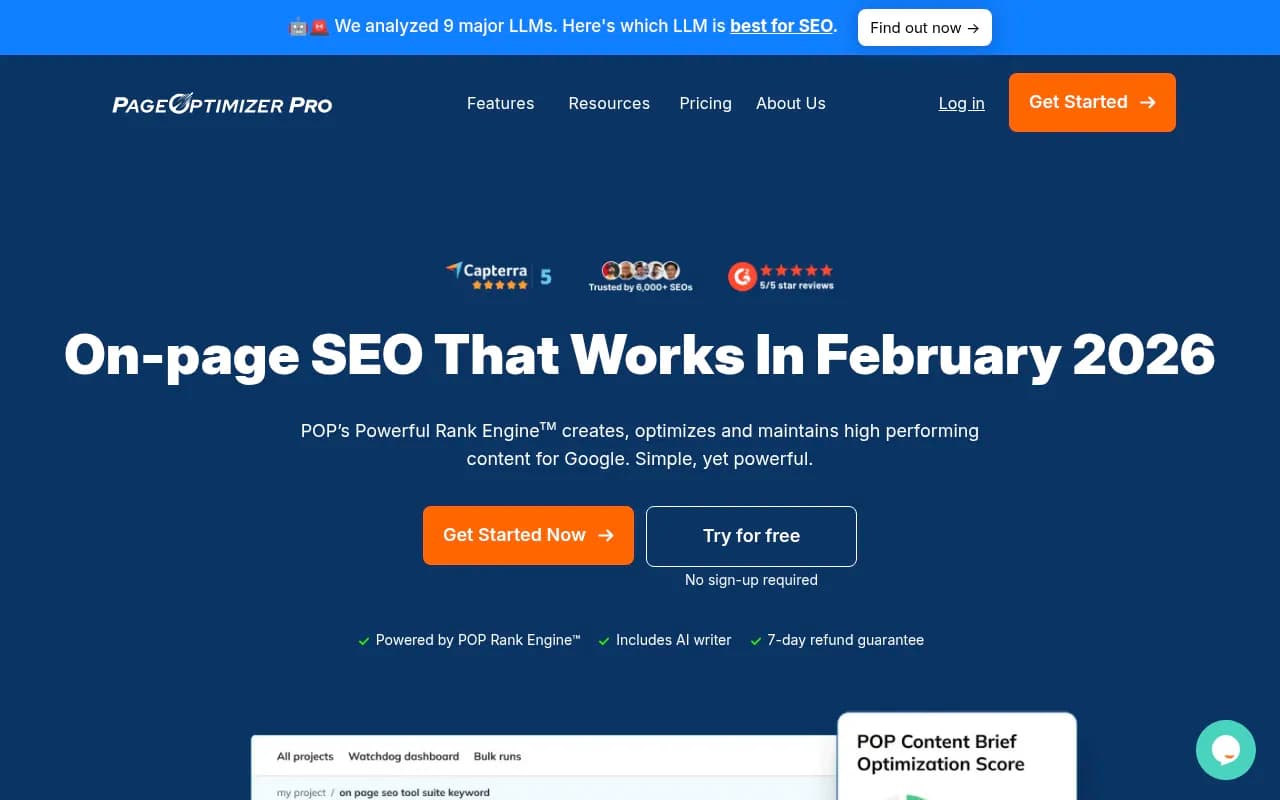
Page Optimizer Pro (POP) is an on-page SEO and content optimization platform built on 400+ peer-reviewed tests. It analyzes 300+ ranking factors to create, optimize, and monitor high-performing content for Google. Used by Walmart, Thomson Reuters, and 6,000+ SEO professionals, POP combines algorithm
Summary
- Best for: SEO agencies, in-house marketing teams, and affiliate marketers who need data-driven on-page optimization backed by real testing, not guesswork
- Core strength: POP Rank Engine analyzes 300+ ranking factors based on 400+ peer-reviewed SEO experiments -- most competitors rely on correlation data or generic best practices
- Standout features: Watchdog monitoring that tells you how to fix ranking drops (not just that they happened), AI-powered schema generation, EEAT auditing, and keyword clustering tools
- Limitations: Focused exclusively on on-page SEO -- no backlink analysis, site audits, or rank tracking beyond Watchdog alerts. Interface can feel dense for beginners.
- Pricing: Plans start at $34/mo for 20 credits (each report costs 1 credit). More expensive than basic tools like Surfer SEO but includes unique features like Watchdog and EEAT scoring.
Page Optimizer Pro (POP) is an on-page SEO platform that tells you exactly what to change on your pages to rank higher in Google. Founded by Kyle Roof -- an SEO known for running controlled experiments to prove what actually works -- POP is built on over 400 peer-reviewed tests and analyzes more than 300 ranking parameters. The target audience is SEO professionals who want recommendations grounded in data, not vague best practices. That includes agencies managing client sites, in-house teams optimizing product pages, affiliate marketers squeezing more revenue from traffic pages, and freelance SEOs who need to show clients measurable results.
POP launched in the mid-2010s and has grown to 6,000+ users, including brands like Walmart, Thomson Reuters, Agoda, and Hostinger. The company is bootstrapped and profitable, with a small team focused entirely on on-page optimization. They don't try to be an all-in-one SEO suite -- no backlink tools, no site crawlers, no keyword rank tracking dashboards. Just deep, actionable on-page analysis.
POP Rank Engine -- The Core Algorithm
The brain behind POP is the Rank Engine, a proprietary algorithm that processes your target keyword, scrapes the top 20 Google results, and analyzes what those pages have in common. It looks at word count, keyword density, semantic variations, heading structure, NLP entities, schema markup, EEAT signals, and dozens of other factors. The output is a scored report (0-100%) showing how well your page matches the ranking pattern, plus a checklist of specific changes to make.
What sets POP apart from competitors like Surfer SEO, Clearscope, or Frase is the testing methodology. Kyle Roof has published hundreds of experiments isolating individual ranking factors -- things like exact keyword placement in H2s, optimal keyword density ranges, and the impact of LSI terms. POP's recommendations come from controlled tests, not just correlation analysis of top-ranking pages. This means you're less likely to get false signals or irrelevant suggestions.
The Rank Engine updates regularly as Google's algorithm evolves. POP runs new tests, adjusts weighting, and pushes updates to the platform. Users don't need to do anything -- the next report they generate reflects the latest findings.
Content Brief -- Optimization Checklist
The Content Brief is POP's main report. You enter a target keyword and optionally a URL (if optimizing existing content). POP scrapes Google, analyzes competitors, and generates a brief with:
- Target word count: Based on what's ranking, with a recommended range
- Primary keywords and variations: Exact phrases to include, with suggested frequency
- Heading structure: How many H2s, H3s, etc., and what topics to cover in each section
- NLP entities: Specific terms and concepts Google associates with your topic (more on this below)
- Optimization score: A 0-100% grade showing how well your content matches the ranking pattern
You can work through the checklist in POP's built-in Content Editor (a WYSIWYG editor that updates your score in real time) or use the Chrome Extension to optimize directly in Google Docs, WordPress, Shopify, Webflow, or 20+ other platforms. The extension overlays POP's recommendations on your editing interface, so you see your score and to-do list without switching tabs.
The Content Brief is straightforward but thorough. It doesn't hold your hand with writing tips or content outlines -- it assumes you know how to write and just need the SEO data. If you're a beginner, the density of information can be overwhelming. If you're an experienced SEO, it's exactly what you want.
AI Writer -- Pre-Optimized Content Generation
POP's AI Writer is not a generic GPT wrapper. It uses 10+ custom prompts behind the scenes to generate content that's already optimized for your target keyword. You can start from scratch or feed it existing content (yours or a competitor's) as a base. The AI rewrites, expands, and restructures the content to hit POP's optimization targets.
Key features:
- Optimization guarantee: AI-generated content always scores 99%+ out of the box
- Bring Your Own API Key: Connect your own GPT-4 API key and generate optimized articles for about $1 each (1 POP credit). Without your own key, it costs more credits.
- Bulk generation: Create up to 50 pieces of content at once, each pre-optimized for a different keyword
- Control over AI rewriting: Adjust how much the AI changes your source material -- useful if you want to preserve brand voice or specific phrasing
The AI Writer is faster and more accurate than using ChatGPT or Claude directly because it's trained on POP's ranking data. You're not guessing at prompts or manually checking keyword density -- the AI knows exactly what POP's algorithm wants and delivers it. The downside is that AI-generated content still needs human editing for originality, fact-checking, and brand voice. POP makes it easy to hit SEO targets, but it won't make your content interesting or trustworthy on its own.
Watchdog -- SEO Monitoring That Actually Helps
Most rank trackers tell you when a page drops in rankings, then leave you to figure out why. POP Watchdog monitors your pages, detects ranking changes, and re-analyzes the SERPs to show you what changed. Did competitors add new sections? Did Google start favoring longer content? Did a new schema type appear in the top results? Watchdog tells you, then generates an updated Content Brief with specific instructions to recover your rankings.
You set up Watchdog alerts for specific pages and keywords. POP checks rankings weekly (or daily on higher plans) and emails you when there's movement. The email includes:
- What changed: Specific differences in competitor content, word count, keyword usage, etc.
- Updated recommendations: A new checklist of changes to make
- Optimization score: How your page now compares to the updated SERP
This is a killer feature for agencies and in-house teams managing dozens or hundreds of pages. Instead of manually re-optimizing content every few months, Watchdog tells you exactly when and how to update. Users report that Watchdog alerts have saved them hours of guesswork and helped them recover rankings within days of making changes.
Nextgen EEAT -- Trust and Authority Auditing
Google's EEAT (Experience, Expertise, Authoritativeness, Trustworthiness) guidelines are critical for ranking in competitive niches, especially YMYL (Your Money or Your Life) topics like health, finance, and legal advice. But most SEO tools ignore EEAT or give vague advice like "add author bios."
POP's Nextgen EEAT tool audits over 100 EEAT signals on your page and scores them against competitors. It checks for:
- Author credentials: Is there an author bio? Does it link to external profiles?
- Citations and sources: Are claims backed by credible sources?
- About page: Does your site have a detailed About page?
- Contact information: Is there a clear way to contact you?
- Privacy policy and terms: Are these pages present and up to date?
- Schema markup: Do you have Author, Organization, or Review schema?
- External mentions: Are you cited or mentioned on authoritative sites?
The tool generates a checklist of missing signals and provides templates or examples for each. For instance, if you're missing Author schema, POP shows you the exact JSON-LD code to add. If your About page is weak, it suggests sections to include.
This is one of POP's most underrated features. EEAT is a ranking factor that's hard to measure and easy to ignore, but POP makes it actionable. Competitors like Surfer SEO and Clearscope don't touch EEAT at all.
AI-Powered Schema -- Automated Structured Data
Schema markup helps Google understand your content and can earn you rich snippets in search results. But writing schema by hand is tedious and error-prone. POP's AI-powered Schema tool analyzes your page and competitors, then generates the appropriate schema types for you.
It supports 70+ schema types, including:
- Article, BlogPosting, NewsArticle
- Product, Offer, AggregateRating
- FAQPage, HowTo, Recipe
- Organization, Person, LocalBusiness
- Event, Course, JobPosting
You fill in a form with your page details (title, author, publish date, etc.), and POP generates the JSON-LD code. You can customize fields, preview the output, and copy-paste it into your site. The tool also checks competitors' schema and suggests types they're using that you're not.
This is a huge time-saver. Writing schema manually takes 15-30 minutes per page. POP does it in 2 minutes. The AI also catches mistakes -- missing required fields, incorrect formatting, etc. -- that would cause schema errors in Google Search Console.
POP NLP -- Google Entity Analysis
When Google crawls your page, it identifies entities (people, places, concepts) and uses them to understand what your page is about. The more relevant entities you include, the more confident Google is in categorizing your content.
POP NLP analyzes the top-ranking pages for your keyword and extracts the entities Google associates with that topic. It shows you which entities your page is missing and suggests where to add them. For example, if you're writing about "best running shoes" and competitors mention "pronation," "arch support," and "Nike Pegasus," POP NLP will flag those as missing entities.
This is more granular than basic keyword research. It's not just about synonyms or related keywords -- it's about the specific terms and concepts that signal topical authority to Google. Adding these entities can improve your rankings even if your keyword density is already optimal.
Keyword Insights and Keyword Strategy -- Research Tools
POP recently added two keyword research tools:
Keyword Insights: Paste in a list of keywords (from Ahrefs, Semrush, etc.) and POP analyzes them for search volume, difficulty, and clustering. It tags keywords as "top level" (pillar content) or "supporting level" (cluster content) and helps you build content silos. This is useful for planning a content strategy around a topic.
Keyword Strategy: Enter a topic or competitor URL and POP generates a list of related keywords, grouped by intent and difficulty. It uses AI to suggest content angles and prioritize high-value keywords. This is more of a brainstorming tool -- it won't replace a full keyword research platform like Ahrefs, but it's handy for quick ideation.
Both tools are newer additions and less mature than POP's core features. They're useful for POP users who don't have access to enterprise keyword tools, but if you already use Ahrefs or Semrush, you'll probably stick with those for research and use POP for optimization.
Integrations and Workflow
POP integrates into your existing workflow in several ways:
- Chrome Extension: Works in Google Docs, WordPress, Shopify, Webflow, Wix, Squarespace, and 20+ other platforms. Displays POP recommendations as an overlay while you edit.
- API Access: Available on higher-tier plans. Lets you pull POP data into custom dashboards, apps, or data warehouses. Useful for agencies building white-label tools or enterprises with custom reporting needs.
- Bulk Optimization: Generate up to 50 Content Briefs or AI articles at once. Export them as HTML or CSV for batch processing.
- Google Docs Integration: Optimize content directly in Google Docs without leaving the document. The extension updates your score in real time as you edit.
POP doesn't integrate with rank trackers, backlink tools, or analytics platforms. It's a standalone tool focused on on-page optimization. You'll need to use Google Search Console, Ahrefs, or Semrush separately for rank tracking and link analysis.
Who Is Page Optimizer Pro For?
POP is built for SEO professionals who want data-driven recommendations and don't need hand-holding. The ideal user is:
- SEO agencies managing 10-100+ client sites. POP's Watchdog alerts and bulk optimization features save hours per week. The ability to show clients a scored report with specific recommendations makes it easy to justify retainers and upsells.
- In-house marketing teams at SaaS companies, e-commerce brands, or publishers. POP helps you optimize product pages, blog posts, and landing pages without hiring an SEO consultant. The EEAT and schema tools are especially valuable for competitive niches.
- Affiliate marketers running niche sites. POP ensures your money pages are scientifically optimized to rank and convert. The AI Writer and bulk optimization features let you scale content production without sacrificing quality.
- Freelance SEOs who need to deliver enterprise-level results on a freelancer budget. POP's reports are detailed enough to impress clients, and the pricing is affordable for solo operators.
POP is not for beginners who are just learning SEO. The interface assumes you understand concepts like keyword density, NLP entities, and schema markup. There's a learning curve, and the platform doesn't explain why certain recommendations matter -- it just tells you what to do. If you're new to SEO, start with a simpler tool like Surfer SEO or Clearscope, then graduate to POP once you understand the fundamentals.
POP is also not for teams that need an all-in-one SEO suite. It doesn't do backlink analysis, site audits, or rank tracking (beyond Watchdog). You'll need to pair it with Ahrefs, Semrush, or Moz for a complete SEO workflow.
Pricing and Value
POP uses a credit-based pricing model. Each plan includes a monthly allotment of credits, which you spend on reports and features:
- Content Brief: 1 credit per report
- AI Writer: 1-5 credits depending on word count (or 1 credit if you bring your own GPT-4 API key)
- Watchdog alert: 1 credit per page per month
- EEAT audit: 1 credit
- NLP analysis: 1 credit
- Schema generation: 1 credit
Plans start around $34/mo for 20 credits (enough for 20 Content Briefs or 4 AI articles). Higher tiers include more credits, bulk optimization, API access, and priority support. There's a 7-day money-back guarantee and a free demo (no signup required) so you can test the tool before committing.
Compared to competitors:
- Surfer SEO: $89/mo for 30 Content Editors. Simpler interface, less depth. No Watchdog, EEAT, or schema tools.
- Clearscope: $199/mo for 20 reports. Strong content briefs, but no AI writer, Watchdog, or EEAT features.
- Frase: $45/mo for 30 articles. Cheaper, but less accurate recommendations and no advanced features like NLP or schema.
POP is mid-priced but offers more unique features than competitors. The Watchdog and EEAT tools alone justify the cost for agencies and in-house teams managing high-value pages. The AI Writer with BYO API key is a steal -- $1 per optimized article is unbeatable.
Strengths
- Testing-based recommendations: POP's algorithm is built on 400+ controlled experiments, not just correlation data. This makes recommendations more reliable and less prone to false signals.
- Watchdog monitoring: The only tool that tells you how to fix ranking drops, not just that they happened. Saves hours of manual analysis.
- EEAT and schema tools: Unique features that competitors ignore. Critical for ranking in competitive or YMYL niches.
- AI Writer with BYO API key: Generate optimized content for $1 each. No other tool offers this.
- Chrome Extension: Optimize content in your existing workflow (Google Docs, WordPress, etc.) without switching tabs.
Limitations
- Steep learning curve: The interface is dense and assumes you already understand SEO concepts. Not beginner-friendly.
- No rank tracking or backlink analysis: POP is on-page only. You'll need Ahrefs, Semrush, or Moz for a complete SEO workflow.
- Credit-based pricing can feel limiting: If you're optimizing dozens of pages per month, you'll burn through credits quickly and need to upgrade or buy more.
- Keyword research tools are basic: The Keyword Insights and Keyword Strategy features are useful but not a replacement for dedicated tools like Ahrefs or Semrush.
Bottom Line
Page Optimizer Pro is the best on-page SEO tool for professionals who want data-driven recommendations backed by real testing. The Watchdog, EEAT, and schema features are unmatched, and the AI Writer with BYO API key is a game-changer for scaling content production. It's not for beginners or teams that need an all-in-one SEO suite, but if you're an agency, in-house team, or affiliate marketer focused on ranking high-value pages, POP delivers results faster than any competitor.
Best use case in one sentence: SEO agencies and in-house teams optimizing 10-100+ pages per month who need scientifically accurate recommendations and automated monitoring to maintain rankings over time.
Tags:
Frequently asked questions
What is Page Optimizer Pro (POP)?
How much does Page Optimizer Pro cost?
Who should use Page Optimizer Pro?
What makes Page Optimizer Pro different from other SEO tools?
Does Page Optimizer Pro offer a free version?
What are the limitations of Page Optimizer Pro?
What is the POP Watchdog feature?
How does Page Optimizer Pro compare to Surfer SEO?
Similar and alternative tools to Page Optimizer Pro