Siteimprove Review 2026
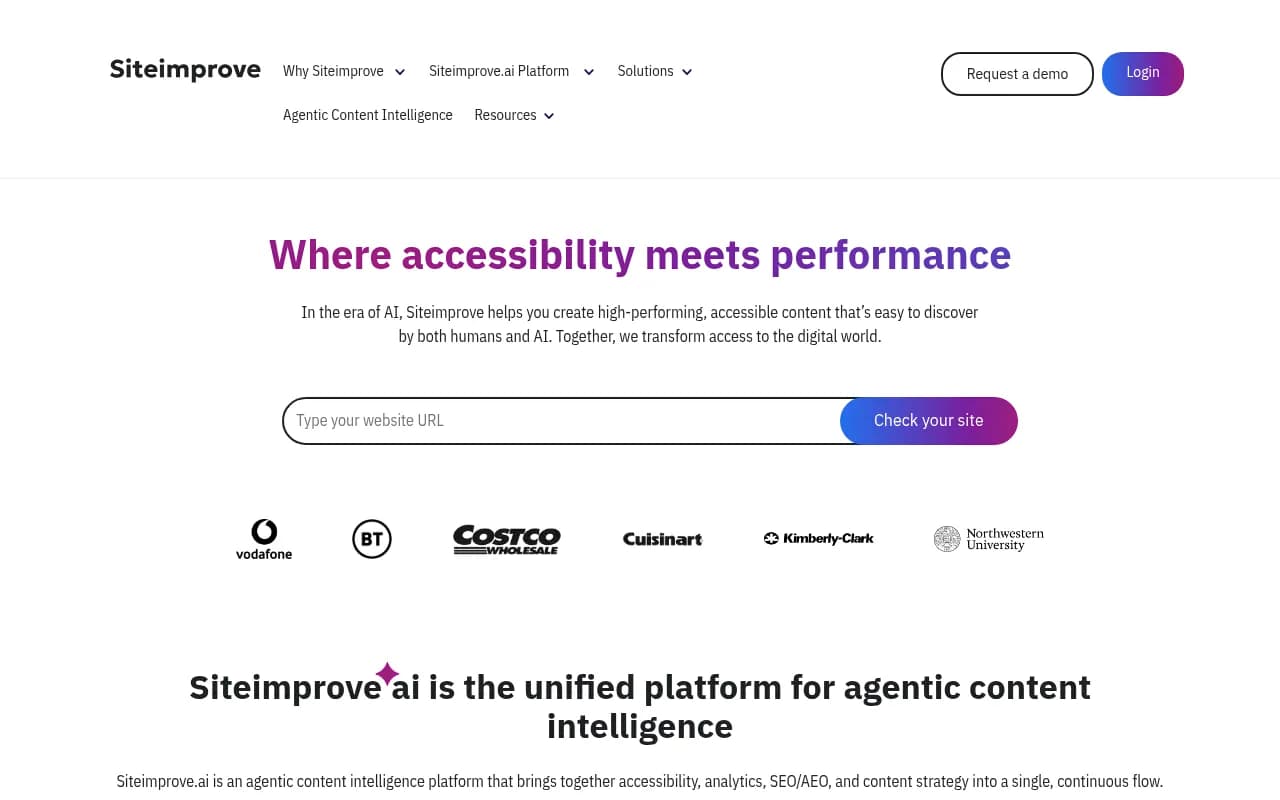
Siteimprove is an enterprise content intelligence platform that combines accessibility compliance, SEO/AEO optimization, analytics, and content strategy into a unified workflow. Used by major brands like Vodafone, BT, and Costco, it deploys AI agents to help teams create discoverable, compliant, hig
Summary: What you need to know about Siteimprove
- Enterprise-grade platform that unifies accessibility, SEO/AEO, analytics, and content strategy -- rare combination that most competitors split across separate tools
- AI agent architecture assists teams throughout content creation rather than just flagging issues after publication
- Multi-channel compliance covers web, mobile, social media, documents, and applications -- not just websites
- Lacks transparent pricing -- custom quotes only, which typically signals enterprise-level costs that exclude smaller teams
- Best for large organizations with dedicated digital teams managing complex, high-stakes content operations where compliance and performance are non-negotiable
Siteimprove positions itself as an "agentic content intelligence platform" -- a term that essentially means AI assistants embedded throughout your content workflow. Founded in Europe (Danish company), it's evolved from accessibility-focused roots into a comprehensive platform serving enterprise marketing, content, and compliance teams. Major customers include Vodafone, BT, Costco, Cuisinart, Kimberly-Clark, and Northwestern University. The company holds multiple G2 Leader badges for Winter 2026 in Digital Accessibility, Digital Governance, and SEO Tools categories.
The platform's core premise: your team works alongside AI agents that surface insights, remove guesswork, and ensure content is discoverable, compliant, and optimized. This isn't about replacing human judgment -- it's about augmenting it with continuous guidance at every stage from planning through publication.
Accessibility Agents: Multi-Channel Compliance by Design
Siteimprove's accessibility module goes beyond typical website scanners. It monitors web pages, mobile apps, social media posts, PDF documents, and custom applications -- a scope most competitors don't match. The AI agents assist designers, developers, and content editors in real-time, catching issues before publication rather than discovering them in post-launch audits.
The platform checks against WCAG 2.1/2.2 standards and provides specific remediation guidance. One standout: the "review before you publish" workflow that integrates directly into content management systems. Editors get accessibility feedback as they draft, not days later when fixing issues requires reopening tickets and re-coordinating with developers.
Siteimprove employs staff who are Certified Professionals in Web Accessibility (CPWA) and Certified Professionals in Accessibility Core Competencies (CPACC) through IAAP. One team member serves as a National Expert for Denmark in the EU's AccessibleEU initiative, and multiple staff chair W3C community groups. This expertise feeds directly into the platform's ruleset accuracy and remediation recommendations -- a depth of knowledge that pure software vendors can't replicate.
For organizations facing legal exposure (government agencies, healthcare, education, financial services), this multi-channel approach addresses a real gap. Most accessibility tools scan websites only. If your brand publishes content across Instagram, mobile apps, and downloadable PDFs, you're manually tracking compliance across disconnected tools. Siteimprove centralizes that.
Analytics Agents: Conversational Insights Instead of Dashboard Archaeology
The analytics module translates raw traffic data into prioritized action items tied to business goals. Instead of staring at Google Analytics dashboards trying to figure out what matters, you ask questions in natural language: "Which pages are underperforming for our target conversion goal?" or "What content topics are driving the most qualified traffic?"
The AI agents surface behavioral patterns, page performance trends, and visitor insights without requiring you to build custom reports or remember where specific metrics live. For content teams without dedicated analysts, this removes a major bottleneck. You get answers in seconds instead of waiting for someone to pull data.
Siteimprove integrates with Google Analytics, Adobe Analytics, and other platforms to pull in existing data rather than forcing you to replace your analytics stack. The value is in the interpretation layer -- turning numbers into narratives that non-technical stakeholders can act on.
One customer quote from Cuisinart's Director of Marketing Communications: "The ability to get immediate insights has helped us improve our workflows and decrease time spent on fixing issues by more than 50%. The best part is that we can already see a positive impact on our revenue." That's the pitch: faster decisions, less manual analysis, measurable business impact.
SEO & AEO Agents: Optimizing for Humans and AI Search Engines
This is where Siteimprove competes directly with tools like Promptwatch, Semrush, Ahrefs, and newer AEO platforms. The SEO/AEO agents provide real-time guidance during content creation to boost visibility in traditional search engines (Google, Bing) and AI search platforms (ChatGPT, Perplexity, Claude, Gemini).

Siteimprove offers keyword research, technical SEO audits (crawl errors, broken links, duplicate content), on-page optimization recommendations, and competitive analysis. The AEO component focuses on structuring content so AI models can easily extract and cite it -- schema markup, clear headings, concise answers to common questions.
However, Siteimprove lacks several capabilities that Promptwatch provides for teams serious about AI search visibility. There's no evidence of AI crawler log monitoring (tracking when ChatGPT, Claude, or Perplexity bots hit your site), no AI traffic attribution to measure actual visitors coming from AI search, and no content gap analysis showing which prompts competitors rank for but you don't. Siteimprove's AEO features appear to focus on content structure and optimization best practices, but without the closed-loop tracking and prompt intelligence that platforms like Promptwatch offer.
For traditional SEO -- technical audits, keyword tracking, backlink analysis -- Siteimprove competes with Semrush and Ahrefs but likely at a higher price point given its enterprise positioning. The advantage is having SEO integrated with accessibility and analytics in one platform rather than juggling separate tools. The disadvantage: if you need deep SEO capabilities (like Ahrefs' massive backlink index or Semrush's keyword database), Siteimprove may feel limited.
Content Strategy Agents: Research, Planning, and Optimization Automation
The content strategy module helps teams plan, brief, and optimize content throughout its lifecycle. AI agents assist with topic research (identifying content gaps and opportunities), content brief generation (outlining structure, keywords, target audience), and performance optimization (suggesting improvements based on analytics and SEO data).
This is designed for content strategists and writers who need to produce high-quality, differentiated content at scale. The agents surface relevant topics, competitive angles, and optimization opportunities so teams spend less time on research and more time on actual creation.
One interesting angle: Siteimprove emphasizes "building brand authority in a sea of AI-created content." The implication is that their agents help you create content that stands out from generic AI-generated filler -- ironic given the platform itself uses AI, but the point is valid. The agents guide human expertise rather than replacing it.
Integration with CMS platforms (WordPress, Drupal, Sitecore, Adobe Experience Manager) means content teams get recommendations directly in their editing environment. No context-switching to a separate tool to check SEO scores or accessibility compliance.
Who Is Siteimprove Built For?
Siteimprove targets enterprise organizations with complex digital operations -- specifically:
Government agencies and educational institutions managing hundreds or thousands of pages with strict accessibility mandates (Section 508, WCAG 2.1 AA). These organizations face legal liability if content isn't compliant, and they typically have distributed content teams (multiple departments, campuses, or agencies) that need centralized governance.
Healthcare and financial services companies with similar compliance requirements plus additional regulatory constraints (HIPAA, GDPR, financial disclosure rules). Multi-channel monitoring across web, mobile apps, and documents is critical.
Large B2C brands (retail, consumer goods, hospitality) managing high-traffic websites where performance directly impacts revenue. Cuisinart, Costco, Vodafone, and BT fit this profile -- they need accessibility compliance, SEO optimization, and analytics insights to drive conversions.
Digital agencies managing multiple client sites could use Siteimprove, but the pricing model (custom quotes, likely per-site or per-page-volume) may not scale well for agencies juggling dozens of smaller clients. This isn't a $99/month tool you spin up for every client.
Who should NOT use Siteimprove: Small businesses, startups, solopreneurs, or teams with limited budgets. The platform is built for enterprise complexity and priced accordingly. If you're a three-person marketing team managing a single website, you'll get better value from focused tools like Screaming Frog (technical SEO), Semrush (keyword research), or WAVE (accessibility scanning). Siteimprove's strength is unifying multiple disciplines for large, distributed teams -- overkill if you don't have that complexity.
Similarly, if your primary goal is AI search visibility and optimization, Promptwatch offers deeper capabilities (crawler logs, traffic attribution, prompt intelligence, content gap analysis) at a fraction of the cost. Siteimprove's AEO features are supplementary to its core accessibility and traditional SEO focus.
Integrations and Ecosystem
Siteimprove integrates with major CMS platforms: WordPress, Drupal, Sitecore, Adobe Experience Manager, and others. Browser extensions for Chrome and Edge let editors check pages without leaving their workflow. The platform also connects to Google Analytics, Adobe Analytics, and tag management systems to pull in existing data.
API access is available for custom integrations and data exports. Larger customers can build automated workflows that trigger Siteimprove scans when content is published or pull compliance data into internal dashboards.
No mention of mobile apps for iOS or Android, which is a gap for teams that need to review content on the go. The platform appears to be web-based only.
Pricing and Value
Siteimprove does not publish transparent pricing. All plans require contacting sales for a custom quote. Based on third-party sources, there are mentions of Essential, Expert, and Enterprise service tiers, but no specific numbers.
One unverified source suggests a comparison tool (possibly a different product) starting at $19/month, but this doesn't align with Siteimprove's enterprise positioning. Expect pricing in the thousands per month for mid-sized deployments, potentially tens of thousands for large enterprises with extensive page volumes and multi-site needs.
The value proposition: if you're currently paying for separate accessibility tools (like AudioEye or UserWay), SEO platforms (Semrush or Ahrefs), analytics consultants, and content strategy software, consolidating into Siteimprove could reduce total cost and eliminate integration headaches. But if you're starting from scratch or only need one or two of those capabilities, you'll pay for features you don't use.
No free trial is advertised on the website. The homepage offers a "test-drive" that likely means a demo with a sales rep, not self-service access.
Strengths: What Siteimprove Does Exceptionally Well
Unified platform for accessibility, SEO, analytics, and content strategy -- rare combination that eliminates tool sprawl for enterprise teams. Most competitors force you to stitch together separate products.
Multi-channel accessibility compliance covering web, mobile, social, documents, and apps. This scope is unmatched by website-only scanners like WAVE or Axe DevTools.
Deep accessibility expertise on staff -- CPWAs, CPACCs, W3C community chairs, EU initiative experts. This translates to more accurate rulesets and better remediation guidance than vendors relying purely on automated checks.
Real-time guidance during content creation rather than post-publication audits. The "review before you publish" workflow catches issues early when they're cheap to fix.
Conversational analytics that translate raw data into prioritized actions. Removes the need for dedicated analysts to interpret dashboards.
Limitations: Where Competitors Are Stronger
No transparent pricing -- custom quotes only, which creates friction and uncertainty. Competitors like Semrush and Ahrefs publish clear pricing tiers.
Limited AI search visibility capabilities compared to Promptwatch. No AI crawler logs, no traffic attribution from AI search engines, no content gap analysis for prompts, no prompt volume or difficulty scoring. Siteimprove's AEO features focus on content structure best practices but lack the closed-loop tracking and optimization tools that dedicated GEO platforms provide.
Likely expensive for smaller teams -- the enterprise focus and custom pricing model exclude startups, small businesses, and agencies managing many small clients.
No mobile apps for on-the-go content review. Competitors like Semrush offer mobile apps for checking rankings and site health.
Potentially limited depth in individual disciplines -- a jack-of-all-trades platform may not match the specialized capabilities of best-in-class tools. Ahrefs has a larger backlink index, Semrush has more keyword data, dedicated accessibility tools like Deque's Axe suite offer more granular testing.
Bottom Line: Who Should Buy Siteimprove and Why
Siteimprove is built for enterprise organizations that need to unify accessibility compliance, SEO, analytics, and content strategy across complex, multi-channel digital operations. If you're a government agency, university, healthcare system, or large B2C brand managing hundreds of pages with distributed content teams and strict compliance requirements, Siteimprove solves real problems. The platform eliminates tool sprawl, embeds guidance directly into content workflows, and provides the governance controls that large organizations require.
Best use case in one sentence: Enterprise content teams managing high-stakes, multi-channel digital experiences where accessibility compliance, SEO performance, and content quality are all mission-critical and need to be governed from a single platform.
If you're a smaller team, a startup, or primarily focused on AI search visibility, look elsewhere. For AI search optimization specifically, Promptwatch offers deeper capabilities (crawler logs, traffic attribution, prompt intelligence, content gap analysis) at a more accessible price point. For traditional SEO on a budget, Semrush or Ahrefs provide better value. For accessibility alone, WAVE or Axe DevTools may suffice.
Siteimprove's strength is integration and governance at enterprise scale. If that's not your situation, you'll pay for complexity you don't need.
Frequently asked questions
What is Siteimprove and what does it do?
How much does Siteimprove cost?
Is Siteimprove free to use?
Who is Siteimprove best suited for?
What makes Siteimprove different from other SEO and accessibility tools?
What accessibility features does Siteimprove offer?
Does Siteimprove have good reviews and industry recognition?
What is an agentic content intelligence platform?
Similar and alternative tools to Siteimprove