Howseen Review 2026
Tracks how ChatGPT, Claude, Gemini and Perplexity recommend your brand, surfacing prompts and threads sending buyers to you or competitors.
Key takeaways
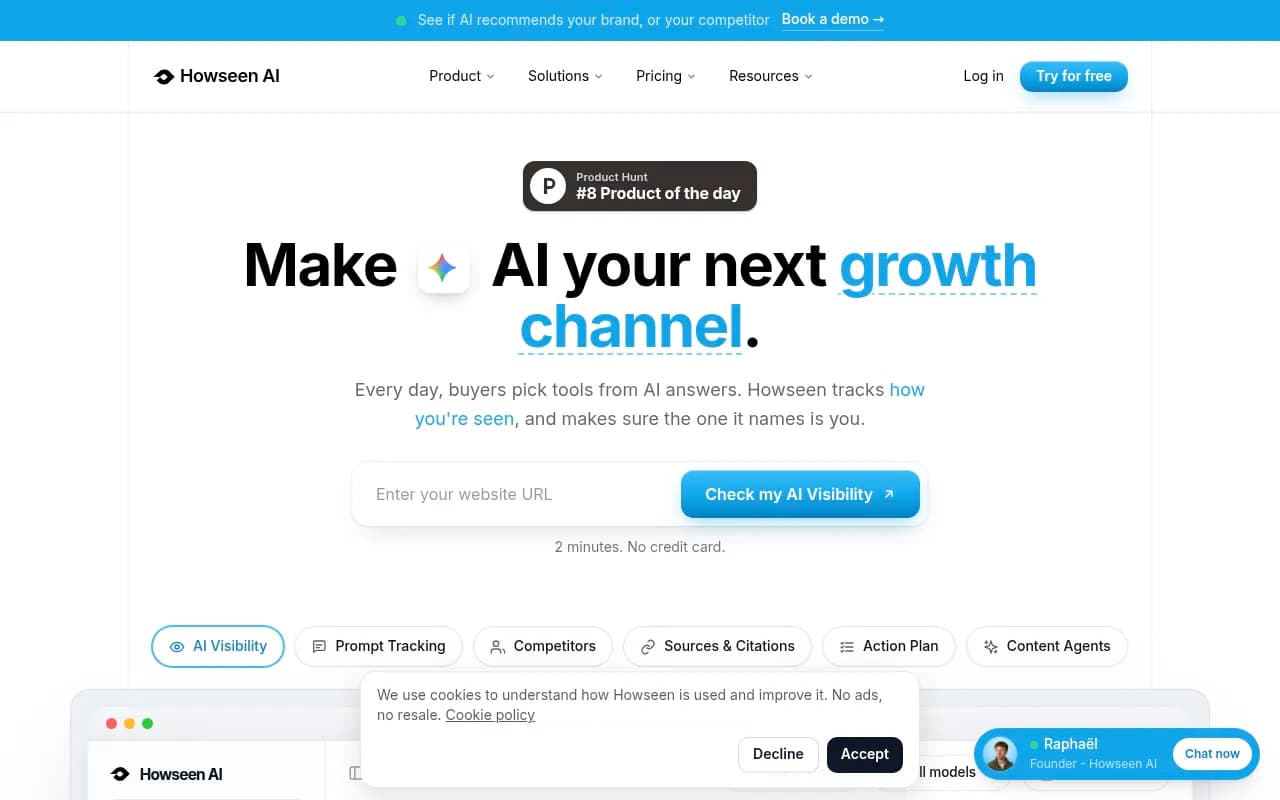
- Howseen is a solo-founder GEO tool out of Paris that tracks brand visibility across ChatGPT, Gemini, Perplexity, Google AI Overviews and Google AI Mode, then auto-generates articles to close the gaps it finds.
- Compared to Promptwatch, Howseen lacks AI crawler logs, AI traffic/visitor attribution, Reddit and YouTube citation tracking, ChatGPT Shopping monitoring, and prompt volume/difficulty scoring — it covers five AI surfaces, Promptwatch covers 10+ models plus AI coding assistants.
- Refresh cadence is every 3 days on its only paid plan, slower than several competitors at the same price point, including Promptwatch's tighter monitoring loop.
- Content generation publishes straight to WordPress, Shopify and Next.js, which is a genuine differentiator against pure trackers like Otterly.AI or Peec.ai.
- Pricing is simple: one plan at €79/month (€63 annualized), with a 3-day trial that requires a card and a 90-day money-back guarantee.
Howseen is a young entrant in the AI search visibility space, built by a single founder, Raphaël Aubry, working out of an office in Paris. The pitch is straightforward: buyers now ask ChatGPT, Gemini and Perplexity what to buy instead of typing a Google query, and most brands have no idea whether they show up in the answer. Howseen tracks that, benchmarks it against named competitors, and then tries to close the gap by writing GEO-optimized articles and pushing them to your CMS.
It launched on Product Hunt and landed at #8 Product of the Day, which is a respectable showing for a one-person operation but also a reminder of how early this product still is. There's no public track record of G2 or Capterra reviews yet, and the company itself is tiny: this is a bootstrapped, founder-led tool, not a funded platform with a sales team.
What's interesting is that Howseen's own blog ran a self-audit of its brand across 50 prompts and came up with zero mentions in 47 non-branded questions, with AI recommending Profound and Peec AI instead. That's an unusually honest piece of self-reported data, and it's also a useful signal about how hard this category actually is, and how far Howseen itself has to go before it shows up where its own tool says it should.
Key features
- Prompt tracking with intent tags. Howseen lets you add prompts manually or pull suggested ones from search data, then tags each by buyer intent (buying intent, comparison, learning). Visibility and sentiment per prompt refresh every 3 days across the five tracked AI surfaces. That's slower than daily-refresh competitors at a similar price.
- Competitor benchmarking. A brand × model heatmap shows visibility percentages for you and named rivals across ChatGPT, Gemini, Perplexity and the two Google AI surfaces, plus a ranking matrix showing which brand AI names first, second, third for each prompt.
- Citation tracing. Howseen maps the domains that feed AI answers, ChatGPT and Perplexity specifically, showing which pages get cited, how often, and what type of source (forum, review site, wiki, video). This is meant to direct PR and outreach toward the sites AI actually trusts.
- Next best action engine. A ranked list of fixes split into on-page content moves and off-page moves (get featured in a specific YouTube roundup, get mentioned in a specific subreddit thread), ranked by impact versus effort. It's a nice idea, though the off-page suggestions amount to pointing at a citation and telling you to go get mentioned there, with no outreach tooling attached.
- Content generation and auto-publish. Every content gap identified can become a drafted article, written in your brand voice, queued on a monthly calendar, and pushed with one click to WordPress, Shopify, or Next.js. The founder claims unsourced stat claims get auto-stripped from generated drafts. This is the clearest differentiator against pure monitoring tools like Otterly.AI or Peec.ai, which stop at the dashboard.
- Technical GEO audit. Checks for noindex tags, sitemap.xml, robots.txt, llms.txt, server-side rendering, Bing indexing and trust signals, rolled into a health score alongside the content and off-page scores.
- Multi-market, multi-language tracking. Supports tracking across multiple countries and languages, and can generate content in roughly two dozen languages, useful for brands selling outside English-speaking markets.
- Agency mode. White-label reporting across multiple client brands, pitched as letting agencies resell GEO as a recurring service.
Who is it for
Howseen fits solo marketers or small teams at SaaS and e-commerce companies who want a single, affordable dashboard rather than a sprawling enterprise platform. Think a two-person growth team at a DTC apparel brand, or a SaaS founder who wants to know if ChatGPT recommends their CRM over Notion or monday.com, without hiring an agency. The demo dashboard uses a Gymshark-style example against Nike, Lululemon and Alo Yoga, which tells you where the product positioning is aimed.
Small agencies managing a handful of client brands could use the white-label reporting to add GEO as a line item, though at one plan and one price, there's no tiered structure for agencies running 20+ clients the way some competitors offer.
Howseen is a poor fit for enterprise marketing teams, brands tracking hundreds of prompts, or anyone who needs daily refresh cycles, AI traffic attribution, or crawler-level diagnostics. Teams that need to prove AI-driven revenue with real visitor data, not just mention counts, will hit a wall here: Howseen has no visitor analytics tying AI citations to actual site traffic or conversions.
Integrations and ecosystem
Publishing integrations cover WordPress, Shopify, and Next.js, a reasonable spread for e-commerce and SaaS content stacks, though noticeably missing Webflow and Framer, which competing GEO platforms support. There's no public API documented, no Zapier connector, and no Slack integration mentioned anywhere on the site or in third-party listings. A GitHub org exists (howseen-ai) but it hosts internal tooling, like a Claude Code skill used to produce the company's own launch video, not a public SDK or developer API for customers.
No browser extension, no mobile app, and no mention of Google Search Console integration. This is a web dashboard product, full stop, which is fine for the audience it's targeting but limits how it plugs into a broader marketing stack.
Pricing and value
Hoween runs a single public plan: Pro at €79/month, or €63/month billed annually, per brand. That gets you 50 tracked prompts refreshed every 3 days across the five AI surfaces, competitor benchmarking, source/citation tracing, up to 15 generated articles a month, one-click CMS publishing, a technical audit, and unlimited team seats. There's a 90-day money-back guarantee if visibility doesn't improve, and a 3-day free trial, though that trial requires a credit card up front, which cuts against the
Frequently asked questions
What is Howseen?
How does Howseen work?
Who is Howseen for?
How much does Howseen cost?
Is Howseen free to use?
Which AI platforms does Howseen track?
What makes Howseen different from other AI monitoring tools?
Can Howseen show if AI is recommending my competitors instead of me?
Why is AI visibility tracking important for brands?
Does Howseen help with AI SEO or generative engine optimization?
Similar and alternative tools to Howseen