ActiveCampaign Review 2026
ActiveCampaign is a marketing automation platform for small businesses, agencies and ecommerce brands that combines email, SMS and WhatsApp campaigns with AI-driven automation. Its Active Intelligence engine drafts campaigns, segments audiences and predicts send times, aiming to cut hours of manual
Key takeaways
- ActiveCampaign is a marketing automation platform built around email, SMS and WhatsApp, with AI (branded Active Intelligence) increasingly doing the drafting and decision-making for you.
- Pricing starts at $15/mo for Starter (1,000 contacts, capped automations) and runs to $145/mo for Enterprise, with WhatsApp-inclusive tiers pushing higher still.
- The newest release, Active Intelligence 3.0 ("Wavelength"), launched August 2026 and adds memory, custom instructions and proactive campaign drafting, which is a genuine step past most competitors' "AI subject line generator" gimmicks.
- Real user reviews flag recurring bugs, a clunky page/form builder, and slow performance, so the AI headline features sit on top of a product that isn't universally polished.
- Good fit for SMBs and ecommerce brands that want deep automation without HubSpot's price tag; not the right pick for teams that need a full sales CRM or enterprise-grade reliability guarantees.
ActiveCampaign has been around since 2003, bootstrapped out of Chicago by founder Jason VandeBoom for over a decade before it took any outside money. That patience shows in the product: it's one of the more mature marketing automation tools on the market, built up feature by feature rather than assembled fast to chase a funding round. It only raised its first $20M in 2016, then scaled quickly after, closing a $240M Series C in 2021 that pushed its valuation past $3 billion. Reported 2024 revenue sits around $250 million.
What it does, in plain terms, is let you build multi-step marketing automations across email, SMS and now WhatsApp, using a visual workflow builder, then layers AI on top to write the content, pick the segments, and decide when to send. The company's current pitch, hammered home across its site, is "autonomous marketing" — the idea that Active Intelligence should handle busywork before you even ask. Whether that lives up to the marketing copy is worth digging into.
The target audience is squarely small-to-midsize businesses, agencies managing client accounts, and ecommerce brands running lifecycle campaigns. It's not trying to be HubSpot. HubSpot's own comparison page puts it well: ActiveCampaign helps you market to customers you already have, HubSpot helps you find the ones you haven't met yet. That's a fair line and it's the right way to think about who should buy this.
Key features
-
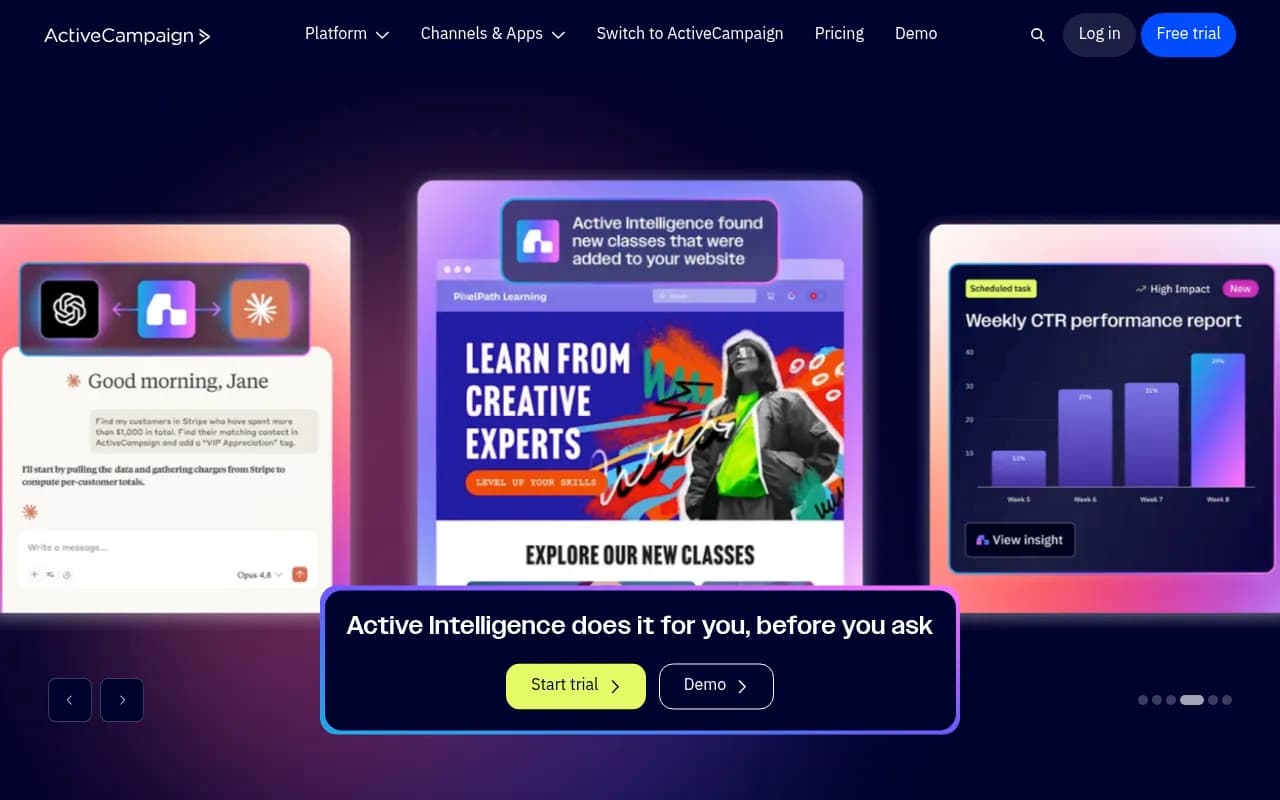
Active Intelligence (AI automation layer). This is the headline feature and the thing ActiveCampaign leads every piece of marketing with. It covers AI-suggested segments, AI campaign drafting, predictive sending, lead scoring, and win probability scoring for sales pipelines. The August 2026 release, Active Intelligence 3.0 ("Wavelength"), adds Memory & Custom Instructions so workflows retain context instead of making you re-explain your business every time, plus External Intelligence that tracks signals like competitor website changes, and Scheduled Tasks for recurring autonomous work. It also ships a Campaign Reference & Brand Kit feature that builds new emails off your best-performing past sends rather than a blank template. This is a more ambitious AI stack than most competitors offer, though how well it performs in practice varies by account complexity.
-
Multichannel messaging (email, SMS, WhatsApp). Email is still the core, with a drag-and-drop designer, A/B testing, and conditional content on higher tiers. SMS is add-on across most plans. WhatsApp automation is newer, powered by ActiveCampaign's April 2025 acquisition of Hilos, a Mexico City WhatsApp automation startup — this explains why WhatsApp is suddenly a first-class channel on the homepage rather than an afterthought.
-
Marketing automation builder. The visual automation canvas supports triggers, conditional branches, and multi-step sequences. Starter caps automations at 5 actions per workflow, which is a real constraint for anyone doing more than a basic welcome sequence — you need Plus or above to build anything with real branching logic.
-
Segmentation and reporting. Segmentation scales from "Limited" on Starter through Standard, Advanced, to "Premium" on Enterprise. Reporting follows the same tiering, with custom reporting, revenue/conversion attribution, and custom event tracking reserved for Professional and up. This tiered gating is worth knowing before you pick a plan based on price alone.
-
CRM and sales tools. ActiveCampaign includes a lightweight CRM (Pipelines + Sales Engagement, sold as an "Enhanced CRM" add-on), plus premium integrations with Salesforce, Microsoft Dynamics 365, and Zendesk Sell on Enterprise. It's not trying to replace a dedicated sales CRM for complex B2B pipelines, and it shouldn't be evaluated as one.
-
Integrations and app marketplace. Over 1,000 native integrations are listed in the App Marketplace, spanning ecommerce (Shopify, WooCommerce, Square on Starter), scheduling, advertising, and communication tools. Route through Zapier and the effective reach extends to thousands more apps. A new Google Ads connector shipped alongside Wavelength, extending AI-driven attribution into ad spend decisions.
-
AI chat connectors for ChatGPT and Claude. A notable and fairly unusual feature: ActiveCampaign now lets you connect your account data to ChatGPT and Claude via MCP connectors, so you can ask questions about your campaign history and account context directly inside those tools instead of exporting CSVs. It's a small feature on paper but genuinely useful if your team already lives in an AI chat interface.
-
Landing pages, forms and web push. Available from Plus upward. Reviewers on Capterra have flagged the page/form builder specifically as unintuitive and occasionally prone to not saving work, which is a real usability gap given how central forms are to lead capture.
Who is it for
ActiveCampaign fits small businesses and solo marketers who need serious automation without HubSpot-level pricing, and it fits ecommerce brands running lifecycle flows (abandoned cart, post-purchase, win-back) on Shopify or WooCommerce. It also fits marketing agencies managing several client accounts, since the tiered permissions and multi-seat support on Professional and Enterprise plans make client work manageable. A good concrete example: a 10-person ecommerce brand with 15,000 contacts running weekly campaigns plus automated flows would sit comfortably on the Plus or Pro tier.
Franchise and multi-location businesses are a specific niche it serves well, tied to its 2023 acquisition of the Australian company Onesend — there's a dedicated "ActiveCampaign for Franchises" solution for coordinating localized campaigns across many locations from one account.
Who should skip it: teams that need a full-strength sales CRM with deep pipeline forecasting should look elsewhere, since ActiveCampaign's CRM is an add-on, not the core product. Enterprises that need rock-solid uptime and zero tolerance for bugs should also proceed carefully — more on that below. And anyone allergic to AI feature creep in their marketing stack may find the current "autonomous marketing" framing more aggressive than they want.
Integrations and ecosystem
The App Marketplace lists 1,000+ native integrations, covering CRM, ecommerce, scheduling, advertising platforms, and developer tools, with roughly 40 new integrations added in 2025 alone. Via Zapier that reach extends into the thousands. Premium CRM integrations — Salesforce, Microsoft Dynamics 365, Zendesk Sell — are gated to Enterprise. Postmark, acquired in 2022, powers the optional transactional email add-on. There's a public GitHub org (github.com/ActiveCampaign) with client libraries like postmark-python, though it's not a heavily developer-facing product overall — most integration work happens through the no-code app marketplace rather than a public API-first developer experience.
Pricing and value
Four core plans, billed annually, priced against 1,000 contacts as a baseline: Starter at $15/mo, Plus at $49/mo, Pro at $79/mo (marked as the popular choice), and Enterprise at $145/mo. Pricing scales up with contact volume and channel — a WhatsApp-inclusive Enterprise tier for 5,000 WhatsApp contacts runs $218/mo. There's a 14-day free trial, no credit card required, and the company advertises a 30-day money-back guarantee.
Starter is genuinely limited: 1 user seat, a 25,000 contact ceiling, and automations capped at 5 actions, which rules it out for anyone doing more than the simplest welcome sequence. It's also new-customer only — existing customers can't downgrade into it. Plus adds multichannel automation and AI content generation. Pro adds advanced segmentation, predictive sending, and revenue attribution. Enterprise adds SSO, HIPAA support, and dedicated account support.
Compared to HubSpot, ActiveCampaign is consistently described by users as "a fraction of the cost" for equivalent email/automation depth, which tracks with its SMB-first positioning. That said, Reddit threads and third-party trackers (Encharge published a piece literally titled about repeated ActiveCampaign price hikes) point to a pattern of quiet price increases over time, so budget for creep as your contact list grows.
Strengths and limitations
What it does well: the automation builder is genuinely deep once you're past Starter, the AI feature set (especially Wavelength's memory and scheduled tasks) is ahead of most competitors' surface-level AI add-ons, and onboarding/support earned 92% positive sentiment in a Capterra review cohort — a real strength for teams new to marketing automation. The 1,000+ integration library and multichannel reach (email, SMS, WhatsApp) also cover more ground than most competitors at this price point.
On the limitations side: G2 sits at 4.4/5 across nearly 15,000 reviews and Capterra at 4.6/5, both solid, but the review mining tells a more textured story. A notable share of reviewers flagged frequent bugs and glitches, with one reviewer describing weekly "errors, bugs and feature reductions" as "alarming." Performance complaints are common too, including reports of laggy load times. The page and form builder specifically has usability complaints around lost work and limited customization. None of these are dealbreakers, but they're worth testing during the 14-day trial before committing annually.
Bottom line
ActiveCampaign is a strong pick for small and midsize businesses, agencies, and ecommerce brands that want serious multichannel automation without paying HubSpot money, and its 2026 Active Intelligence push genuinely moves past cosmetic AI features into something closer to autonomous campaign management. Just go in with eyes open about the bug reports and builder rough edges that show up once you're past the demo.
Best use case: an ecommerce or SMB marketing team that wants AI-assisted email, SMS and WhatsApp automation at a lower price than enterprise marketing suites, and can tolerate occasional platform rough edges in exchange for depth and flexibility.
Tags:
Frequently asked questions
What is ActiveCampaign used for?
How much does ActiveCampaign cost?
Is there a free trial?
What is Active Intelligence 3.0 (Wavelength)?
How does ActiveCampaign compare to HubSpot?
Does ActiveCampaign have known reliability issues?
Similar and alternative tools to ActiveCampaign