Alertmouse Review 2026
Finds brand mentions across the web, filters noise and delivers prioritized email alerts. Brand monitoring, not AI search tracking.
Key takeaways
- Alertmouse is a low-cost brand mention monitor that works as a noticeably better Google Alerts replacement. It starts free and paid plans begin at $10/month billed annually.
- Each mention gets a 1 to 100 relevance score, so inbox alerts arrive prioritized instead of as a raw dump of links.
- It is brand and web monitoring, not AI search tracking. Teams that need to see how ChatGPT, Perplexity or Google AI Overviews talk about them should look at Promptwatch, which adds prompt tracking, AI crawler logs, traffic attribution and a Content Agent that Alertmouse does not have.
- Best for brands that get dozens to hundreds of mentions a week. The makers say it may not suit brands with thousands of mentions a day.
- Limits to know: the free tier caps at 10 mentions per day, MCP access is paid-only, and the REST API is enterprise-only.
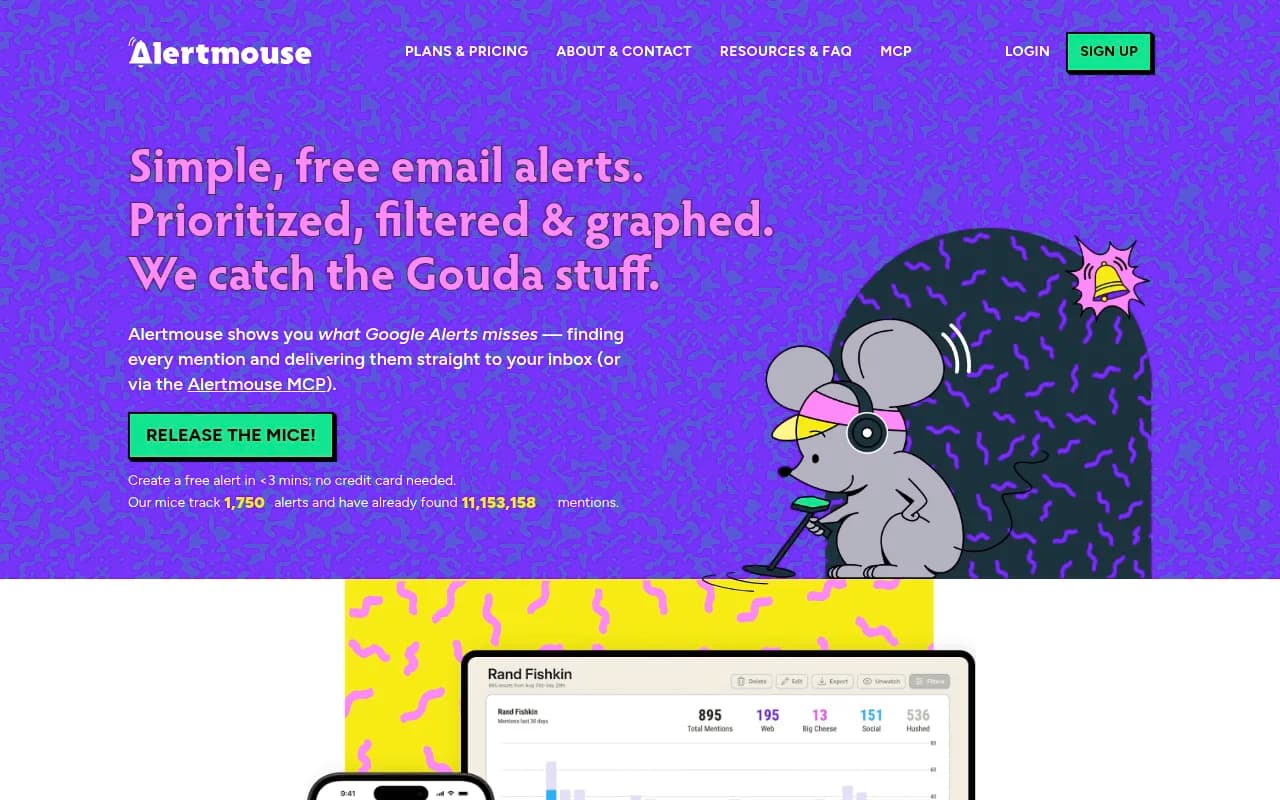
Alertmouse is a brand mention monitoring service from a small indie team in Seattle. It pitches itself as a simpler, more accurate and punnier alternative to Google Alerts. The homepage is full of cheese and mouse jokes ("We catch the Gouda stuff"), which tells you the tone, but the product underneath is a serious attempt to fix the main complaint about Google Alerts: it misses things and buries the useful hits in noise.
The core idea is simple. You create an alert with a name, brand or topic, optionally add boolean modifiers, and Alertmouse crawls the web for matches. It filters, categorizes and scores what it finds, then sends prioritized email alerts and plots mention volume over time. According to the homepage counter, its mice track 6,583 alerts and have found more than 39.8 million mentions so far. I would treat that as a rough scale indicator, not an audited number.
The audience is people who want self-service software without a sales call: founders, CEOs and CMOs, PR and comms people comparing themselves against competitors, creators and authors, and SEOs who care about which words co-occur with their brand. It is aimed squarely at the gap between free Google Alerts and enterprise suites that cost thousands per month.
Key features
Prioritized, scored mentions. Every mention carries a score from 1 to 100, plus a title, snippet and, when available, a content date. The score is what separates Alertmouse from a plain feed. Instead of reading 40 emails to find the one article from a major publication, you scan the top-scored items first. Google Alerts has no equivalent, and many cheap monitors only sort by date.
Noise filtering and categorization. The pitch is that Alertmouse filters before it delivers. Testimonials on the site, including one from marketer Jono Alderson, single out noise reduction as the standout. In practice that means fewer duplicates, scraped copies and irrelevant matches landing in your inbox.
Boolean modifiers and advanced filters. Alerts support boolean logic, and the docs expose two advanced filter fields: must_include_one and cannot_include_any. These let you disambiguate a common brand name (say, excluding a similarly named product). The docs themselves warn to use the exclusion filter cautiously, because an overzealous exclude list will hide mentions you wanted. That is honest advice and worth following.
Broad source coverage. Reviewers quoted on the site say it tracks conversations across Google results, Reddit, job postings and social media, and that it surfaces blogs, forums and profiles they did not know mentioned them. I could not independently verify the full source list, so test it against a brand you know well before committing.
Trend graphs. Mention volume is charted so you can see spikes after a launch, a press hit or a controversy. Fans call them "visual mousterpieces". They are simple, not a full analytics suite, but they do the job for spotting changes in attention and comparing against competitors.
30-day backfill. A new alert pulls mentions from the previous 30 days, which can take a few minutes. That is useful because you see real data right away instead of waiting a week for the first alert. One catch from the docs: editing an alert via the API deletes its existing mentions and re-fetches the last 30 days, so don't tweak filters casually if you care about stored history.
Alertmouse MCP. Paid plans include an MCP server at alertmouse.com/mcp. The docs walk through setup for ChatGPT (custom MCP plugin) and Claude (custom connector), with authorization handled through Alertmouse. You can then ask an assistant something like "tell me about my new mentions" and get a summary. It is a neat fit for people who already live in an AI assistant and would rather ask than open a dashboard.
REST API for enterprise. Enterprise customers get a REST API with Bearer key authentication (keys are created on the Settings page). Endpoints cover alerts (list, get, create, patch, delete) and mentions at /api/alerts/{id}/mentions. The mentions endpoint takes a since parameter, which is the right design for a cron job that pulls only new items. One quirk: the date field is the discovery date, not the publication date, so old content can appear as a new mention. Use content_date where present.
Who is it for
The sweet spot is a solo founder, a small marketing team or a PR freelancer who wants to know when and where they are mentioned without paying for Brandwatch or Meltwater. Think a SaaS marketer at a 20-person company tracking the brand name plus three competitors, or a podcast host watching for show mentions and guest reposts. Authors, journalists and consultants who want to see where their name and published work are spreading also fit well, as do agencies that want a cheap monitor for each client brand.
SEOs and AI marketers get one specific use: watching how brand mentions co-occur with words that influence search and LLM answers. That is a reasonable reputation and link-prospecting angle, since unlinked mentions are classic outreach targets. But it is not AI visibility measurement.
Who should skip it? Brands with thousands of mentions a day. The company says so itself on the homepage. Large consumer brands, listed companies and anyone needing deep sentiment models, influencer databases, broadcast and print coverage, or team workflows with approvals will outgrow it quickly. And if your real question is how often ChatGPT, Gemini or Google AI Overviews recommend you, this is the wrong category of tool entirely.
Integrations and ecosystem
The primary delivery channel is email, which is both the charm and the limit. There is no native Slack, Zapier or Teams integration listed on the pages I reviewed, so if you need alerts piped into chat or a CRM, you either use the MCP route, the enterprise REST API, or forward emails with your own rules.
The MCP is the more interesting piece. Paid users can connect Alertmouse to ChatGPT or Claude and query mentions conversationally. The REST API is reserved for enterprise customers, which will frustrate developers on lower tiers who just want a webhook. I found no browser extension, mobile app, or public import/export documentation, and no official links to X, GitHub, Discord or LinkedIn. Support runs through [email protected].
Pricing and value
Pricing is where Alertmouse is most appealing. The tiers I could verify:
- Nibble (free): 1 alert, 1 user, up to 10 mentions per day, 60 days of history. The site says the first alert is free forever and needs no credit card.
- Slice (Basic): $120/year, shown as $10/month billed annually. 5 alerts, 3 users, unlimited mentions, 1 year of history and MCP access.
- Higher tiers: A search snippet showed $600/year ($50/month billed annually) for a mid-tier plan and $1,200/year ($100/month billed annually) for an enterprise-style plan described as being for large organizations with custom needs. I could not confirm the alert counts, user limits or tier names, so check alertmouse.com/pricing before buying.
Compared with enterprise listening platforms that often start in the hundreds or thousands of dollars per month, this is a bargain for what it does. Compared with the free Google Alerts, you are paying for better recall, scoring and graphs. The free tier is a genuine trial: one alert with a daily cap is enough to test whether it finds mentions Google misses.
Strengths and limitations
Strengths
- Price. $10/month for 5 alerts and 3 users is hard to beat.
- Prioritization. The 1 to 100 score makes alert emails scannable.
- Simple setup. The company claims a free alert takes under 3 minutes, and the flow matches that.
- MCP access. Asking ChatGPT or Claude about new mentions is a nice touch at this price.
- Honest docs. Warnings about exclusion filters and discovery dates are helpful.
Limitations
- The free tier cap of 10 mentions per day can mean you miss things on busy brands.
- API access is enterprise-only and MCP is paid-only.
- Email-first delivery, with no listed native chat or workflow integrations.
- Not built for very high mention volumes.
- I found no independent reviews, so the glowing quotes on the site are the only social proof available, and they come from the vendor.
What it lacks compared to Promptwatch
Alertmouse monitors the open web. It does not track AI answers. Promptwatch covers ChatGPT, Google AI Overviews, AI Mode, Gemini, Perplexity, Copilot, Claude and more through their real interfaces, and adds things Alertmouse has no equivalent for:
- Prompt tracking with volumes, difficulty and query fan-outs
- IP-verified AI crawler logs and crawl-to-citation tracking
- AI traffic attribution through visitor analytics
- Content gap analysis, a Content Agent and CMS publishing to WordPress, Webflow and Framer
- Reddit, YouTube and LinkedIn citation tracking, plus offsite mentions
- AI Shopping and Ads Radar, Agent Chat and a prioritized Action Board
The two are not interchangeable. They solve different problems, and some teams could reasonably run both.

Bottom line
Alertmouse is a cheap, focused upgrade over Google Alerts. If you are a founder, PR person or creator who wants prioritized mention alerts without enterprise pricing, start with the free alert and move to the $10/month plan once you need more than one.
If your goal is growing visibility inside AI answers, not just watching web mentions, pick an AI visibility platform such as Promptwatch, which tracks, explains and helps you fix how AI engines cite you. Best use case in one sentence: a low-cost, scored inbox feed of who is talking about your brand across the web.
Tags:
Frequently asked questions
What is Alertmouse?
How much does Alertmouse cost?
Does Alertmouse track mentions in ChatGPT or other AI search engines?
Does Alertmouse have an API or MCP?
Who should not use Alertmouse?
Similar and alternative tools to Alertmouse