Key takeaways
- Developer tools win AI citations through documentation, GitHub, and product pages, not just blog content. Pick a platform that can show you which of those pages AI actually reads.
- Prompt tracking alone is not enough for dev tools. Crawler logs, citation-level data, and a way to act on gaps matter more than a pretty share-of-voice chart.
- Coding agents (Codex, Claude Code, OpenCode) now recommend libraries and SDKs. Few tools track this, and it is worth asking vendors about it.
- Promptwatch is the most complete fit for dev tool teams. Gauge, Profound, and SE Ranking suit narrower needs, and API-first tools like DataForSEO suit teams that want to build their own reporting.
- Most "best of" lists, including several quoted below, are written by the vendors themselves. Treat the rankings as claims to test in a trial.
Why developer tools need a different approach
A consumer brand can get away with tracking whether it is mentioned in "best running shoes" prompts. A developer tool company has a harder problem. Your buyer asks things like "best auth library for Next.js", "Supabase vs Firebase for React Native", or "how do I rate limit an API in Express". The answer is built from docs, GitHub repos, Stack Overflow threads, and comparison pages. Your homepage barely enters the picture.
Promptwatch Data backs this up. In its report on the most cited sites in ChatGPT for software-related prompts (Sep 28 to Oct 4, 2026), GitHub was the most cited software domain at 1.2% of software citations, followed by learn.microsoft.com at 0.98% and G2 at 0.73%. AWS docs got 0.41% and Google Cloud docs 0.35%. By source type, docs and help centers earned 2.64% and vendor sites 2.01%, while review sites and analysts earned 1.57%. Vendor sites and docs together earned about three times what review sites did.
The practical read: keep your docs public and crawlable, keep a real GitHub presence, and keep your G2 and Capterra profiles current. Those are the surfaces AI leans on when someone asks about software.
Content type matters too. According to Promptwatch's data on which content types ChatGPT cites (Sep 28 to Oct 4, 2026), product pages made up 22.4% of citations, landing pages 16.8%, listicles 13.6%, how-to guides 8.7%, and documentation 7.5%. For informational prompts, docs and how-tos earned more than they do overall. Developer queries are mostly informational, so your docs and tutorials carry real weight.
There is also a freshness angle. Promptwatch's content half-life report found that landing pages and docs stay cited for months, while news loses half its pages in about five weeks. Evergreen docs are a better long-term bet than launch-announcement blog posts.
What to look for in a platform
Before comparing vendors, decide what you actually need. For dev tool companies I would rank the criteria like this:
- Real-UI tracking of the engines your buyers use, with stack-specific prompts rather than generic category prompts.
- Citation-level data: which of your pages (docs, GitHub, changelog) get cited, and which third-party pages get cited instead of you.
- AI crawler logs. If GPTBot or ClaudeBot hits a 403 on your docs, no amount of content work fixes it.
- Coding agent visibility. Developers increasingly ask Claude Code or Codex which SDK to use.
- An action layer: content gap analysis, briefs, publishing, and a way to check whether the fix worked.
- API or MCP access so you can pipe the data into your own dashboards.
Most tools do item 1. Far fewer do 2 through 5.
Quick comparison
| Platform | Best for | Crawler logs | Coding agent tracking | Content execution | API/MCP |
|---|---|---|---|---|---|
| Promptwatch | End-to-end tracking and fixing | Yes, IP-verified | Yes (Codex, Claude Code, OpenCode) | Yes, with CMS publishing | REST API, MCP |
| Gauge | Dev tool teams wanting tracking plus content engine | Not a headline feature | Not a headline feature | Yes | Via integrations |
| Profound | Enterprise, compliance-heavy buyers | Limited | No | Limited | Sales-led |
| SE Ranking | Agencies and SaaS teams wanting SEO plus AI in one stack | No | No | Limited | Yes |
| DataForSEO | Teams building their own data product | No | No | No | Full REST API |
| Otterly.AI | Cheap entry-level monitoring | No | No | No | Limited |
| Peec AI | Smart prompt suggestions, multi-language | No | No | No | Limited |
Vendor-reported features change quickly, so confirm each one on a trial before you commit.
The platforms worth shortlisting
Promptwatch
Promptwatch is the one I would start with for a developer tool company, mainly because it covers the parts of the problem that dev tools actually have. It tracks real user interfaces in ChatGPT, Google AI Overviews, AI Mode, Gemini, Perplexity, Copilot, and others, and it is one of the few platforms that also tracks how coding agents (Codex, Claude Code, and OpenCode) recommend tools, SDKs, and docs.

The crawler side is just as useful for this audience. IP-verified logs of GPTBot, OAI-SearchBot, ClaudeBot, PerplexityBot, and others show which doc pages AI reads and where it hits errors. Dev tool sites are often behind aggressive bot protection, JavaScript-rendered docs, or Cloudflare rules, and this is where invisibility usually starts. Weekly site audits catch orphaned doc pages and sitemap gaps.
Then there is the action layer. Content gap analysis shows prompts where competitors get cited and you do not. The Content Agent can plan, write, and publish articles to WordPress, Webflow, or Framer, and the Action Board turns findings into a prioritized to-do list. Published pages are tracked through crawls, citations, and AI-referred visits, so you can see whether a tutorial actually got picked up.
Promptwatch also tracks Reddit, YouTube, and LinkedIn citations, which matters if your community lives on Reddit or your devrel team publishes video. One caveat from Promptwatch's own data: ChatGPT's reddit.com citation share fell from about 4% to 0.5% on August 14, 2026, and ChatGPT drew only 0.46% of citations from social platforms versus 12.2% for AI Overviews in late September to early October. So community presence now matters more for Google surfaces than for ChatGPT.
Pricing starts with a free Explore tier, then Essential at $95/mo, Professional at $245/mo, and Business at $579/mo, which adds the automated Content Agent. Check promptwatch.com/pricing for current numbers. There is a 7-day free trial on the monthly paid plans. The hosted MCP server and REST API are included, which suits technical teams who want to query visibility data from Cursor or their own scripts.
Gauge
Gauge is the most dev-tool-specific pitch on the list. Its own materials name Vellum, Sourcegraph, Supabase, and PostHog as customers, and it emphasizes stack-specific prompt tracking and a Content Engine that goes from gap to published article. Its Ask Gauge agent combines GA4, Search Console, and DataForSEO data.
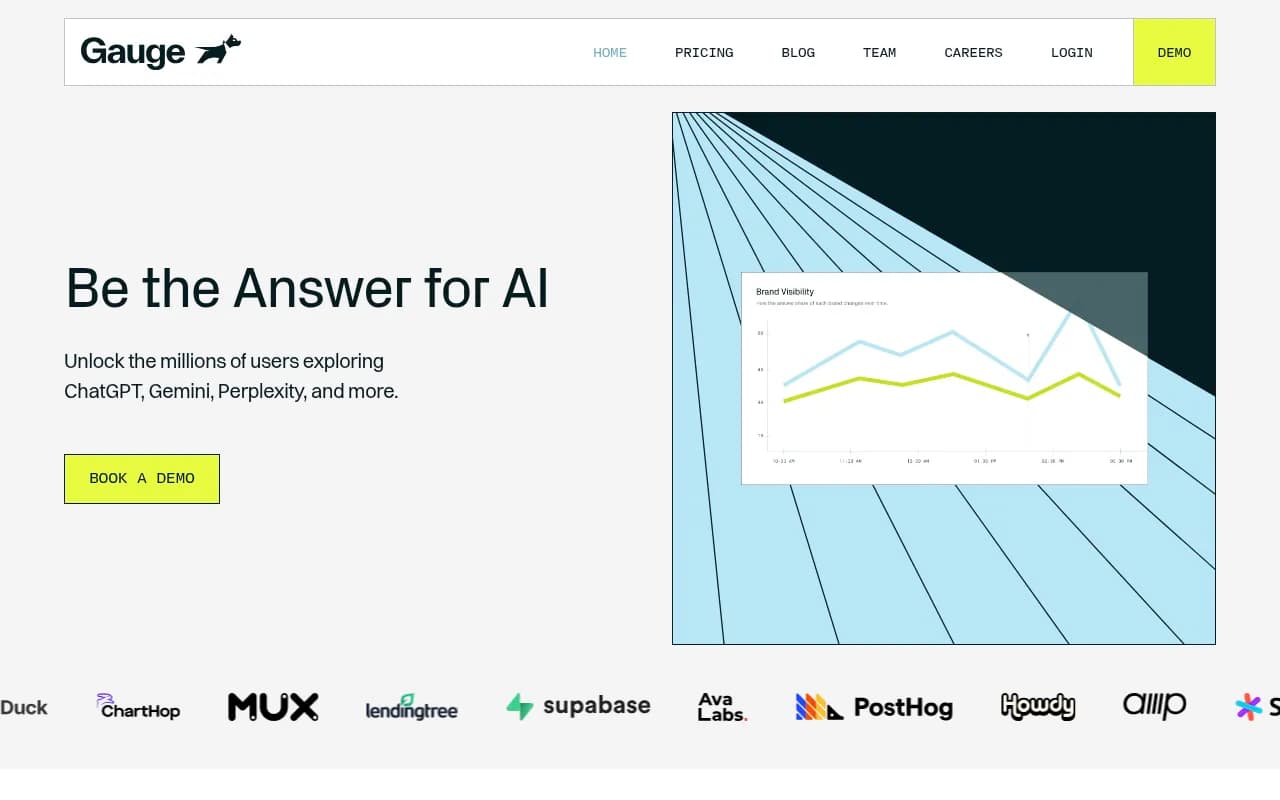
The listed Growth plan is $599/mo for 600 daily prompts across six engines, with 18 articles a month. Note that Claude and Grok run through bring-your-own-key. The customer list and rankings come from Gauge's own content, so verify them in a demo.
Profound
Profound is the enterprise name. It has a Conversation Explorer database of prompts and responses and SOC 2 Type II compliance, which helps if your security review is a gate. Entry pricing reported in vendor-authored material is $399/mo for 100 prompts on ChatGPT only, with higher tiers sales-led. That is steep for a seed-stage dev tool company, and it is a monitoring-first product.

SE Ranking and SE Visible
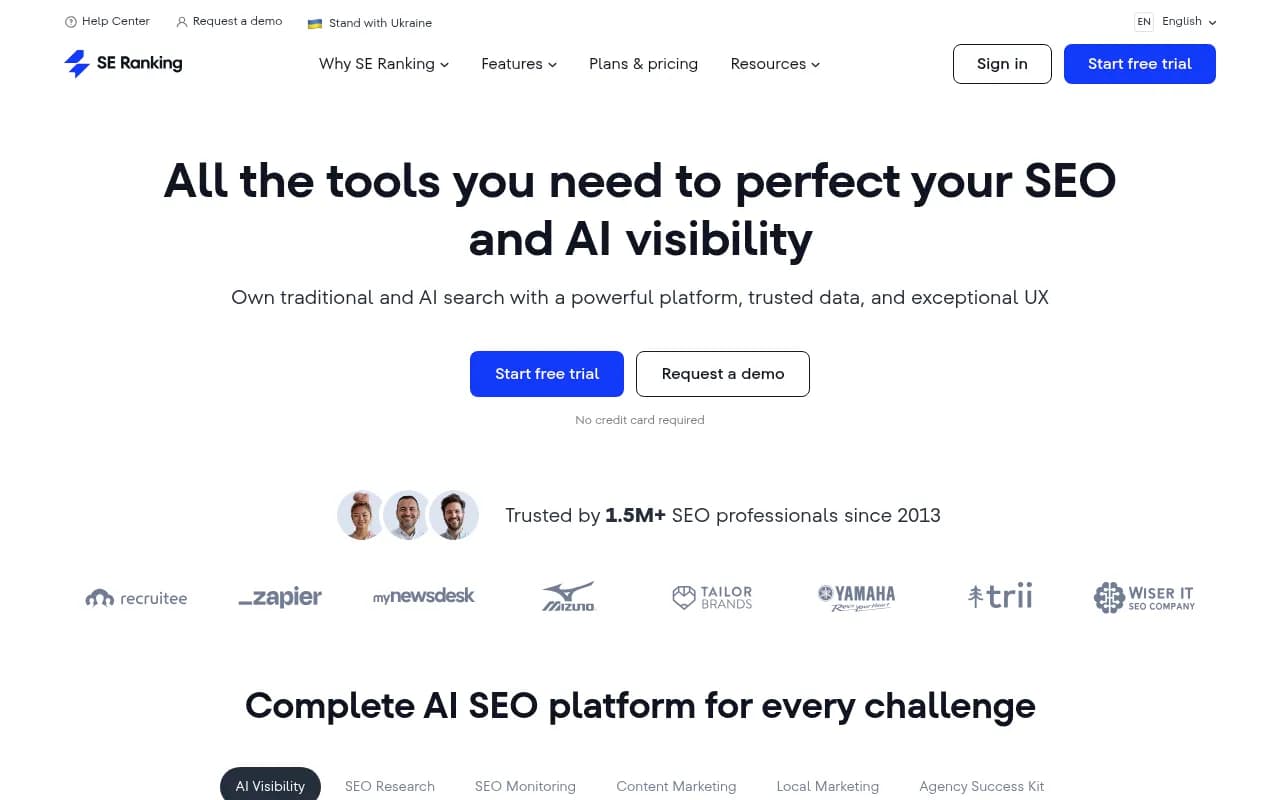
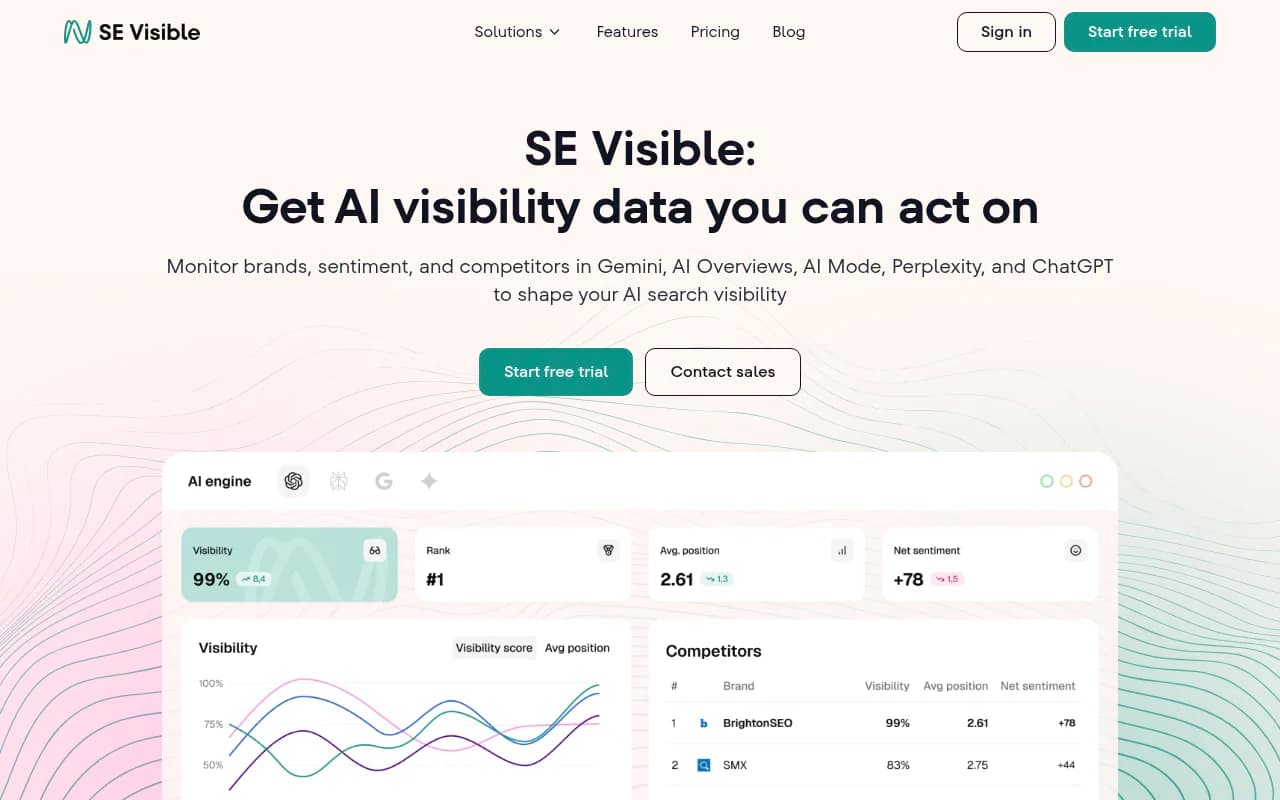
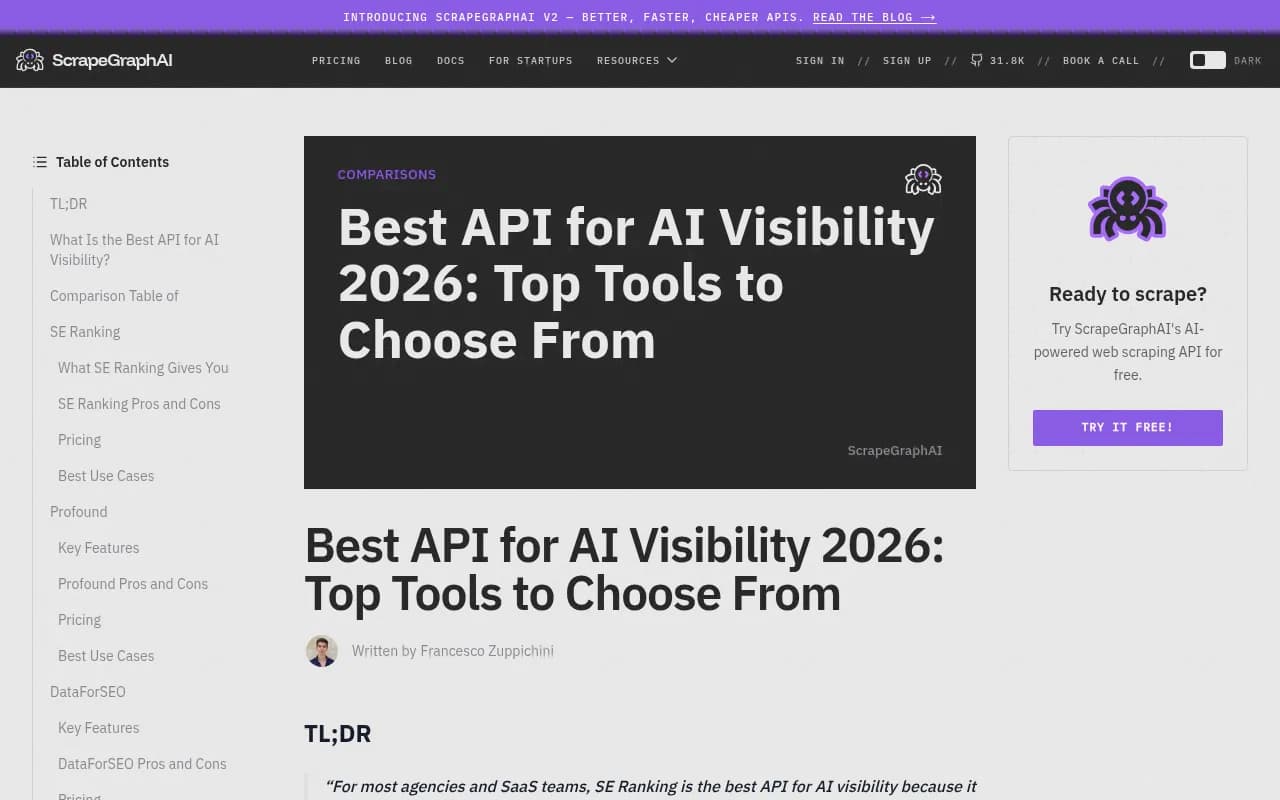
If your SEO team already lives in SE Ranking, adding AI visibility there is a sensible, low-friction move. A ScrapeGraphAI comparison picks it as the safest all-around choice for agencies and SaaS teams that want LLM mention tracking, AI Overview monitoring, reporting, and a REST API in one account. It is less specialised for developer queries, but the API access is real.
Otterly.AI, Peec AI, and ZipTie
These are the budget and mid-tier trackers that show up in nearly every roundup. Zapier's list picks OtterlyAI for affordability, Peec AI for smart suggestions, and ZipTie for deep analysis and reporting. They are fine for answering "are we mentioned?" They generally will not tell you why a docs page is ignored or help you fix it.


Semrush and Ahrefs Brand Radar
Traditional SEO suites have added AI tracking. If you already pay for them, the integration with classic rankings is convenient. The tradeoff is usually fixed prompt sets and shallower AI-specific data, with no crawler logs.
API-first options for teams that build their own
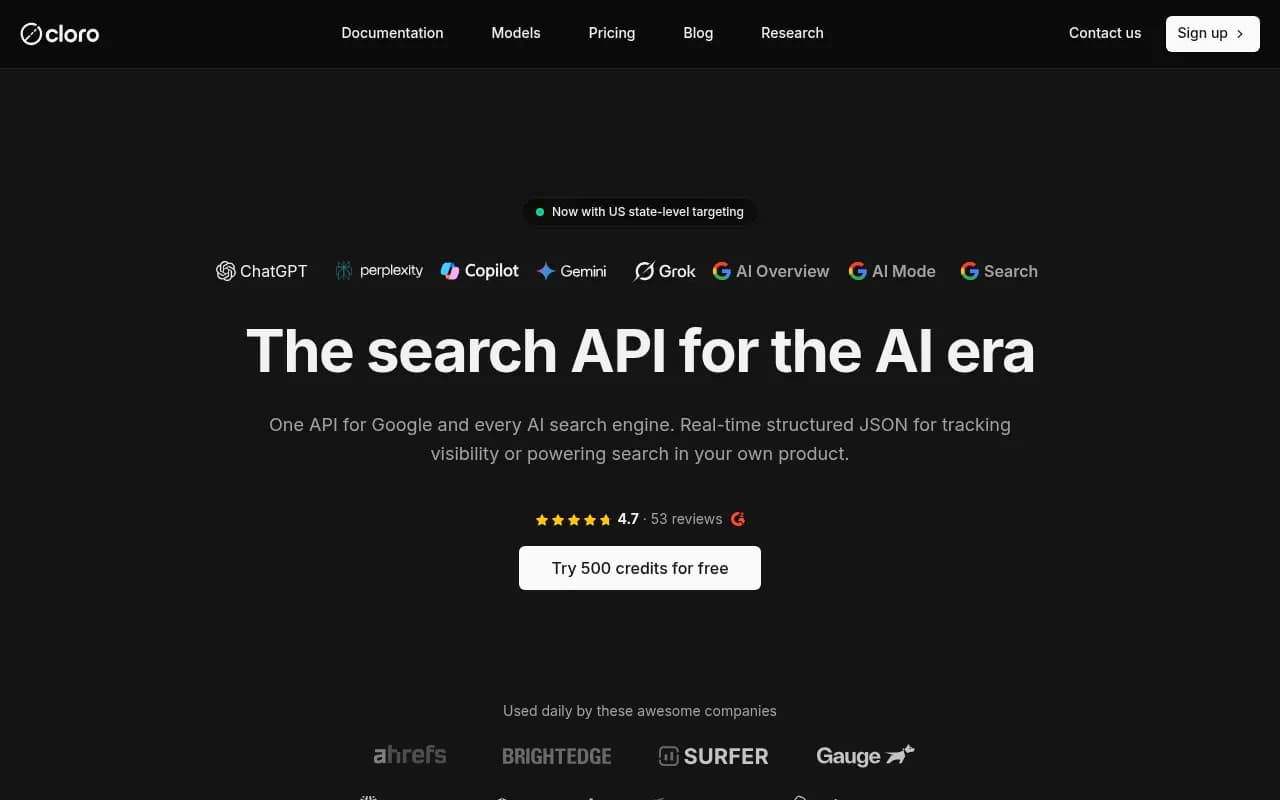
Some dev tool companies would rather build a reporting layer than buy a dashboard. DataForSEO gives pay-as-you-go REST access, though its AI coverage is partial, mostly Google AI Overviews data. Cloro, listed in our catalog, advertises a mention-rate API.
If that is your route, also look at the hosted MCP and REST API on platforms like Promptwatch, since they pair raw data with a product layer you do not have to build.
Do not confuse these with LLM observability tools
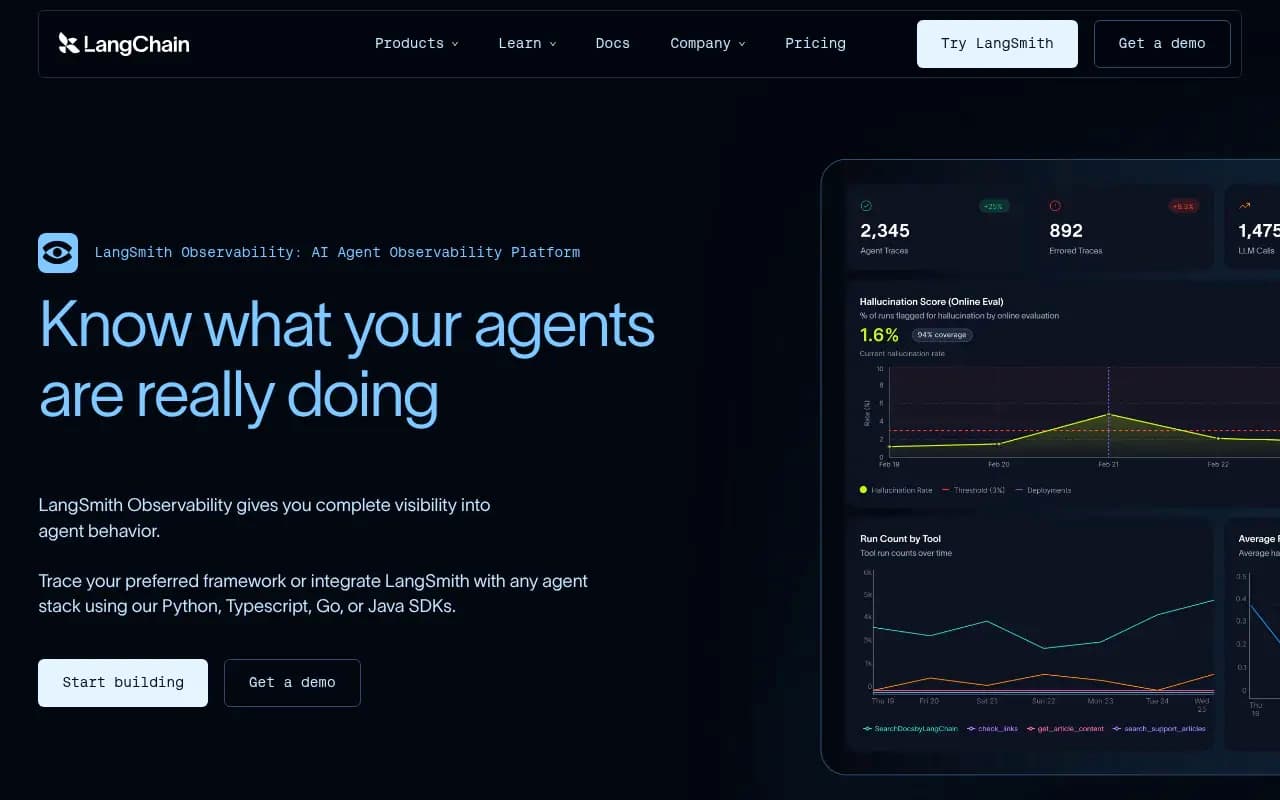
Developer tool teams sometimes search for "AI visibility" and land on LLM observability products. LangSmith, Helicone, Humanloop, and PromptLayer help you trace and evaluate the LLM calls inside your own application. They do not tell you whether ChatGPT recommends your SDK. Different job, different buyer. If you are building AI features, you may need both categories, but they are not substitutes.

A practical rollout for a dev tool team
Week 1: fix access
Check whether AI crawlers can actually read your docs. Review robots.txt, WAF rules, and JavaScript rendering. Connect crawler logs through your CDN (Cloudflare, Vercel, Netlify, and others are common) and look for 403s and 404s on doc URLs. Promptwatch's free AI Crawler URL Inspector and Robots.txt Generator for AI are a quick first pass.
Week 2: build a stack-specific prompt set
Write prompts the way developers phrase them: framework plus task plus constraint. Include comparison prompts ("X vs Y for Z"), migration prompts, and "how do I" prompts that your docs should answer. Add competitor names so you can measure share of voice, and tag prompts by persona, such as backend engineer versus engineering manager.
Week 3: read the citations
Look at which URLs get cited for your prompts. Expect GitHub, official docs, and a few review sites. Note which third-party pages name you without linking, and which competitor pages dominate. This tells you whether the gap is coverage (not appearing), prominence (appearing late), or content (mentioned but never cited).
Week 4 onward: ship fixes and measure
Prioritize a handful of pages: a missing comparison page, a thin quickstart, an outdated integration guide. Publish, then check whether crawlers visited, whether citations followed, and whether AI-referred visits convert. Keep G2 and Capterra profiles complete, since Promptwatch's software citation data shows review sites still earn a measurable share.
Choosing between them
- If you want tracking, crawler diagnostics, coding agent visibility, and content execution in one product, start with Promptwatch.
- If you want a vendor with named dev tool customers and a content engine, trial Gauge alongside it.
- If procurement requires SOC 2 and you have enterprise budget, look at Profound.
- If you already run SE Ranking or Semrush and only need a baseline, use their AI add-ons first.
- If you are exploring on a tight budget, Otterly.AI or Peec AI will tell you whether you are visible at all.
For wider comparisons, the GEO software directory at bestgeosoftware.com lists far more options than fit here.
Questions to ask in every demo
- Do you track the real ChatGPT and AI Overviews interface, or only API output? The two can differ.
- Can you show me IP-verified crawler logs for my docs subdomain?
- Do you track Codex, Claude Code, or OpenCode recommendations?
- How do you handle stack-specific prompts at scale, and what does a prompt cost?
- What happens after you find a gap? Who writes, who publishes, and how do you verify it worked?
- Can I get the data out through an API or MCP server?
A vendor that cannot answer the crawler and coding agent questions is selling a monitoring dashboard. That can be enough for a first look, but dev tool companies usually outgrow it within a quarter.