Cloro Review 2026
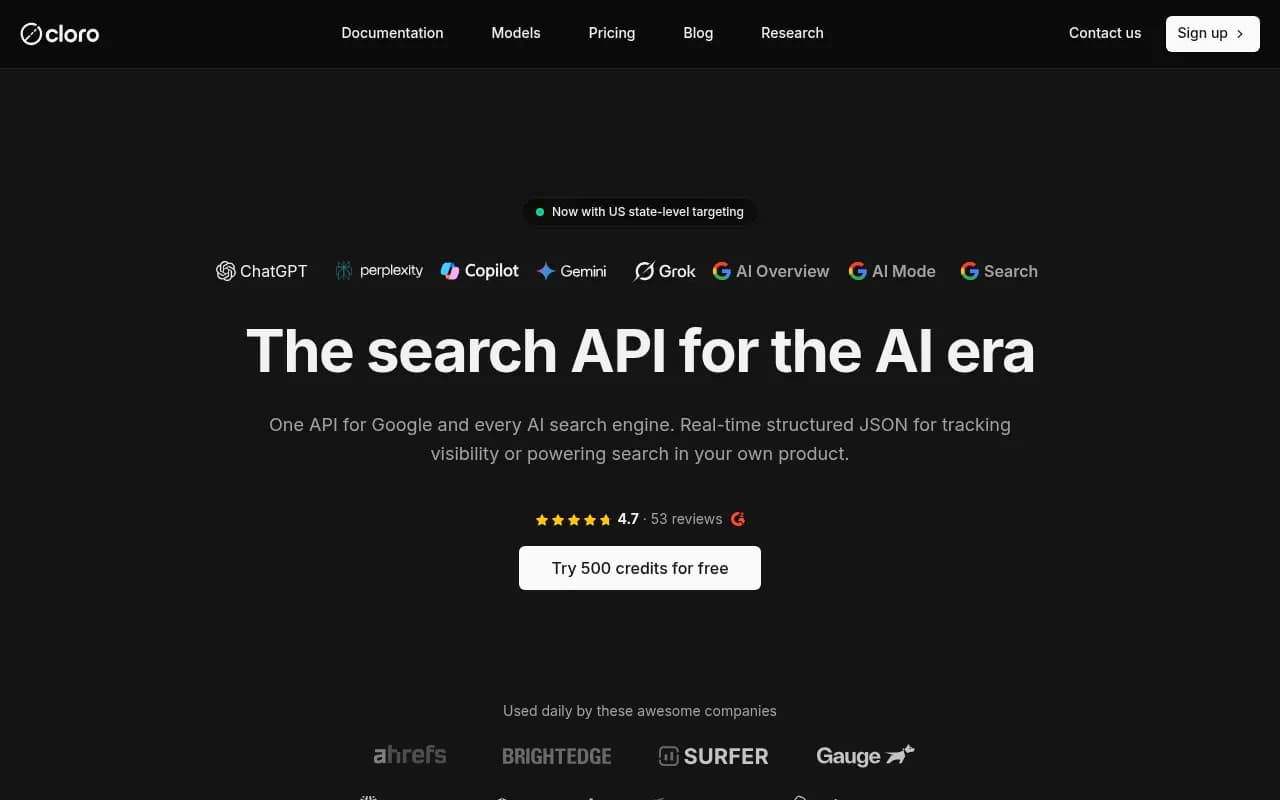
Computes mention rate, share of voice and brand visibility across ChatGPT, Perplexity, Gemini and AI Mode via a developer API.
Key takeaways
- Cloro is an API, not a dashboard. It returns parsed JSON (text, sources, citations, query fan-outs, shopping cards) from ChatGPT, Perplexity, Gemini, Copilot, Grok, Google AI Mode, AI Overview, and plain Google Search, so you build the visibility reporting layer yourself.
- It scrapes the actual UI each engine shows users rather than hitting the underlying model API, which means you get citation cards and source lists that the raw ChatGPT or Gemini APIs simply don't expose.
- It lacks the monitoring-to-action loop: no content gap analysis, no automated content generation or CMS publishing, no AI crawler logs, no visitor-level traffic attribution. Promptwatch covers that full stack; Cloro gives you raw data and leaves the optimization work to you.
- Response times run 30-45 seconds per request, which rules it out for anything that needs to feel real-time, and credits don't roll over month to month.
- Pricing starts at $30/month (Lite, 37,500 credits) after a 500-credit free tier, scaling to multi-million-credit enterprise plans, which is reasonable for a pure data API but means you're paying for raw material, not a finished report.
Cloro is built by Cloro Incorporation Ltd., a small team based in Valletta, Malta, led by co-founder and CEO Ricardo Batista. It launched in 2025 and by August 2026 had crossed 250 paying customers and roughly 800 active users, processing close to a billion API calls a month according to its own press release. That's a lot of calls for a company with a domain rating in the 40s and a few hundred monthly site visits, which tells you something about who actually uses it: not marketers browsing the website, but engineers calling the API directly from their own products.
The pitch is straightforward. Instead of writing separate scrapers or integrations for ChatGPT, Perplexity, Gemini, Copilot, Grok, and Google's various AI surfaces, you send one POST request with a consistent payload shape and get back clean markdown, parsed source lists, citations, query fan-out data, and shopping cards where applicable. If you're an AI SEO tool builder, an agency running your own internal tracking spreadsheet, or a developer bolting "AI visibility" onto an existing SaaS product, Cloro is infrastructure you'd otherwise have to build and maintain yourself, including the headless browser sessions and anti-bot workarounds that make scraping these interfaces painful in the first place.
Key features
- Multi-engine coverage through one API. Cloro supports ChatGPT, Perplexity, Microsoft Copilot, Google Gemini, Grok, Google AI Mode, Google AI Overview, Google Search, and Google News, all behind the same request/response shape. Country targeting works across all of them, and the newest addition is US state-level targeting for ChatGPT, Copilot, Perplexity, Gemini, and Grok, so you can see how an AI answer changes when the request appears to come from California versus Texas.
- UI-level scraping, not model API calls. This is the feature that actually differentiates Cloro from calling OpenAI's or Google's APIs directly. Cloro runs real browser sessions against the live consumer-facing interface of each engine, which is why it can return citation pills, source cards, and shopping blocks that don't exist in the raw model API response. If you want to know what a real ChatGPT Search user actually sees, including the little source favicon row, this is closer to ground truth than hitting the API.
- Structured extras per platform. Beyond plain text, responses include
searchQueries(query fan-out) for ChatGPT and Copilot,citationPillsacross Perplexity, Copilot, and Gemini,shoppingCardswith price, rating, and review count for Google, Gemini, and AI Mode, and place cards with phone numbers, websites, and a stable Google Knowledge GraphplaceIdfor AI Mode and AI Overview results. These were mostly added or refined in September 2026 changelog entries, so the API has been actively extended rather than left static. - Hosted MCP server. Cloro runs an MCP server at mcp.cloro.dev that exposes its monitoring endpoints as tools for Claude Code, Claude Desktop, Cursor, and any MCP-compatible client. The hosted connector flow doesn't even require an API key for sign-in, which is a nice touch for quickly wiring an agent up to live search data without managing credentials in a config file.
- Async batch processing with webhooks. For high-volume jobs, you submit a task and get the result back via webhook instead of holding a connection open. Sync requests cost 2 extra credits compared to async, so there's a built-in incentive to batch your work if you're running anything beyond small-scale testing.
- Published credit pricing per request type. Rather than opaque token-based billing, each engine has a fixed credit cost (ChatGPT web search around 5 credits, Perplexity around 3, Copilot around 5, and so on), so you can estimate a monthly bill before you run anything. That's a genuine advantage over wiring together several providers' native APIs where token costs vary by model and shift without warning.
- A public weekly leaderboard. Cloro republishes an AI Visibility Leaderboard every Monday showing which brands get named and cited by ChatGPT, Perplexity, Gemini, Copilot, and Google AI Mode across twelve software categories, along with every domain cited as a source. It's a decent way to see what Cloro's own data looks like before committing to a plan, and each weekly snapshot stays archived so you can cite a specific week later.
- No pay-as-you-go, but a real free tier. 500 credits per month, no card required, 1 concurrent job. It's enough to kick the tires, not enough to run a real monitoring program.
Who is it for
Cloro is squarely a developer tool. If you're an engineer at an AI SEO startup building your own citation-tracking dashboard on top of someone else's data layer, or you're a technical founder who wants mention-rate and share-of-voice numbers piped straight into your own product without building scrapers for six different AI engines, this is exactly the kind of infrastructure you'd want. G2 reviewer data backs this up: most reviewers are small businesses, with titles like "Full-stack Digital Marketer," "Applied AI Engineer," and "Lead Solutions Architect" showing up repeatedly, and the regional skew (Europe and Asia dominating over North America) suggests a lean, technical, cost-sensitive buyer rather than enterprise marketing departments.
Agencies that already have their own reporting templates and just need the underlying AI response data can use Cloro as the pipe, feeding results into their own Looker Studio dashboards or internal tools. It also fits teams building "AI visibility" as a feature inside a broader product, since several reviewers mention using it as backend infrastructure for their own SaaS rather than as an end-user monitoring tool.
Who should skip it: marketing teams and brand managers who want a finished dashboard, sentiment tracking, or content recommendations out of the box. Cloro gives you JSON, not insight. If you don't have an engineer who can turn mention-rate numbers into something a CMO reads on a Monday, you'll end up building (or buying) a reporting layer on top of this anyway, which changes the actual cost equation.
Integrations and ecosystem
Cloro ships official Python and TypeScript/Node SDKs, plus a GitHub org (github.com/cloro-dev) with an MCP server repo described as letting you "query ChatGPT, Perplexity, Gemini, Copilot, Grok, Google AI Mode, Google Search and Google News as agent tools." Third-party reviews mention workflow connections through n8n, Zapier, and LangChain, which matters if your team isn't writing raw API calls but wants to wire Cloro into an existing automation stack. G2 user profiles list integrations with tools like Claude, Claude Code, and Next.js, which reinforces that this is mostly consumed by developers embedding it directly into code.
There's no mobile app and no browser extension, which makes sense given the product. Social presence is thin: the official X account (@cloroai) has a handful of followers as of this writing, and I couldn't find a Discord community. For a tool this technical, that's not disqualifying, but it does mean you're relying on docs and email support rather than a community to troubleshoot edge cases.
Pricing and value
The free tier gives you 500 credits a month with no card required, enough to test the API but not to run anything ongoing. Paid plans start at Lite ($30/month, 37,500 credits, $0.80 per 1,000 credits), then Hobby ($100/month, 250,000 credits, $0.40 per 1,000), Starter ($250/month, 650,000 credits, marked most popular), Growth ($500/month), Business ($1,000/month), and a stack of self-serve Enterprise tiers from $2,000 to $5,000+/month topping out around 16.4 million credits. Credits don't roll over between billing cycles, which is worth factoring in if your usage is spiky rather than steady.
For context, a single ChatGPT web search call costs around 5 credits, so the Lite plan buys roughly 7,500 ChatGPT queries a month, while Perplexity calls at around 3 credits stretch further. That's cheap compared to maintaining your own scraping infrastructure against six anti-bot-hardened interfaces, but it's not cheap compared to buying a finished monitoring product if all you need is a handful of brand-mention numbers. One G2 reviewer's AI-summarized consensus specifically flags pricing as steep for smaller teams, and an older third-party review from May 2026 complained there was "no budget tier below $100," which the $30 Lite plan has since addressed, so pricing has clearly moved in a more accessible direction over the past several months.
Strengths and limitations
Cloro does a few things genuinely well. The UI-level scraping approach is the standout: it captures citation cards, source lists, and shopping blocks that the underlying model APIs don't return at all, which matters if you actually care what a real user sees rather than what the model says in isolation. The unified request shape across eight different engines saves real integration time, reviewers consistently mention setup taking under 15 minutes, and the published per-request credit costs make budgeting predictable in a space where token pricing usually isn't.
The limitations are just as real. Response times average 30-45 seconds per request, which one third-party reviewer flatly called unsuitable for real-time applications, and that's consistent with a UI-scraping architecture rather than a direct model call. The changelog itself shows reliability has been shaky at times: Perplexity served login walls on most requests for weeks before a mid-September 2026 fix, and ChatGPT's Czech targeting had to be pulled for roughly three months after anonymous Czech IPs started hitting login walls. That's an honest trade-off of this approach: quality depends on how aggressively each AI provider is fighting bots that week, and Cloro can't fully insulate you from that.
More importantly for anyone comparing this against a full AI visibility platform: Cloro stops at data delivery. There's no content gap analysis, no automated content generation or CMS publishing, no AI crawler log monitoring, and no visitor-level traffic attribution tying AI mentions back to actual site traffic or conversions. It also doesn't track Reddit or YouTube citations specifically, doesn't score prompt volume or difficulty, and doesn't give you ChatGPT Shopping or Ads Radar reporting out of the box, you'd have to build that analysis yourself from the raw shopping card data it returns. Promptwatch, by contrast, is built around that full loop: crawler logs explaining why AI does or doesn't cite you, citation trend analysis across Reddit and YouTube, visitor analytics tying AI traffic to revenue, and Content Agents that actually draft and publish optimized content to fix gaps. Cloro gives you the raw ingredients; Promptwatch gives you the ingredients and cooks the meal.

Bottom line
Cloro is a solid, fairly priced data API for teams with the engineering resources to build their own AI visibility reporting on top of it, and it's genuinely useful as backend infrastructure if you're building an AI SEO product yourself or need raw citation and source data piped into an existing pipeline. If you want a platform that monitors, explains, and then actively fixes your AI visibility gaps with content generation and crawler-level diagnostics, Promptwatch is the stronger choice; Cloro hands you the data and trusts you to do the rest.
Best use case: developers and AI SEO tool builders who need structured, multi-engine AI search data piped directly into their own product or reporting stack.
Frequently asked questions
What is Cloro used for?
How much does Cloro cost?
Is Cloro a replacement for an AI visibility platform like Promptwatch?
How fast is the Cloro API?
What AI engines does Cloro support?
Does Cloro have a free plan?
Similar and alternative tools to Cloro