OptimizeGEO Review 2026
Tracks mentions, citations, sentiment and a composite visibility score across 6+ LLMs, then deploys automated fixes through its action center and AI agents.
Key takeaways
- OptimizeGEO pairs AI visibility tracking with an Action Center and five execution agents, so it goes beyond a pure dashboard. Its Accuracy Score, which fact-checks AI claims against your own source material, is a standout.
- It is a monitoring-plus-execution tool that competes directly with Promptwatch. Compared with Promptwatch it publishes no IP-verified AI crawler logs, no Reddit, YouTube, LinkedIn or Instagram citation tracking, no stated prompt volume and difficulty data, and CMS publishing is limited to WordPress and Webflow (no Framer).
- Pricing is steep and rigid: $499/month for Standard, $1,999/month for Pro, and Custom from $4,999/month, all on 12-month minimums. There is no free tier or free trial.
- Standard tracks only 75 prompts on 3 models, refreshed weekly. Pro refreshes every 3 days. Daily tracking is not listed on either tier.
- Best for large, multi-market consumer brands and the agencies that serve them. Small teams and anyone who wants to test before committing will find it hard to justify.
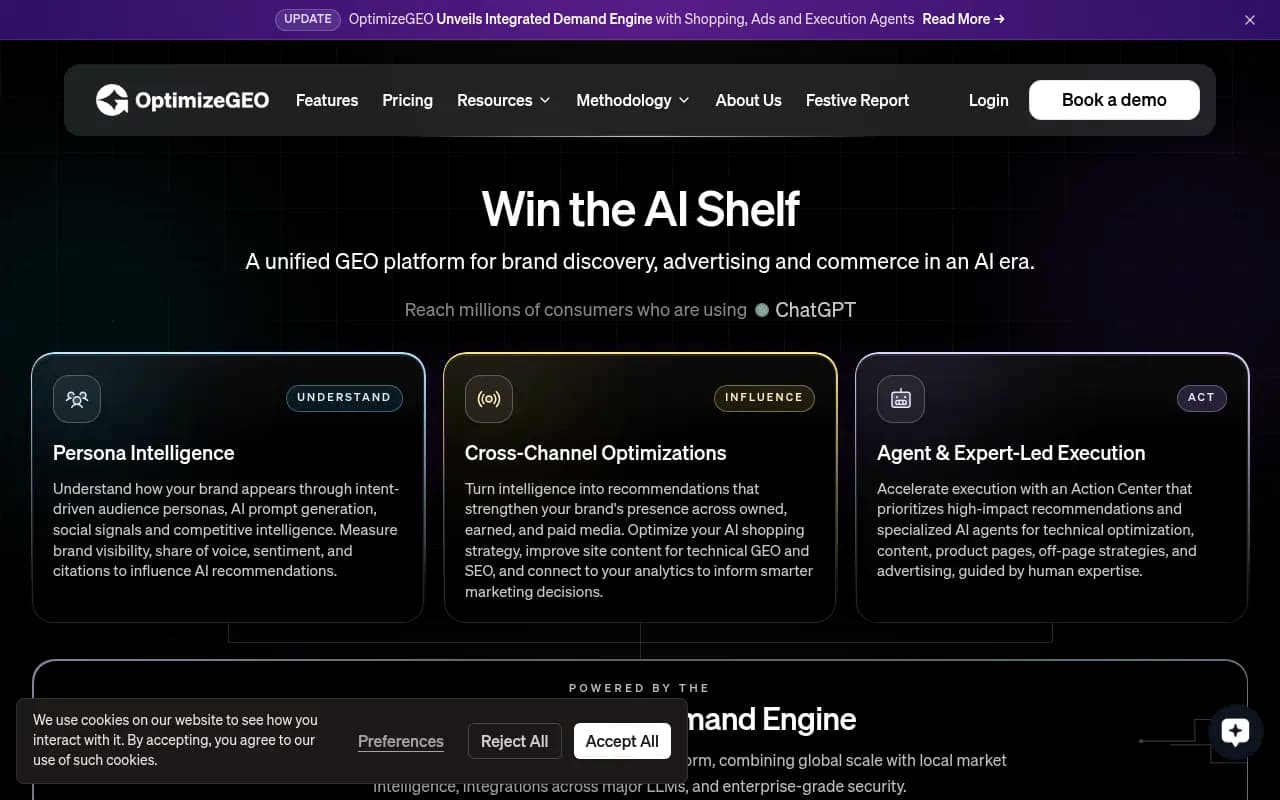
OptimizeGEO is a generative engine optimization platform built by co-founders Kirthiga Reddy (CEO) and Saurabh Doshi. It tracks how ChatGPT, Gemini, Perplexity, Claude, Microsoft Copilot and Google AI Overviews mention, cite and describe a brand. Then it tries to turn those findings into work: a prioritized Action Center, content agents, and as of the November 2026 Integrated Demand Engine launch, agents for technical fixes, product pages, off-page work and ads.
The customer roster tells you who it is built for. The site shows logos from L'Oreal brands (Garnier, Kerastase, Redken), P&G brands (Pampers, Ariel, Vicks, Old Spice, Head & Shoulders), Castrol, Jio, ICICI, WPP and Madison, plus startups like Zamp. The company claims more than 100 brands in 20 countries. This is a global, multi-market, CPG-heavy product, and it shows in the design choices: persona-based prompts, multi-language workspaces, city-level competitor comparison, and a heavy emphasis on shopping.
I would describe it as a more ambitious product than the typical prompt tracker, with a sales motion that looks closer to an enterprise software vendor than a self-serve SaaS tool.
Key features
Persona intelligence. Prompts are built around buyer personas rather than a flat list of keywords. You define who you are trying to reach, and the platform generates prompts reflecting that person's intent. The more interesting part is the reporting: sentiment is shown as a persona-by-platform matrix, so you can see how ChatGPT describes your brand to a first-time buyer versus how Perplexity frames it for a researcher. Most trackers give you one aggregate sentiment number, so this is a real improvement.
Accuracy Score. This is the feature I would pay attention to. OptimizeGEO checks every claim an AI engine makes about your brand (pricing, product details, leadership) against your own source material and flags the wrong ones. The company's shopping research claims over 15% of products were described inaccurately by LLMs, which suggests the problem is common. One case study cites negative sentiment falling from 5% to 1% after misrepresented snack ingredients were traced to their sources and corrected.
Visibility metrics and competitive alerts. The core dashboard covers a composite visibility score, share of voice, sentiment, citations and prompt performance, refreshed weekly on the entry plan. Citation source mapping shows which domains drive your presence. Alerts fire when a competitor crosses a threshold or your share of voice drops. It also separates branded and non-branded prompts, which matters for understanding funnel position.
Cross-channel roadmap and Action Center. Recommendations are prioritized and span five channels, including paid media, PR and product, not only on-site content. The roadmap updates when a competitor mention or sentiment crosses a threshold you set. Standard gives 5 recommendations every two weeks. Pro gives 50. That gap is large, and it effectively makes the recommendation engine a Pro feature.
Content agents. These generate articles, FAQs, comparison pages and category guides built from observed prompts, using retrieval augmented generation to pair what buyers ask with what your brand says. A human-in-the-loop approval step is built in, and the agents integrate with WordPress and Webflow. A customer testimonial describes a full recommendation, draft, review and publish pipeline running through the API.
Execution agents. The November 2026 Integrated Demand Engine launch added a Technical Agent, Content Agent, PDP Agent, Off-page Agent and Ads Agent. They audit sites, analyze competitors, and generate code, content and product pages, all with human approval. The PDP Agent is a notable idea for e-commerce teams, since product pages are what shopping answers lean on. How deep these agents go in practice is hard to judge from public material.
AI Shopping Intelligence and AI Ads Insights. Shopping Intelligence gives SKU-level competitive data on which products AI platforms recommend and which retailers capture the demand. Ads Insights shows which brands advertise on ChatGPT, which prompts trigger the ads and what creative is served, combining paid and organic share of voice. The company's own study of 40,000 unbranded shopping queries across 12 categories found 72% of cited sources were editorial publishers, about 1 in 7 citations came from brand sites, and 14% of answers showed an ad. It is vendor research, so treat it as directional, but the coverage of shopping and ads is a real differentiator against basic trackers.
Global and local scale. One workspace handles multiple languages, regions and brands. You can compare competitors by city and region. For multinational portfolios this is a practical advantage over tools where localization was bolted on.
Compliance. ISO 27001 certified, SOC 2 compliant and GDPR ready. For enterprise procurement that is table stakes, and it is good to see it covered.
Who is it for
The sweet spot is a global consumer brand or a holding-company agency running AI visibility across many markets. Think a regional marketing lead at a beauty, personal care or home goods company that needs prompts built around distinct buyer personas, tracked in several languages, with fixes routed to PR, paid and product teams rather than just the SEO team. Agencies like WPP and Madison appear in the logo list, and the pricing page describes brand workspaces for agencies that convert clients to Standard or Pro.
E-commerce and retail teams get the most from the shopping and PDP tooling. Financial services and insurance names (ICICI, Axis Max Life) suggest regulated industries are also a fit, where the Accuracy Score has obvious value because a wrong claim about pricing or terms has real consequences.
Who should skip it? Solo founders, small SaaS teams and freelancers will balk at a $499 floor with a 12-month commitment. Anyone who wants to run a two-week proof of concept will be blocked, because I found no free tier or trial. And Standard's 75 prompts on 3 models, refreshed weekly, is thin for a brand with several product lines. Teams that want daily tracking, IP-verified crawler analytics or Reddit and YouTube citation reports will need to look elsewhere.
Integrations and ecosystem
- CMS: WordPress and Webflow publishing for the content agents. Framer is not mentioned.
- API and MCP: both plans include API, MCP and third-party integration support. Pro adds SSO. One customer describes running the recommend, draft, review and publish loop through the API.
- Analytics: the site says you can connect your analytics to inform decisions, but I did not find a named integration list for Google Search Console, GA4 or Looker Studio.
- Reporting: role-specific dashboards for SEO, content, brand, PR, product and growth teams. Custom reports are mentioned in customer feedback.
- Support: Pro includes a dedicated account manager, and customers repeatedly praise the team's responsiveness. Standard gets email support.
- Platforms tracked: ChatGPT, Gemini, Perplexity, Claude, Microsoft Copilot and Google AI Overviews. The pricing page does not say which models each tier covers, only that Standard gets 3 and Pro gets 4.
There is no official Twitter/X, GitHub or Discord presence that I could find. The company is active on LinkedIn and at industry events (AI & Big Data Expo London, BRIDGE Summit Abu Dhabi, Bengaluru Tech Summit), and it was named in Sandy Carter's SXSW 2026 keynote list of favorite AI teammates.
Pricing and value
Pricing is on the official page at optimizegeo.ai/pricing, and a third-party snippet quoting a flat $1,999 is out of date.
- Standard, $499/month: 3 AI models, 75 tracked prompts, 225 responses tracked weekly, 5 recommendations every two weeks, email support, API, MCP and integration support.
- Pro, $1,999/month: 4 AI models, 200 prompts, 800 responses tracked every 3 days, 50 recommendations every two weeks, a dedicated account manager, SSO and the same API access.
- Custom, from $4,999/month: custom integrations and hands-on support for enterprises, sold through a sales conversation.
- Add-ons: extra prompts at $10/month per 10 prompts on either plan.
- Commitment: a 12-month minimum on both paid plans, with 2 months free on annual payment.
- Trial: none that I could find.
Value is where I have reservations. Standard at $499 gets you 75 prompts and weekly data. By comparison, Promptwatch's Essential plan is $95/month with 50 prompts tracked daily, Professional is $245/month with 150 prompts, and Business is $579/month with 350 prompts, the Content Agent, crawler logs and Fact Check, all with a 7-day free trial and no annual lock-in. Pro at $1,999 buys 200 prompts every 3 days, which is a lot of money for that tracking volume. What you are paying for is the account manager, the recommendation volume and the cross-channel advice. If your team will actually use those, the premium can make sense. If you mostly want data, it won't.
Strengths and limitations
Strengths
- The Accuracy Score checks AI claims against your own material, which is more useful than counting mentions.
- Persona-by-platform sentiment is more granular than the single score most tools offer.
- Shopping, ads and PDP tooling reaches into commerce, where many trackers stop at text answers.
- Multi-market, multi-language support is part of the design, with city-level competitor comparison.
- ISO 27001, SOC 2 and GDPR coverage, plus consistently praised customer support.
Limitations
- The 12-month minimum, no trial and $499 entry price put it out of reach for small teams.
- Tracking is weekly on Standard and every 3 days on Pro, with prompt caps of 75 and 200.
- No public independent reviews on G2 or similar sites that I could verify, and case studies are vendor-published.
What it lacks compared with Promptwatch
Promptwatch covers ground OptimizeGEO does not publicly document:
- IP-verified AI crawler logs and a crawl-to-citation path per page
- Visitor analytics with AI traffic and conversions, plus Google Search Console and Bing data next to AI data
- Reddit, YouTube, LinkedIn and Instagram citation tracking, Page Tracker and Offsite Mentions
- Prompt volumes, difficulty scoring and query fan-outs
- Daily tracking on every plan, up to hourly on Business and Agency Scale, and local targeting at exact coordinates
- Framer publishing and Content Refresh for existing pages
- Tracking of Meta AI, Amazon Alexa and coding agents like Codex, Claude Code and OpenCode, with real-UI data collection
Promptwatch also carries a 4.7/5 G2 rating from a base of 1,840+ customers, which gives buyers independent evidence that OptimizeGEO's marketing page cannot yet match.
Bottom line
OptimizeGEO is a credible choice for large consumer brands and agencies that want persona-driven insight, fact-checking of AI claims and shopping intelligence, and are comfortable with an enterprise-style annual contract. The Accuracy Score and the commerce focus are real differentiators, and the customer list suggests it holds up at scale.
For teams that want optimization with deeper measurement, Promptwatch is the stronger alternative. It adds crawler logs, AI traffic attribution, broader citation tracking and a Content Agent with closed-loop measurement, starting at $95/month with a 7-day free trial. You can compare options in the GEO software directory at bestgeosoftware.com.
Best use case: a multi-market CPG or retail brand that needs persona-level AI visibility and shopping intelligence across several countries.
Tags:
Frequently asked questions
What is OptimizeGEO?
How much does OptimizeGEO cost?
Does OptimizeGEO have a free plan or trial?
Which AI platforms does OptimizeGEO track?
What is the Accuracy Score?
How does OptimizeGEO compare to Promptwatch?
Similar and alternative tools to OptimizeGEO