Xofu Review 2026
Tracks brand and keyword visibility in ChatGPT and other AI search engines, helping SEO professionals monitor their presence in AI-generated responses.
Key takeaways
- Xofu focuses specifically on bottom-of-funnel (BOFU) buyer prompts -- "best X for Y" and vendor comparison queries -- rather than vanity brand mentions, which is a smarter framing than most competitors
- Monitoring-only platform: Xofu shows you where you're invisible in AI answers but provides no built-in content generation, AI writing tools, or optimization workflows to fix the gaps it finds -- unlike Promptwatch, which includes an AI writing agent, Answer Gap Analysis, and content optimization built into the same platform
- No AI crawler logs, no prompt volume/difficulty scoring, no Reddit or YouTube tracking, no ChatGPT Shopping monitoring, and no traffic attribution -- all capabilities Promptwatch offers
- The free BOFU snapshot tool is a genuinely useful entry point that requires no signup
- Backed by Citation Labs (a link-building agency), which provides a services layer for brands that want help acting on Xofu's data
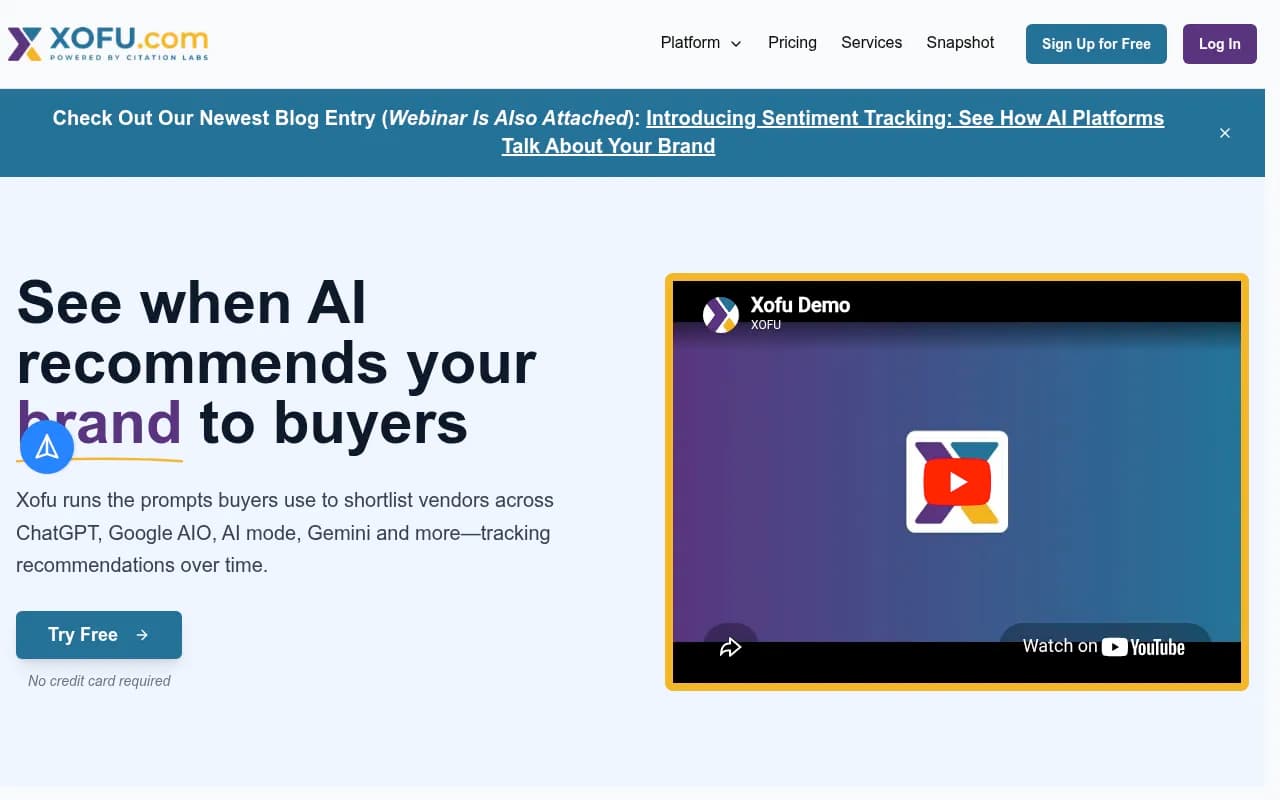
Xofu is an AI search visibility tracker built around a specific and defensible idea: most brands should care less about whether ChatGPT knows their name and more about whether it recommends them when buyers are actively evaluating vendors. The tool runs what it calls "buyer prompts" -- queries like "best CRM for mid-market sales teams" or "top project management tools for agencies" -- across ChatGPT, Google AI Overviews, Google AI Mode, Gemini, and Perplexity, then tracks how often your brand appears versus competitors over time.
The target audience is B2B marketers, SEO professionals, and demand generation teams at companies where pipeline visibility matters more than brand awareness metrics. If you're selling software, professional services, or any category where buyers research options before contacting sales, Xofu's framing makes sense. It's not trying to tell you whether AI "knows" your brand -- it's trying to tell you whether AI recommends your brand at the moment a buyer is making a shortlist.
Xofu is connected to Citation Labs, a well-known link-building and content strategy agency. That relationship is relevant because Xofu explicitly positions its reporting as the input to a Citation Labs engagement -- you find the gaps in Xofu, then pay Citation Labs to help you fix them. It's an interesting model, though it also means the platform itself doesn't close the loop on optimization.
Key features
Bottom-of-funnel prompt tracking
This is Xofu's core differentiator. Rather than running generic brand queries ("What is [Brand]?"), Xofu tracks the prompts buyers actually use during vendor evaluation. You set up a project around a product category or use case, define the prompts that matter to your pipeline, and Xofu runs them on a scheduled basis across supported AI platforms. The results show whether your brand appears in the AI's response, what position it holds, and which sources the AI cited.
In practice, this means you're tracking queries like "best email marketing platform for ecommerce" rather than "tell me about Klaviyo." That distinction matters because the former is where purchase decisions actually happen.
Competitive benchmarking
Xofu lets you define a set of competitors and compare visibility across the same prompt set. You can see share of voice -- how often each brand appears across all tracked prompts -- and drill into individual prompts to see who shows up and who doesn't. The trend view lets you track whether your share is growing or shrinking after content changes.
This is genuinely useful for executive reporting. Instead of screenshots of one-off ChatGPT sessions, you get a consistent, repeatable measurement of competitive position.
Citation gap analysis
When a competitor appears in an AI response and you don't, Xofu shows you which sources the AI cited in that response. This tells you which pages, domains, or publications are influencing AI recommendations in your category. The idea is that you can then prioritize those sources for content placement or link-building outreach.
It's a solid feature in concept. The limitation is that Xofu stops at showing you the gap -- it doesn't help you create content to fill it or tell you which gaps are highest priority based on prompt volume or difficulty.
Multi-platform monitoring
Xofu runs the same prompts across ChatGPT, Google AI Overviews, Google AI Mode, and Gemini. This matters because AI platforms don't all recommend the same brands for the same queries -- a brand that dominates in ChatGPT might be invisible in Google's AI Mode. Tracking across platforms helps you avoid optimizing for one assistant at the expense of others.
The platform coverage is reasonable but not exhaustive. Promptwatch, for comparison, monitors 10+ AI models including Claude, Perplexity, DeepSeek, Grok, Mistral, Meta AI, and Copilot alongside the ones Xofu covers.
Visibility score and share of voice trending
Xofu produces a visibility score that aggregates your appearance rate across tracked prompts, and a share of voice metric that shows your slice relative to competitors. Both trend over time, so you can see whether changes to your content or link profile are moving the needle.
This is the kind of output that works for exec updates and quarterly reviews -- a number that goes up or down, with enough context to explain why.
Sentiment tracking (new)
Xofu recently added sentiment tracking, which monitors not just whether AI mentions your brand but how it talks about you. This is a meaningful addition -- an AI that mentions your brand while calling it "expensive" or "difficult to implement" is worse than not being mentioned at all. The feature is new enough that it's hard to evaluate depth, but the direction is right.
Free BOFU snapshot
No signup required. You enter your brand, a few competitors, and a category, and Xofu runs a quick visibility check showing how you stack up in buyer prompts. It's a smart acquisition tool and a genuinely useful way to get a first read on your AI visibility before committing to a paid plan.
Citation Labs services integration
For brands that want help acting on Xofu's data, Citation Labs offers a structured pilot: they rerun your prompt set, map competitor citations, build an on-page and off-page roadmap, help ship changes, and package results for internal reporting. This is the "fix it" layer that Xofu itself doesn't provide natively. It's a real service from a credible agency, but it's a separate engagement with separate pricing -- not something built into the platform.
Who is it for
Xofu fits best for B2B marketing and SEO teams at companies where AI search is starting to show up in pipeline conversations. Think a 20-50 person SaaS company whose sales team is hearing "ChatGPT recommended your competitor" on discovery calls, or an SEO agency that wants to add AI visibility reporting to client deliverables without building the infrastructure themselves.
The BOFU framing is particularly well-suited to companies with defined buyer personas and clear purchase-intent queries. If you can articulate the specific prompts your buyers use to evaluate vendors in your category, Xofu's setup process is straightforward. If your category is broad or your buyers don't use AI for vendor research yet, the value is less immediate.
Agencies managing multiple client accounts will find the project-based structure workable, though the platform doesn't appear to have deep multi-client management features or white-label reporting. The Citation Labs services connection could be valuable for agencies that want to offer AI visibility as a managed service.
Who should probably look elsewhere: brands that need to act on the data themselves without agency support, teams that want content generation built into the same workflow, or companies that need coverage of AI models beyond the core four (ChatGPT, Gemini, Google AIO, Perplexity). Enterprise teams that need AI traffic attribution, crawler log analysis, or Reddit/YouTube citation tracking will also find Xofu's feature set too narrow.
Integrations and ecosystem
Xofu's integration story is thin based on available information. There's no mention of a public API, Zapier integration, Google Search Console connection, or Looker Studio export. The platform appears to be a standalone web application with its own reporting interface.
The most significant "integration" is the Citation Labs services layer -- but that's a human services engagement, not a technical integration. For teams that need to pipe AI visibility data into existing reporting stacks or BI tools, Xofu doesn't appear to offer that path.
There's no mention of a browser extension or mobile app. The free BOFU snapshot tool at xofu.com/bofu is the closest thing to a lightweight entry point outside the main platform.
Pricing and value
Xofu's specific pricing tiers aren't publicly listed on the main website -- the knowledge base references a "Subscription Tiers Overview" and a "Flexible Pricing Plan for Projects," suggesting project-based pricing rather than flat monthly tiers. The free BOFU snapshot requires no signup, and there's a free trial available for the full platform.
Without published pricing, it's hard to make a direct comparison. The project-based model suggests costs scale with the number of brands or prompt sets you're tracking, which could work well for agencies billing per client but may be harder to predict for in-house teams.
For context, Promptwatch's published pricing starts at $99/month for a single site with 50 prompts, scaling to $249/month for the Professional tier (2 sites, 150 prompts, crawler logs, AI traffic attribution) and $579/month for Business (5 sites, 350 prompts, 30 AI-generated articles per month). Xofu's value proposition would need to be assessed against whatever its actual pricing is -- the lack of transparency here is a minor friction point for buyers doing due diligence.
Strengths and limitations
What Xofu does well:
- The BOFU framing is genuinely differentiated. Tracking purchase-intent prompts rather than brand awareness queries is a smarter approach for B2B companies, and it's a clear positioning choice that most competitors haven't made as explicitly.
- The free snapshot tool at xofu.com/bofu is a low-friction way to get real data without a sales conversation. It's one of the better free entry points in this category.
- Citation gap analysis -- showing which sources AI cites when competitors appear and you don't -- gives you a concrete starting point for content and link-building strategy.
- The Citation Labs connection means there's a credible services path for brands that need hands-on help, not just a dashboard.
- Sentiment tracking is a meaningful new addition that goes beyond binary mention/no-mention tracking.
Honest limitations:
- Xofu is a monitoring-only platform. It shows you the problem but doesn't help you solve it. There's no content generation, no AI writing agent, no on-page optimization tools, and no built-in workflow for turning citation gaps into published content. Promptwatch's built-in AI writing agent generates articles grounded in citation data and prompt analysis -- that's a fundamentally different capability that Xofu doesn't have.
- No AI crawler logs. Knowing which pages AI crawlers are visiting (and which they're ignoring or hitting errors on) is increasingly important for AI SEO. Xofu doesn't offer this. Promptwatch does.
- No traffic attribution. You can't connect AI visibility to actual website traffic or revenue without a separate analytics setup. Promptwatch offers traffic attribution via a code snippet, GSC integration, or server log analysis.
- No Reddit or YouTube tracking. A significant portion of AI citations come from Reddit threads and YouTube content. Xofu doesn't surface these. Promptwatch does.
- No prompt volume or difficulty scoring. Xofu doesn't tell you which prompts are worth prioritizing based on how many buyers use them or how competitive they are. You're left to guess at prompt importance.
- No ChatGPT Shopping tracking, no query fan-outs, no multi-language/multi-region support mentioned.
- Platform coverage is limited to four AI models versus Promptwatch's 10+.
Bottom line
Xofu is a focused, well-positioned tool for B2B teams that want to track AI visibility at the bottom of the funnel. The BOFU framing is smart, the free snapshot is useful, and the Citation Labs services layer gives you somewhere to go when the data reveals problems. If you want a clean monitoring dashboard and you're comfortable engaging an agency to act on the findings, Xofu is worth evaluating.
That said, it's a monitoring tool in a category that's moving toward optimization platforms. Teams that need to close the loop -- find gaps, generate content, track results -- will find Xofu's feature set incomplete. Promptwatch covers more AI models, includes AI content generation, crawler logs, traffic attribution, Reddit/YouTube tracking, and prompt intelligence in a single platform. For teams that want to actually improve their AI visibility rather than just measure it, that's a meaningful difference.
Best use case: B2B marketing teams that want structured, repeatable tracking of buyer-intent AI prompts and are willing to use a separate agency or content team to act on the findings.
Frequently asked questions
What is Xofu?
How is Xofu different from other AI visibility tools?
Is there a free version of Xofu?
How much does Xofu cost?
Which AI platforms does Xofu monitor?
Can Xofu help me improve my AI visibility, or just track it?
Similar and alternative tools to Xofu