Summary
- ChatGPT Shopping and product carousels represent a fundamental shift in how consumers discover and purchase products -- tracking these channels is now as critical as monitoring Google rankings
- Most AI visibility platforms focus on brand mentions and citations, but only a handful track actual product recommendations and shopping carousels across ChatGPT, Perplexity, and other AI engines
- Promptwatch leads the category with dedicated ChatGPT Shopping tracking, Reddit product discussion monitoring, and page-level attribution that connects AI visibility to actual revenue
- The best platforms combine shopping carousel tracking with content gap analysis and optimization tools -- monitoring alone isn't enough in 2026
- Pricing ranges from $29/month for basic monitoring to $579/month for comprehensive shopping tracking, content generation, and multi-site management
Why ChatGPT Shopping tracking matters in 2026
When someone asks ChatGPT "best running shoes for flat feet" or "affordable noise-canceling headphones," the response includes product recommendations and shopping carousels. These aren't traditional search results. They're curated suggestions that blend editorial content with direct purchase pathways. If your products don't appear in these carousels, you're invisible to a growing segment of purchase-intent traffic.
The numbers tell the story. Gartner research projects search engine volume will drop 25 percent by 2026 as users shift to AI chatbots for product discovery. Over 60% of searches now end without a click -- the answer appears directly in the AI response. For e-commerce brands, this means the old playbook of ranking #1 on Google no longer guarantees visibility. You need to be cited, recommended, and featured inside the AI responses themselves.
ChatGPT Shopping specifically launched product carousels that surface items based on conversational queries. Unlike Google Shopping ads (which you can buy), these recommendations are algorithmically determined based on what content and sources ChatGPT trusts. You can't bid your way in. You have to earn it through content, citations, and authority signals the AI models recognize.
Most traditional SEO tools weren't built for this. They track keyword rankings on Google but have no visibility into what ChatGPT, Perplexity, Claude, or Gemini recommend when users ask product questions. The platforms covered in this guide fill that gap.
What makes a good ChatGPT Shopping tracking platform
Not all AI visibility tools are created equal when it comes to product tracking. Here's what separates monitoring-only dashboards from actual optimization platforms:
Shopping carousel detection: The platform must specifically identify when your products appear in ChatGPT's shopping carousels, not just generic brand mentions. This requires dedicated tracking of product-specific prompts and purchase-intent queries.
Multi-engine coverage: ChatGPT isn't the only game. Perplexity, Google AI Overviews, Gemini, and Claude all influence product discovery. The best platforms track all of them.
Reddit and community tracking: AI models heavily cite Reddit discussions when answering product questions. Platforms that surface which Reddit threads influence AI recommendations give you a massive advantage.
Content gap analysis: Seeing where you're invisible is only useful if the platform tells you what content to create. The best tools show exactly which product questions competitors are visible for but you're not.
Page-level attribution: You need to know which specific product pages are being cited and how often. Vague brand-level metrics don't help you optimize.
Traffic and revenue connection: The ultimate question is whether AI visibility drives actual sales. Platforms that connect citations to traffic and conversions close the loop.
With those criteria in mind, here's how the leading platforms stack up.
The platforms with ChatGPT Shopping tracking
Promptwatch: The action-oriented leader
Promptwatch is the only platform rated as a "Leader" across all categories in a 2026 comparison of 12 GEO platforms. What sets it apart is the focus on action, not just monitoring.

Most competitors show you where you're invisible and leave you stuck. Promptwatch shows you the gap, then helps you fix it. The Answer Gap Analysis feature identifies exactly which product prompts competitors are visible for but you're not. You see the specific content your website is missing -- the topics, angles, and product questions AI models want answers to but can't find on your site.
The built-in AI writing agent generates product comparisons, listicles, and buying guides grounded in real citation data (880M+ citations analyzed), prompt volumes, and competitor analysis. This isn't generic SEO filler. It's content engineered to get cited by ChatGPT, Perplexity, and other AI models.
ChatGPT Shopping tracking: Promptwatch monitors when your brand appears in ChatGPT's product recommendations and shopping carousels. You see exactly which product queries trigger your listings and how your visibility compares to competitors.
Reddit product discussion tracking: The platform surfaces Reddit threads that directly influence AI product recommendations. You can see which community discussions are shaping what ChatGPT suggests when users ask product questions. Most competitors ignore Reddit entirely.
AI crawler logs: Real-time logs show when ChatGPT, Claude, Perplexity, and other AI crawlers hit your product pages. You see which pages they read, errors they encounter, and how often they return. This helps you fix indexing issues that prevent your products from being cited.
Page-level tracking and attribution: Promptwatch tracks which specific product pages are being cited, how often, and by which AI models. You can connect visibility to actual traffic with code snippet integration, Google Search Console data, or server log analysis. This closes the loop between AI citations and revenue.
Prompt intelligence: Volume estimates and difficulty scores for each product prompt help you prioritize high-value, winnable queries instead of guessing.
Multi-language and multi-region: Monitor AI responses in any language, from any country, with customizable personas that match how your actual customers prompt.
Promptwatch monitors 10 AI models: ChatGPT, Perplexity, Google AI Overviews, Google AI Mode, Claude, Gemini, Meta/Llama, DeepSeek, Grok, Mistral, and Copilot.
Pricing: Essential $99/month (1 site, 50 prompts, 5 articles), Professional $249/month (2 sites, 150 prompts, 15 articles, crawler logs, state/city tracking), Business $579/month (5 sites, 350 prompts, 30 articles). Free trial available.
Best for: E-commerce brands, marketing teams, and agencies that want to track ChatGPT Shopping visibility and actually improve it with content optimization and gap analysis.
SE Visible (SE Ranking): User-friendly brand tracking
SE Visible is SE Ranking's dedicated AI visibility toolkit. It's designed for marketing leaders and brand specialists who want a clear picture of how their brand appears across AI engines without a steep learning curve.
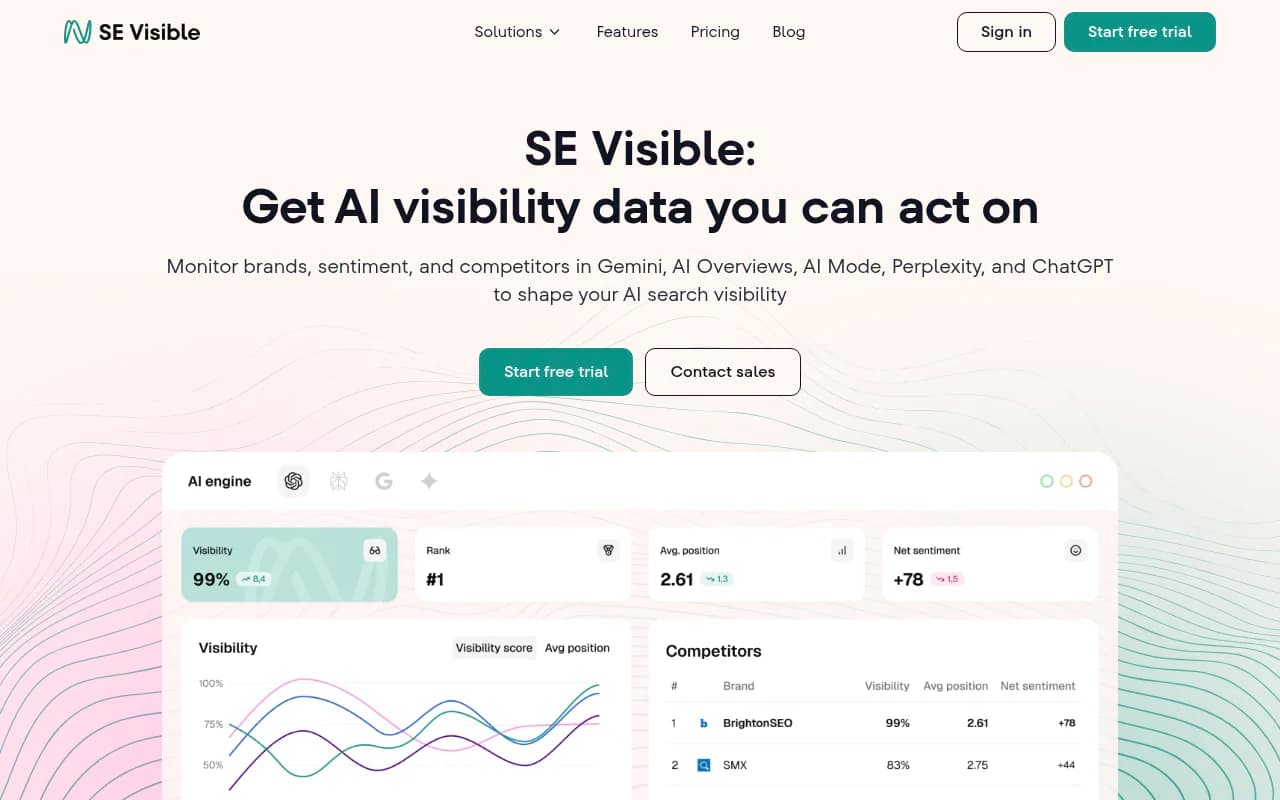
The platform tracks brand mentions, sentiment, and visibility scores across ChatGPT, Perplexity, Gemini, and other AI models. The Net Sentiment Score aggregates how positively or negatively your brand is portrayed in AI responses. For product-focused brands, this matters -- if AI models cite negative reviews or complaints when users ask about your products, you need to know.
ChatGPT Shopping tracking: SE Visible monitors product recommendations and shopping-related prompts, though it's not as granular as Promptwatch's dedicated carousel tracking. You can see if your brand appears in product-related AI responses and compare against competitors.
Competitor benchmarking: The platform shows how your AI visibility stacks up against competitors across different prompt categories, including product and shopping queries.
Sentiment trends: Track how AI models' tone and framing of your brand changes over time. This is useful for reputation management when negative content starts influencing AI recommendations.
Pricing: $189/month. CSV data export only (no API or Looker Studio integration).
Best for: CMOs, marketing leaders, and brand specialists who want straightforward AI visibility tracking without technical complexity.
Otterly.AI: Affordable multi-engine monitoring
Otterly.AI is one of the most affordable entry points for AI visibility tracking. It monitors brand mentions across ChatGPT, Perplexity, Gemini, and other engines, with a focus on the Brand Visibility Index and sentiment analysis.

The platform is monitoring-focused. You see where your brand appears, how often, and in what context. It doesn't offer content gap analysis or optimization tools, but for teams that just need to track product mentions and shopping-related prompts without a large budget, it's a solid choice.
ChatGPT Shopping tracking: Otterly tracks product-related prompts and can identify when your brand appears in shopping recommendations. The tracking is less detailed than platforms like Promptwatch, but it covers the basics.
GEO audit: The platform provides a generative engine optimization audit that highlights areas where your brand is underrepresented in AI responses, including product queries.
Pricing: $29/month. Lower-tier plans have prompt limits.
Best for: Agencies managing multiple brands on a budget, or small teams that need basic AI visibility monitoring without optimization features.
Profound AI: Enterprise narrative control
Profound AI is built for large brands and enterprise agencies that want to control the narrative around their products in AI responses. The platform tracks visibility scores, conversation volume, and trends across AI engines.

ChatGPT Shopping tracking: Profound monitors product recommendations and shopping carousels, with a focus on how your brand is positioned relative to competitors in purchase-intent queries.
Conversation volume tracking: See how often your products are mentioned in AI responses and how that volume changes over time. This helps you understand if your content strategy is gaining traction.
Pricing: $99/month. Advanced features (including deeper shopping tracking) are locked to higher-tier plans.
Best for: Large brands and enterprise agencies that need robust AI visibility tracking and are willing to pay for advanced features.
ZipTie: Actionable AI optimization
ZipTie focuses on turning AI visibility data into clear actions. The platform provides an AI success score, citation optimization recommendations, and competitor analysis.
ChatGPT Shopping tracking: ZipTie tracks product-related prompts and identifies citation gaps where competitors are being recommended but you're not. The platform then suggests specific content optimizations to close those gaps.
Citation optimization: ZipTie analyzes which pages AI models cite and provides recommendations to improve your citation rate for product queries.
Pricing: $69/month. Credit-based billing with report delays.
Best for: Marketing leaders who want clear, actionable recommendations for improving AI visibility, not just monitoring dashboards.
Xofu: Bottom-of-funnel AI visibility
Xofu specializes in high-intent, purchase-stage prompts. The platform tracks AI citations for bottom-of-funnel queries where users are ready to buy.
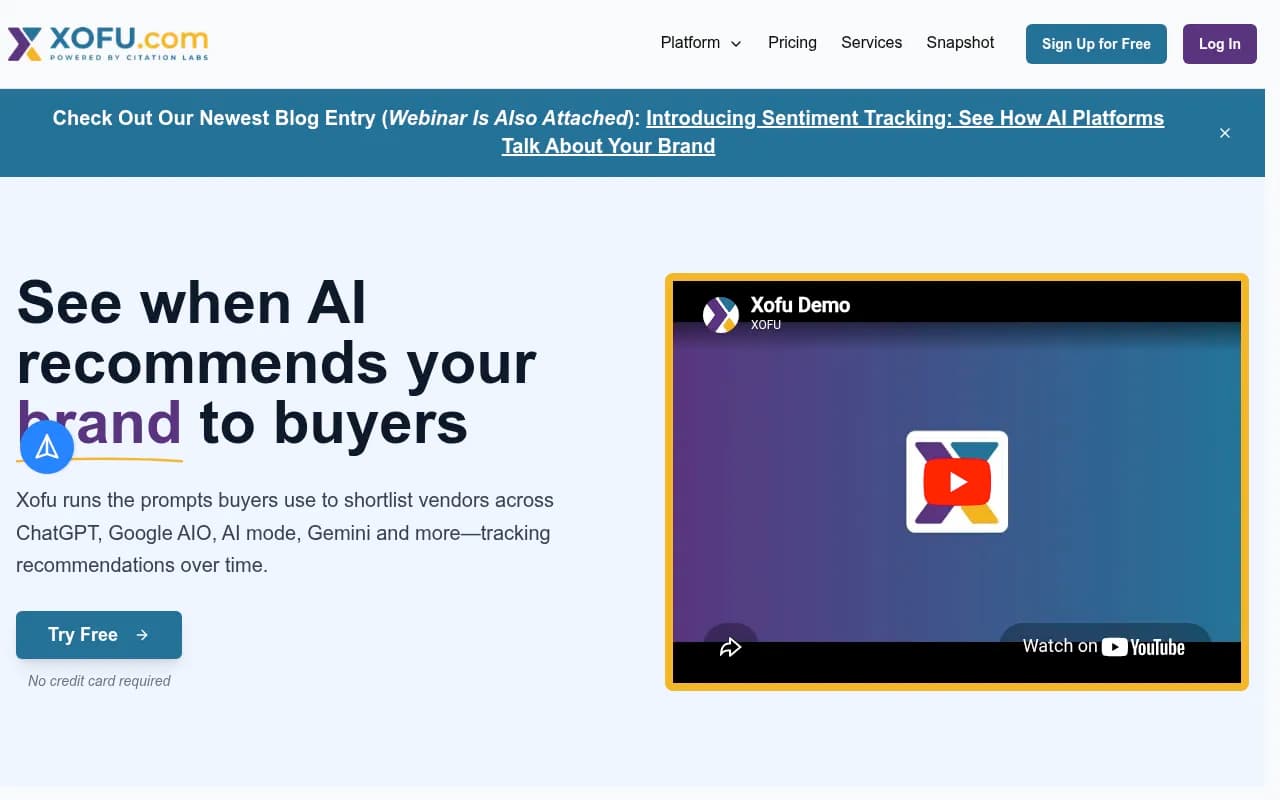
ChatGPT Shopping tracking: Xofu focuses specifically on purchase-intent prompts and shopping recommendations. If your goal is to appear in AI responses when users are ready to buy, this is the platform to watch.
Competitive benchmarks: See which competitors are being recommended for high-intent product queries and what content they're using to earn those citations.
Pricing: Free tier available, $99/month for full features. Steep learning curve and niche content focus.
Best for: Teams focused on bottom-of-funnel AI visibility and purchase-stage recommendations.
Platforms with partial or indirect shopping tracking
Several other AI visibility platforms don't have dedicated ChatGPT Shopping tracking but can still provide value for product-focused brands:
Nightwatch: Hybrid SEO and AI tracking platform with generative rankings and AI visibility scores. AI tracking is a paid add-on ($39/month + $99 AI add-on). Tracks brand mentions and citations but not specifically shopping carousels.
Morningscore: Beginner-friendly AI tracking with brand mentions, screenshots, and weekly updates. Weekly updates only, shallow analysis. No dedicated shopping tracking. $49/month.
Rankability: Agency-focused AI visibility analytics. Tracks brand mentions and citations but not specifically product recommendations or shopping carousels. Strong competitor analysis features.
AthenaHQ: Tracks brand visibility across 8+ AI search engines. Monitoring-focused, lacks content optimization and generation capabilities. No dedicated shopping carousel tracking.

Searchable: AI search visibility platform with monitoring and content tools. Tracks brand mentions but not specifically shopping carousels. Includes content optimization features.
Comparison table: ChatGPT Shopping tracking features
| Platform | ChatGPT Shopping Tracking | Reddit Tracking | Content Gap Analysis | AI Writing Agent | Page-Level Attribution | Pricing |
|---|---|---|---|---|---|---|
| Promptwatch | Yes (dedicated) | Yes | Yes | Yes | Yes | $99-579/mo |
| SE Visible | Yes (basic) | No | No | No | No | $189/mo |
| Otterly.AI | Yes (basic) | No | No | No | No | $29/mo |
| Profound | Yes (basic) | No | No | No | No | $99/mo |
| ZipTie | Yes (via citations) | No | Yes | No | No | $69/mo |
| Xofu | Yes (purchase-intent) | No | No | No | No | Free/$99/mo |
| Nightwatch | No | No | No | No | No | $39+99/mo |
| Morningscore | No | No | No | No | No | $49/mo |
How to choose the right platform
Your choice depends on what you need to accomplish:
If you want to track ChatGPT Shopping visibility AND improve it: Promptwatch is the clear choice. It's the only platform that combines shopping carousel tracking with content gap analysis, AI content generation, and page-level attribution. You see where you're invisible, get specific recommendations on what content to create, and track the results.
If you just need basic monitoring on a budget: Otterly.AI at $29/month gives you brand mention tracking across AI engines, including basic shopping-related prompts. It won't help you optimize, but it'll show you where you stand.
If you're a marketing leader who wants user-friendly tracking: SE Visible offers a clean interface and sentiment analysis at $189/month. It's less technical than Promptwatch but covers the basics for brand and product tracking.
If you're focused on bottom-of-funnel product recommendations: Xofu specializes in high-intent, purchase-stage prompts. It's niche, but if your goal is to appear when users are ready to buy, it's worth exploring.
If you're an agency managing multiple brands: Otterly.AI's affordable pricing makes it viable for multi-client tracking. For deeper optimization, Promptwatch's Business plan ($579/month) supports 5 sites with full content generation and gap analysis.
The action loop: Monitoring isn't enough
The biggest mistake brands make is treating AI visibility like traditional SEO -- track your rankings, maybe tweak some meta tags, and hope for the best. That doesn't work in AI search.
AI models cite sources based on content quality, authority signals, and how well your pages answer specific questions. If your content doesn't exist or doesn't match what AI models are looking for, you'll never be cited. Monitoring alone won't fix that.
The platforms that matter in 2026 help you close the loop:
- Find the gaps: See exactly which product prompts competitors are visible for but you're not. Understand what content your website is missing.
- Create content that ranks in AI: Generate articles, product comparisons, and buying guides grounded in real citation data and prompt volumes. This isn't generic SEO filler -- it's content engineered to get cited.
- Track the results: See your visibility scores improve as AI models start citing your new content. Connect citations to actual traffic and revenue.
Promptwatch is the only platform built around this cycle. Most competitors stop at step one.
Reddit's hidden influence on ChatGPT Shopping
One insight most brands miss: Reddit discussions heavily influence what ChatGPT recommends for product queries. When users ask "best budget laptops" or "most reliable dishwashers," ChatGPT often cites Reddit threads where real users share experiences and recommendations.
If your products are being discussed positively on Reddit, that signals authority to AI models. If competitors are dominating those discussions, they'll get the citations.
Promptwatch is one of the few platforms that surfaces which Reddit threads influence AI product recommendations. You can see the exact discussions shaping what ChatGPT suggests and identify opportunities to participate or create content that addresses the same questions.
Most competitors ignore Reddit entirely. That's a blind spot you can exploit.
The future of product discovery is conversational
ChatGPT Shopping isn't a novelty feature. It's the beginning of a fundamental shift in how consumers discover and purchase products. Traditional search results -- a list of blue links -- are being replaced by curated, conversational recommendations that blend editorial content with direct purchase pathways.
Brands that adapt early will dominate this channel. Those that wait will find themselves invisible to a growing segment of high-intent traffic.
The platforms covered in this guide give you the visibility and optimization tools to compete. The question is whether you'll use them before your competitors do.
Getting started
If you're new to AI visibility tracking, start with a free trial of Promptwatch or a low-cost plan from Otterly.AI. Set up tracking for your top product categories and a handful of high-value prompts. Run the tracking for 30 days and see where you stand.
You'll likely find gaps -- prompts where competitors are being cited but you're not. That's your roadmap. Use the content gap analysis to identify what's missing, create the content, and track the results.
The brands winning in AI search aren't guessing. They're using data to find gaps, create content that fills them, and tracking the results. That's the action loop. That's how you win in 2026.