Morningscore Review 2026
Turns SEO and GEO work into mission-based tasks, useful for lean marketing teams tracking AI visibility alongside SEO.
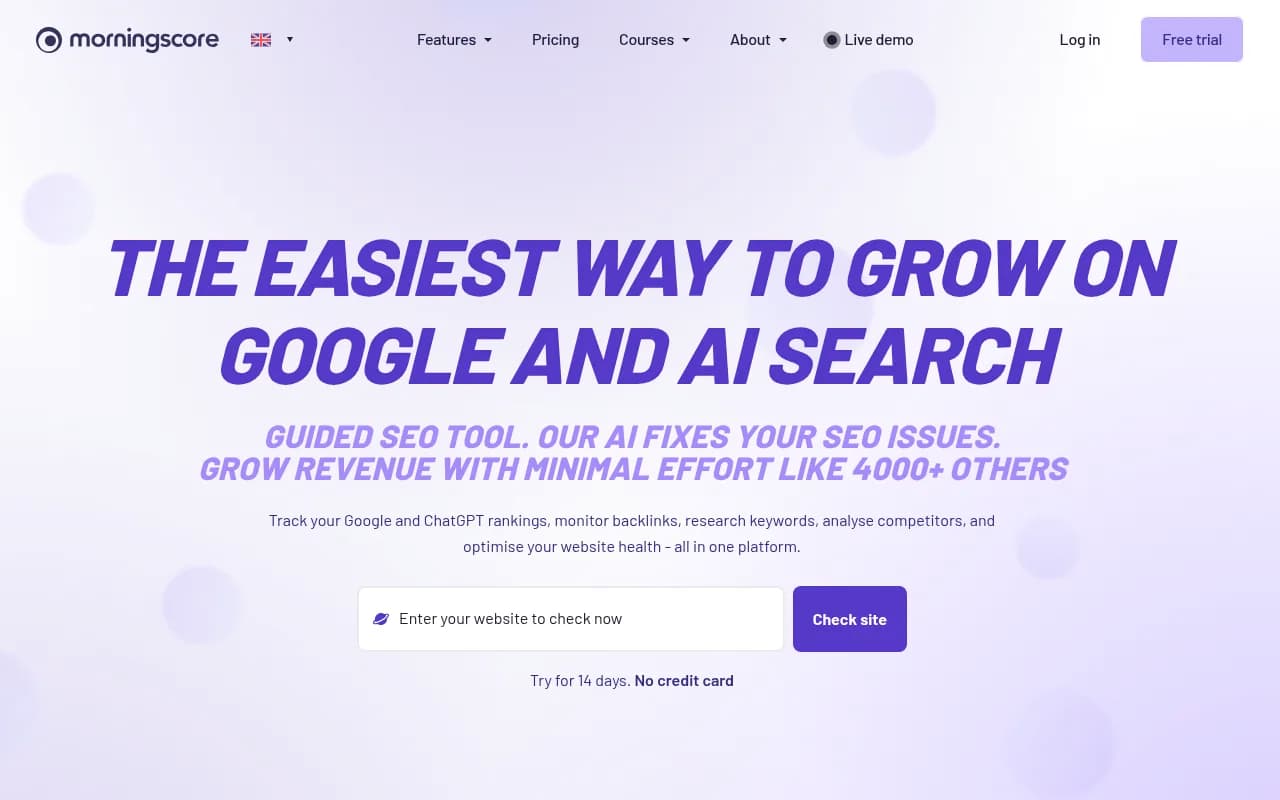
Key takeaways
- Morningscore is one of the most beginner-friendly SEO platforms I've tested, wrapping rank tracking, site audits, backlink monitoring, and basic AI visibility into a genuinely fun, mission-based interface
- Its GEO coverage is thin compared to dedicated platforms: it only tracks Google and ChatGPT, with no Perplexity, Claude, Gemini, or Grok monitoring, and no AI crawler logs, traffic attribution, or Reddit/YouTube citation tracking like Promptwatch offers
- Pricing is transparent and generous for what you get ($69–$299/mo, every plan includes the full feature set), but the keyword and backlink databases lag well behind Ahrefs and Semrush
- Best suited for small-to-mid-sized businesses and lean marketing teams who want guided SEO without hiring an agency; agencies doing deep link prospecting will hit a ceiling
- 14-day free trial, no credit card, and human chat support that actually answers — rare in this category
What Morningscore actually is
Morningscore, built by a team in Odense, Denmark (founded 2018), tries to solve a real problem: most SEO tools are built for people who already understand SEO. Morningscore is built for everyone else. The whole product is organized around "Missions" — a prioritized to-do list of SEO tasks, each with an estimated traffic value and XP rewards when you complete them. It sounds gimmicky. It mostly isn't. For a small business owner with one hour a week, having the tool say "do this first, it's worth roughly this much traffic" is genuinely useful.
The company claims $1M ARR as of 2025 and 4,000+ business customers, which for a bootstrapped-feeling Danish SaaS is respectable. Ratings back it up: 4.8/5 on Capterra (43 reviews) and 4.5/5 on G2, with ease-of-use scores near the ceiling.
The core SEO toolkit
The rank tracker updates daily and organizes keywords into folders, with an instant scan button if you're impatient. Keyword research pulls from a global database covering 167 countries, sourced from seven data partners fetched on-demand. That on-demand approach means fresher results but slower initial loads — a fair trade, though the database itself is smaller than Ahrefs or Semrush. If you're doing deep competitive keyword mining for enterprise clients, you'll notice the difference.
The health tool scores your site 0–100 and prioritizes issues based on Google's guidelines, then offers one-click automatic fixes either in-app, via the WordPress or Shopify plugins, or through the API. The Link Score gives you a daily view of gained and lost backlinks. It works. But the backlink index is the most common complaint I found from agencies — smaller and less fresh than the big players, which matters if link prospecting is a core workflow.
The standout detail: Morningscore expresses your SEO value in actual money. Your dashboard shows what your organic traffic is worth in dollars, not abstract points. For reporting to a non-technical boss, this alone justifies the subscription for some users.
The GEO and AI visibility side
This is where Morningscore has expanded recently, and where I have mixed feelings. The GEO Score tracks your AI visibility across 100 prompts, covering whether your brand appears directly in ChatGPT answers or as a source in Google AI Overviews. You can add custom prompts or pick from their suggestions, and track progress over time against competitors.
It's a reasonable starting point, and I appreciate that it's built into every plan rather than sold as an add-on. But it's a monitoring layer, not an optimization platform. You see a score; you don't see why the score moved. There are no AI crawler logs showing when ChatGPTBot or ClaudeBot visited your pages or what errors they hit. There's no attribution of actual AI-driven visitors and conversions to your site. And the model coverage stops at Google and ChatGPT — an explicit product decision to "simplify and focus," which is defensible for their core audience but leaves you blind on Perplexity, Claude, Gemini, and Grok.
That blindness matters more than it used to. AI citation patterns are volatile: Promptwatch's data shows Reddit's share of ChatGPT Search citations dropped from 6.11% in May 2026 to 3.71% in June 2026, and even the top-cited domain holds under 4% of a highly fragmented citation pool. Visibility on one AI engine tells you very little about visibility on the others. A platform like Promptwatch covers 10+ models, adds prompt volumes and difficulty scoring, tracks Reddit and YouTube citations specifically, and — the part I'd weight most heavily — closes the loop with content gap analysis and automated GEO content generation rather than stopping at the score.

Pricing
Four tiers, all with the identical feature set (limits scale, features don't gate):
- Lite: $69/mo — 2 users, 3 websites, 100 keywords, 10 tracked prompts
- Business: $99/mo — 4 users, 10 websites, 500 keywords, 100 tracked prompts
- Pro: $159/mo — 10 users, 30 websites, 2,000 keywords, 500 tracked prompts
- Premium: $299/mo — 20 users, 100 websites, 5,000 keywords, 2,000 tracked prompts
Annual billing gives two months free. There's also the "Journey" bundle at $1,590/year, which packages the tool with 12 months of 1:1 human guidance — essentially fractional SEO consulting at a fraction of agency rates. For a small business with no in-house SEO knowledge, Journey is arguably the most interesting thing Morningscore sells.
Strengths and limitations
Strengths: the onboarding and daily usability are best-in-class for beginners; missions with ROI estimates turn SEO from intimidating to manageable; monetary valuation of traffic makes reporting easy; every plan includes the full toolkit plus API access; the new MCP server (beta since May 2026) works with Claude, Cursor, and Lovable, which is a forward-looking move; support is human and responsive during CET business hours.
Limitations: backlink and keyword databases trail Ahrefs/Semrush noticeably; reporting customization is limited, a pain for agencies that white-label; data coverage skews toward Europe and North America; only Google and ChatGPT are tracked; no AI crawler logs, no AI traffic attribution, no Reddit/YouTube citation insights, no ChatGPT Shopping tracking, and no content gap analysis grounded in actual AI responses — all things Promptwatch provides. One Capterra reviewer also flagged keyword tracking accuracy issues, worth testing during your trial.
Who should use it
A marketing manager at a 20-person e-commerce company who needs SEO to "just happen" with an hour a week. A founder comparing quotes from SEO agencies and realizing $99/mo plus Journey guidance costs a tenth of a retainer. An in-house generalist marketer who finds Ahrefs overwhelming. These people will love Morningscore.
Skip it if you're an agency doing large-scale link prospecting, enterprise competitive analysis, or serious GEO work across multiple AI engines. For the last group especially, a dedicated AI visibility platform like Promptwatch is the stronger fit — it explains why you're visible (or not), measures the actual traffic AI sends you, and generates the content to fix the gaps, rather than just scoring them.
Bottom line
Morningscore does what it promises: it makes SEO approachable, measurable in dollars, and even a little fun. As a guided SEO tool for small teams, it earns a strong recommendation. Just go in knowing the AI visibility piece is a scorecard, not a strategy — if growing AI-driven revenue is the actual goal, pair it with (or switch to) a platform built for that job.
Frequently asked questions
How much does Morningscore cost?
Which AI search engines does Morningscore track?
Is Morningscore as good as Ahrefs or Semrush?
Is Morningscore good enough for GEO and AI visibility work?
Similar and alternative tools to Morningscore