Key takeaways
- A product launch is the one moment you can set an AI visibility baseline of zero and watch it move. Start tracking before the announcement, not after.
- Promptwatch Data shows press and news coverage fades from ChatGPT citations fast (half of cited news pages gone after 36 days), while landing pages, docs, and comparison pages stay cited much longer.
- New brands have the most room in organic prompts, where answers cite many domains. Branded prompts lean on a short source list that your own site and review sites control.
- Tool choice depends on what you need: a cheap tracker to get a baseline, a platform that also shows crawler access and AI traffic, or something that writes the content too.
- Run a three-phase plan: baseline before launch, citation seeding in the first two weeks, then refresh and measurement through day 90.
Why launches are different in AI search
When you launch a product, traditional SEO gives you a slow ramp. New pages get indexed, links trickle in, rankings move over months. AI search is odd because the answer to "what's the best tool for X" is assembled on the fly from many sources, and a brand-new product has no history in the model's training data at all. If ChatGPT or Perplexity knows about you in week one, it is because it searched the live web and found something.
That is both the problem and the opening. You can't rely on being remembered. You can influence what gets found.
Two patterns from Promptwatch Data shape how I'd plan a launch.
First, Promptwatch's unique domains report (Sep 28 to Oct 4, 2026) found that 47.6% of ChatGPT responses with citations cite 10 or more domains, and for organic prompts that name no brand it's 52.5%. Crowded answers mean a newcomer can be added to the list without displacing a single incumbent. For brand-specific prompts, the most common count is just 5 domains, so the handful of sources ChatGPT picks decides how you are described.
Second, the content half-life report tracked every page ChatGPT cited on July 6, 2026 for 90 days. Almost a quarter of news pages were never cited again after day 0, and half were gone after 36 days. Landing pages kept 78% of citations after 30 days and docs kept 76%. Product pages, reviews, and how-tos have a half-life of about 74 to 77 days.
The launch implication is blunt. A press push gives you roughly five weeks of citation fuel. The pages that keep paying are the boring ones you own.
What to track from day one
Before comparing tools, decide what you actually want to see. For a launch I'd track five things.
- Prompt coverage. Which category prompts ("best X for Y", "X alternatives") name you, and at what position.
- Citations. Which of your URLs get cited, and which third-party pages are carrying your name.
- Narrative. What the models say about you: pricing, features, who it's for. Early descriptions tend to harden.
- Crawler access. Whether AI bots can read your new site at all. Launch sites are often half-built, blocked by a staging robots.txt, or behind JavaScript that bots skip.
- Traffic and conversions. Whether any of this sends people.
Most trackers cover the first two. Fewer cover the last three. That gap is where the tool decision gets interesting.
Best AI search tools for product launches, compared
| Tool | Best launch use | Covers crawlers and AI traffic | Content creation | Notes |
|---|---|---|---|---|
| Promptwatch | Full loop: track, find gaps, publish, measure | Yes | Yes (Business plan) | Plans from $95/mo, 7-day trial |
| Semrush AI Visibility | Teams already in Semrush | Site audit for crawler blocks | Content workflows | $99/mo add-on per Data-Mania |
| Profound | Enterprise launches | Server-level crawl tracking | Limited | Higher price point |
| Peec AI | Cheap multi-language baseline | No | No | Monitoring focus |
| Otterly.AI | First-time AI tracking | No | No | Affordable monitoring |
| AthenaHQ | Tracking across 8+ engines | No | Limited | Monitoring-led |
| Scrunch | Brand monitoring | No | Limited | Monitoring-led |
| Rankability | Agency launch work | No | No | Agency-oriented |
I have not verified current pricing for every vendor here, so check each pricing page before committing. The pattern is what matters: most tools are good at telling you whether you were mentioned. Fewer help you do something about it.
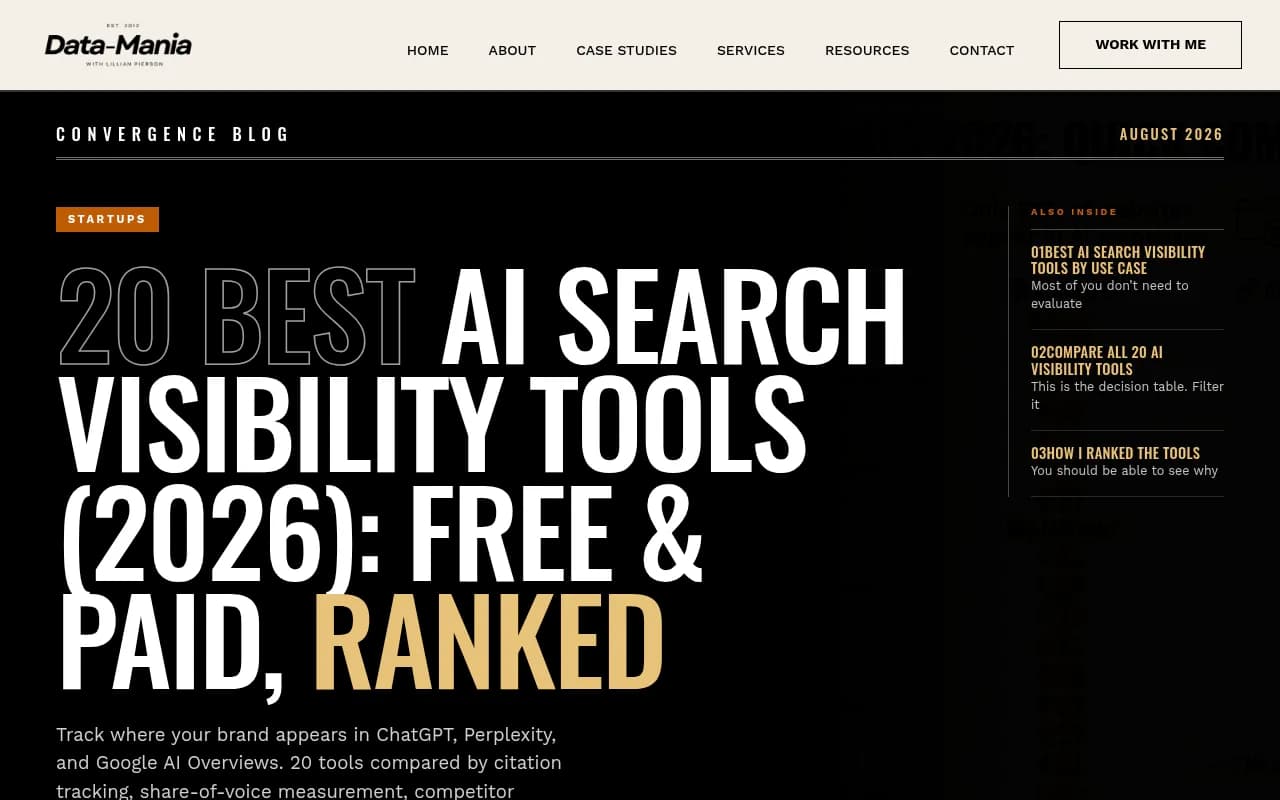
The Data-Mania roundup above is a useful second opinion if you want a broader list. It evaluates 20 platforms on engine coverage, citation tracking, prompt intelligence, optimization recommendations, reporting, and price, though by its own note it relied on vendor docs and third-party reviews rather than hands-on testing of all 20.
Promptwatch for the full launch loop
Promptwatch is the one I'd pick if the launch needs to move from "are we visible" to "what do we publish next." It tracks ChatGPT, Gemini, Claude, Perplexity, Google AI Overviews, Google AI Mode, Copilot and more from the real interfaces, in the countries and languages you choose. Beyond tracking, the Action Board lists prioritized fixes, content gap analysis maps your pages against the prompts AI answers, and on the Business plan the Content Agent writes and publishes to WordPress, Webflow, or Framer.
The launch-specific parts I'd use:
- IP-verified AI crawler logs to confirm GPTBot, OAI-SearchBot, ClaudeBot and PerplexityBot can read the new site, and see the errors if they can't.
- Page Tracker, to watch a specific launch URL and see which prompts cite it.
- Brand Narrative, to catch an early inaccurate claim (wrong pricing, missing feature) while it is still a handful of responses.
- Visitor analytics, so the question "did AI send signups" gets an answer.
Pricing starts at $95/mo for Essential (50 prompts, daily tracking) and $245/mo for Professional, with crawler logs from Professional up. Business at $579/mo adds the Content Agent and hourly tracking options. Confirm at promptwatch.com/pricing. There is a 7-day free trial on monthly billing, and a free AI visibility report if you want a quick read first.

Crisp is a useful reference point: its case study reports 2x higher conversion rates from AI traffic than traditional channels, and it scaled to 5 to 10 articles per day.
Semrush for teams already living in it
If your launch team already pays for Semrush, the AI Visibility add-on is the lowest-friction start. Data-Mania lists it at $99/month with a 7-day trial and a large prompt database, and the site audit flags blocked LLM crawlers. It is a solid choice when you want SEO data and AI tracking in one place. It is less suited to teams who want AI-specific depth like crawler-to-citation paths.
Profound for enterprise launches
Profound has built a name on going beyond simple monitoring, and Data-Mania credits it with 10+ engines, API and SSO access, and server-level tracking of how models crawl your content. It suits big launches with procurement requirements and budget to match. Smaller teams may find it more than they need.

Peec AI, Otterly.AI, and other trackers
If all you want on launch day is a baseline and a weekly chart, the lighter trackers do the job. Peec AI is strong on multi-language tracking, and Otterly.AI is a common first purchase for teams entering AI visibility.


The trade-off is that they stop at monitoring. You will see that a competitor is cited and you are not. Working out why, and fixing it, is on you.
AthenaHQ, Scrunch, and Rankability
AthenaHQ tracks across 8+ AI engines, Scrunch focuses on brand monitoring, and Rankability is built around agency reporting. Any of them can serve as your launch dashboard; pick based on whether you need client-ready reports or just a tracker.

For more options beyond this shortlist, the GEO software directory at bestgeosoftware.com lists many more.
A launch plan in three phases
Phase 1: baseline (2 to 4 weeks before launch)
Build a prompt set of 30 to 50 questions your buyers would ask. Mix three types: organic category prompts ("best project tool for design teams"), competitor comparisons ("Asana vs Monday.com"), and branded prompts you'll want to own after launch. Add personas if your product serves distinct buyer types.
Your baseline will probably be zero on the branded and category prompts. That is fine. You want the starting line on record so you can show movement later.
Also check crawler access now. Open your robots.txt and make sure you are not blocking AI bots by accident, and use a free tool like the Agentic Readiness Check or the AI crawler URL inspector to confirm bots can fetch your key pages. A staging-era disallow rule that ships to production is the classic launch mistake.
Phase 2: seed citations (launch day to day 14)
This is where the content mix matters. Promptwatch's content type data (Sep 28 to Oct 4, 2026) found product pages earn 22.4% of ChatGPT citations and landing pages 16.8%, so about 39% of citations go to pages describing what a company sells. Listicles get 13.6%, how-tos 8.7%, and comparisons 5.9%.
For commercial prompts like "best CRM for small businesses", product pages jump to 26.0%, landing pages to 20.6%, and listicles to 15.0%. Comparisons rise to 7.9%.
So the launch-day checklist is:
- A clear product page and landing page that state what the product is, who it is for, and what it costs. Pricing pages count as landing or product pages and last a long time.
- At least one comparison page against the incumbents you want to be listed alongside.
- Public, crawlable docs. In software prompts, documentation and help centers earn the largest share of citations, and GitHub, Microsoft's docs, and G2 lead.
- An FAQ page. Branded prompts cite FAQ pages 4.8% of the time.
- Review profiles on trusted sites. Reviews rise to 5.6% of citations for branded prompts, more than three times their overall share.
- Placement in "best of" roundups, which is outreach work rather than writing work.
Press is still worth doing. It just serves a different job: getting third-party pages to name you so the models have something to find in week one. Do not treat it as your durable asset.
One caution on Reddit. Promptwatch Data shows reddit.com's share of ChatGPT citations fell from roughly 4% to 0.5% on August 14, 2026, and ChatGPT got only 0.46% of its citations from social platforms in late September and early October, per the social media citations report. Google AI Overviews took 12.2% from social. Community seeding still matters for Google surfaces, but I would not build a ChatGPT launch around it.
Phase 3: measure and refresh (day 15 to day 90)
Watch four numbers weekly: visibility on your category prompts, position within the answer, which of your own URLs are cited, and what the models say about you. Low visibility is a coverage problem. Late position is a prominence problem. Mentions with no citations to your domain point to content or crawlability.
Then refresh. Product pages and how-tos decay at about the same pace, so a launch-day product page that never gets touched will slide out of citations within a few months. Update pricing, add new screenshots and use cases, and publish the next comparison or how-to based on the gaps your tracker shows. If you want help planning that sequence, the 90-day GEO program in the Promptwatch Academy is a reasonable template.
How to choose
| Your situation | Pick |
|---|---|
| Solo founder, tiny budget, want a baseline | Otterly.AI, Peec AI, or Promptwatch Essential |
| Already paying for Semrush | Semrush AI Visibility add-on |
| Need to publish content fast and measure it | Promptwatch Business with the Content Agent |
| Enterprise launch with security reviews | Profound or Promptwatch (ISO/IEC 27001 certified) |
| Agency running several client launches | Rankability or a Promptwatch agency plan |
Watch out for tools that only report a score. A score tells you the launch is not working. It does not tell you which page to write. Before paying, ask whether the tool shows crawler access, which cited pages beat yours, and whether it tracks traffic.
Common launch mistakes
- Tracking only branded prompts. On day one nobody is searching your name. Category prompts are where discovery happens.
- Judging from one prompt. Answers vary run to run; measure across many.
- Counting a mention as a win. Check position and the wording of the description, not just presence.
- Launching docs behind a login. If a bot can't read them, they can't be cited.
- Forgetting the refresh. Plan a 30-day and 60-day update to your product and comparison pages.
The cheapest launch advantage in AI search is also the least glamorous: a clear landing page, a comparison page, and public docs, all crawlable, all live before the announcement. Pick a tracker that proves it worked.