Key takeaways
- "AI search tools" means two things for a founder: answer engines you use for research (Perplexity, ChatGPT, Claude, Gemini) and visibility tools that show how those engines talk about your product.
- Solo founders need a short stack: one research engine, one visibility platform, and one way to ship content. Not twelve subscriptions.
- Promptwatch Data (Sep 28 to Oct 4, 2026) shows ChatGPT software citations favor docs, help centers, vendor pages and review sites. Reddit threads no longer reliably get you in.
- Product and landing pages make up about 39% of ChatGPT citations in the same period, so your own pages matter more than most founders assume.
- Start with a free visibility check, then pay for tracking only once you know which prompts matter to your buyers.
What founders actually mean by AI search tools
When a SaaS founder who also runs marketing types "AI search tools" into Google, two different needs get mixed together.
The first is research. You want a fast answer engine that cites sources, so you can size a market, read competitor pricing pages, or draft a positioning doc without 40 open tabs.
The second is visibility. Your buyers now ask ChatGPT, Gemini and Perplexity "best CRM for a 5-person agency" and get a shortlist. You want to know whether your product is on it, what the model says about you, and which pages it cites.
This guide covers both, because a one-person marketing team needs both. I'll keep the research section short and spend more time on visibility, since that's where most founders have no tooling at all.
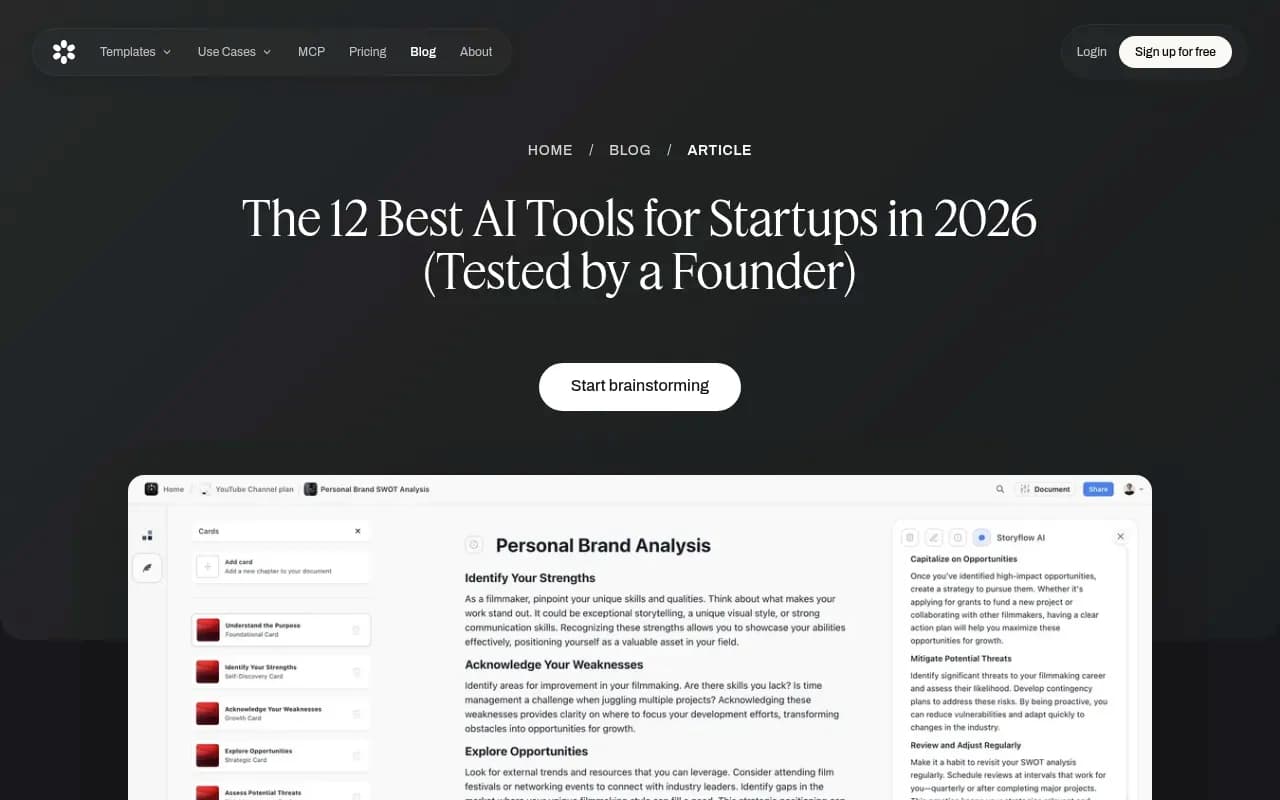
Most of the "best AI tools for startups" lists out there (the Storyflow one above ranks Claude, Cursor, Perplexity and ChatGPT near the top) are about productivity. Useful, but they don't tell you whether AI recommends you to customers. That's a different job.
Part 1: answer engines for founder research
You probably already use at least one of these. The question is which to use for what.
Perplexity
Best for sourced research. Every claim comes with a link, so you can check it fast. I use this kind of tool for competitor teardowns: "what does Competitor X charge, and what do reviewers complain about?" The sources tell you whether the answer is solid or hallucinated filler.
ChatGPT
Best for general ideation, drafting and quick analysis. Its search mode is also the engine your buyers are most likely using, so it doubles as a test environment: ask it the questions your customers would ask and read what comes back.
Claude is stronger for long-form reasoning, editing a messy positioning doc, or working through a pricing decision. Gemini is worth keeping open because Google AI Overviews and AI Mode pull from the same ecosystem.
NotebookLM is a quiet favorite for founders: drop in your customer interview transcripts, support tickets and sales call notes, then ask it what objections keep showing up. It only answers from your sources, which keeps it honest.
Quick comparison for research use
| Tool | Best founder use | Cites sources | Watch out for |
|---|---|---|---|
| Perplexity | Competitor and market research | Yes, inline | Verify numbers on the source page |
| ChatGPT | Drafting, ideation, buyer-question testing | In search mode | Answers vary by phrasing |
| Claude | Positioning, strategy, long documents | Limited | Won't replace live web research |
| Gemini | Testing what Google's AI surfaces say | Yes | Different from AI Mode results |
| NotebookLM | Analyzing your own interviews and docs | From your uploads | Only knows what you feed it |
Part 2: why visibility tools matter for SaaS specifically
SaaS is one of the categories where AI recommendations bite hardest. Buyers ask for comparisons and shortlists, and the answers cite a fairly narrow set of sources.
Promptwatch Data's ChatGPT software citation report (Sep 28 to Oct 4, 2026) found the most cited domains for organic software prompts were GitHub (1.2% of software citations), learn.microsoft.com (0.98%) and G2 (0.73%). By source type, docs and help centers earned the largest share at 2.64%, vendor sites followed at 2.01%, and review sites and analysts at 1.57%. G2, Gartner, Capterra and Software Advice together earned more than any single vendor, Microsoft included.
Translate that to a small SaaS: your docs, your help center, your G2 and Capterra profiles, and your product pages are doing most of the work. A founder who ignores those and only writes blog posts is leaving citations on the table.
The content-type data points the same way. In Promptwatch's content type report, product pages were 22.4% of ChatGPT citations and landing pages 16.8%, together about 39%. For commercial prompts like "best CRM for small businesses," product pages, landing pages, listicles and comparisons made up almost 70% of citations. For branded prompts like "is HubSpot good for startups," reviews were 5.6% of citations, more than three times their share across all prompts.
So what should you build? Clear product pages, honest comparison pages, and complete review profiles. Not a hundred top-of-funnel posts.
A word on Reddit and social
A lot of founder advice from 2025 said "get on Reddit and ChatGPT will cite you." That has aged badly. Promptwatch's data on Reddit in ChatGPT shows reddit.com's share of ChatGPT citations fell from roughly 4% to 0.5% on August 14, 2026. In the October 2026 social media report, ChatGPT drew just 0.46% of citations from social platforms, while Google AI Overviews drew 12.2% (YouTube 4.28%, Facebook 2.38%, Reddit 2.15%).
Practical read: don't build your ChatGPT plan on Reddit threads. If your buyers lean on Google, YouTube matters more. For Perplexity, LinkedIn and Reddit tie at 0.86% each, so LinkedIn posts are worth the time. X barely registers.
Part 3: AI visibility tools worth considering
There are hundreds of tools in this category now. The directory at bestgeosoftware.com is a good place to browse the full field. Here is how I'd think about the options for a founder with no marketing team.
The tiers
- Free checks: one-off scans to see where you stand. Good for a first look.
- Monitoring-only trackers: show prompts, mentions and share of voice. Useful, but they leave the fixing to you.
- End-to-end platforms: tracking plus content creation, crawler data and traffic attribution. More expensive, but they match how a solo founder actually works, since you have no one to hand the report to.
Promptwatch
Promptwatch is the one I'd shortlist first for a founder doing everything. It tracks how ChatGPT, Gemini, Claude, Perplexity, Google AI Overviews, AI Mode and Copilot mention and cite you, using the real interfaces rather than just APIs. The part that matters for a one-person team is what comes after the dashboard: an Action Board that lists what to do next, content gap analysis, and a Content Agent that writes and publishes to WordPress, Webflow or Framer.

It also shows IP-verified AI crawler logs, so you can tell whether a bot can't read your docs or whether it reads them and just doesn't cite them. Those are different fixes. And visitor analytics tie AI traffic to conversions. Crisp, a SaaS company, reported 2x higher conversion rates from AI traffic than traditional channels.
Pricing, as listed at promptwatch.com/pricing: Essential is $95/month (50 prompts, 1 project), Professional is $245/month (150 prompts, 5 AEO articles, crawler logs), and Business is $579/month (350 prompts, the automated Content Agent). Confirm on the pricing page before buying. Annual billing gives 12 months for the price of 10, and monthly plans have a 7-day free trial.
Honest take: Essential is enough to start tracking, but it has no crawler logs or article generation. If you want the agent to publish for you, you need Business. For a bootstrapped founder that's a real jump, so start small and upgrade when the data justifies it. You can run the free AI visibility report first, no login needed.
Monitoring-focused alternatives
These are worth a look if you only want to watch your numbers.

Otterly.AI is a popular affordable monitor. Good for checking mentions and citations on a budget, but it lacks crawler logs and content generation.

Peec AI is clean and multi-language, strong for tracking across markets.

Profound has deep monitoring but sits at a higher price point, which is hard to justify for a solo founder.
AthenaHQ tracks across multiple engines and is aimed at brands with some budget and a team to act on the data.
If you already pay for Ahrefs or Semrush, their AI add-ons are the lowest-friction way to get a rough read. Expect fixed prompt sets and shallower AI-specific data than a dedicated platform.
Budget and small-team options
The catalog also lists tools aimed at startups on tight budgets, including AI Peekaboo (built for SaaS companies), MaxAEO (self-serve for SMBs and startups), Atyla and Geoptie. I haven't tested these side by side, so check each one's current features and pricing before committing.
Comparison table
| Tool | Type | Fixes gaps for you | Crawler logs | Best for |
|---|---|---|---|---|
| Promptwatch | End-to-end platform | Yes (Content Agent, Action Board) | Yes (Professional and up) | Founders who need tracking and execution |
| Otterly.AI | Monitor | No | No | Cheap mention tracking |
| Peec AI | Monitor | No | No | Multi-language tracking |
| Profound | Monitor | Limited | Check current plans | Larger budgets |
| AthenaHQ | Monitor | Limited | Check current plans | Teams with an analyst |
| Ahrefs Brand Radar | SEO suite add-on | No | No | Existing Ahrefs users |
| AI Peekaboo / MaxAEO | Budget trackers | Varies | Varies | Early-stage SaaS on a tight budget |
Pricing for competitors changes often, so verify on their sites.
A founder's workflow that takes about two hours a week
Tools don't help if you never open them. Here's a loop that fits around a product roadmap.
- Pick 20 to 30 prompts your buyers would really ask. "Best [category] for [persona]", "[you] vs [competitor]", "[competitor] alternatives". Skip vanity prompts.
- Run a baseline. Note your visibility, which competitors show up, and which pages get cited. A free report or a trial is enough.
- Check your sources first. Are your docs and help center crawlable? Are your G2 and Capterra profiles complete and current? Promptwatch's software data recommends exactly this, plus a public GitHub presence if you sell a developer tool.
- Fix the page types AI actually cites. A comparison page, a real product page per use case, an updated pricing page.
- Read what AI says about you. Wrong claims ("no mobile app," "expensive for small teams") usually trace to an outdated page. Fix the page, not the model.
- Re-check weekly. Content half-life matters: Promptwatch's half-life report found news loses half its cited pages within about five weeks, while landing pages and docs keep theirs much longer. Put your effort into evergreen pages.
What to automate and what to keep yourself
Automate the grunt work: data pulls, weekly briefings, first drafts of refreshed pages. Zapier or n8n can send a weekly summary to Slack in a few minutes.
Keep yourself in the loop on positioning, claims about your product, and anything that touches pricing. AI-written pages that state the wrong feature set will get cited too, and not in your favor. Promptwatch's Content Agent has a review inbox for this reason; use it rather than going fully hands-off until you trust the output.
Mistakes I see founders make
- Tracking 300 prompts on day one. You'll drown. Start with the 20 that map to revenue.
- Treating AI visibility as a separate project from SEO. The pages that rank in Google and the pages AI cites overlap a lot. Search Console data next to AI data helps you spot pages that rank but never get cited.
- Blocking AI crawlers in robots.txt by accident. Check it. The free Agentic Readiness Check shows which crawlers can read your site.
- Chasing a single score. Visibility, position and sentiment tell different stories. Low visibility is a coverage problem. Mentions without citations is usually a content or crawl problem.
- Skipping measurement of actual traffic. A mention that never sends a visitor isn't worth much. Make sure AI-referred visits are attributed; the guide to attributing AI traffic walks through it.
Do you need an agency?
Some founders hit a point where they'd rather hand this off. If you want senior specialists to handle technical SEO, content and GEO together, 1001 SEO Media is the agency behind this site and works with white-hat methods and no long-term contracts. If you're still pre-revenue or under about $1M ARR, I'd run the workflow above yourself first. You'll learn what good looks like, and you'll brief an agency far better afterward.
My recommendation
If you want a short answer:
- Research: Perplexity plus Claude or ChatGPT. Add NotebookLM for customer interviews.
- Visibility: start with a free report, then Promptwatch Essential or the 7-day trial. Move up when you need crawler logs or the Content Agent.
- Budget-only monitoring: Otterly.AI, Peec AI, or one of the startup-focused trackers.
- Everything else: wait until the first three prove their worth.
The data says buyers see AI answers built from your docs, product pages and review profiles. Open those three and check them this week.
For more tools in this space, the AI rank tracking directory lists dozens of options.