Key takeaways
- ChatGPT Shopping is the easiest of the three to track from outside, and it is the only one not tied to a single retailer. Start there if most of your sales run through your own store.
- Amazon Rufus is the biggest in raw reach (300M+ users in 2025, nearly $12B in incremental annualized sales per Amazon), but it only reads the Amazon catalog. Track it first if Amazon is your main channel.
- Google AI Mode draws on Google's Shopping Graph (50B+ product listings), so your Merchant Center feed matters more than your copy.
- Product cards appear on only a low single-digit share of all ChatGPT web-search responses, but far more on commercial and transactional prompts. Track those prompts, not generic ones.
- Do a manual check first: ten shopper questions, three runs each, on each surface. Buy a tool when you need that weekly.
Why this decision is harder than it looks
A year ago, "AI shopping" mostly meant Rufus. Now there are at least three surfaces worth caring about, each with a different data source, a different audience and a different way of showing (or hiding) your products. You probably cannot watch all of them properly on day one.
The pressure is real. Shopify says AI-driven traffic to its merchants grew eightfold year over year in Q1 2026, with orders from AI-powered searches up nearly thirteenfold. Ron Schmelzer's Forbes piece from September 2026 puts the risk bluntly: the store can become a data source behind somebody else's interface.
So the question is not which surface is best. It is which one deserves your first hour, your first tool budget and your first round of catalog fixes.
How the three surfaces actually work
ChatGPT Shopping
ChatGPT does not sit on a retailer catalog. It reads the open web, retailer pages, brand sites, third-party reviews and product feeds where they exist. OpenAI's shopping documentation lists availability, price, quality and whether the seller is the maker or primary seller among its ranking factors. Sponsored placements run separately and, per OpenAI, cannot alter the organic recommendation.
One thing changed this year: OpenAI effectively dropped Instant Checkout in March 2026 after only about 30 merchants went live. Discovery still works. The in-chat purchase largely does not. That matters for tracking, because ChatGPT is now mostly a shortlist generator and the order still happens on a store.
Product cards are also not shown often. According to Promptwatch Data's ChatGPT Shopping usage report, shopping features appear on a low single-digit percentage of ChatGPT web-search responses across all prompts, and only where ChatGPT ran a search and returned citations. The rate moves in steps. It roughly doubled overnight in late May, then fell back weeks later, which suggests OpenAI tunes when cards appear. On commercial and transactional prompts the rate is much higher than the average.
Ads complicate things further. Promptwatch's ChatGPT ads data (May 20 to August 17, 2026) shows ads in an average of 20.1% of web-search responses over the 90 days, passing 30% from July 1 with a daily peak of 43.9%.
Amazon Rufus
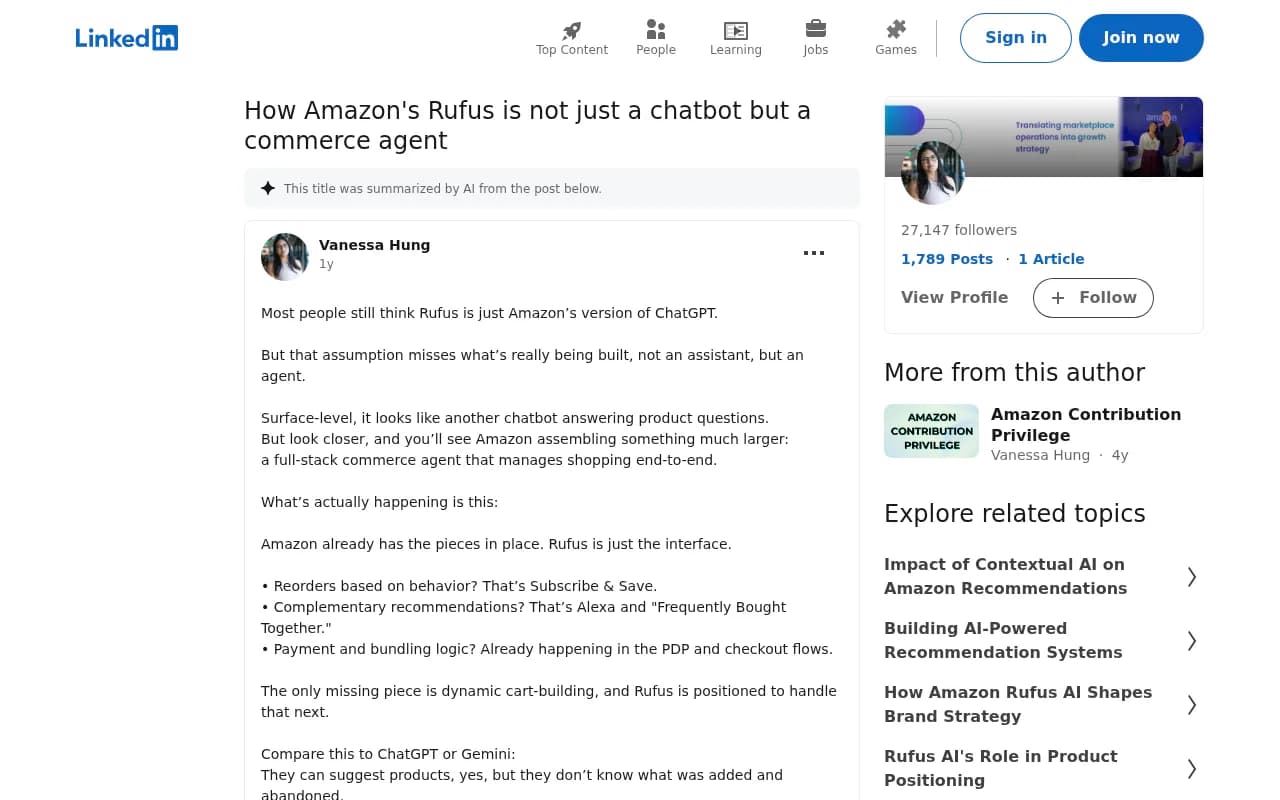
Rufus lives inside the Amazon app and search bar, and it only knows the Amazon catalog. Amazon said more than 300 million customers used it in 2025 and credited it with nearly $12 billion in incremental annualized sales. Third-party analyses put conversion on Rufus-assisted sessions at more than 3x non-AI sessions, though I would treat that figure as directional rather than gospel.
It is also the most purchase-ready surface. Shoppers open Amazon already intending to buy, and features like Auto Buy (price-threshold purchasing, rolled out in March 2026) and Buy For Me (which can purchase from some other stores) push it toward agentic checkout.
What Rufus evaluates is mostly inside your listing: Q&A depth, review signals, A+ content and behavioral data. You do not get to influence it with your brand site.
Google AI Mode
Google says AI Mode shopping is powered by its Shopping Graph: 50 billion+ product listings, with 2 billion refreshed every hour. For most brands the practical input is the Merchant Center feed you already maintain. Third-party estimates put AI Mode on roughly 14% of shopping queries, and agentic checkout through Google Pay is rolling out alongside the Universal Commerce Protocol that Shopify and Google developed.
Google is also testing ads in AI Mode, where Gemini writes the explanation that pairs a sponsored product with the shopper's question. Expect paid and organic to blur here faster than anywhere else.
Side-by-side comparison
| ChatGPT Shopping | Amazon Rufus | Google AI Mode | |
|---|---|---|---|
| Catalog source | Open web, retailer pages, merchant feeds | Amazon catalog only | Google Shopping Graph, Merchant Center feeds |
| Reach | ~900M weekly platform users, shopping users not disclosed | 300M+ customers in 2025 | Roughly 14% of shopping queries (third-party estimate) |
| Purchase readiness | Discovery; Instant Checkout wound down in March 2026 | High; Auto Buy, Buy For Me | Agentic checkout via Google Pay |
| What you control | Product pages, schema, feed, third-party reviews and roundups | Listing content, reviews, Q&A, A+ | Merchant Center feed, product data, reviews |
| Ads | Self-serve ads with CPC bidding | Amazon's own ad ecosystem | Gemini-written sponsored products in test |
| Ease of outside tracking | Good; tools read product cards | Narrow; few tools cover it | Moderate; brand level easier than product level |
What ChatGPT cites, and why that shapes your catalog work
If you pick ChatGPT first, know what it quotes. In Promptwatch Data's content type report (Sep 28 to Oct 4, 2026), product pages were the most cited type at 22.4% of citations, landing pages 16.8% and listicles 13.6%. On commercial prompts, product pages hit 26.0% and landing pages 20.6%. Those two plus listicles and comparisons make up almost 70% of commercial citations.
Translation: your product pages need to be comparable (price, specs, who it is for), and you want to be inside the "best of" roundups ChatGPT already cites. Also note that almost half of ChatGPT responses cite 10 or more unique domains, per Promptwatch's unique domains report, so the competition for each answer is wide, not narrow.
Where to track first: a decision framework
If most revenue comes from your own store
Start with ChatGPT, then Google AI Mode. These two read your site and your feed. Rufus cannot see your site at all. Both ChatGPT and AI Mode also respond well to the same inputs: complete Product schema, accurate price and availability, a clean feed and third-party reviews.
If Amazon is 50% or more of revenue
Start with Rufus, and accept that tooling is thinner. Goodie's higher plan is among the few that track products on Rufus (and Walmart's Sparky) at the product level, according to its own FAQ. Peec AI lists Rufus as an add-on model on higher tiers. Everything else on your list likely stops at ChatGPT and AI Mode.
If you sell high-consideration products
Electronics, specialty gear and anything researched for weeks tend to start in ChatGPT or Perplexity. Lead with ChatGPT.
If you sell everyday repeat purchases
Groceries, consumables and personal care favor Amazon's ecosystem and Rufus. Lead there.
If you run Google Shopping or Performance Max already
AI Mode is probably your cheapest win, because the feed work is already done. Track it early to see whether feed quality is actually showing up.
Do the manual test first
Before paying for anything, take last quarter's ten best-selling products. Write the question a shopper would type for each. Run each three times on ChatGPT and three times on Google AI Mode, and try the same inside Rufus if you sell on Amazon. Mark which of your products appear, at what price, and from whose store.
Three runs matter because answers vary. One run can land on an outlier day. Then put that column next to your sales report. If you see a gap between where you sell well and where AI recommends you, that is your first priority.
Tools that can do this weekly
A tool earns its fee when you want that test every week, for hundreds of questions, with history kept. Surface coverage is the thing to check first, because many trackers read ChatGPT's product carousel only.
Promptwatch is the one I would look at for a brand that wants the tracking and the fixing in one place. It monitors ChatGPT, Google AI Overviews, Google AI Mode and others from the real interfaces, has a dedicated ChatGPT Shopping view (which products AI recommends, which competitors it picks instead, how your uploaded catalog performs) and an Ads Radar for sponsored placements. It also logs AI crawler visits so you can tell whether a product page is unreadable or just not chosen. Shopping and Ads Radar sit on the Business plan ($579/mo); confirm current details at promptwatch.com/pricing. It does not track Amazon Rufus today, so pair it with a Rufus-specific tool if Amazon matters.

For Rufus and Walmart Sparky coverage at the product level, Goodie is the clearest option in the research.
Peec AI tracks your catalog product by product from a lower price, but each self-serve plan picks three models, so ChatGPT and AI Mode use two of them.

Otterly.AI is the cheapest way to see ChatGPT's shopping cards at all, but it records cards per question and does not start from your catalog, so matching to SKUs is manual.

Profound adds SKU and merchant layers for ChatGPT Shopping, on a contract.

Azoma is built specifically for enterprise AI shopping optimization across ChatGPT and Rufus.
| Tool | Strongest surface | Rufus coverage | Best for |
|---|---|---|---|
| Promptwatch | ChatGPT Shopping, AI Mode, AI Overviews, crawler logs, content fixes | No | Brands selling mainly on their own store |
| Goodie | Rufus, Sparky, ChatGPT, AI Mode, Perplexity | Yes | Amazon and Walmart sellers |
| Peec AI | Catalog-level ChatGPT tracking | Add-on on higher tiers | Own-store brands on a budget |
| Otterly.AI | ChatGPT shopping cards | No | A cheap test before a budget |
| Profound | ChatGPT Shopping SKU and merchant layers | Not confirmed | Contract buyers |
| Azoma | ChatGPT and Rufus optimization | Yes | Enterprise brands |
More options are listed in the GEO software directory at bestgeosoftware.com.
What to fix while you track
Tracking without fixes is just a nicer way to watch yourself lose. The shared work across all three surfaces is boring and effective:
- Complete Product and Offer schema, with accurate price and stock. Out-of-stock items showing as available frustrate agents that connect buyers with real intent.
- A clean merchant feed, updated often. OpenAI accepts updates as frequently as every 15 minutes, and where a feed exists it treats it as the source of truth for price and availability.
- Product pages that state who the product is for, specs and pricing plainly.
- Reviews on trusted third-party sites, which show up more on branded prompts.
- Listing depth on Amazon: A+ content, FAQs and review responses for Rufus.
- Open crawler access. Check your robots rules before blaming content. The AI Crawler URL Inspector is a quick free test.
Measure what AI sends you
Use GA4 custom channel groups for referrals from ChatGPT, Gemini, Perplexity and Copilot, and compare AOV and conversion by source. One wrinkle: ChatGPT stopped sending a referrer on October 8, 2026, so tag your links with utm_source=chatgpt.com where you control them, and count that traffic as ChatGPT. Be honest about attribution limits. Most AI-assisted orders still close on a store, and OpenAI itself warns that shopping research can be wrong about price and availability.
A sensible 30-day plan
- Week 1: run the ten-question manual test on every surface you care about. Screenshot results.
- Week 2: fix the obvious feed and schema gaps for the products that did not appear.
- Week 3: pick one tool matching your sales channel mix and load your real commercial prompts.
- Week 4: compare appearance rate against sales for the top ten products. Set the one metric you will report monthly, such as the share of tracked prompts where your product appears with the right price.
Treat ChatGPT shopping the way you would have treated early Google Shopping: modest traffic now, and early brands are hard to displace. Rufus is where the volume already is. AI Mode is where the feed work you already did pays off.
The short answer
Own store: ChatGPT, then AI Mode. Amazon-heavy: Rufus first, with a tool that actually covers it. Google Shopping advertiser: AI Mode first. If you cannot tell, run the manual test this week. It costs nothing and the results will usually answer the question.