Key takeaways
- Entry-level AI visibility tools cost $20 to $300 a month. A freelancer on Upwork typically runs $15 to $35 an hour, and agencies start around $3,000 a month.
- Tools measure. Freelancers execute. The most common waste is paying a tool to confirm a flat zero, or paying a freelancer without any data to point them at.
- Advertised tool prices are often not the real price. Per-engine fees, extra seats and prompt packs can push a bill to 2 to 3 times the headline number, according to AmICited, a vendor with its own tool to sell.
- For most seed-stage startups, the cheapest setup that works is a $29 to $250 tool plus 10 to 20 freelancer hours a month, not a $6,850 retainer.
- Check every price on the vendor's page before you buy. This category changes tiers often.
The actual question you are trying to answer
Most startups frame this as tool versus person. That framing is slightly off. An AI visibility tool answers "does ChatGPT, Perplexity or Google AI Overviews name us when a buyer asks for a recommendation?" A GEO freelancer answers "what do we write, fix or publish so that it does?"
Those are different jobs. A tool does not change the answer. A freelancer without data is guessing at which prompts matter. So the real cost comparison is about which job is your bottleneck right now: knowing where you stand, or doing the work to move.
I'll lay out both price lists first, then the hidden costs, then a few setups I'd actually pick depending on your stage.
What AI visibility tools cost in 2026
Prices below come from vendor pages and review roundups published between September and November 2026. I did not verify every pricing page directly, so confirm before you commit.
| Tool | Entry price | What you get at entry | Watch out for |
|---|---|---|---|
| Rankscale | $20/mo | Credit-based tracking across many engines | Credits run out fast with daily tracking |
| Otterly.AI | $29/mo | 15 prompts, 4 engines | $189/mo for about 100 prompts; Gemini and Claude are add-ons |
| HubSpot AEO | $50/mo | 25 prompts, 3 engines | Narrow prompt count |
| Peec AI | from $95/mo | 50 prompts, 3 engines | More engines cost extra |
| Semrush AI Visibility Toolkit | $99/mo per domain | 25 prompts, 5 engines | $99 per extra domain or user |
| AthenaHQ | free tier, then about $295/mo | Up to 11 models on paid | Steep jump from free |
| Scrunch | $250 to $300/mo | 4 engines at Core | High floor for a solo founder |
| Profound | custom enterprise | 7-day trial | No self-serve brand tier, per Profound's pricing page |
| Petra Labs | from $15,000/mo | Enterprise suite | Typical annual total $250k to $600k per Zapier |
A few of these I'd flag for startups specifically. Otterly.AI is the budget option most roundups settle on.

Rankscale is cheaper still and covers more engines, but the credit model means it suits occasional checks better than daily monitoring.
Peec AI sits at the $95 mark and is popular with European teams and agencies.

If you already pay for an SEO suite, check the add-on first. Semrush and Ahrefs Brand Radar both sell AI tracking inside an existing subscription, which can be cheaper than a new vendor.

And here is the range summarized by Zapier's testing of nearly 50 tools: affordability picks start at $29, and enterprise all-in-ones start at $15,000 a month. The middle is where most startups end up, somewhere between $95 and $300.
The hidden costs of tools
AmICited's pricing guide argues that most vendor pricing pages understate the real bill. Their list: per-engine fees, seat licenses, API overages, and for larger teams, setup and migration costs of $0 to $20,000. They claim you should expect 2 to 3 times the base price. That is a vendor claim, and AmICited sells a competing product, so I would treat the multiplier as a warning rather than a measurement.
But the individual items are real. Otterly sells Gemini, Claude and AI Mode as add-ons, plus extra prompts at $99 per 100. Semrush charges per domain. ZipTie, per Zapier, charges per engine tracked. Before comparing two tools, write down your engine count, prompt count and number of people who need a login, then get a quote on that.
There is also the cost nobody puts in a table: someone has to act on the dashboard. A tool with no owner is a $95 a month subscription to feel informed.
What a GEO freelancer or agency costs in 2026
The range here is much wider, and it depends heavily on who you hire.
| Option | Typical cost | Commitment | Source |
|---|---|---|---|
| Freelancer, hourly | $15 to $35/hr typical, $7 to $100/hr range | None | Upwork GEO specialist listings |
| Freelancer, project | $1,500 to $5,000, up to $3,000 to $10,000 | Per project | Upwork |
| Consulting, hourly (agency) | $125 to $325/hr, median $205 | None | First Page Sage |
| Agency, custom retainer | $3,000 to $15,000/mo, median $7,200 | About 6 months | First Page Sage |
| Agency, tiered package | $2,500 to $25,000/mo, median $6,300 | 3 to 6 months | First Page Sage |
| Agency, entry | from $3,000/mo (WebFX) | Varies | WebFX |
| In-house specialist | $146,028/yr, about $12,169/mo | Full-time | First Page Sage |
First Page Sage reports a median GEO retainer of $6,850 a month in Q3 2026, up 66% since Q1 2024, and 45% above the median traditional SEO retainer. That report is vendor-published, so read the medians as a rough guide, not gospel. Still, the shape is consistent with other sources: agencies cluster at $3,000 and up.
The freelancer number deserves honesty too. $15 to $35 an hour on Upwork is real, but it is also the low end of a market where quality varies wildly. GEO is new enough that "specialist" often means someone who read a lot of blog posts last year. Individual profiles range from $7 to $100 an hour for a reason.
The hidden costs of freelancers
- Onboarding time. A freelancer new to your product needs to learn your positioning before writing anything AI would cite.
- No tooling by default. Without a visibility tool, they cannot show you whether their work moved anything, so you get deliverables, not evidence.
- Management overhead. Someone on your team briefs, reviews and publishes. For a three-person startup that is not free.
- Slow feedback. First Page Sage puts the first deliverable from an in-house specialist at 13.6 weeks. Freelancers are faster, but AI citation changes still take weeks to show.
Side-by-side cost comparison
Here is a realistic first-year view for a startup. These are my own illustrative scenarios built from the prices above, not published benchmarks.
| Setup | Monthly cost | First-year cost | What you get |
|---|---|---|---|
| DIY with a budget tool (Otterly Lite or Rankscale) | $20 to $29 | $240 to $350 | Measurement only. You do the work. |
| DIY with a mid-tier tool (Peec, Semrush toolkit) | $95 to $99 | about $1,140 to $1,190 | Better data, still your time |
| Freelancer only, 10 hrs/month at $25 | $250 | $3,000 | Execution without measurement |
| Hybrid: budget tool plus 15 freelancer hrs | about $400 | about $4,800 | Measurement and execution |
| Agency, entry retainer | $3,000+ | $36,000+ | Done-for-you, fewer decisions from you |
| Agency, median retainer | $6,850 | $82,200 | Full program |
The annual gap between a tool-led setup and an agency is somewhere around ten to twenty times. That does not mean agencies are a bad deal. It means you should be able to say what you expect to get for the difference.
What the data says about where your effort should go
Some of the math on how much to invest depends on how many slots there are to win. According to Promptwatch's data on sources per AI response, ChatGPT cites about 5 sources per web-search answer, while Google AI Overviews and Perplexity cite roughly 10. Fewer slots means ChatGPT is harder to crack for a young domain. AI Overviews and Perplexity are easier first targets.
And mid-authority sites do better than you'd think. Promptwatch's citation share by domain rank report found that sites with domain rank 46 to 75 earned almost half of ChatGPT citations in August 2026, while DR 91 to 100 fell to about 3%. A startup does not need a giant domain. It needs the right pages.
Which pages? Promptwatch's content-type data shows product pages were the most cited type in ChatGPT at 22.4% of citations (Sep 28 to Oct 4, 2026), followed by landing pages and listicles. For software prompts specifically, GitHub, Microsoft's docs and G2 led, and documentation and help centers earned the biggest share. If you sell software, that tells a freelancer exactly what to build: strong product pages, docs, and a presence on review sites.
One more thing worth knowing before you pay anyone to refresh old content: Promptwatch's content half-life study found landing pages and docs stayed cited longest, while news lost half its cited pages within 36 days. Evergreen pages are the better place for a limited freelancer budget.
When a tool is the right first purchase
Buy a tool first when:
- You have no idea whether AI engines mention you at all, and a free check has not settled it.
- Someone on your team will actually write or edit pages and just needs to know which ones.
- You are in a competitive category with named rivals, and you want share-of-voice data against them.
- You need numbers for a board or investor update.
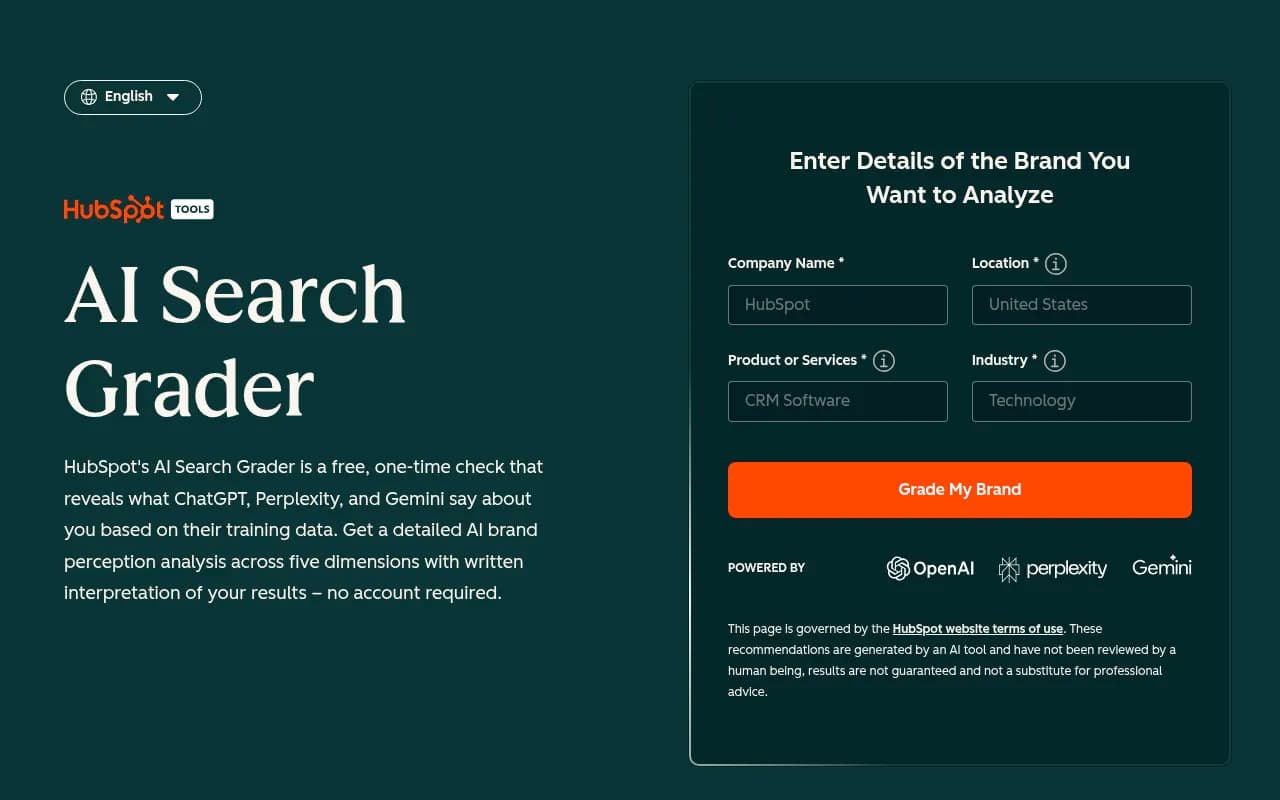
If you have almost no AI presence yet, I would run a free check before paying anything. Paying $29 to $300 a month to watch a flat zero is the most common waste in this category. Promptwatch offers a free AI visibility report that scans ChatGPT, Gemini and Perplexity with no login, and the Agentic Readiness Check tells you whether AI crawlers can read your site at all. HubSpot's AEO Grader is another free one-off option.

When a freelancer is the right first purchase
Hire a person first when:
- The free check shows you are invisible and the reasons are obvious: thin product pages, no docs, blocked crawlers, no third-party mentions.
- Nobody on your team has the time or skill to write answer-first content.
- You have a clear list of 5 to 10 money queries to target.
Give the freelancer a tight brief: one page per money query, answer-first copy, real citations, FAQ blocks, and schema hygiene. Ask them what they will measure. If the answer is "rankings" and nothing else, keep looking.
The hybrid setup most startups should pick
I think the best value for a seed-stage company is a hybrid, because each side fixes the other's weakness. The tool gives the freelancer a target and gives you proof. The freelancer turns the dashboard into pages.
- Run a free visibility check and note your starting position.
- Pick one budget tool ($20 to $99) and track 25 to 50 prompts that match real buyer questions.
- Hire a freelancer for 10 to 20 hours a month, scoped to the gaps the tool surfaces.
- Review monthly. If citations or mentions on your tracked prompts move, keep going. If not, change the content, not the tool.
- Upgrade the tool only when your prompt list or engine count outgrows the plan.
Total cost is around $300 to $700 a month. That is a fraction of an agency retainer and gives you a feedback loop the freelancer alone cannot.
When the tool does the freelancer's job
A newer category of platform tries to collapse both lines. Instead of just reporting, they find content gaps and draft or publish pages. Promptwatch is one: its Essential plan is $95 a month, and the Business plan at $579 a month adds a Content Agent that plans, writes and publishes against your visibility gaps to WordPress, Webflow or Framer, with a review inbox so a human still approves. Crawler logs, visitor analytics and page-level citation tracking then show whether each published page got read, cited and clicked. Confirm the current plan limits on the pricing page.
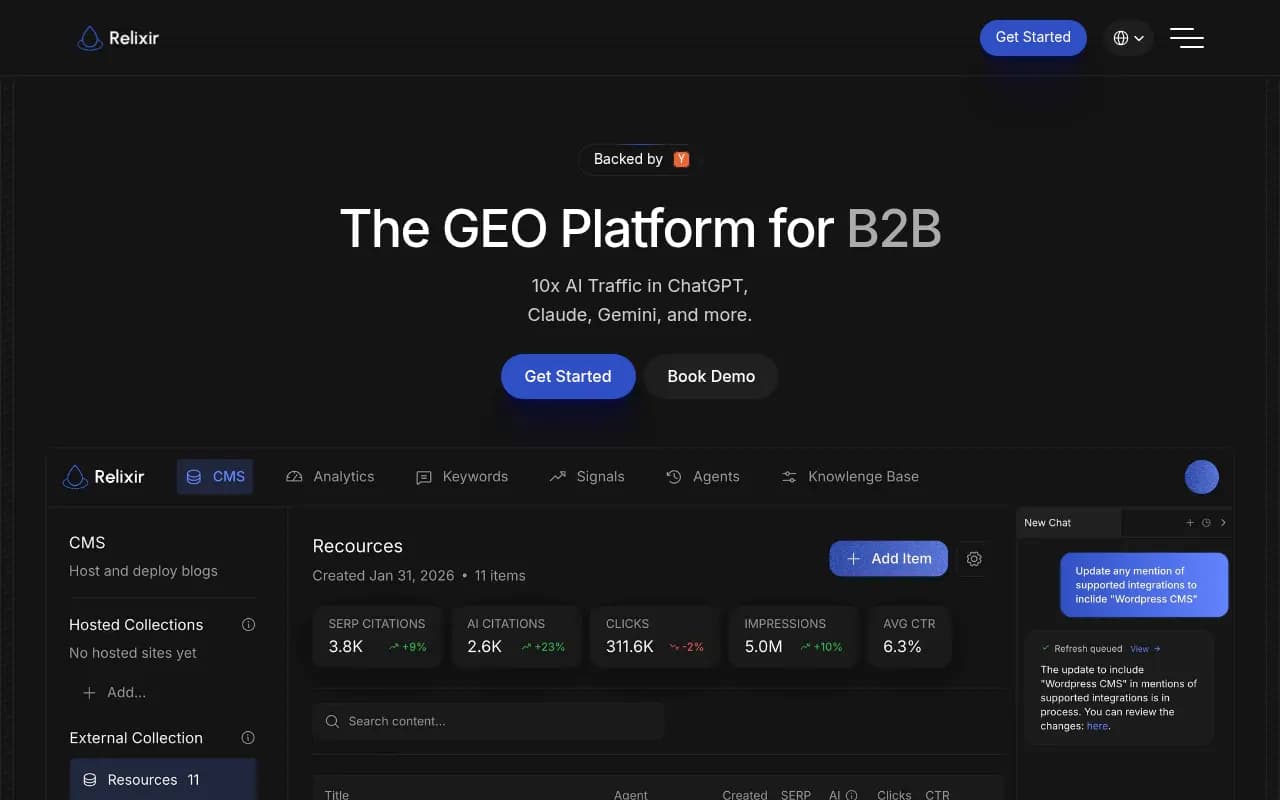
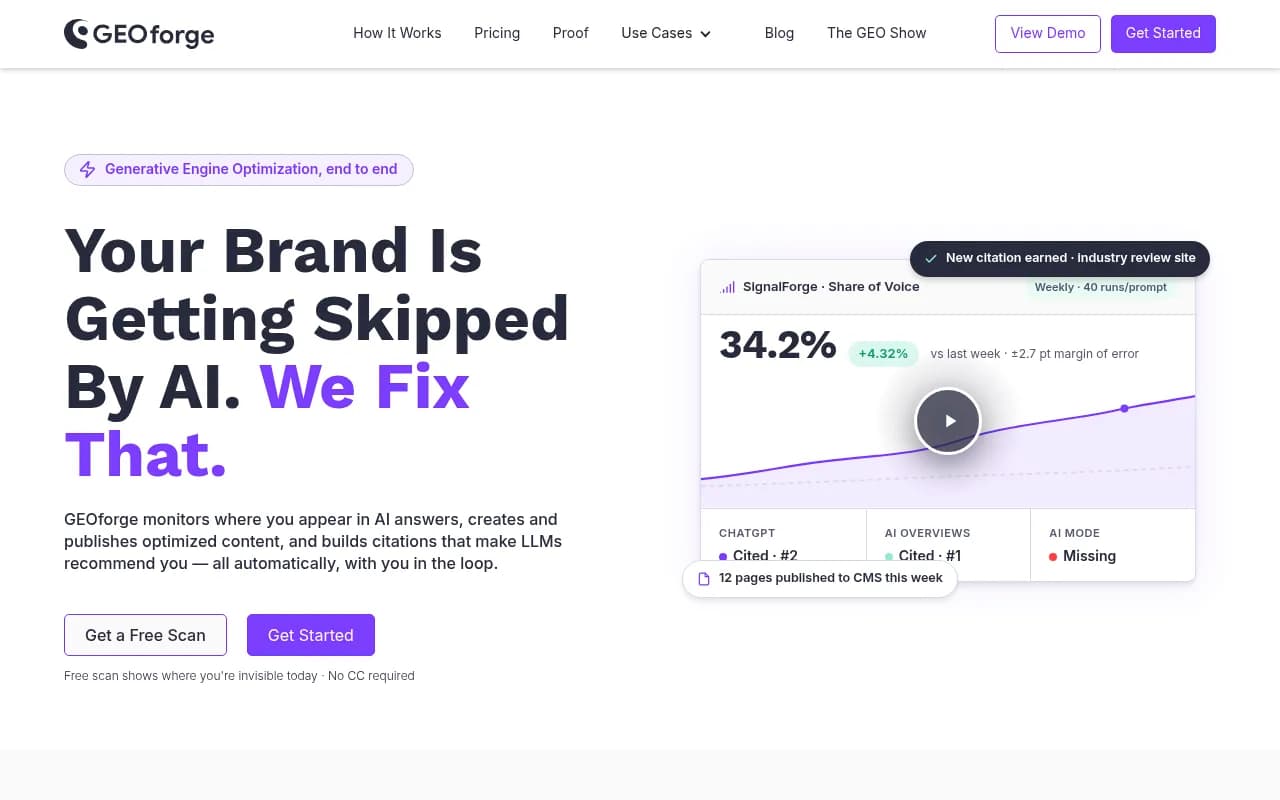
Other tools aim at the same idea, including Relixir, Slate and GEOforge, though I have not tested their output quality. Whether an AI-drafted page beats a good freelancer is an open question. My view: for volume pages like comparisons and FAQs, agentic tools are good enough with an editor. For positioning-heavy flagship pages, a human still writes better.
If you want to browse more options, the GEO software directory lists tools by category and price.
When to skip the freelancer and hire an agency
An agency retainer at $3,000 and up makes sense when you have a team that cannot execute, a funded growth target tied to AI-sourced pipeline, and enough content to justify a program. Agencies also bring digital PR and link-building that a solo freelancer usually can't. If you go that route, 1001 SEO Media is one option that combines technical SEO, content and GEO work with no long-term contracts, and it is worth getting a few quotes to compare against the median numbers above.
How to decide in 10 minutes
| Your situation | Best first move | Rough monthly budget |
|---|---|---|
| Pre-launch or near-zero AI presence | Free check, then fix core pages yourself | $0 |
| Seed stage, one marketer, some content | Budget tool, DIY | $20 to $100 |
| Seed stage, nobody to write | Freelancer plus a budget tool | $300 to $700 |
| Series A, competitive category, board metrics | Mid-tier tool plus freelancer or content-agent platform | $600 to $1,500 |
| Funded growth team, AI pipeline target | Agency retainer plus a tool for reporting | $3,000+ |
Mistakes to avoid
- Buying on the headline price without counting engines, seats and prompts.
- Signing a six-month agency commitment before you have a baseline.
- Hiring a freelancer without giving them a measurement tool, then having no way to judge their work.
- Tracking 200 prompts when you have capacity to act on 20.
- Treating a visibility score as comparable across tools. There is no standard score.
Bottom line
If you can only spend one dollar, spend it on a free check first, then on someone's hours. Tools run $20 to $300 a month, freelancers $15 to $35 an hour, agencies $3,000 a month and up. For most startups the best return sits in the hybrid: a cheap tracker to find the gaps and a freelancer for 10 to 20 hours a month to close them. Move to a bigger retainer only after your tracked prompts show movement.
And double-check current prices on each vendor's page. Several of the numbers above are vendor-reported and this market reprices often.