Rankscale AI Review 2026
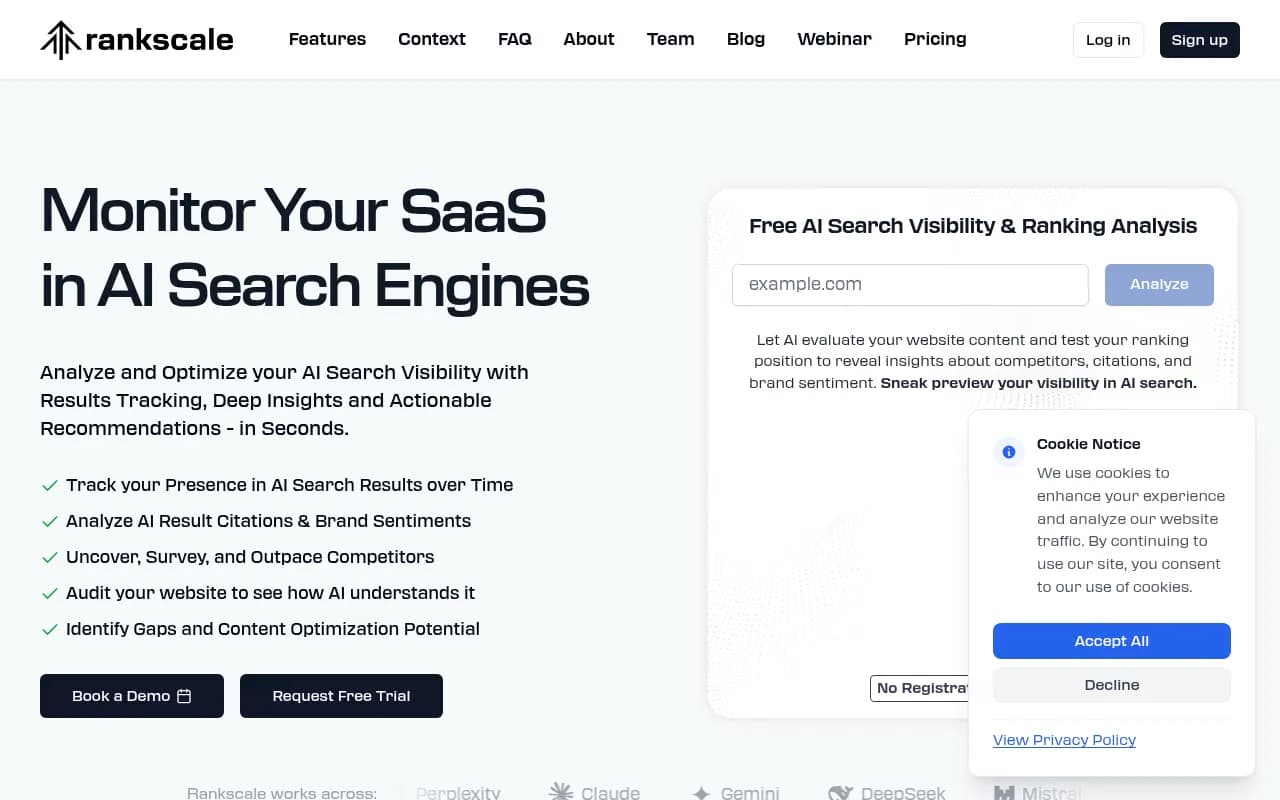
Tracks how brands and content rank in AI-generated search responses. Focuses on generative engine optimization with visibility scoring across multiple AI platforms.
Key takeaways
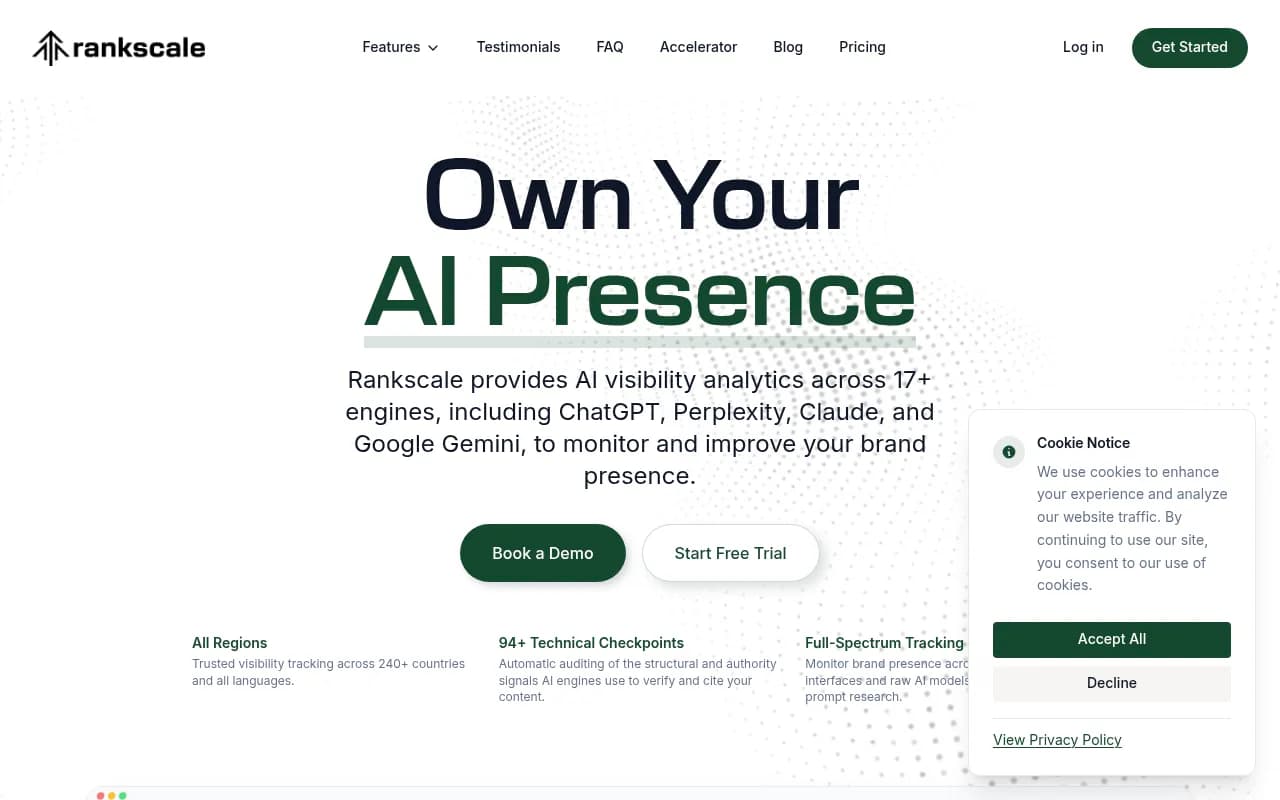
- Rankscale covers 17+ AI engines with granular prompt-level tracking, sentiment analysis, and citation breakdowns -- solid breadth for a tool launched in mid-2025
- Lacks content generation, AI crawler logs, and traffic attribution that Promptwatch offers -- Rankscale shows you what's happening but doesn't help you fix it with content or connect visibility to revenue
- Credit-based pricing starting around €20/month makes it accessible for small agencies and freelancers managing a handful of clients
- Page audit feature (200+ factors, 94 technical checkpoints) is a genuine differentiator -- most monitoring-only tools skip technical AI readiness entirely
- Best fit for SEO consultants and mid-size agencies who want detailed monitoring dashboards and client reporting exports, not an end-to-end optimization workflow
Rankscale is an AI search visibility platform built by Mathias Ptacek, an Austrian entrepreneur who started the project in October 2024 after years in tech and marketing roles. The core problem it addresses is one that's become impossible to ignore: as more users shift their searches to ChatGPT, Perplexity, and Google's AI Mode, traditional rank trackers go blind. Your position in a blue-link SERP tells you nothing about whether you're being cited in an AI-generated answer. Rankscale tracks exactly that -- which brands appear in AI responses, how often, with what sentiment, and from which source URLs.
The company incorporated as Rankscale GmbH in July 2025 and has grown to 1,000+ active users across brands, agencies, and publishers. The client list includes recognizable names like Bosch, UBS, O2, REWE, and Dentsu, alongside a long tail of digital agencies. The team tripled in size in early 2026, which suggests they're past the "founder with a side project" phase and moving toward a real product organization. The tool has been mentioned in roundups by Ahrefs, Semrush, Surfer SEO, and ClickUp, which gives it some third-party credibility in the SEO community.
Key features
Brand Visibility Dashboard The central hub shows AI visibility scores across all tracked engines, sliceable by model and timeframe. You can manage multiple brands from a single interface, which matters for agencies running 10+ client accounts. The dashboard aggregates mention frequency, citation counts, and share of voice into a single score. In practice, this is where most users spend their time -- checking weekly trends and comparing performance across ChatGPT vs. Perplexity vs. Gemini.
AI Rank Tracker Tracks visibility scores, rankings, and sentiment per prompt across engines. Historical trend charts let you see how a content update or PR push affected your AI presence over time. The "actionable recommendations" layer is worth noting -- it surfaces specific suggestions tied to ranking gaps, though the depth of those recommendations varies by use case.
Competitor Analysis Rankscale auto-identifies competitors appearing in AI search results for your tracked prompts, which is a smart approach -- you're not just comparing against brands you already know about. You can compare AI visibility scores, citation counts, and sentiment side-by-side. The "uncover ranking gaps" feature shows where competitors are visible but you aren't, which is useful for prioritizing content work.
Citation Analysis Shows exactly which URLs AI engines are citing when they mention your brand or answer prompts in your topic area. You can see citation frequency broken down by model, and connect source URLs to visibility gaps. This is genuinely useful data -- knowing that Perplexity keeps citing a specific competitor's blog post tells you something concrete about what content you need to create or improve.
Sentiment Analysis Tracks how AI engines describe your brand -- positive, negative, neutral -- by topic and model. You can surface specific keyword themes driving positive or negative sentiment and monitor how brand perception shifts over time. The depth here is notable; Rankscale claims "unmatched deep citation sentiment analysis" and several user testimonials specifically call out the sentiment features as a differentiator.
Page Audits This is one of Rankscale's more distinctive features. The audit checks 200+ factors and 94 technical checkpoints specifically related to AI readiness -- things like AI bot crawlability, site hierarchy, structured data, and authority signals that AI engines use to verify and cite content. You get a prioritized list of fixes. Most AI visibility tools skip technical auditing entirely, so this fills a real gap.
Prompt Research Estimates prompt search volume through "semantic reconstruction" -- essentially reverse-engineering likely query patterns from AI behavior. You can decode intent and prompt density, and get suggestions for content optimization based on question patterns AI models tend to answer. The volume estimates are approximations (no one has ground-truth data on ChatGPT query volumes), but they're useful for prioritization.
Monitoring schedules Eight different monitoring frequencies, including hourly tracking for users who need to detect shifts quickly. This is more granular than most competitors, which typically offer daily or weekly snapshots.
Who is it for
Rankscale fits best for SEO consultants and digital agencies managing multiple client brands who need to show AI visibility data in client reports. The credit-based pricing model -- where you can allocate different budgets per client and choose which AI engines and regions to track -- is specifically designed for agency workflows. Several testimonials from agency founders (Digimentals, ClickReady, OMcollective, Pixelclip) mention the reporting and export features as the deciding factor. If you're running a GEO service for 5-20 clients and need clean, exportable dashboards, Rankscale is a reasonable fit.
In-house SEO teams at mid-size brands (think SiteGround, Facile.it, n8n, Cloudbeds -- all listed as users) also get value from the competitor benchmarking and historical trend data. These teams typically have one or two people responsible for AI search strategy and need a tool that doesn't require heavy technical setup. Rankscale's UI is described repeatedly in testimonials as intuitive and approachable, which matters when you're not a dedicated GEO specialist.
Publishers are a third segment Rankscale explicitly targets -- Die Zeit and Frankfurter Allgemeine are listed as users. For publishers, knowing which articles are being cited by AI engines (and which competitors' content is getting cited instead) is directly tied to traffic strategy.
Who should probably look elsewhere: teams that want to close the loop between AI visibility and actual content creation. Rankscale tells you where you're invisible and what competitors are doing, but it doesn't generate content to fill those gaps, doesn't log AI crawler activity on your site, and doesn't attribute AI-driven traffic back to revenue. If you want a full optimization workflow rather than a monitoring dashboard, Promptwatch covers those additional layers.

Integrations and ecosystem
Rankscale's integration story is relatively thin at this stage. The platform has export capabilities that users mention for creating client reports, and there's a Slack community channel that several agency users call out as valuable for support and product feedback. The founding team appears to be highly responsive to user requests, which is a reasonable substitute for integrations when you're early-stage.
No native Google Search Console integration, no Looker Studio connector, and no public API were mentioned in the scraped content. The tool appears to be a standalone web application without browser extensions or mobile apps. For agencies that need to pipe data into existing reporting stacks (Data Studio, Whatagraph, etc.), the current export-and-import workflow adds friction.
The Zapier logo appears in the user list (zapier.com is listed as a customer), but there's no indication of a native Zapier integration -- that appears to be Zapier as a customer, not a partner.
Pricing and value
Rankscale uses a credit-based pricing model, which is genuinely different from most competitors' seat-based or fixed-prompt-count plans. Plans start from approximately €20/month, with credits consumed per prompt query, per engine, and per monitoring frequency. This means you can run a lean setup for a small client at low cost, or scale up credits for enterprise-level tracking.
The pricing page advertises tiers from Essentials to Enterprise, with the entry point around €20. Exact tier breakdowns weren't fully available in the scraped content, but the credit system means costs scale with usage rather than jumping between fixed tiers. Several agency users specifically mention the credit model as a reason they chose Rankscale -- it lets them offer AI visibility tracking to smaller clients who couldn't justify a higher fixed monthly fee.
A free trial is available (the homepage prominently features "Start Free Trial"). No permanent free tier appears to exist.
For comparison: Promptwatch's Essential plan starts at $99/month for one site and 50 prompts, with content generation and crawler logs included. Rankscale's lower entry price makes it accessible for freelancers and small agencies, but the gap in capabilities means you're comparing different things.
Strengths and limitations
What Rankscale does well:
- Breadth of AI engine coverage. 17+ engines including ChatGPT, Perplexity, Claude, Gemini, AI Overviews, DeepSeek, Grok, Copilot, Mistral, and AI Mode is genuinely comprehensive. Most competitors cover 5-8 engines.
- Page audit depth. The 200+ factor, 94-checkpoint technical audit is a real differentiator. Knowing your site has crawlability issues that prevent AI bots from indexing your content is actionable in a way that pure visibility scores aren't.
- Sentiment analysis granularity. Tracking how AI models describe your brand -- not just whether they mention you -- is more sophisticated than most tools in this space. The ability to surface specific keyword themes driving negative sentiment is particularly useful for brand management.
- Credit-based pricing flexibility. For agencies managing clients with varying budgets, the ability to allocate credits per client rather than paying for fixed seats is a practical advantage.
- Founder-led responsiveness. Multiple testimonials mention direct access to Mathias and fast response to feature requests. For a tool this young, that matters.
Honest limitations:
- No content generation. Rankscale identifies gaps but doesn't help you fill them. There's no built-in writing agent or content optimization workflow. You see that a competitor is visible for a prompt you're missing -- then you're on your own to figure out what to write.
- No AI crawler logs. You can't see which AI bots are crawling your site, which pages they're reading, or whether they're encountering errors. This is a significant blind spot for diagnosing why certain pages aren't being cited. Promptwatch's crawler log feature addresses this directly.
- No traffic attribution. Rankscale doesn't connect AI visibility to actual website traffic or revenue. There's no code snippet, GSC integration, or server log analysis to tell you whether your AI visibility improvements are driving clicks. This makes it hard to justify the tool's ROI to stakeholders who want business outcomes, not just visibility scores.
- No Reddit or YouTube tracking. AI models frequently cite Reddit threads and YouTube videos. Rankscale doesn't surface which discussions on those platforms are influencing AI recommendations about your brand or category.
Bottom line
Rankscale is a capable AI visibility monitoring tool with genuine strengths in engine breadth, technical auditing, and sentiment analysis. For SEO agencies managing multiple clients who need clean dashboards and exportable reports, the credit-based pricing and multi-brand management make it a practical choice. The page audit feature alone is worth evaluating if you suspect technical issues are limiting your AI citations.
That said, it's fundamentally a monitoring tool. It shows you the problem but doesn't help you solve it. Teams that want to go beyond tracking -- generating content to fill visibility gaps, logging AI crawler behavior, or attributing AI traffic to revenue -- will hit a ceiling quickly. For that full optimization loop, Promptwatch is the stronger option.
Best use case in one sentence: Rankscale is the right tool for digital agencies that need multi-client AI visibility dashboards with deep sentiment and citation data, and are comfortable handling content strategy separately.
Frequently asked questions
What is Rankscale AI?
How much does Rankscale cost?
Which AI engines does Rankscale monitor?
Does Rankscale help create content to improve AI visibility?
Who is Rankscale best suited for?
How does Rankscale compare to other GEO tools?
Similar and alternative tools to Rankscale AI