Key takeaways
- AthenaHQ is a solid AI visibility tracker, but it's primarily a monitoring tool -- it shows you where you're invisible without helping you fix it.
- The best alternatives in 2026 combine monitoring with content gap analysis, AI content generation, and crawler insights.
- Promptwatch is the only platform rated as a "Leader" across all GEO categories in a 2026 comparison of 12 platforms, largely because it closes the loop from gap detection to content creation to result tracking.
- Budget options like Otterly.AI and Rankscale work fine for basic tracking; enterprise teams need platforms with deeper prompt intelligence and content tooling.
- The right choice depends on whether you want to watch your AI visibility or actually improve it.
AthenaHQ does what it says. You set up prompts, it queries AI engines, and you get a dashboard showing whether your brand appears. For teams that are just getting started with GEO (Generative Engine Optimization), that's genuinely useful.
But here's the problem most teams run into after a few months: you know you're invisible for certain prompts, and you have no idea what to do about it. AthenaHQ doesn't tell you why competitors are getting cited and you're not. It doesn't generate content to fill those gaps. It doesn't show you which of your pages AI crawlers are actually reading.
That's not a knock on AthenaHQ specifically -- it's a monitoring tool, and it monitors well. But in 2026, with AI search eating into traditional organic traffic at a pace that's hard to ignore, "monitoring only" is starting to feel like watching your house burn down and taking detailed notes.
This guide covers 10 alternatives worth considering, with honest assessments of what each one actually does well and where it falls short.

What separates a monitoring tool from an optimization platform
Before getting into the list, it's worth being clear about this distinction because it affects every buying decision.
A monitoring tool answers: "Am I visible in AI search results?"
An optimization platform answers: "Why am I not visible, and here's how to fix it."
Most tools in this space are still in the first category. They query ChatGPT, Perplexity, Gemini, and a handful of others, count how often your brand appears, and show you a score. That's useful data. But it's not a strategy.
The platforms that stand out in 2026 do at least some of the following on top of basic monitoring:
- Show you which specific prompts competitors rank for that you don't
- Analyze what content is being cited and why
- Help you create or brief content that addresses those gaps
- Track AI crawlers hitting your site so you know when pages get discovered
- Connect visibility to actual traffic and revenue
Keep that framework in mind as you read through the alternatives below.
The 10 best AthenaHQ alternatives in 2026
1. Promptwatch -- best overall for teams that want to actually improve rankings
Promptwatch is the most complete GEO platform available right now. Where most competitors stop at showing you a visibility score, Promptwatch is built around a three-step loop: find gaps, create content, track results.
The Answer Gap Analysis is the feature that makes the biggest practical difference. It shows you the exact prompts where competitors are getting cited and you're not -- not just "you're missing coverage in this topic area" but the specific questions AI models are answering with your competitors' content instead of yours. That's actionable in a way that a visibility score isn't.
From there, Content Agents generate articles, listicles, comparisons, and briefs grounded in real prompt data, citation patterns, and competitor analysis. This isn't generic AI writing -- it's content built specifically to answer the gaps AI models are already exposing.
The crawler log feature is also genuinely useful and rare. You can see in real time which pages ChatGPT, Claude, Perplexity, and others are crawling, how often they return, and when a crawled page actually starts getting cited. Most competitors don't have this at all.
Promptwatch monitors 10 AI models (ChatGPT, Perplexity, Google AI Overviews, Google AI Mode, Claude, Gemini, Meta/Llama, DeepSeek, Grok, Mistral, Copilot), tracks Reddit and YouTube as citation sources, and includes ChatGPT Shopping tracking -- a channel that's becoming increasingly important for product brands.
Pricing starts at $99/month for the Essential plan (1 site, 50 prompts, 5 articles), $249/month for Professional (2 sites, 150 prompts, crawler logs), and $579/month for Business (5 sites, 350 prompts, 30 articles). A free trial is available.

2. Profound -- best for enterprise dashboards and executive reporting
Profound has built a strong reputation with larger organizations that need polished reporting and deep integrations. The platform covers prompt analytics, competitive benchmarking, and share-of-voice tracking across major AI engines.
Where Profound shines is in the executive dashboard layer -- it's the kind of tool you can put in front of a CMO without needing to explain what you're looking at. The data visualization is clean, and the benchmarking against competitors is solid.
The limitation is that Profound is still primarily a monitoring and reporting tool. There's no content generation, no crawler logs, and no answer gap analysis that tells you what to create. For teams that need to act on the data, Profound requires pairing with other tools.
Pricing starts around $99/month, though enterprise plans scale significantly.

3. Peec AI -- best for international and multilingual brands
Peec AI is one of the stronger options for brands operating across multiple countries and languages. It supports multi-country tracking with localized AI responses, sentiment analysis on how your brand is described, and competitive share-of-voice comparisons.
The multi-language support is genuinely good -- not just translated prompts but actual localized querying that reflects how AI engines respond in different markets. For a European brand tracking visibility in German, French, and Spanish AI results simultaneously, Peec AI handles that well.
It's a monitoring-focused platform, so you won't find content generation or gap analysis here. But for international monitoring specifically, it's one of the better-built tools in the category.
Pricing starts at €89/month.

4. Otterly.AI -- best budget option for basic monitoring
Otterly.AI sits at the more affordable end of the market and does a reasonable job of covering the fundamentals. You get AI visibility tracking across major models, unlimited reports, and some basic keyword research functionality.
It's a good starting point for smaller teams or individuals who want to understand their AI search presence without committing to a larger platform budget. The interface is straightforward, and setup is fast.
The trade-off is depth. Otterly.AI doesn't have crawler logs, content generation, prompt volume data, or gap analysis. If you're serious about improving your AI visibility rather than just measuring it, you'll likely outgrow it within a few months.
Pricing starts at $29/month.

5. Scrunch AI -- best for content teams and agencies
Scrunch AI has positioned itself well for content-heavy teams. It includes AI traffic analytics, site audit capabilities, and some SEO agent functionality that helps content teams understand how their pages are performing in AI search.
The agency-oriented features make it worth considering for teams managing multiple client accounts. Reporting is reasonably flexible, and the site audit tools help identify technical issues that might be affecting AI crawlability.
Like most tools in this space, Scrunch AI is stronger on the monitoring and audit side than on content generation. But the combination of traffic analytics and site auditing gives content teams more to work with than pure visibility trackers.
Pricing starts at $100/month.
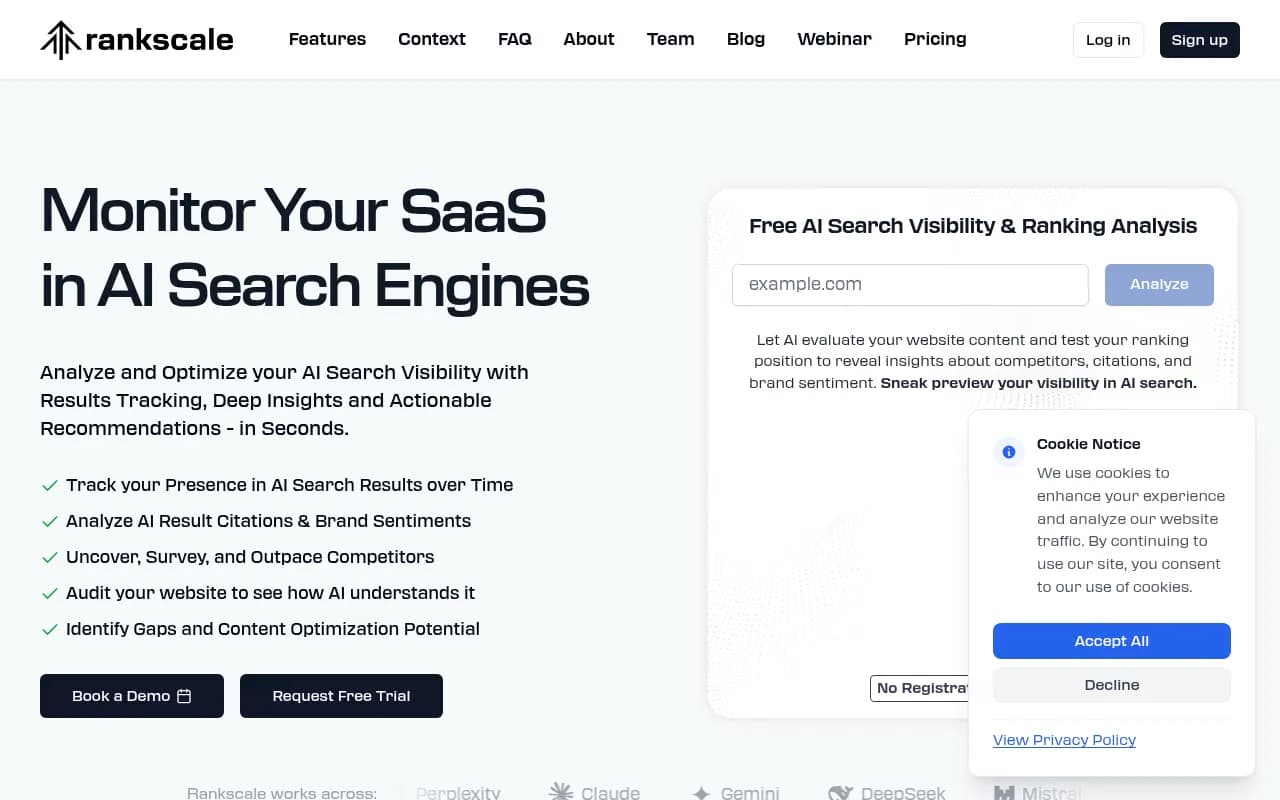
6. Rankscale -- best low-cost option with traditional SEO integration
Rankscale is interesting because it combines GEO tracking with traditional SEO metrics in a single platform at a price point that's hard to argue with. The Google Analytics sync is useful for teams that want to correlate AI visibility with actual traffic data.
At $20/month, it's the most affordable option on this list that still offers meaningful functionality. The GEO tracking covers the major AI engines, and the traditional SEO integration means you're not managing two completely separate tools.
The depth isn't there for serious GEO work -- prompt volume data is limited, there's no content generation, and the crawler insights are basic. But for a small business or solo marketer who wants a single affordable tool that covers both traditional and AI search, Rankscale is worth a look.
7. Ahrefs Brand Radar -- best for teams already in the Ahrefs ecosystem
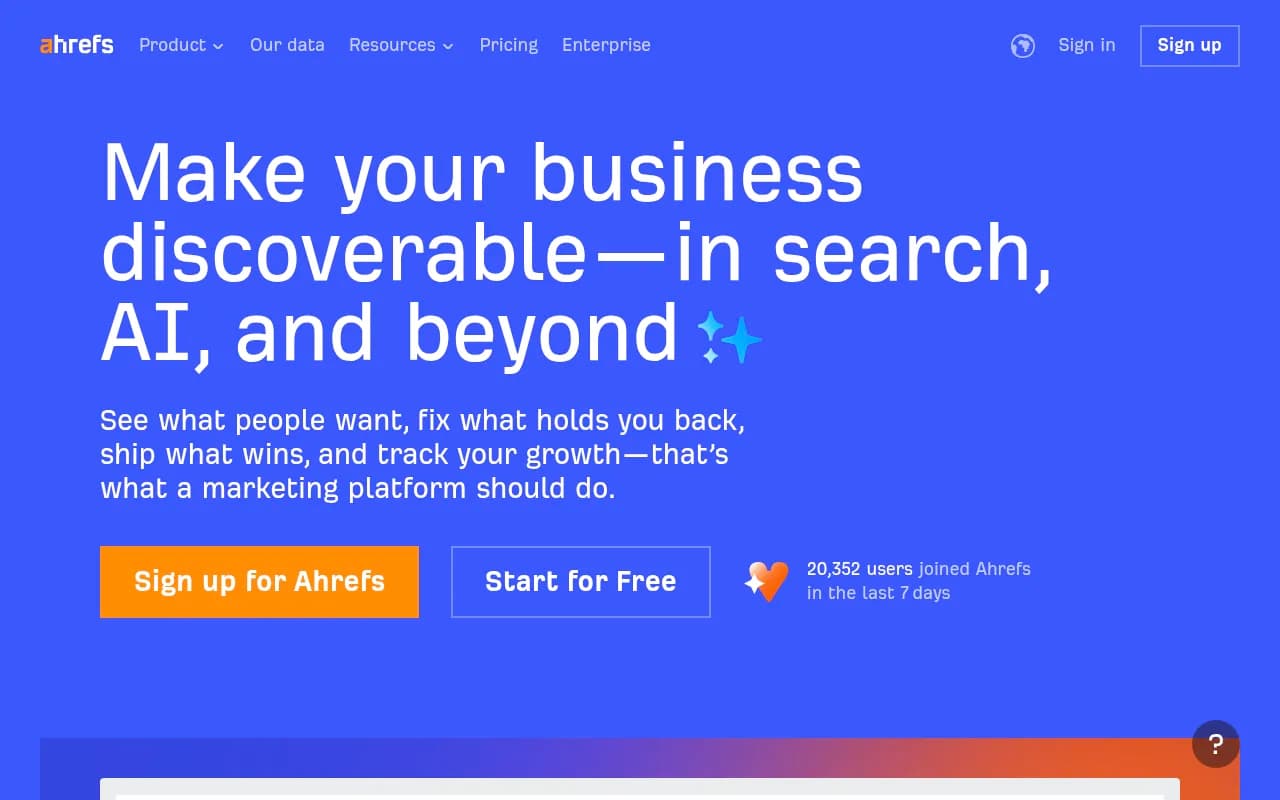
Ahrefs Brand Radar is the AI visibility add-on for teams already using Ahrefs for traditional SEO. It tracks brand mentions across six AI platforms, monitors branded search volume, and pulls in web, YouTube, and Reddit mentions alongside citation analysis.
The main advantage is integration. If your team already lives in Ahrefs, Brand Radar gives you AI visibility data in the same environment without switching tools. The citation analysis is solid, and the Reddit/YouTube monitoring is a useful addition that many pure-play GEO tools don't include.
The limitations are real though. Prompts are fixed rather than customizable, there's no AI traffic attribution, and there's no content generation. It's a monitoring layer on top of a traditional SEO tool, not a dedicated GEO platform.
Pricing starts at $129/month (as part of Ahrefs plans).
8. Rankability -- best for agencies focused on AI visibility analytics
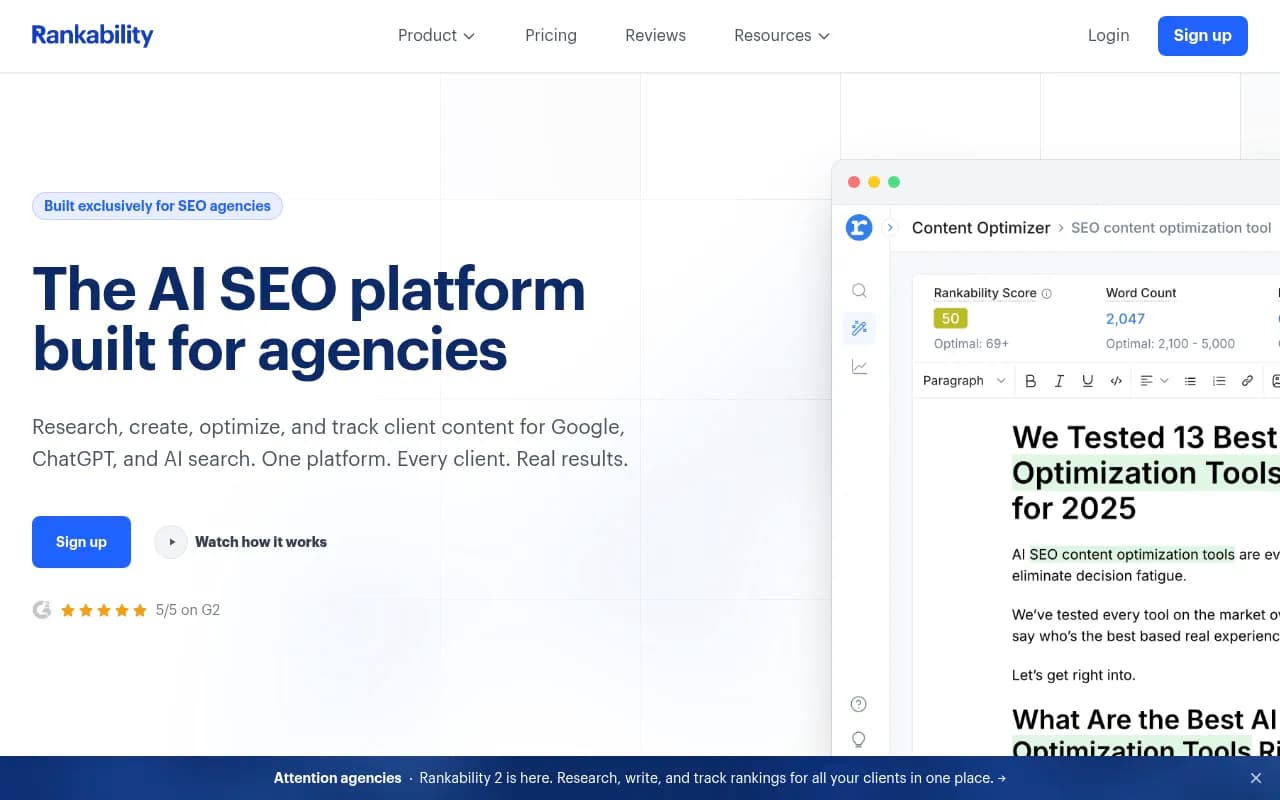
Rankability has built a focused product for agencies that need to track and report on AI visibility across client accounts. The platform covers cross-engine monitoring well and includes some analytics features that make client reporting more straightforward.
The agency workflow is reasonably well thought out -- multi-client management, white-label reporting options, and visibility comparisons across AI models. For agencies that are starting to add GEO to their service offering, Rankability gives them something concrete to show clients.
It's monitoring-focused, so the same caveat applies: you'll get good data about where clients stand, but the platform doesn't help you create content to improve those standings.
9. SE Visible -- best for user-friendly monitoring without the complexity
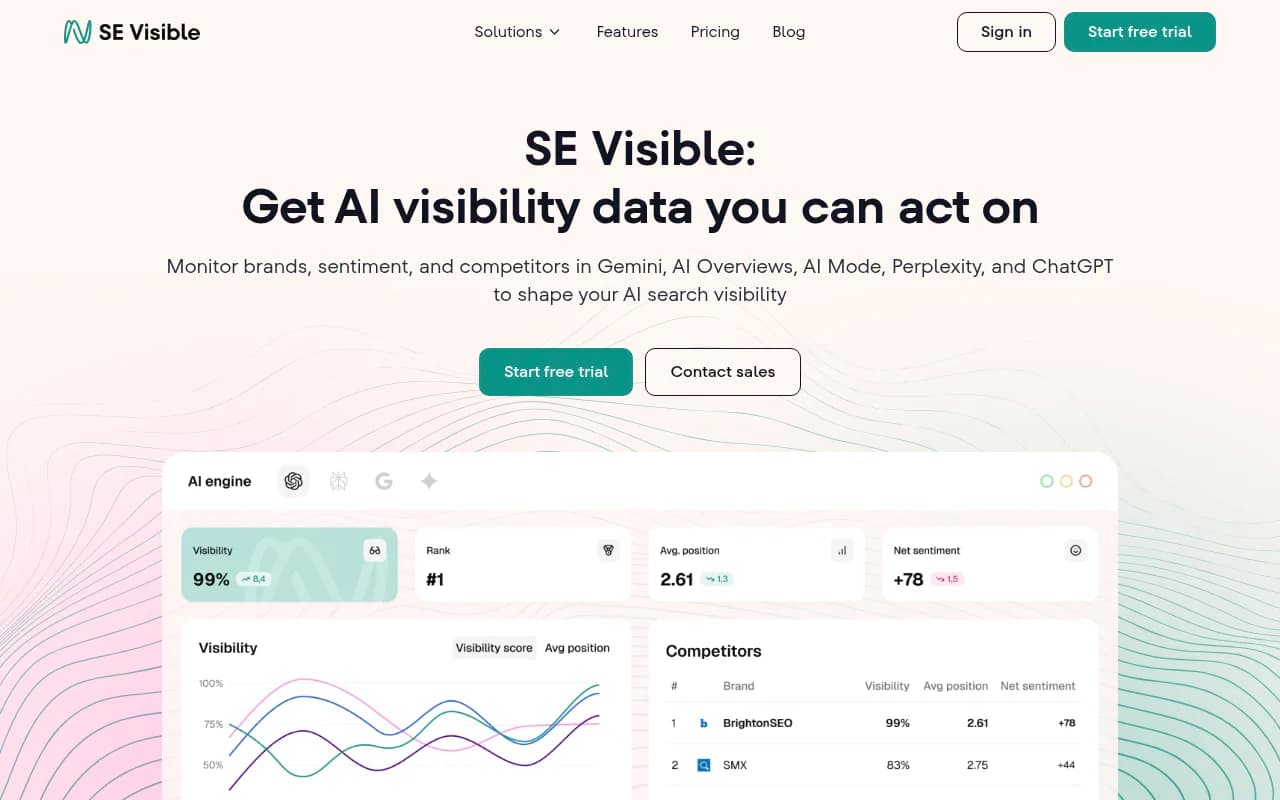
SE Visible (from SE Ranking) takes a deliberately accessible approach to AI visibility tracking. The interface is clean, setup is quick, and the learning curve is minimal compared to more complex platforms.
For marketing teams that don't have dedicated SEO specialists, SE Visible is worth considering. It covers the major AI engines, provides visibility scores, and integrates with SE Ranking's broader SEO toolkit if you're already using that platform.
The trade-off is that simplicity comes at the cost of depth. Advanced features like prompt volume data, crawler logs, and content gap analysis aren't here. But for teams that want to get started with AI visibility tracking without a steep onboarding process, it's a reasonable choice.
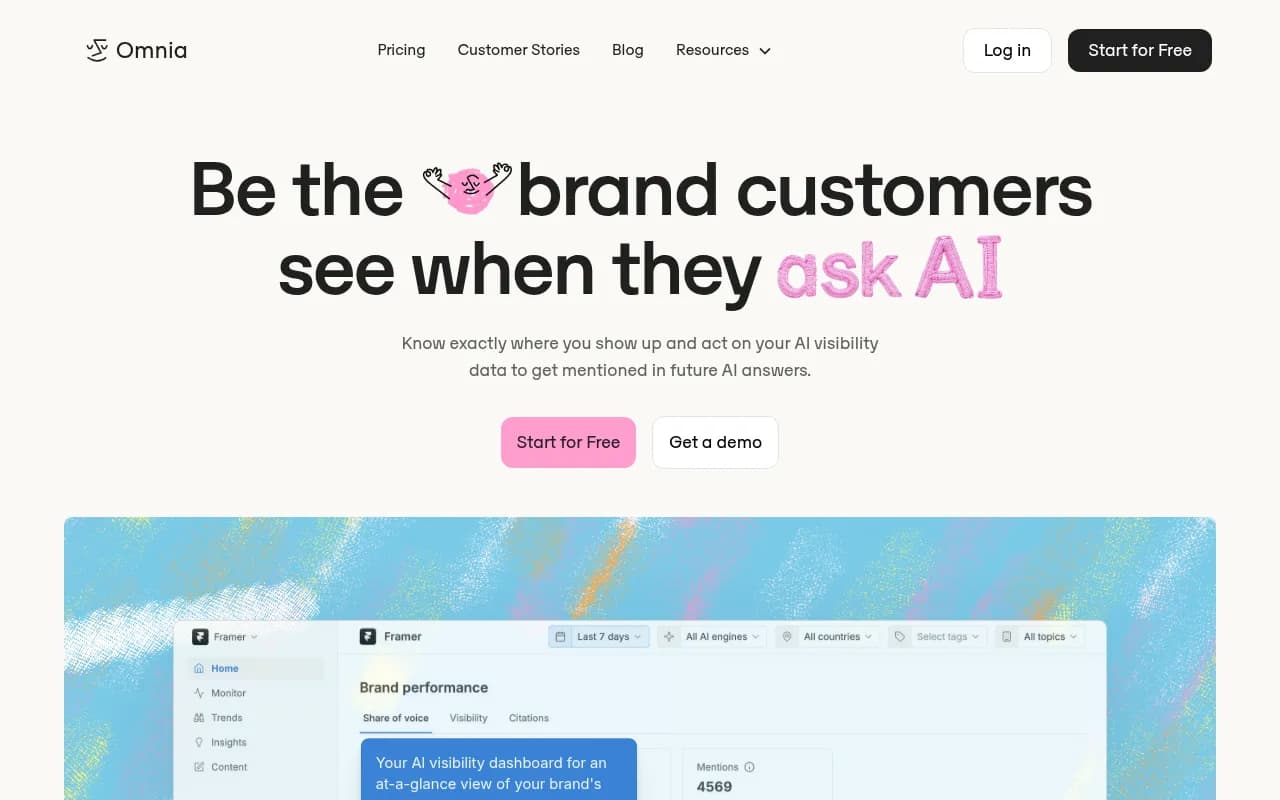
10. Omnia -- best for competitive displacement tracking
Omnia takes a slightly different angle on AI visibility by focusing specifically on competitive displacement -- tracking when prospects research your category in AI engines and your competitors appear instead of you. That framing is useful for sales and marketing teams that think in terms of pipeline rather than just visibility scores.
The platform covers competitor displacement patterns well and provides context around why certain brands are getting cited in category-level searches. For B2B companies where understanding the competitive landscape in AI search matters as much as raw visibility, Omnia's approach is worth exploring.
How these tools compare
| Tool | Starting price | Content generation | Crawler logs | Prompt gap analysis | Multi-model coverage | Best for |
|---|---|---|---|---|---|---|
| Promptwatch | $99/mo | Yes | Yes | Yes | 10 models | Teams that want to monitor AND improve |
| Profound | ~$99/mo | No | No | No | 5+ models | Enterprise reporting |
| Peec AI | €89/mo | No | No | No | 5+ models | International brands |
| Otterly.AI | $29/mo | No | No | No | 4+ models | Budget monitoring |
| Scrunch AI | $100/mo | No | Limited | No | 4+ models | Content teams and agencies |
| Rankscale | $20/mo | No | No | No | 3+ models | Budget SEO + GEO combo |
| Ahrefs Brand Radar | $129/mo | No | No | No | 6 models | Ahrefs users |
| Rankability | Custom | No | No | No | 5+ models | Agencies |
| SE Visible | Varies | No | No | No | 4+ models | Beginners |
| Omnia | Custom | No | No | No | 4+ models | Competitive intelligence |
How to choose the right alternative
The honest answer is that the right choice depends on what you're actually trying to accomplish.
If you want to measure AI visibility and report on it, almost any tool on this list will work. Otterly.AI and Rankscale are fine for this at low cost. Profound and Ahrefs Brand Radar are better if you need polished reporting or ecosystem integration.
If you want to actually improve your AI visibility -- which is presumably the point -- you need a platform that goes beyond monitoring. That means prompt gap analysis, content tools, and crawler insights. Right now, Promptwatch is the clearest option in that category. The gap between "we track your visibility" and "we help you improve it" is still wide in this market, and most tools are firmly on the tracking side.
A few practical questions to guide your decision:
- Do you need to manage multiple sites or client accounts? Look at Promptwatch's Business or Agency plans, or Scrunch AI for agencies.
- Are you primarily tracking international markets? Peec AI's multilingual support is genuinely strong.
- Are you already deep in the Ahrefs ecosystem? Brand Radar is the path of least resistance.
- Are you on a tight budget and just starting out? Rankscale at $20/month or Otterly.AI at $29/month are reasonable entry points.
- Do you need to show ROI and connect AI visibility to revenue? Promptwatch's traffic attribution and agent analytics are the most developed in this area.
The monitoring trap
One thing worth naming directly: there's a version of this market where teams spend months tracking their AI visibility scores, watching them stay flat, and not knowing why. That's not a tool problem -- it's a framing problem. Visibility scores are outputs. Content quality, topical coverage, and citation patterns are inputs.
The tools that help you understand and change the inputs are the ones worth paying for. Most of the platforms on this list will tell you your score. Fewer will tell you what's driving it. Fewer still will help you change it.
That gap is closing as the market matures, but in mid-2026, it's still the main thing to evaluate when choosing between AthenaHQ and its alternatives.