Key takeaways
- AirOps started as an AI workflow automation tool and added LLM citation tracking via its "Insights" product -- it's useful for monitoring mentions and share of voice across ChatGPT, Perplexity, Gemini, and Claude.
- Promptwatch is built specifically for AI search visibility and GEO, covering 10+ AI models with features that go beyond monitoring: crawler logs, content gap analysis, AI content generation, and traffic attribution.
- The core difference is what happens after you see the data. AirOps shows you where you're cited (or not). Promptwatch shows you why, then helps you create content to fix it.
- If your team just needs citation monitoring, AirOps is a reasonable option. If you want to actually improve your AI visibility, Promptwatch is the more complete platform.
- ChatGPT and Perplexity cite sources differently -- depth and topical authority matter more than traditional SEO signals, which makes content optimization (not just tracking) the real competitive edge.
Why this comparison matters right now
ChatGPT crossed 1 billion weekly users in 2026. Perplexity hit 100 million active users. AI now drives roughly 25% of discovery for many product categories -- and that share is growing fast. If your brand isn't appearing in AI-generated answers, you're invisible to a growing chunk of your potential audience.
The problem is that most marketing teams are still flying blind. They know Google rankings. They don't know whether ChatGPT recommends them when someone asks "what's the best [category] tool for [use case]?" They don't know which of their pages Perplexity actually reads. And they definitely don't know what content gaps are causing AI models to recommend competitors instead.
That's the gap both AirOps and Promptwatch are trying to fill -- but they approach it very differently.
What AirOps actually does
AirOps started as an AI workflow automation platform. Think content pipelines, prompt management, and AI-assisted writing at scale. Over time, it added "AirOps Insights" -- a monitoring layer that tracks how AI platforms mention and cite your brand.
The Insights product covers ChatGPT, Perplexity, Gemini, Claude, and Google AI Overviews. It tracks:
- Brand mentions and citations across those platforms
- Sentiment around those mentions
- Competitive share of voice (how often you're cited vs competitors for the same queries)
- The "mention-citation gap" -- cases where AI knows your brand but doesn't cite your content
That last one is genuinely useful. There's a real difference between an AI model that knows your brand exists and one that trusts your content enough to link to it. AirOps surfaces that distinction.
The platform also emphasizes consistent weekly testing to catch inaccuracies before they shape buyer perceptions -- which is good advice regardless of what tool you use.
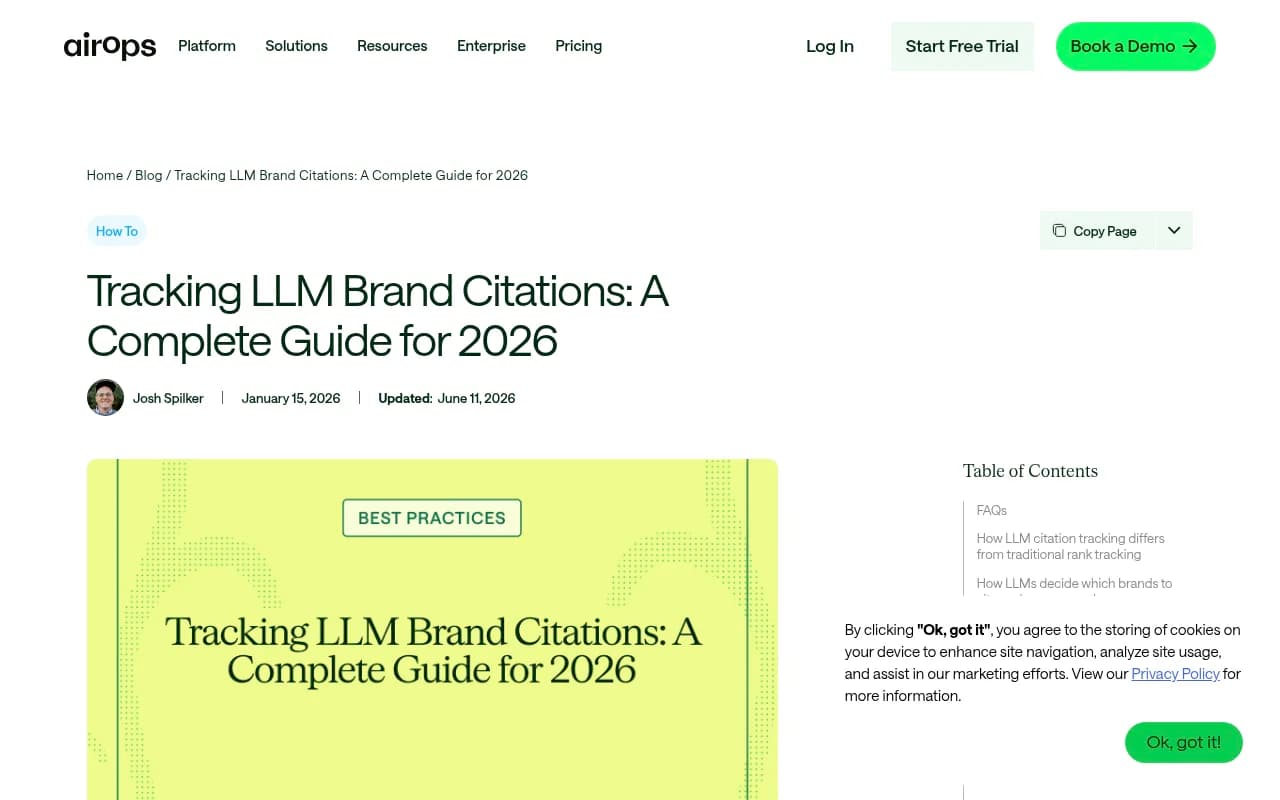
Where AirOps gets complicated is its identity. It's still partly a workflow automation tool, partly a content generation tool, and partly a monitoring tool. That breadth can be useful if you need all three, but it also means the monitoring features aren't as deep as a platform built specifically for AI visibility.
What Promptwatch actually does
Promptwatch is built from the ground up for AI search visibility and Generative Engine Optimization (GEO). It covers 10 AI models -- ChatGPT, Perplexity, Google AI Overviews, Google AI Mode, Claude, Gemini, Meta/Llama, DeepSeek, Grok, Mistral, and Copilot -- and it's used by 1,480+ brands and agencies including Booking.com and Center Parcs.
The platform is organized around a three-step loop:
- Find the gaps -- Answer Gap Analysis shows exactly which prompts competitors rank for that you don't. You see the specific topics and questions AI models want answered but can't find on your site.
- Create content that ranks -- Content Agents generate articles, listicles, and briefs grounded in real citation data, prompt volumes, and competitor analysis. Not generic AI writing, but content engineered around the specific gaps AI models are exposing.
- Track the results -- Page-level tracking shows which pages are being cited, how often, and by which models. AI Crawler Logs show when crawlers hit your site, which pages they read, and when a crawled page moves to an actual citation.

That third piece -- the crawler logs -- is something most competitors don't have. Knowing that Perplexity's crawler visited your site but never cited a specific page is genuinely actionable. It tells you the content exists but something about it isn't working. That's a very different problem than content that was never crawled at all.
Promptwatch also tracks Reddit discussions and YouTube videos that influence AI recommendations, ChatGPT Shopping appearances, and offsite citations (which third-party pages, listicles, and brand mentions are driving your AI visibility outside your own site).
Head-to-head comparison
| Feature | AirOps Insights | Promptwatch |
|---|---|---|
| AI models covered | ChatGPT, Perplexity, Gemini, Claude, Google AI | 10 models incl. Grok, DeepSeek, Mistral, Meta AI |
| Citation tracking | Yes | Yes |
| Mention vs citation gap | Yes | Yes |
| Competitive share of voice | Yes | Yes (with heatmaps) |
| AI crawler logs | No | Yes |
| Content gap analysis | Limited | Full answer gap analysis |
| AI content generation | Yes (workflow-based) | Yes (citation-grounded content agents) |
| Prompt volume & difficulty | No | Yes |
| Reddit & YouTube tracking | No | Yes |
| ChatGPT Shopping tracking | No | Yes |
| Traffic attribution | No | Yes |
| Multi-language / multi-region | Limited | Yes |
| Pricing (entry) | Not publicly listed | $99/mo (Essential) |
| Free trial | Yes | Yes |
The table tells most of the story. AirOps covers the basics of citation monitoring well. Promptwatch covers more models, goes deeper on each one, and -- critically -- gives you tools to act on what you find.
How ChatGPT and Perplexity actually decide what to cite
This is worth understanding before you pick a tool, because it shapes what you should be optimizing for.
ChatGPT tends to reward topical authority and depth. If your site has comprehensive, well-structured coverage of a topic, ChatGPT is more likely to treat it as a reliable source. Traditional SEO signals (backlinks, domain authority) matter less than whether your content actually answers the question thoroughly. Thin pages with good keyword density don't perform well here.
Perplexity behaves differently. It's more unpredictable and seems to weight freshness and specificity more heavily. A detailed, recent piece on a narrow topic can outperform a broader, older one. Perplexity also tends to pull from a wider range of sources -- Reddit threads, YouTube videos, niche publications -- which is why tracking those channels matters.
Google AI Overviews are closer to traditional SEO in their signals but still favor content that directly answers specific questions rather than content optimized around keyword density.
The practical implication: you can't optimize for all three with the same content strategy. You need to know which models are citing you (or not), for which prompts, and why. That's where the platform you choose actually matters.
Where AirOps falls short
AirOps Insights is a monitoring product. It tells you what's happening. It doesn't tell you what to do about it in any systematic way.
If you see that a competitor has 40% share of voice for "best project management tool for remote teams" and you have 5%, AirOps will show you that gap. But it won't show you which specific pages on your site are being crawled and ignored, which content topics are missing entirely, or what kind of article would actually close that gap. You're left to figure that out yourself.
The workflow automation side of AirOps can help you produce content faster, but it's not grounded in citation data or prompt intelligence. You might write a lot of content that doesn't move the needle because it's not addressing the specific gaps AI models are exposing.
There's also the coverage question. Five AI models is a reasonable start, but if you're not tracking Grok, DeepSeek, or Mistral, you're missing a growing slice of AI-driven discovery -- especially in markets outside the US.
Where Promptwatch has the edge
The crawler logs are the clearest differentiator. No other tool in this category gives you real-time visibility into which AI crawlers are hitting your site, which pages they're reading, and whether those pages are converting to citations. That's not just interesting data -- it's the difference between knowing you have a problem and knowing exactly where to fix it.
The content generation side is also more targeted. Promptwatch's Content Agents generate articles based on actual citation data and prompt volumes. If Perplexity is citing three competitors for "enterprise project management software comparison" but not you, the platform can generate a brief (or a full article) specifically designed to fill that gap -- with brand guidance, competitor context, and the specific angles AI models are already rewarding.
The traffic attribution piece matters too. Most GEO tools stop at visibility. Promptwatch connects AI citations to actual site traffic and, where possible, to revenue. That's the metric that gets budget approved.
Which one should you choose?
It depends on what stage you're at and what you actually need.
If you're just starting to understand your AI visibility and want a simple way to monitor citations and share of voice, AirOps Insights is a reasonable entry point. It's particularly useful if you're already using AirOps for content workflows and want monitoring baked in.
If you want to actually improve your AI visibility -- not just measure it -- Promptwatch is the more complete platform. The combination of crawler logs, answer gap analysis, citation-grounded content generation, and traffic attribution gives you a full loop from diagnosis to action to measurement. That's what most teams are missing.
For agencies managing multiple brands, Promptwatch's multi-site plans and white-label options are worth looking at. For enterprise teams with complex multi-region needs, the Business and Enterprise tiers cover the depth you'd need.
A few other tools worth knowing about in this space:

Profound is strong on enterprise monitoring with deep historical data, though it starts at $499/month and lacks content generation.

Peec AI is a solid monitoring-only option for research-led teams that don't need automation.
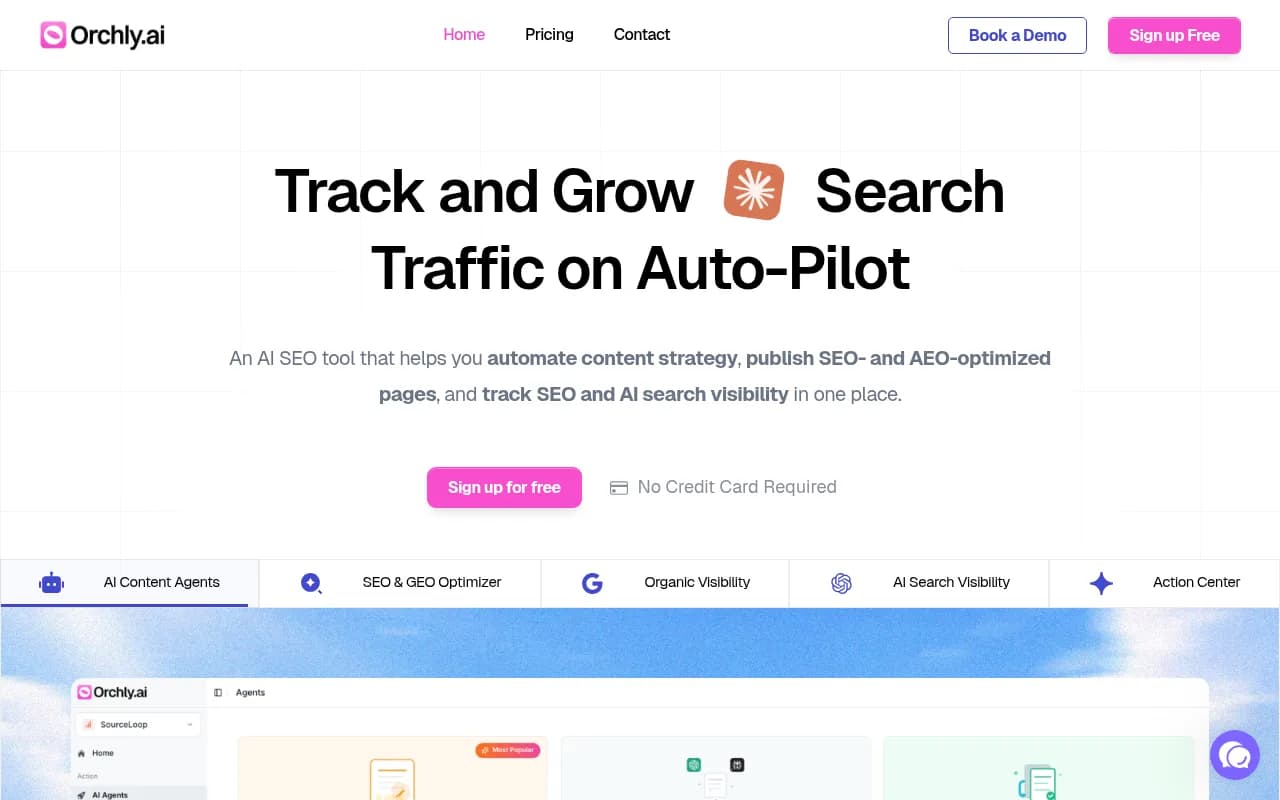
Orchly offers pre-built AI agents for content automation alongside visibility tracking, which is a similar combination to AirOps but at a lower price point.
The bottom line
Both tools track AI citations. Only one helps you get more of them.
AirOps tells you where you stand. Promptwatch tells you where you stand, why you're losing to competitors, and gives you the content tools to close the gap. In a world where AI search is driving 25% of discovery and growing, "just monitoring" is increasingly not enough.
The question isn't whether you need AI visibility tracking. You do. The question is whether you want a dashboard that shows you the problem or a platform that helps you solve it.
Promptwatch pricing starts at $99/month with a free trial. AirOps doesn't publish pricing publicly, which makes direct comparison harder -- but based on the feature gap, Promptwatch delivers more for teams focused specifically on AI search visibility.
If you're serious about getting cited in ChatGPT and Perplexity, start with the tool that was built for exactly that problem.