Key takeaways
- Most AI visibility platforms stop at monitoring -- they show you gaps but don't help you close them
- AirOps, Relixir, and Whitebox each address parts of the gap-to-citation loop, but with different strengths and tradeoffs
- Promptwatch is the only platform in this comparison that connects gap analysis, content generation, crawler logs, and AI traffic attribution in one place
- The "closed loop" question -- can you go from discovering a gap to proving a citation drove revenue? -- is the right way to evaluate any GEO tool in 2026
- Pricing and use case fit matter: AirOps suits content-heavy teams, Relixir suits B2B SaaS, Whitebox suits agencies wanting automation, and Promptwatch suits brands that want the full stack
The problem with most GEO tools in 2026
Here's the honest situation: the GEO market has exploded, and most tools are monitoring dashboards wearing optimization clothing. They'll show you a visibility score, tell you ChatGPT isn't citing your brand for a given prompt, and then... stop. What you do with that information is your problem.
That's fine if you have a content team ready to act on raw data. But for most marketing teams, the gap between "we're invisible for this prompt" and "we published something that got cited" involves a lot of manual work -- content briefs, writing, publishing, waiting, checking again. The loop is open, and it stays open.
The four platforms in this comparison -- AirOps, Promptwatch, Relixir, and Whitebox -- all claim to do more than just monitor. Let's see how far each one actually goes.
What "closing the loop" actually means
Before comparing tools, it's worth being precise about what a closed loop looks like. There are four steps:
- Discover which prompts you're missing (gap analysis)
- Understand why -- what content exists, what's cited, what's missing
- Create content specifically designed to fill those gaps
- Confirm that the new content gets crawled, cited, and drives traffic or revenue
Most platforms do step one reasonably well. Some do step two. Very few do step three. Almost none do step four in a way that connects back to steps one and two.
AirOps
AirOps started as an AI workflow platform and has evolved into something closer to a GEO content engine. Its Quill agent, launched in May 2026, generates articles and content briefs grounded in prompt data. The core idea is that you feed it your brand context, target prompts, and competitive landscape, and it produces content designed to be cited by AI models.
What AirOps does well: the content generation quality is genuinely good. Quill produces structured, well-sourced articles that follow the patterns AI models tend to cite. It also tracks LLM brand citations across ChatGPT, Perplexity, and Gemini, and its citation tracking guide (updated June 2026) is one of the more thorough public resources on the topic.
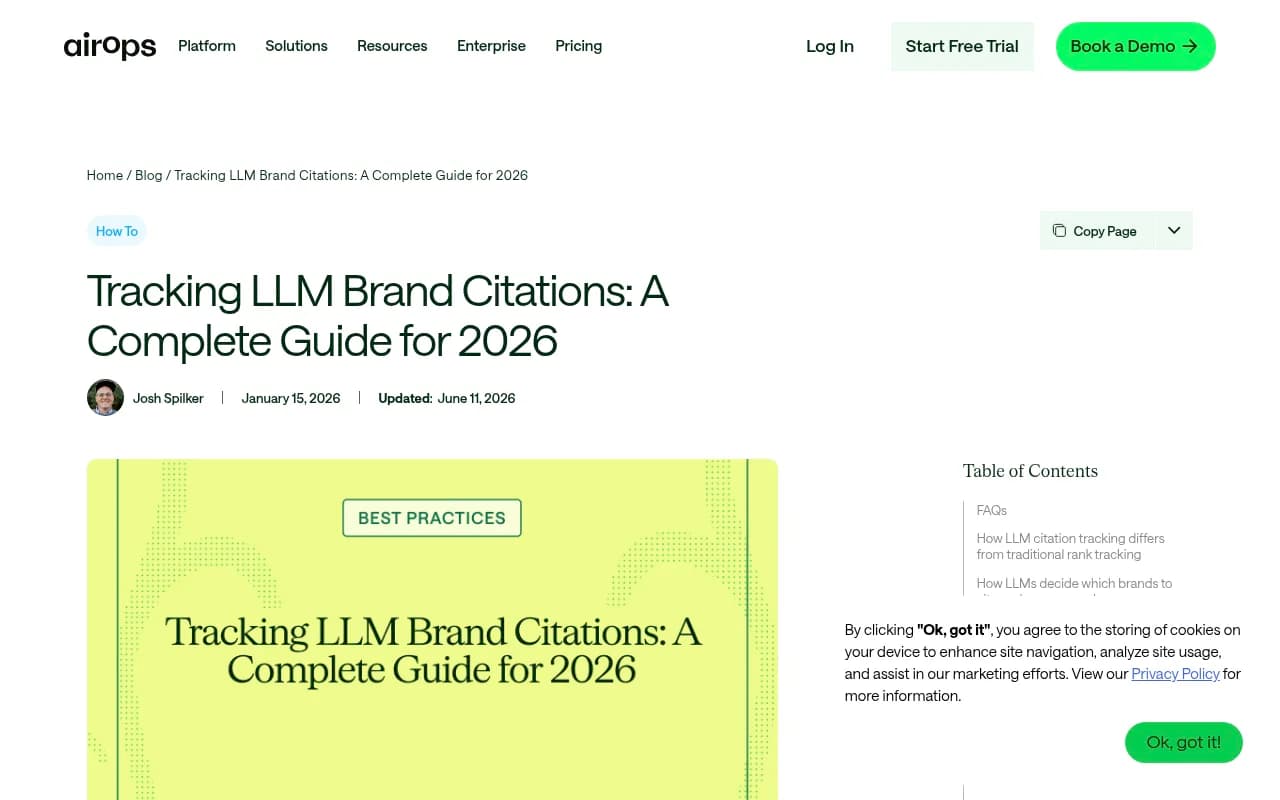
Where it falls short: AirOps closes part of the loop -- gap to content -- but the attribution side is thin. There's no crawler log integration showing when AI agents hit your new pages, and the connection between published content and citation improvement isn't tracked at the page level. You can see your overall visibility change, but proving that a specific piece of content drove a specific citation improvement requires manual correlation.
It's also worth noting that AirOps is primarily a content workflow tool that added GEO features, not a GEO platform that added content. That distinction matters when you're trying to prioritize prompts by volume and difficulty, or when you want to understand which Reddit threads are influencing AI recommendations.
Relixir
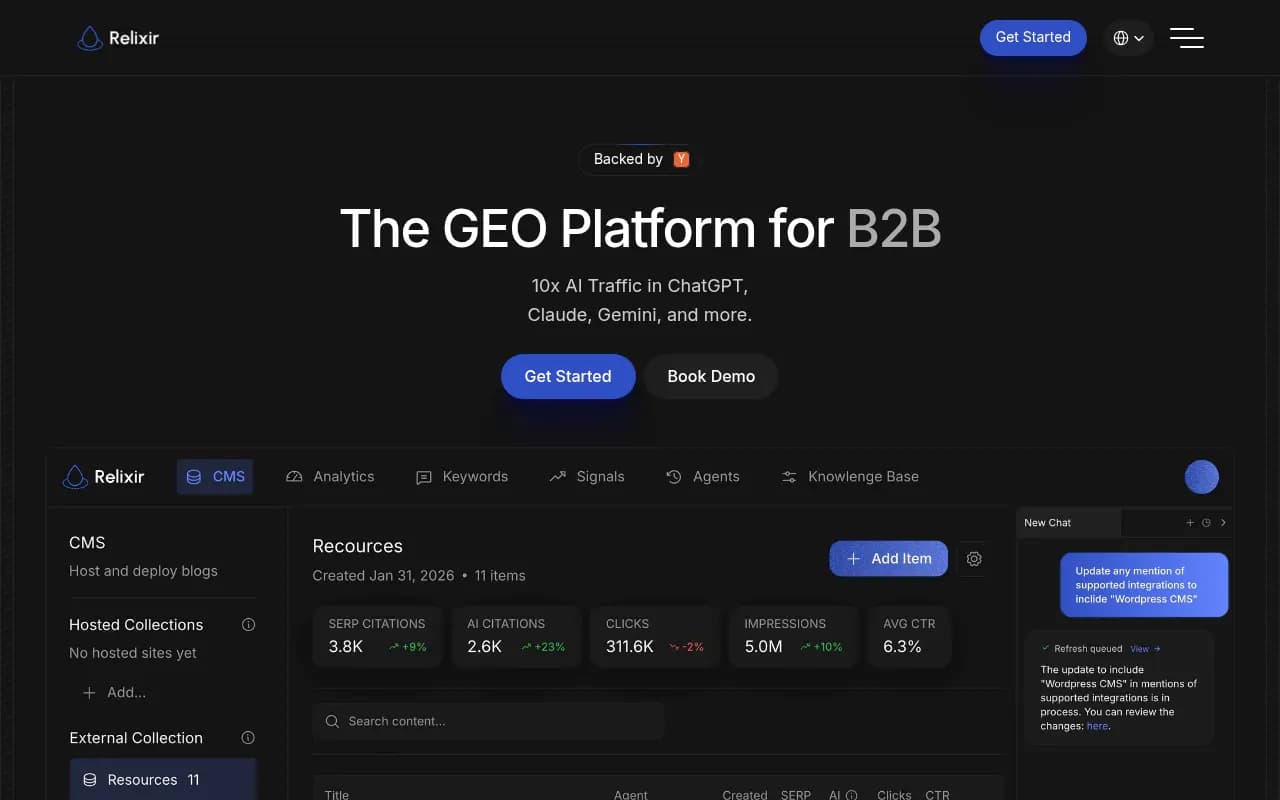
Relixir positions itself as an all-in-one GEO platform with an AI-native CMS and autonomous content capabilities. It's built specifically for B2B SaaS companies and focuses on the buyer journey -- tracking which prompts map to different stages of the funnel and generating content that intercepts buyers at each stage.
The platform's strength is its focus. Rather than trying to cover every AI model for every use case, Relixir goes deep on the B2B buying journey. It tracks competitive share of voice for buyer-intent prompts, identifies where competitors are winning, and generates content briefs and articles targeted at those specific gaps.
Relixir also has an autonomous content mode -- it can identify gaps and publish fixes without manual intervention. For B2B teams that want to set up a GEO workflow and let it run, that's genuinely useful.
The tradeoff: the autonomous approach means less control. If your brand has specific tone guidelines, regulatory constraints, or content approval workflows, fully autonomous publishing creates friction. The platform is also newer, which means the citation database and prompt volume data are thinner than what you'd get from platforms that have been running longer.
On the attribution side, Relixir tracks visibility improvements but doesn't connect them to revenue in the way that a full-stack platform would. The loop closes at "content published and visibility improved" rather than "content published, crawled, cited, and drove X conversions."
Whitebox
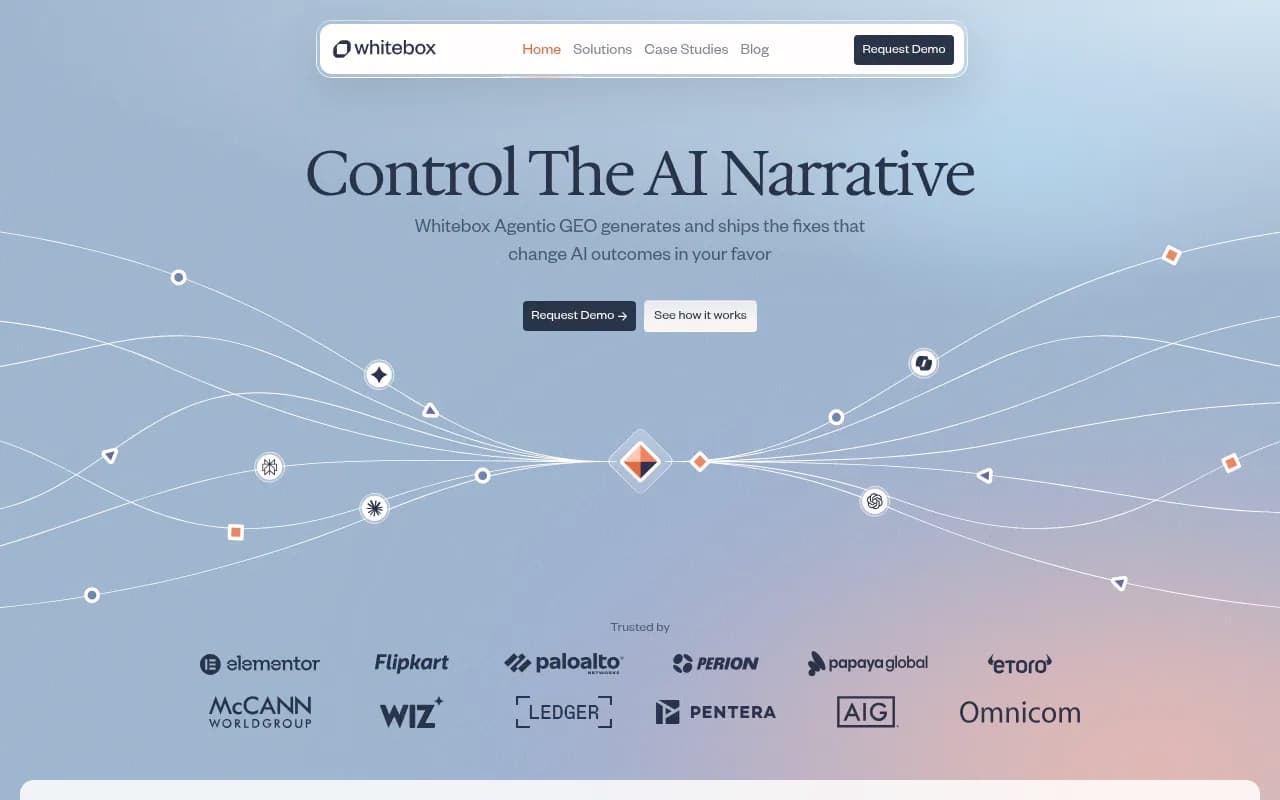
Whitebox takes a different approach: it's an agentic GEO platform that focuses on generating and shipping AI narrative fixes automatically. The idea is that AI models have specific narratives about your brand -- sometimes accurate, sometimes not -- and Whitebox identifies those narratives and creates content to correct or reinforce them.
This is a genuinely interesting angle. Most GEO tools focus on prompt coverage (are you mentioned when someone asks about your category?), but Whitebox focuses on narrative accuracy (when you are mentioned, is the description correct and favorable?). For brands dealing with outdated or inaccurate AI descriptions, that's a real problem worth solving.
The agentic automation is also a differentiator. Whitebox can identify a narrative gap, generate corrective content, and push it to publication without requiring a human in the loop for each piece. Agencies managing multiple client brands find this particularly useful.
Where Whitebox is limited: it's narrower in scope than the other platforms here. It doesn't offer the same depth of prompt tracking, citation analytics, or crawler log data. The focus on narrative fixes means it's more of a specialized tool than a full GEO platform. If you want to understand your overall AI visibility landscape -- which prompts you're winning, which competitors are outranking you, how your visibility has trended over six months -- Whitebox isn't the right primary tool.
Promptwatch
Promptwatch is built around a specific idea: monitoring without action is a waste of time. The platform's core loop is find gaps, create content, track results -- and each step connects to the next.

The gap analysis side tracks prompts across 10 AI models (ChatGPT, Perplexity, Gemini, Claude, Grok, DeepSeek, Copilot, Meta AI, Google AI Overviews, and Google AI Mode), with volume estimates and difficulty scores for each prompt. Query fan-outs show how a single prompt branches into sub-queries, which helps prioritize where to focus. Competitor heatmaps show exactly who's winning for each prompt and why.
The content side generates articles, listicles, comparisons, and briefs grounded in that real prompt data. Crucially, the content agents are informed by citation data -- they know which pages and sources AI models are already citing, so the output is structured to match those patterns rather than generic SEO content.
What makes Promptwatch different from AirOps and Relixir is what happens after you publish. The AI crawler logs show when ChatGPT, Claude, Perplexity, and other AI agents actually visit your new pages -- which pages they read, errors they encounter, how often they return. The agent analytics timeline shows the progression from publish to crawl to citation. And the AI visitor attribution connects those citations to actual traffic and revenue.
That's the closed loop. Not just "we found a gap and created content" but "we found a gap, created content, confirmed it was crawled, confirmed it was cited, and here's the traffic it drove."
A few other things worth mentioning: Promptwatch tracks Reddit threads and YouTube videos that influence AI recommendations -- a channel most competitors ignore entirely. It also has ChatGPT Shopping tracking for brands that appear in product recommendations, and offsite citation analysis that shows which third-party pages are driving AI visibility outside your own site.
Pricing runs from $99/month (Essential: 1 site, 50 prompts, 5 articles) to $579/month (Business: 5 sites, 350 prompts, 30 articles), with agency and enterprise pricing available. There's a free trial.
Side-by-side comparison
| Feature | AirOps | Relixir | Whitebox | Promptwatch |
|---|---|---|---|---|
| Prompt tracking | Yes | Yes | Limited | Yes (10 AI models) |
| Gap analysis | Yes | Yes | Narrative-focused | Yes (with volume + difficulty) |
| Content generation | Yes (Quill agent) | Yes (autonomous) | Yes (narrative fixes) | Yes (Content Agents) |
| Crawler logs / AI agent tracking | No | No | No | Yes |
| Page-level citation tracking | No | Limited | No | Yes |
| AI traffic attribution | No | Limited | No | Yes (revenue attribution) |
| Reddit / YouTube insights | No | No | No | Yes |
| ChatGPT Shopping tracking | No | No | No | Yes |
| Competitor heatmaps | Limited | Yes | No | Yes |
| Prompt volume + difficulty scoring | No | Limited | No | Yes |
| Query fan-outs | No | No | No | Yes |
| Multi-language / multi-region | Limited | No | No | Yes |
| Best for | Content-heavy teams | B2B SaaS | Agencies, narrative fixes | Full-stack GEO teams |
| Starting price | Custom | Custom | Custom | $99/month |
Which platform should you use?
The honest answer depends on what part of the loop you actually need help with.
If your main problem is content production -- you know what gaps exist and just need help writing content at scale -- AirOps is worth evaluating. Quill produces good content and the workflow integrations are solid for teams already using AirOps for other tasks.
If you're a B2B SaaS company focused specifically on buyer-journey prompts and want autonomous content generation with minimal setup, Relixir is a reasonable fit. The narrow focus is a feature, not a bug, if your use case matches.
If you're an agency managing brands with narrative accuracy problems -- AI models describing your clients incorrectly or using outdated information -- Whitebox's agentic approach to narrative fixes is genuinely useful as a specialized tool.
If you want the full loop -- gap discovery, content creation, crawler confirmation, citation tracking, and revenue attribution -- Promptwatch is the only platform in this comparison that actually delivers all of it. The crawler logs alone are something most competitors lack entirely, and the connection between published content and proven citations is what separates optimization from monitoring.
One practical note: these tools aren't necessarily mutually exclusive. Some teams use AirOps for content production volume while using Promptwatch for tracking and attribution. But if you're choosing a primary GEO platform and the closed loop matters to you, the feature table above tells the story pretty clearly.
The broader context
The GEO market in 2026 is full of platforms that do one thing well and call it a complete solution. Monitoring tools call themselves optimization platforms. Content tools call themselves GEO platforms. The terminology is loose enough that "closing the loop" can mean almost anything.
The clearest test is this: can you start with a specific prompt where a competitor is visible and you're not, and end with a confirmed citation for that prompt, with a clear line connecting the two? That's the loop. Most platforms can't draw that line.
For teams that need to prove ROI on GEO investment -- and in 2026, most teams do -- the attribution piece isn't optional. Knowing that your AI visibility score improved is useful. Knowing that the article you published three weeks ago is now being cited by Perplexity for a high-intent prompt, and that citation drove 400 visits last month, is what actually moves budget conversations.
That's the standard worth holding any GEO platform to.