Whitebox Review 2026
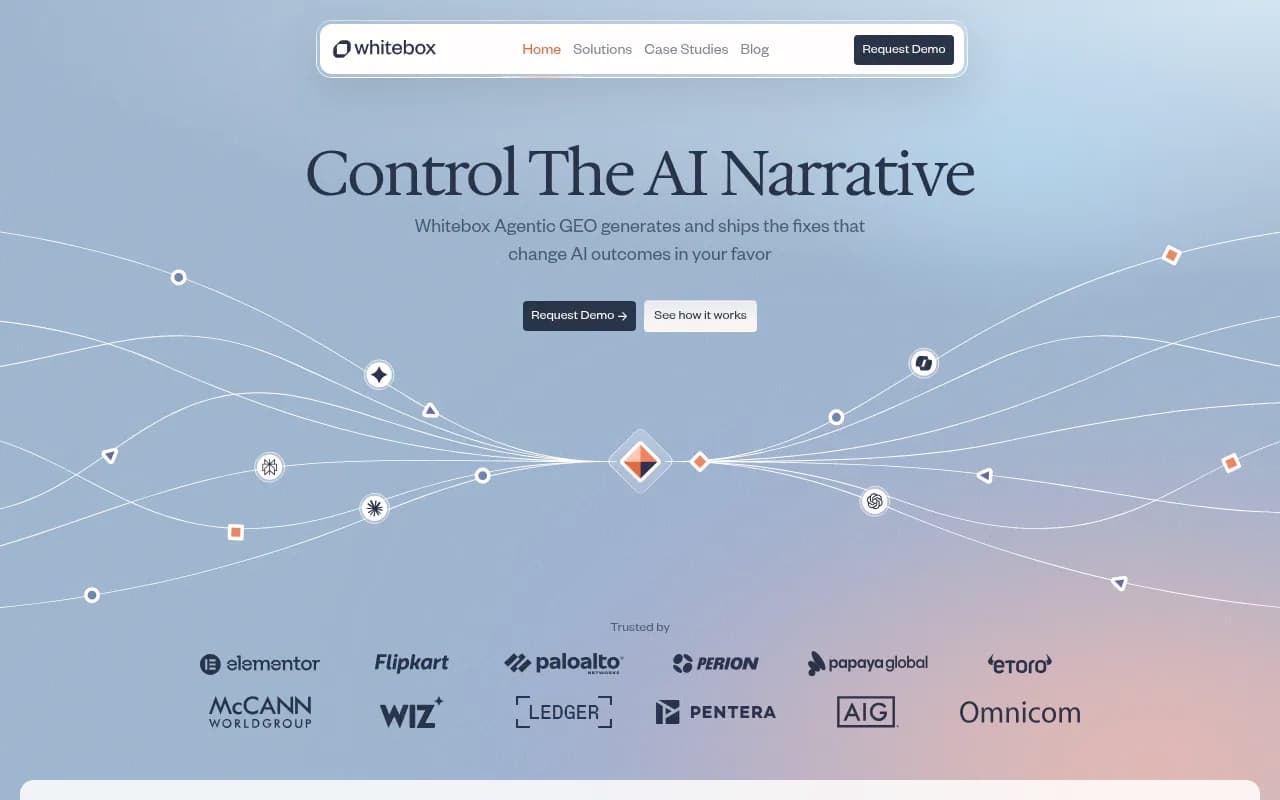
Whitebox is an AI perception intelligence platform that helps CMOs and marketing teams control how their brand appears in AI search engines like ChatGPT, Perplexity, and Claude. Unlike monitoring-only GEO tools, Whitebox identifies gaps in AI responses, generates optimized content fixes, and verifies impact before launch—closing the loop from diagnosis to solution.
Key takeaways
- Agentic approach: Whitebox doesn't just show you where your brand is missing from AI responses—it generates the specific content fixes and structured data needed to close those gaps, then verifies impact before you ship.
- Built for CMOs, not just SEO teams: Positions itself as "AI perception intelligence" rather than traditional GEO, focusing on brand narrative control and revenue growth instead of vanity metrics.
- Lacks monitoring breadth vs Promptwatch: No AI crawler logs, no traffic attribution, no Reddit/YouTube tracking, and unclear multi-model coverage compared to Promptwatch's 10+ AI engines and 880M+ citation database.
- Enterprise positioning: Custom pricing and demo-only access signal a high-touch sales model aimed at large brands (Palo Alto Networks, Flipkart, eToro) rather than self-serve SMBs.
- Content generation focus: The core differentiator is automated content creation grounded in gap analysis—similar to Promptwatch's AI writing agent but with less transparency around the underlying data and methodology.

Whitebox entered the GEO market in 2023 with a bold claim: most tools tell you where you rank in AI search results, but Whitebox shows you why and generates the fixes automatically. The platform is used by enterprise brands including Palo Alto Networks, Flipkart, eToro, Wiz, Ledger, and major agencies like McCann and Omnicom. Its pitch centers on "agentic GEO"—the idea that AI perception management should be end-to-end automated, not just a monitoring dashboard.
The target audience is explicitly CMOs and marketing leaders, not technical SEO teams. Whitebox frames the problem as brand narrative control in an era where customers meet your brand through AI before they reach your website. If you can't see how ChatGPT or Perplexity interprets your story, you can't control the outcome. That framing resonates with executives who care about revenue and reputation, not keyword rankings.
Key features
Gap Mapping: Whitebox identifies which user questions, geographic locations, and conversation flows either drop your brand entirely or position you incorrectly in AI responses. This isn't just "you're not cited for keyword X"—it's a behavioral analysis of where the AI's understanding of your brand breaks down. The platform claims to tie this to real human user behavior, not just API prompts, though specifics on data sources are vague.
Content Generation: Once gaps are identified, Whitebox generates specific page sections, content additions, and structured data markup to close them. The content is supposedly built from your brand voice and optimized for how AI models actually behave. This is similar to Promptwatch's AI writing agent, which generates articles grounded in 880M+ citations and prompt volume data. Whitebox doesn't disclose the size of its training data or citation corpus, which makes it harder to evaluate the quality of its recommendations.
Impact Verification: Before you publish anything, Whitebox tests the proposed changes against real AI platforms to predict which edits will move results and which won't. This pre-launch validation is a smart feature—it prevents you from shipping content that doesn't actually improve AI visibility. However, it's unclear which AI models are tested (ChatGPT? Perplexity? Claude? All of them?) and whether this includes regional or persona-based variations.
AI Perception Intelligence: Whitebox's branding emphasizes "scientific clarity" and "AI perception" rather than traditional SEO metrics. The platform claims to show not just where you rank, but how and why AI models think about your brand. This is a higher-level abstraction than most GEO tools, which focus on citation counts and visibility scores. The downside: less transparency into the raw data. You're trusting Whitebox's interpretation of AI behavior without seeing the underlying prompts, citation sources, or model responses.
Automated Workflow: The platform is described as "agentic," meaning it's designed to run the full optimization loop with minimal manual intervention. You get gap analysis, content recommendations, and impact predictions in one flow. This is appealing for teams that don't have dedicated GEO specialists, but it also means less control over the process. If you want to dig into specific prompts, see which Reddit threads are influencing AI responses, or track AI crawler behavior on your site, Whitebox doesn't appear to offer those capabilities.
Brand Narrative Focus: Unlike tools that optimize for individual keywords or prompts, Whitebox emphasizes controlling your brand's overall narrative across the customer journey. The messaging is about owning how AI introduces your brand to potential customers, not just ranking for transactional queries. This is a strategic positioning that appeals to brand marketers, but it's less useful for performance marketers who need granular prompt-level data.
Who is it for
Whitebox is built for enterprise marketing teams and agencies managing major brands. The client roster (Palo Alto Networks, Flipkart, eToro, Wiz, Ledger, AIG, Omnicom, McCann) signals a focus on companies with significant brand equity and large marketing budgets. If you're a CMO at a B2B SaaS company with 500+ employees, or a VP of Marketing at a consumer brand doing $100M+ in revenue, Whitebox is designed for you.
The platform is also positioned for agencies serving enterprise clients. The emphasis on brand narrative and reputation control makes it a good fit for agencies that handle strategic positioning, not just tactical SEO. If you're running GEO campaigns for Fortune 500 clients and need a tool that speaks the language of brand strategy, Whitebox fits that brief.
Who should NOT use Whitebox: SMBs, startups, and self-serve marketers. The demo-only access and custom pricing model mean this isn't a tool you can sign up for and start using today. If you're a solo founder or a small marketing team that needs to see prompt-level data, track AI crawler logs, or monitor Reddit discussions influencing AI responses, Promptwatch is a better fit. Whitebox's abstraction layer—showing you "AI perception" instead of raw citation data—is less useful when you need to understand exactly which pages are being cited and why.
Integrations and ecosystem
Whitebox doesn't publicly disclose its integrations. There's no mention of API access, Google Search Console integration, CMS plugins, or connections to analytics platforms. This is a significant gap compared to competitors like Promptwatch, which offers Looker Studio integration, API access, and traffic attribution via code snippet or server log analysis.
The lack of integration details suggests Whitebox operates as a standalone platform with a managed service component. You likely work with their team to implement recommendations rather than pushing data into your existing marketing stack. This fits the enterprise positioning but limits flexibility for teams that want to build custom workflows or export data for internal reporting.
Pricing and value
Whitebox uses custom pricing with a demo-required sales process. No public pricing tiers are available. Based on the enterprise client roster and positioning, expect pricing to start in the thousands per month, likely $2,000-$5,000+ depending on brand size and scope.
For comparison, Promptwatch offers transparent pricing starting at $99/mo for small businesses, with Professional at $249/mo and Business at $579/mo. Promptwatch's self-serve model and lower entry point make it accessible to a much wider range of companies. Whitebox's custom pricing and demo-only access signal a high-touch sales model aimed at enterprise budgets.
The value proposition depends on your needs. If you're a large brand with a dedicated marketing budget and you want a managed approach to AI narrative control, Whitebox's end-to-end service model could be worth the premium. If you need granular data, self-serve access, and the ability to track AI crawler behavior and traffic attribution, Promptwatch delivers more transparency and control at a fraction of the cost.
Strengths and limitations
Strengths:
- Agentic workflow: The automated gap-to-fix-to-verification loop is genuinely differentiated. Most GEO tools stop at showing you the problem; Whitebox generates the solution.
- Brand-level positioning: Framing the problem as "AI perception intelligence" rather than keyword rankings resonates with CMOs and brand marketers who care about narrative control.
- Enterprise credibility: The client roster (Palo Alto Networks, Flipkart, eToro, Wiz) signals that major brands trust the platform for high-stakes reputation management.
- Pre-launch testing: Impact verification before you ship content is a smart feature that prevents wasted effort on changes that don't move the needle.
Limitations:
- No AI crawler logs: Unlike Promptwatch, Whitebox doesn't show you real-time logs of AI crawlers (ChatGPT, Claude, Perplexity) hitting your website. You can't see which pages they're reading, errors they encounter, or how often they return. This is a critical blind spot for diagnosing indexing issues.
- No traffic attribution: Whitebox doesn't appear to offer visitor analytics or traffic attribution to connect AI visibility to actual revenue. Promptwatch provides code snippet, GSC integration, and server log analysis to close this loop.
- No Reddit or YouTube tracking: Promptwatch surfaces Reddit threads and YouTube videos that influence AI recommendations. Whitebox doesn't mention this capability, which means you're missing a major source of AI training data.
- Unclear multi-model coverage: Whitebox doesn't specify which AI models it monitors. Promptwatch tracks 10+ engines (ChatGPT, Perplexity, Claude, Gemini, Meta AI, DeepSeek, Grok, Mistral, Copilot, Google AI Overviews). Without this transparency, you can't be sure Whitebox covers the models your customers actually use.
- No prompt-level data: The emphasis on "AI perception" and high-level narrative means less granular insight into specific prompts, citation sources, and query fan-outs. If you need to prioritize high-value, winnable prompts, Promptwatch's prompt intelligence (volume estimates, difficulty scores, query fan-outs) is more actionable.
- No self-serve access: Demo-only and custom pricing mean you can't evaluate the platform on your own timeline. This is a barrier for smaller teams and companies that need to move fast.
Bottom line
Whitebox is a strong choice for enterprise brands and agencies that want a managed, end-to-end approach to AI narrative control and have the budget for custom pricing. The agentic workflow—gap mapping, content generation, and impact verification—is genuinely differentiated, and the brand-level positioning resonates with CMOs who care about reputation and revenue, not just rankings.
However, the platform lacks critical capabilities that Promptwatch offers: AI crawler logs, traffic attribution, Reddit/YouTube tracking, prompt-level intelligence, and transparent multi-model coverage. If you need granular data, self-serve access, and the ability to connect AI visibility to actual traffic and revenue, Promptwatch is the stronger alternative. Whitebox's abstraction layer is appealing for executives who want high-level insights, but it's less useful for teams that need to diagnose and fix specific issues at the page and prompt level.
Best use case: Enterprise brands with $5,000+/mo budgets that want a managed service approach to AI perception management and don't need deep technical visibility into AI crawler behavior or citation sources.
Frequently asked questions
What is Whitebox and what does it do?
How much does Whitebox cost?
Who is Whitebox designed for?
How is Whitebox different from other GEO tools?
Does Whitebox offer a free trial or self-serve access?
Which AI models does Whitebox monitor?
Similar and alternative tools to Whitebox