Key Takeaways
- Whitebox is enterprise-only with custom pricing and an "agentic" approach that generates fixes automatically -- AthenaHQ offers self-serve plans starting at $95/mo annual ($295/mo monthly) with more transparent pricing
- AthenaHQ tracks 8+ LLMs and provides detailed visibility dashboards -- Whitebox focuses on "AI narrative control" but doesn't publicly specify which models it monitors
- Whitebox emphasizes automated solution generation ("we generate the fixes") -- AthenaHQ gives you the data and recommendations but leaves execution to your team
- AthenaHQ has clear use-case positioning (CMO, SEO, PR, Content teams) -- Whitebox targets enterprise brands with a more opaque value proposition
- Neither platform offers a free trial -- both require demos or direct contact to get started
- For teams wanting actionable data without black-box automation, AthenaHQ is more transparent -- for enterprises wanting a managed "fix it for us" approach, Whitebox might appeal
Overview
Whitebox: Agentic AI presence management
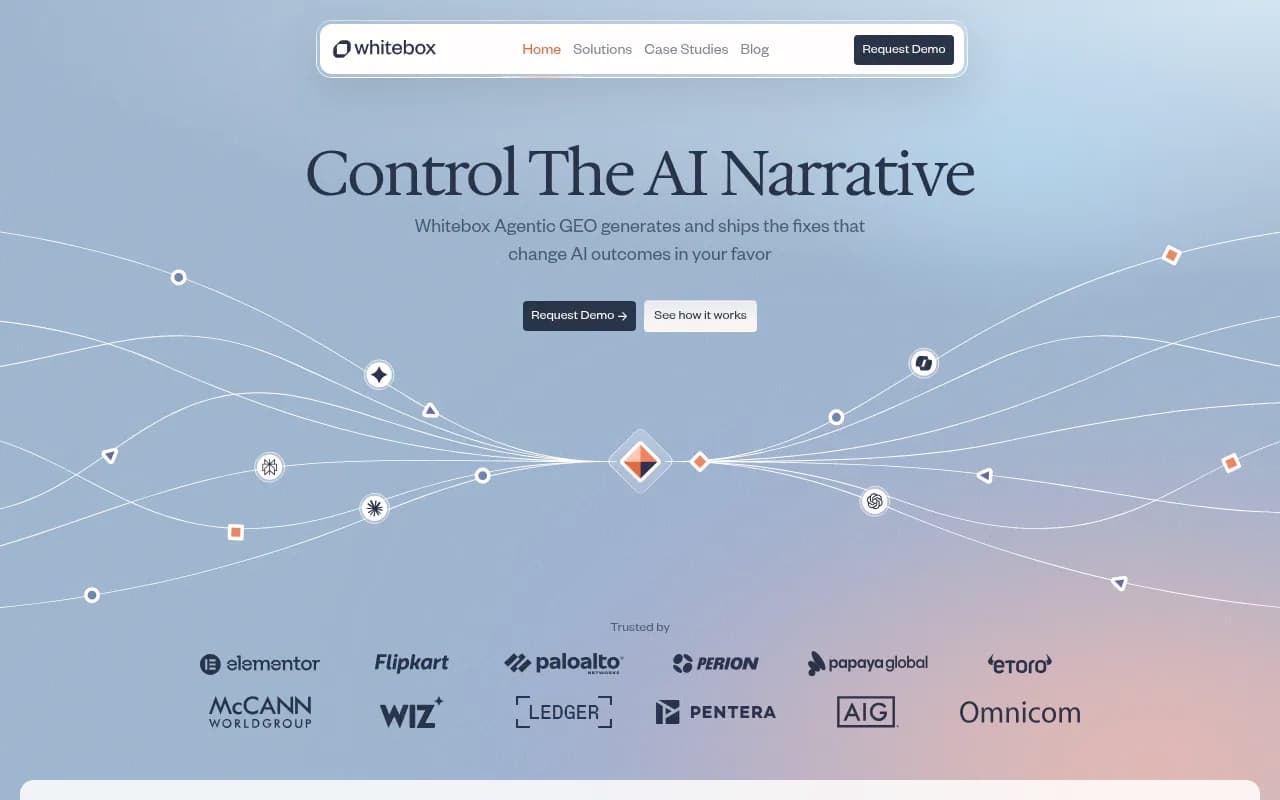
Whitebox positions itself as an "agentic GEO" platform that doesn't just show you problems -- it generates and ships fixes automatically. The pitch: "Control the AI narrative" by letting Whitebox's system diagnose why AI engines interpret your brand a certain way, then produce solutions that change outcomes in your favor. Client roster includes Elementor, Flipkart, Palo Alto Networks, eToro, Wiz, and other enterprise brands. Pricing is custom (no public tiers), and the platform requires a demo to access.
The core promise is moving from insight to action without manual work. Whitebox claims to "see the truth" (understand AI interpretation), "get the solutions" (measure real-time perception shifts), and "influence outcomes strategically." What that looks like in practice is unclear from public materials -- the site is heavy on concept, light on specifics.
AthenaHQ: End-to-end GEO platform with transparent pricing

AthenaHQ is a comprehensive AI search visibility platform that tracks how your brand appears across ChatGPT, Perplexity, Google AI Overviews, Claude, Gemini, and other LLMs. Built for marketing teams, SEO specialists, and brand managers, it offers visibility dashboards, citation source analysis, automated content optimization recommendations, and ROI tracking. Clients include ZoomInfo, SoFi, Coinbase, OneSignal, Nextiva, and Volkswagen.
Pricing starts at $95/mo (annual billing) or $295/mo (monthly). Enterprise plans available with custom pricing. No free trial, but the platform offers a 10-minute free audit. AthenaHQ has been featured in Forbes, WSJ, and backed by Y Combinator. The platform is designed for different team roles -- CMO dashboards, SEO command centers, PR monitoring, content marketing workflows, and brand tracking.
Side-by-Side Comparison
| Feature | Whitebox | AthenaHQ |
|---|---|---|
| Starting price | Custom (enterprise-only) | $95/mo annual, $295/mo monthly |
| Free trial | No (demo required) | No (free 10-min audit available) |
| LLMs tracked | Not publicly specified | 8+ (ChatGPT, Perplexity, Google AI, Claude, Gemini, etc.) |
| Core approach | Agentic automation ("we generate the fixes") | Data + recommendations (you execute) |
| Content optimization | Automated fix generation | Recommendations and guidance |
| Citation analysis | Unclear from public info | Yes (source tracking and link building) |
| ROI tracking | Not mentioned | Yes (executive dashboards) |
| Target audience | Enterprise brands | Marketing teams, SEO, PR, CMOs (mid-market to enterprise) |
| Transparency | Low (vague messaging, no pricing) | High (clear pricing, feature breakdown, use cases) |
| Self-serve option | No | Yes |
| Public case studies | Client logos only | Client logos + use-case positioning |
| Backed by | Not disclosed | Y Combinator |
Head-to-head feature breakdown
Pricing and accessibility
Whitebox doesn't publish pricing. You need to request a demo, and based on the enterprise client list (Palo Alto, Wiz, Flipkart), it's safe to assume five-figure annual contracts. This makes sense for large brands with dedicated budgets, but it locks out smaller teams entirely.
AthenaHQ offers transparent self-serve pricing: $95/mo if you pay annually, $295/mo if you go month-to-month. Enterprise plans are available for larger organizations. This makes AthenaHQ accessible to mid-market companies and startups, not just Fortune 500s.
Verdict: AthenaHQ wins on accessibility. If you're a startup or mid-sized company, Whitebox isn't an option. If you're enterprise and want white-glove service, Whitebox might be worth the premium -- but you'll need to negotiate.
AI model coverage
AthenaHQ explicitly tracks 8+ LLMs: ChatGPT, Perplexity, Google AI Overviews, Claude, Gemini, and others. This is clearly stated on their site and in their positioning.
Whitebox doesn't specify which AI engines it monitors. The messaging is abstract ("AI systems," "AI narrative") without naming models. This could mean comprehensive coverage or selective monitoring -- you won't know until you're in a sales call.
Verdict: AthenaHQ is transparent about what you're tracking. Whitebox's vagueness is a red flag if you need to know exactly which models you're optimizing for.
Optimization approach: Agentic vs. guided
This is the core philosophical difference.
Whitebox's pitch is "agentic GEO" -- the platform generates fixes and ships them automatically. The idea: you don't want to manually optimize content or tweak pages. You want a system that diagnoses the problem, creates the solution, and implements it. The site says "we generate the fixes" and "influence outcomes strategically," implying a hands-off approach where Whitebox does the work.
AthenaHQ gives you visibility, analysis, and recommendations, but you (or your team) execute. It shows you which prompts you're missing, which competitors are winning, which citation sources matter, and what content gaps exist. Then you create the content, update the pages, or adjust your strategy. It's a command center, not an autopilot.
Verdict: This depends on your team. If you want a black-box system that handles optimization for you (and you trust it), Whitebox's agentic approach might appeal. If you want control, transparency, and the ability to review changes before they go live, AthenaHQ's guided model is safer. Most teams prefer the latter -- automated "fixes" can backfire if they're not aligned with brand voice, legal requirements, or strategic priorities.
Visibility and analytics
AthenaHQ offers detailed dashboards for different roles: CMO-level ROI tracking, SEO command centers, PR monitoring, content marketing workflows, and brand visibility reports. You can see citation sources, track visibility across LLMs, analyze competitor presence, and measure the impact of optimization efforts. The platform claims a 50% reduction in time spent on AI visibility tracking.
Whitebox's analytics are described in vague terms: "see the truth," "measure real-time shifts in AI perception," "get scientific clarity." No screenshots, no specifics about what metrics you actually see or how dashboards are structured.
Verdict: AthenaHQ provides clear visibility into what you're tracking and how. Whitebox's lack of detail makes it hard to evaluate whether its analytics meet your needs.
Content and citation analysis
AthenaHQ includes citation source analysis and link building recommendations. You can see which pages, domains, and sources AI models cite when answering prompts related to your brand. This helps you understand where to publish, what to optimize, and which backlinks matter.
Whitebox mentions "influence outcomes" but doesn't explain how citation analysis works or whether it's part of the platform.
Verdict: AthenaHQ has a clear citation analysis feature. Whitebox's offering is unclear.
Team workflows and use cases
AthenaHQ explicitly positions itself for different team roles: AEO/GEO managers get a command center for workflow management, CMOs get executive dashboards with ROI tracking, SEO teams get cross-platform visibility and content optimization, PR teams get brand monitoring, content marketers get automated recommendations, and brand managers get citation analysis.
Whitebox shows client logos but doesn't explain how different teams use the platform or what workflows it supports.
Verdict: AthenaHQ is designed for multi-team use with role-specific views. Whitebox's use-case positioning is opaque.
Transparency and trust
AthenaHQ is backed by Y Combinator, featured in Forbes and WSJ, and provides clear pricing, feature lists, and use-case examples. You know what you're getting before you sign up.
Whitebox's site is visually polished but informationally sparse. No pricing, no feature breakdown, no explanation of how the "agentic" system works, no case studies beyond logos. The messaging is conceptual ("control the AI narrative") without concrete details.
Verdict: AthenaHQ is transparent. Whitebox feels like a black box -- which might be intentional for an enterprise sales model, but it makes evaluation difficult.
Pricing comparison
Since Whitebox doesn't publish pricing, we can only compare AthenaHQ's tiers:
| Plan | AthenaHQ Price | Whitebox Price |
|---|---|---|
| Self-serve (monthly) | $295/mo | Not available |
| Self-serve (annual) | $95/mo ($1,140/year) | Not available |
| Enterprise | Custom pricing | Custom pricing (demo required) |
For enterprise deals, both platforms likely negotiate based on company size, number of users, and feature requirements. AthenaHQ's advantage is that you can start self-serve and upgrade later. Whitebox requires enterprise commitment from day one.
Pros and cons
Whitebox pros
- Agentic approach could save time if automation works well
- Enterprise client roster (Palo Alto, Wiz, Flipkart) suggests it handles complex use cases
- "Generate the fixes" pitch appeals to teams that want hands-off optimization
Whitebox cons
- No public pricing (enterprise-only, likely expensive)
- Vague feature descriptions and lack of transparency
- No self-serve option or free trial
- Doesn't specify which LLMs it tracks
- Black-box automation means less control over changes
- No clear explanation of how "agentic" fixes work
AthenaHQ pros
- Transparent pricing starting at $95/mo annual
- Tracks 8+ LLMs with clear model coverage
- Role-specific dashboards for CMOs, SEO, PR, content teams
- Citation source analysis and link building recommendations
- ROI tracking and executive reporting
- Y Combinator-backed with Forbes/WSJ coverage
- Self-serve option available
AthenaHQ cons
- No free trial (only a 10-minute audit)
- You execute optimizations yourself (not fully automated)
- May require more hands-on work than Whitebox's agentic approach
- Enterprise pricing not disclosed (need to contact sales)
Who should pick which tool
Choose Whitebox if:
- You're an enterprise brand with a large budget and want a managed, hands-off approach
- You trust black-box automation and don't need to review every change
- You're willing to negotiate custom pricing and go through a lengthy sales process
- You want a platform that "generates and ships fixes" without manual execution
Choose AthenaHQ if:
- You want transparent pricing and a self-serve option
- You need clear visibility into which LLMs you're tracking and what data you're seeing
- You prefer control over optimization decisions rather than automated fixes
- You want role-specific dashboards for different team members (CMO, SEO, PR, content)
- You're a mid-market company or startup that can't afford enterprise-only pricing
- You value transparency and want to understand how the platform works before committing
Consider alternatives if:
- You want a platform that goes beyond monitoring to help you create content that ranks in AI search. Promptwatch offers content gap analysis, AI-powered content generation grounded in 880M+ citations, and page-level tracking -- closing the loop from insight to action to results. It's worth exploring if you need more than dashboards and want a tool that helps you fix visibility gaps, not just report them.

Final verdict
AthenaHQ is the safer, more transparent choice for most teams. You get clear pricing, detailed feature breakdowns, role-specific workflows, and control over your optimization strategy. The platform tells you what's wrong and gives you recommendations -- you decide how to fix it.
Whitebox's agentic approach is intriguing but risky. Automated fixes sound appealing until they conflict with your brand voice, legal requirements, or strategic priorities. The lack of transparency (no pricing, vague features, unspecified LLM coverage) makes it hard to evaluate whether the premium is justified. If you're enterprise and want a white-glove service where someone else handles optimization, Whitebox might be worth exploring -- but expect a long sales cycle and a hefty contract.
For teams that want visibility, control, and the ability to start quickly without enterprise negotiations, AthenaHQ is the clear winner in 2026.