Key Takeaways
- Whitebox positions itself as an "agentic GEO" platform that generates and ships fixes automatically, while Bluefish focuses on deep measurement and manual optimization workflows for enterprise marketing teams
- Bluefish has transparent pricing starting around $4,000/month with annual contracts, while Whitebox uses custom enterprise pricing with no public tiers
- Both platforms target Fortune 500 brands exclusively -- neither offers self-service plans or SMB-friendly pricing
- Whitebox's client roster includes Elementor, Flipkart, Palo Alto Networks, and eToro; Bluefish doesn't publicly list clients but emphasizes Fortune 500 positioning
- Bluefish offers more granular measurement tools (custom audiences, tailored prompts, Collections for campaign ROI tracking), while Whitebox emphasizes automation and "influencing outcomes strategically"
- For teams that want to understand how AI systems think and need deep control, Bluefish is the clearer choice. For teams that want automated fixes with less manual work, Whitebox's agentic approach may appeal -- though details on how it actually works are sparse
Overview
Whitebox
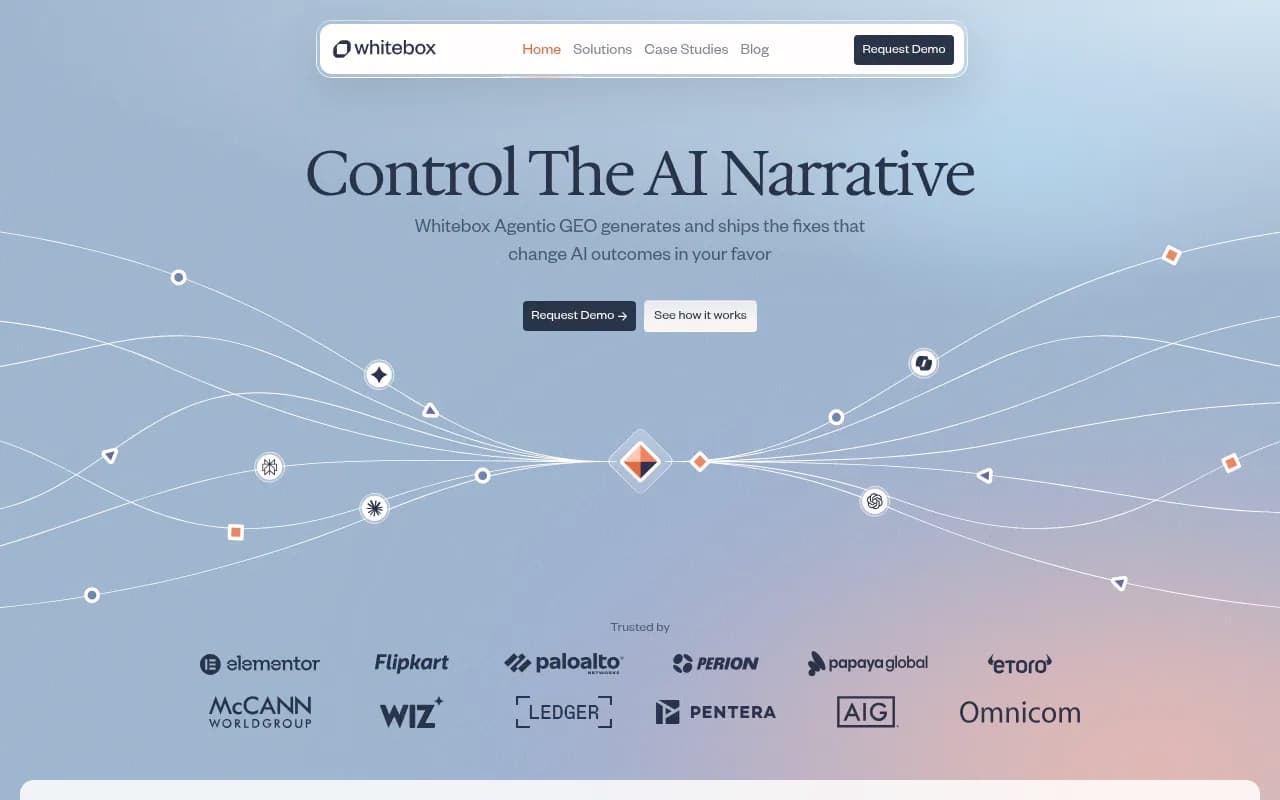
Whitebox calls itself an "end-to-end AI presence management platform" with a focus on "Agentic GEO" -- the idea that the platform generates and ships fixes that change AI outcomes in your favor. The messaging is heavy on automation: "We Generate The Fixes" is the core pitch. The platform promises to show you "the truth" about how AI systems interpret your brand, measure real-time shifts in AI perception, and influence outcomes strategically. Client logos include recognizable enterprise names like Elementor, Flipkart, Palo Alto Networks, Wiz, eToro, Ledger, and several major agencies (McCann, Omnicom). Pricing is custom and enterprise-focused with no public tiers.
Bluefish
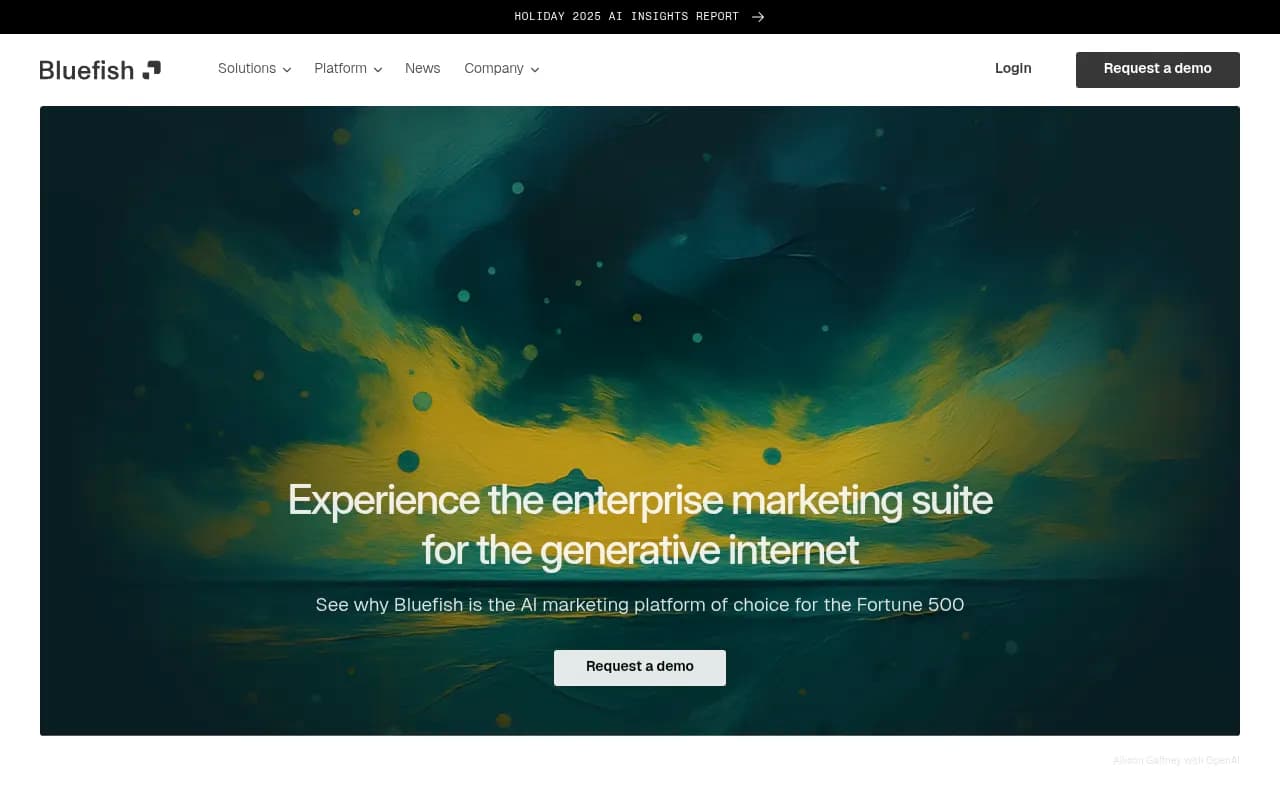
Bluefish positions itself as "the AI marketing platform of choice for the Fortune 500" with an emphasis on depth, control, and measurement. The platform covers AI monitoring, GEO optimization, GEO measurement, and AI commerce tracking across ChatGPT, Perplexity, and other AI search engines. Bluefish's differentiation centers on going "beyond superficial metrics" with custom audiences, tailored prompts, and advanced performance tools. The platform recently launched Collections for measuring ROI of digital marketing campaigns in the AI channel, and published research showing Super Bowl ads influence AI recommendations. Pricing starts around $4,000/month with annual contracts standard.
Side-by-side comparison
| Feature | Whitebox | Bluefish |
|---|---|---|
| Target market | Enterprise (Fortune 500) | Enterprise (Fortune 500) |
| Starting price | Custom (no public pricing) | ~$4,000/month |
| Free tier | No | No |
| Self-service signup | No (demo required) | No (sales contact required) |
| Core positioning | Agentic automation, fixes generation | Deep measurement, manual optimization |
| AI models tracked | Not specified | ChatGPT, Perplexity, others (not fully listed) |
| Custom audiences | Not mentioned | Yes (emphasized as differentiator) |
| Tailored prompts | Not mentioned | Yes |
| Campaign ROI tracking | Not mentioned | Yes (Collections feature) |
| Automation focus | High ("generates and ships fixes") | Lower (workflow automation mentioned) |
| Public client list | Yes (12+ logos shown) | No (generic Fortune 500 claims) |
| Research/thought leadership | Not evident | Yes (Super Bowl study, holiday reports) |
Core philosophy: automation vs measurement
The biggest difference between these platforms is what they think enterprise teams need most.
Whitebox's pitch is that you shouldn't have to manually fix AI visibility problems. The platform promises to "generate the fixes" and "ship" them for you -- an agentic approach where the software does the optimization work. The website talks about "seeing the truth," "getting the solutions," and "influencing outcomes strategically," but it's light on specifics about how the automation actually works or what you're approving before it ships changes.
Bluefish takes the opposite stance. The platform is built around giving enterprise marketing teams deep visibility and control so they can make informed decisions. Custom audiences let you segment data by buyer personas or regions. Tailored prompts let you test specific queries relevant to your business. The Collections feature tracks how specific campaigns (like a Super Bowl ad) influence AI recommendations over time. Bluefish assumes you want to understand the data and run your own optimization playbook, not hand control to an automated agent.
For teams with dedicated AI visibility resources who want to own the strategy, Bluefish's measurement-first approach makes more sense. For teams stretched thin who want a platform to handle optimization automatically, Whitebox's agentic pitch is appealing -- though you're trusting a black box to make changes on your behalf.
Feature depth and transparency
Bluefish provides more detail about what you're actually getting:
- AI monitoring with real-time visibility into brand reputation across AI native experiences
- GEO optimization tools (though specifics aren't fully detailed)
- GEO measurement frameworks that let you track performance against custom metrics
- AI commerce tracking for agentic shopping experiences
- Collections for campaign-level ROI measurement
- Custom audience segmentation
- Tailored prompt libraries
Whitebox's website is more conceptual. You get three value props -- "See the Truth," "Get the Solutions," "Influence Outcomes" -- but the actual feature set isn't broken down. The platform promises to show you "how AI systems interpret your brand and why," measure "real-time shifts in AI perception and ranking with precision," and help you "strategically influence outcomes," but there's no feature list, no screenshots of the interface, no specifics on which AI models are tracked or how the agentic fixes work.
This lack of transparency is a red flag. Enterprise buyers need to understand what they're buying before committing to a custom contract. Bluefish at least gives you a sense of the platform's capabilities even if full details require a demo.
Pricing and contract structure
| Plan type | Whitebox | Bluefish |
|---|---|---|
| Entry point | Custom (no public info) | ~$4,000/month |
| Contract length | Not specified | Annual contracts standard |
| Pricing model | Quote-based | Quote-based, scales with brands/markets/features |
| Transparency | None (must contact sales) | Ballpark figure available |
Bluefish wins on pricing transparency. Knowing the starting point is around $4,000/month helps you self-qualify before spending time on a sales call. Whitebox forces you into a demo with zero pricing guidance, which is frustrating for buyers doing initial research.
Both platforms are enterprise-only with annual contracts. Neither is accessible to small businesses or mid-market companies looking for a $500-$1,500/month solution.
If you're comparing these two and need more flexibility or a lower price point, Promptwatch offers plans starting at $99/month with self-service signup and covers similar AI visibility tracking plus content gap analysis and AI content generation.

Client proof and credibility
Whitebox shows 12 client logos on its homepage: Elementor, Flipkart, Palo Alto Networks, Perion, Papaya Global, eToro, McCann, Wiz, Ledger, Pentera, AIG, and Omnicom. This is solid social proof -- recognizable brands across fintech, cybersecurity, e-commerce, and agencies.
Bluefish doesn't show any client logos. The site repeatedly claims to be "the AI marketing platform of choice for the Fortune 500" but provides no evidence. The only named reference is "Allison Gaffney with OpenAI" in a testimonial-style callout, though no actual quote or context is provided.
Without client proof, Bluefish's Fortune 500 positioning feels like marketing copy rather than validated reality. Whitebox at least backs up its enterprise claims with recognizable names.
Thought leadership and market intelligence
Bluefish publishes research and insights:
- A study proving Super Bowl ads influence AI recommendations (February 2026)
- Holiday 2025 AI Insights Report
- Blog posts on market intelligence and product updates
This content signals that Bluefish is actively researching how AI systems work and sharing findings with the market. It's a credibility builder.
Whitebox's website has no blog, no research, no thought leadership content. The site is purely product-focused with conceptual messaging. For enterprise buyers who want a vendor that understands the AI visibility landscape deeply, Bluefish's content output is a differentiator.
Enterprise readiness and infosec
Bluefish explicitly mentions passing infosec reviews "with ease" and being "built for enterprise" with customization options for data teams. This is important for Fortune 500 buyers who need SOC 2 compliance, SSO, custom data retention policies, and other enterprise requirements.
Whitebox doesn't mention security, compliance, or enterprise IT requirements anywhere on the site. For a platform targeting Palo Alto Networks and AIG, this is a surprising omission. Enterprise buyers will need to ask about this in the sales process.
Use case fit
Choose Whitebox if:
- You want a platform that automates optimization rather than requiring manual work
- You're comfortable with less transparency about how the automation works
- You prefer a vendor with public client proof (recognizable logos)
- You're willing to go through a custom pricing process with no ballpark guidance
Choose Bluefish if:
- You want deep measurement tools and control over your optimization strategy
- You need custom audiences, tailored prompts, and campaign-level ROI tracking
- You value thought leadership and market research from your vendor
- You want a rough sense of pricing before engaging sales (~$4,000/month starting point)
- You need a platform explicitly built for enterprise infosec requirements
Pros and cons
Whitebox pros:
- Agentic automation could save time for resource-constrained teams
- Strong client roster with recognizable enterprise brands
- Positioning around "generating fixes" is differentiated
Whitebox cons:
- No pricing transparency whatsoever
- Extremely light on feature details and platform specifics
- No thought leadership or market research content
- Unclear which AI models are tracked
- No mention of security, compliance, or enterprise IT requirements
- Automation black box -- unclear what you're approving vs what happens automatically
Bluefish pros:
- Deep measurement tools (custom audiences, tailored prompts, Collections)
- Pricing ballpark available (~$4,000/month)
- Active thought leadership (Super Bowl study, holiday reports)
- Explicit focus on enterprise infosec and data team needs
- More transparent about platform capabilities
Bluefish cons:
- No public client logos or proof points
- Generic Fortune 500 positioning without evidence
- Less emphasis on automation -- more manual optimization work required
- Annual contracts lock you in
- Still expensive for mid-market companies
Final verdict
Bluefish is the safer choice for enterprise teams that want to understand their AI visibility data and run their own optimization strategies. The platform provides more transparency about features, pricing, and enterprise readiness. The thought leadership content (Super Bowl study, holiday reports) shows Bluefish is actively researching the space. Custom audiences, tailored prompts, and Collections give you the control to segment data and measure campaign impact.
Whitebox's agentic automation pitch is interesting but undercut by a lack of detail. The website doesn't explain how the automation works, which AI models are tracked, or what you're approving before fixes ship. The client roster is impressive, but without feature transparency or pricing guidance, it's hard to evaluate whether the platform delivers on its promises. If you're considering Whitebox, push hard in the demo for specifics on the automation workflow and what level of control you retain.
For most enterprise marketing teams, Bluefish's measurement-first approach aligns better with how sophisticated buyers want to operate -- understand the data, test hypotheses, measure results, iterate. Whitebox's automation may appeal to smaller teams that want to offload the work, but the lack of transparency makes it a riskier bet.