Key takeaways
- Most brands see their first AI citations within 4-8 weeks of publishing well-structured content, but consistent, measurable traffic typically takes 3-6 months.
- AI search traffic converts at roughly 14x the rate of traditional organic -- so even small citation gains are worth chasing.
- Traditional SEO timelines and AI visibility timelines are different problems. A page can rank #1 on Google and still get zero AI citations, and vice versa.
- Sites that published large volumes of unedited AI content saw traffic drops of 40-90% in 2026 core updates. Volume is not the strategy.
- Tracking your progress requires purpose-built tools -- Google Analytics alone won't show you which AI models are citing your content or why.
There's a question every content team asks after publishing something new: "When will this start working?"
For traditional SEO, the answer has been roughly understood for years. You wait. Three months for early signals, six months for real traction, a year for compounding returns. Frustrating, but predictable.
AI search visibility is a different beast. The timeline looks similar on the surface, but the mechanics underneath are completely different. You're not waiting for Google to crawl and index a page and slowly build PageRank. You're waiting for language models to encounter your content, decide it's credible enough to cite, and then actually surface it in response to relevant prompts.
That process has its own rhythm. And in 2026, with AI search traffic up 527% year over year according to Semrush's analysis of the Previsible AI Traffic Report, understanding that rhythm is no longer optional.
Here's what the timeline actually looks like.
Phase 1: The first 30 days -- crawling and indexing by AI
Before any AI model can cite your content, it needs to know the content exists. This sounds obvious, but it's where a lot of brands get stuck.
AI crawlers -- the bots that ChatGPT, Perplexity, Claude, and others send to read the web -- don't behave like Googlebot. They have different crawl frequencies, different priorities, and different signals they're looking for. A page that gets indexed by Google within 48 hours might not be read by an AI crawler for weeks.
What happens in month one:
- AI crawlers discover your new page (usually through links from already-indexed pages, sitemaps, or high-authority domains linking to you)
- The content gets processed and added to training or retrieval systems
- Early, low-confidence citations might appear in some AI responses, but they're inconsistent
You probably won't see measurable traffic from AI sources in the first 30 days. That's normal. What you should be doing during this window is making sure AI crawlers can actually access your content -- no crawler blocks in robots.txt, clean page structure, fast load times, and schema markup that helps models understand what the page is about.
One underrated move: check your AI crawler logs. Most teams have no idea which AI bots are visiting their site, which pages they're reading, and whether they're hitting errors. Tools like Promptwatch surface this in real time, showing you exactly which crawlers visited, what they read, and what went wrong.

Phase 2: Weeks 4-12 -- first citations appear
This is when things start getting interesting.
If your content is well-structured, answers real questions with genuine specificity, and covers a topic that AI models are regularly asked about, you'll start seeing it cited. Not consistently -- more like occasional appearances in responses to relevant prompts.
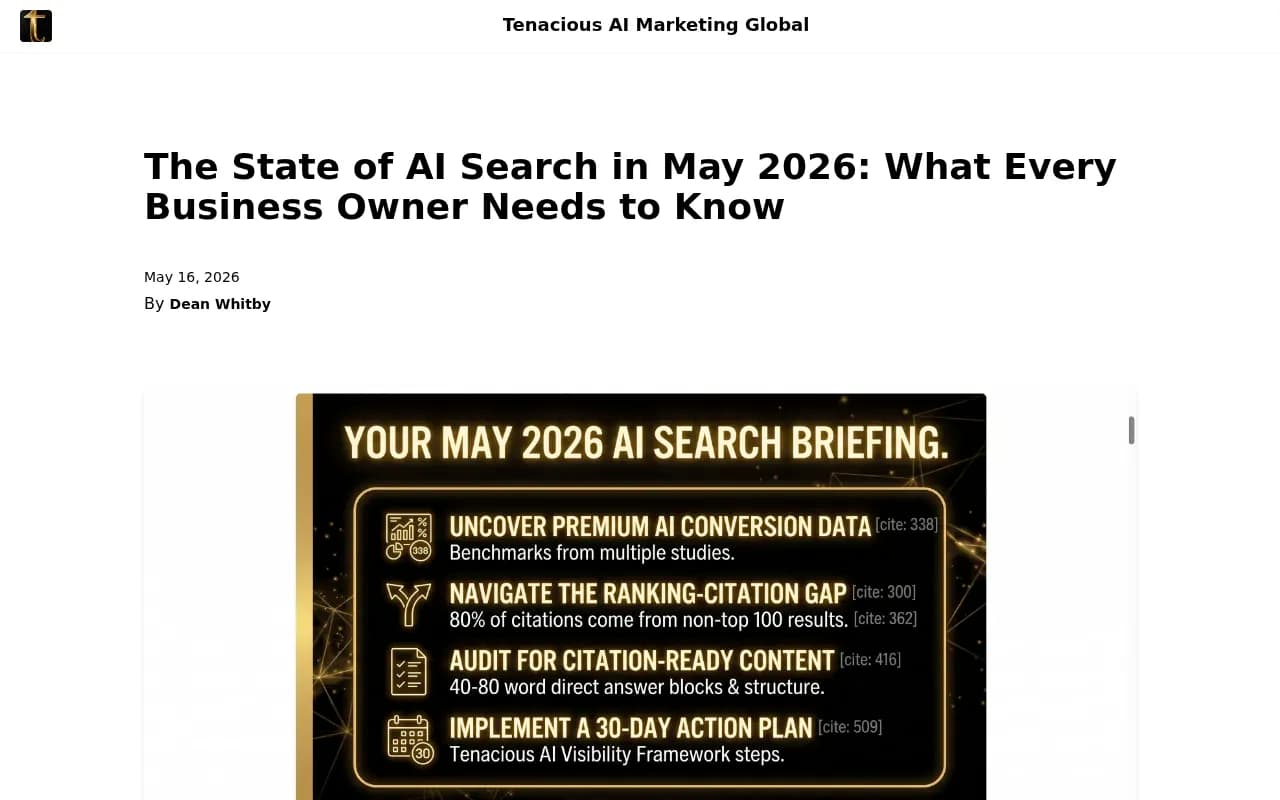
The research from the State of AI Search in May 2026 is worth sitting with here: up to 80% of AI citations come from pages that don't appear in the traditional top 100 Google results. That's not a typo. AI models are pulling from a completely different pool of sources than Google's ranking algorithm favors. Your Google rank and your AI visibility are separate problems.
What drives early citations in this phase:
- Content that directly answers specific questions (not vague overviews, but actual answers)
- Pages with clear structure -- headers that match how people prompt AI models
- Original data, statistics, or perspectives that aren't available elsewhere
- Author credibility signals (bylines, expertise markers, linked credentials)
- Citations from other credible sources pointing to your content
What doesn't work: publishing thin, generic content at high volume. Sites that went heavy on unedited AI-generated articles saw traffic drops of 40-90% in Google's 2026 core updates, and AI models are increasingly skeptical of the same content. The bar is specificity and genuine insight, not word count.
What to track during this phase
You need to know whether citations are actually happening. Your Google Analytics dashboard won't tell you -- AI traffic often shows up as direct traffic or gets misattributed. You need tools that specifically monitor AI model responses for your brand and content.
Several platforms in the market track this. For monitoring-focused needs, tools like Otterly.AI and Peec AI provide basic citation tracking.


For teams that want to go deeper -- seeing which specific prompts trigger citations, how often, and from which models -- you need something more comprehensive.
Phase 3: Months 3-6 -- building consistent visibility
This is the phase where the work either compounds or stalls.
If your initial content is getting cited, you now have data to work with. You can see which prompts are surfacing your pages, which competitors are appearing for prompts you're missing, and where the gaps are. That data should drive your next round of content.
If your content isn't getting cited, this is the phase to diagnose why. Common reasons:
- The content covers topics AI models aren't being asked about (prompt research matters as much as keyword research now)
- Competitors have more comprehensive, more credible coverage of the same topics
- Your site lacks the authority signals AI models look for (external citations, mentions in credible sources, Reddit/forum discussions)
- Technical issues are preventing AI crawlers from properly reading your content
The 3-6 month window is where most teams see their first meaningful AI traffic numbers. Brandlume's 2026 analysis puts the typical window for "AI-focused results" at 3-6 months of consistent implementation -- which aligns with what traditional SEO timelines look like, but for different reasons.
The content gap problem
One of the most common mistakes at this stage: teams keep publishing content on topics they already cover instead of filling the gaps where competitors are visible and they're not.
Answer Gap Analysis -- looking at which prompts your competitors appear for that you don't -- is how you find the high-value opportunities. It's the difference between guessing what to write next and knowing exactly what AI models want to cite but can't find on your site.
Tools like AthenaHQ and Profound also offer visibility monitoring that can surface competitive gaps.


Phase 4: Months 6-12 -- consistent traffic and compounding returns
By month six, brands that have been doing this properly start seeing something interesting: the returns compound.
Each piece of content that gets cited builds your site's credibility with AI models. That credibility makes future content more likely to be cited. You're building what some call "AI authority" -- a track record that models use as a signal when deciding what to surface.
The conversion numbers make this worth the patience. Traffic from AI citations converts at 14.2% on average, compared to 2.8% from traditional Google organic, according to AEO Engine's 2026 analysis. The reason is intent: someone who asks an AI model a specific question and gets directed to your site is further along in their decision process than someone who clicked a blue link.
So even if your AI traffic volume is modest compared to your organic numbers, the revenue impact can be disproportionate.
What the 6-12 month period looks like for brands doing this well:
- Stable citation rates across multiple AI models (not just one)
- Measurable traffic from AI sources showing up in attribution reports
- Specific pages becoming reliable citation sources for particular topics
- Visibility in AI models starting to influence brand awareness, even when users don't click through
The visibility-without-clicks problem
This is something the research from LinkedIn's 2026 growth analysis captures well: growth in 2026 is increasingly about visibility, not raw traffic. AI models often answer questions without sending users anywhere. Your brand gets mentioned, the user gets an answer, no click happens.
That's not a failure -- it's a new form of brand exposure. But it means your measurement framework needs to account for it. Tracking only traffic will undercount the value of AI visibility.
What actually accelerates the timeline
Some factors genuinely speed up how quickly you go from published to cited. Others are myths.
What works
Specificity over breadth. A 1,200-word article that directly answers one specific question outperforms a 3,000-word overview that touches on ten things. AI models are looking for the clearest, most direct answer to a specific prompt.
Original data and research. If your content contains a statistic, finding, or perspective that doesn't exist anywhere else, AI models have a reason to cite you specifically. Generic content that rephrases what's already online gives them no reason to choose you.
Structured content. Headers that match how people phrase prompts, FAQ sections, clear definitions, and numbered steps all make it easier for AI models to extract and cite your content.
Building topical depth. One article rarely drives consistent AI citations. A cluster of content that covers a topic from multiple angles -- including the questions people ask before and after the main topic -- builds the kind of topical authority AI models respond to.
External mentions and citations. AI models pay attention to what other credible sources say about you. Getting cited in industry publications, mentioned in Reddit threads, or referenced in YouTube videos all contribute to your AI visibility. This is a channel most SEO teams ignore entirely.
What doesn't work
Publishing at high volume without quality controls. The 40-90% traffic drops seen by sites with 1,000+ unedited AI articles in 2026 are a clear signal.
Optimizing only for Google. Your Google ranking and your AI visibility are separate problems with separate solutions. Treating them as the same thing means you're probably neglecting one of them.
Waiting for results without tracking. The teams that improve fastest are the ones that can see what's working and double down on it. Flying blind for six months and then checking your analytics is not a strategy.
The measurement problem
Here's the honest challenge: measuring AI visibility progress is genuinely hard.
Google Analytics doesn't break out AI referral traffic cleanly. Many AI interactions don't result in clicks at all. Different AI models have different citation patterns, and what works for ChatGPT might not work for Perplexity.
You need a measurement stack that specifically addresses AI visibility. At minimum:
- Track which AI models are citing your content and for which prompts
- Monitor your brand mentions in AI responses (including responses that don't send traffic)
- Attribute revenue to AI-sourced traffic separately from organic
- Watch competitor visibility to understand where you're losing ground
Several tools in the market address different parts of this. Here's how the main options compare:
| Tool | Citation tracking | Content gap analysis | AI content generation | Crawler logs | Traffic attribution |
|---|---|---|---|---|---|
| Promptwatch | Yes | Yes | Yes | Yes | Yes |
| AthenaHQ | Yes | Limited | No | No | No |
| Profound | Yes | Limited | No | No | No |
| Otterly.AI | Basic | No | No | No | No |
| Peec AI | Basic | No | No | No | No |
| Rankscale | Yes | No | No | No | No |
| SE Ranking | Yes | No | No | No | No |
The core difference between monitoring-only tools and a full optimization platform is what happens after you see the data. Knowing you're invisible for a set of prompts is step one. Having a path to fix it -- through content gap analysis, AI-grounded content creation, and closed-loop tracking -- is what actually moves the needle.
A realistic timeline summary
| Timeframe | What to expect | What to focus on |
|---|---|---|
| 0-4 weeks | No measurable AI traffic; crawlers discovering content | Technical setup, crawler access, schema markup |
| 4-12 weeks | First inconsistent citations; early visibility signals | Content quality, prompt research, gap analysis |
| 3-6 months | Consistent citations for target topics; first AI traffic | Content clusters, external mentions, tracking setup |
| 6-12 months | Compounding visibility; measurable revenue impact | Optimization, expanding to new topics, attribution |
The teams that get to month six with real results are the ones that treated AI visibility as a distinct discipline from traditional SEO -- with its own research methods, its own content standards, and its own measurement tools. The teams that struggle are the ones that assumed their existing SEO work would carry over automatically.
It mostly doesn't. But the work is learnable, and the conversion rates on the other end make it worth doing properly.