Key takeaways
- AI search traffic grew 527% year-over-year, but most brands see flat dashboards for the first 3-4 months -- that's normal, not failure
- Months 1-3 are about foundation: crawler access, content gaps, and baseline measurement. Don't expect citation spikes yet
- The 6-month mark is when content investments start paying off -- brands publishing AI-optimized content consistently see measurable visibility gains by month 5-7
- At 12 months, the gap between brands that acted and brands that only monitored becomes stark and hard to close
- Traffic is no longer the primary KPI -- citation rate, share of voice across LLMs, and AI-driven conversions matter more
Something counterintuitive is happening in 2026: brands are investing in AI search visibility, watching their dashboards for months, seeing almost nothing change, and concluding the whole thing is a waste of time. Then they cancel their subscriptions.
Most of them were actually on track. They just didn't know what "on track" looks like.
AI search visibility doesn't behave like traditional SEO. The feedback loops are different, the signals are different, and the timeline for results is different. A brand that starts optimizing for ChatGPT and Perplexity in January shouldn't expect to see meaningful citation growth in February. But by August? The brands that started in January should be pulling away from the ones that started in June.
This guide breaks down what realistic growth actually looks like at three checkpoints -- 3 months, 6 months, and 12 months -- and gives you concrete benchmarks to measure against.
Why AI search benchmarks matter right now
AI search traffic grew 527% in a single year, according to Semrush's 2026 data. That's not a gradual shift -- it's a structural change in how people find information, compare products, and make decisions.
60% of B2B buyers now use ChatGPT, Perplexity, or Gemini to build vendor shortlists before they ever visit a website. 99.9% of informational keywords trigger an AI Overview. And when someone does click through from an AI answer, they convert at 4.4x the rate of traditional organic visitors.
The problem is that most teams are still measuring this with traditional SEO metrics. They look at organic traffic, check rankings, and declare AI search "not moving the needle." But AI visibility doesn't show up in Google Search Console. A brand can be cited in thousands of ChatGPT responses per month and see zero attribution in their analytics -- because the user never clicked.
This is why benchmarks specific to AI search matter. You need to know what good looks like, and when to expect it.
The baseline: what you should have before measuring anything
Before talking about growth timelines, there's a prerequisite conversation. If you don't have the right foundation in place, no benchmark applies to you -- you're not on a growth curve yet, you're still in setup.
The foundation has three parts:
Crawler access. AI models need to be able to read your content. If your robots.txt is blocking GPTBot, ClaudeBot, or PerplexityBot, you're invisible by design. Check your crawler logs to see which AI agents are actually hitting your site and which pages they're reading. Most teams have never looked at this.
Prompt coverage. You need to know which prompts your customers are actually asking AI models. Not keyword lists -- actual conversational queries. "What's the best project management tool for remote teams?" is a prompt. "project management software" is a keyword. These require different content strategies.
A measurement baseline. You can't measure growth without a starting point. Run a baseline audit: which prompts is your brand cited for today, across which models, at what frequency? This is your month-zero number.
Tools like Promptwatch can pull all three of these together -- crawler logs, prompt tracking, and baseline citation data -- before you start any optimization work.

Months 1-3: the foundation phase
This is the phase where most teams get discouraged. The dashboard looks flat. Nothing seems to be happening. The temptation is to conclude that AI search optimization doesn't work.
What's actually happening is that you're building infrastructure that AI models can't cite yet -- because the content doesn't exist, or the crawlers haven't found it, or the models haven't updated their training or retrieval indexes.
What good looks like at 3 months
At the 3-month mark, you should be measuring inputs, not outputs. The output metrics (citation rate, share of voice, AI-driven traffic) are too early to be meaningful. What you want to see:
- Crawler access confirmed for at least the major AI agents (GPTBot, ClaudeBot, PerplexityBot, Google's AI crawler)
- A documented prompt universe of 50-150 queries your target customers are asking AI models
- A content gap analysis showing which of those prompts your site currently has no good answer for
- At least 8-12 pieces of AI-optimized content published (long-form, FAQ-dense, schema-rich)
- A baseline citation score established so you have something to measure against
Citation rate growth in months 1-3 is typically minimal -- 5-15% improvement over baseline at best. If you're seeing that, you're ahead of schedule. If you're seeing nothing, check whether your content is actually being crawled.
One data point worth keeping in mind: Averi's team documented 10.6M Google impressions over 12 months, with most of the non-branded query growth showing as flat for the first 4 months. That's a real-world example of what the early phase looks like even when the strategy is working.
What bad looks like at 3 months
- No baseline established (you don't know your starting point)
- Content published without prompt research (writing for topics you think matter vs. topics AI models are actually being asked about)
- Crawler access not verified
- Measuring only traditional organic traffic and concluding AI search isn't working
Months 4-6: the inflection phase
This is where things start to move. Content published in months 1-3 has had time to be crawled, indexed in retrieval systems, and tested by AI models. If the content is genuinely useful -- specific, well-structured, answering real questions -- citation rates start climbing.
Kevin Indig's State of AI Search Optimization 2026 report frames this well: AI models are shifting from ranked lists to definitive answers. The content that gets cited isn't the content that ranks #1 for a keyword -- it's the content that most directly answers the specific question being asked. That takes time to build, and it takes time for models to discover it.
What good looks like at 6 months
At 6 months, you should be measuring outputs alongside inputs. Concrete benchmarks for a brand that started with a solid foundation:
- 20-40% improvement in citation rate across tracked prompts (vs. month-zero baseline)
- Visibility in at least 3-4 AI models for your core prompt set (ChatGPT, Perplexity, Gemini, and one other)
- Share of voice improvement of 10-25 percentage points for your primary category
- Some AI-attributed traffic showing up in analytics (even if small -- the trend matters more than the absolute number)
- Competitor heatmap showing you've closed gaps on 2-3 prompts where competitors were previously dominating
The 6-month mark is also when you should be doing your first serious content audit. Which pieces are getting cited? Which aren't? The answer tells you what to double down on and what to rewrite.
What bad looks like at 6 months
- Citation rate still at baseline (suggests content quality or crawler access issues)
- Visibility concentrated in only one AI model (fragile -- model behavior changes)
- No competitor comparison (you might be growing but still losing share)
- Still measuring only traffic (missing the actual signal)
Months 7-12: the compounding phase
This is where the gap between brands that acted and brands that only monitored becomes visible and painful. AI search visibility compounds in a way that's similar to traditional SEO -- but faster, and more winner-take-most.
Here's why: AI models develop preferences. When a model has cited a particular source repeatedly for a particular type of query, it tends to keep citing that source. The brand that built 50 well-cited pages in months 1-6 isn't just ahead -- it's harder to displace, because the model has a track record with that content.
Brands that spent months 1-6 watching dashboards without publishing content are now trying to catch up against a competitor that has a 6-month head start and compounding citation momentum.
What good looks like at 12 months
At 12 months, a brand with a consistent AI search strategy should be seeing:
- 60-120% improvement in citation rate vs. month-zero baseline (this varies significantly by industry and starting point)
- Top-3 share of voice in their primary category across at least 2-3 major AI models
- AI-attributed traffic that's measurable and growing month-over-month
- A clear content moat: pages that are consistently cited across multiple models for high-value prompts
- Attribution data connecting AI visibility to actual pipeline or revenue
The brands hitting the top end of these ranges are typically the ones that paired tracking with content production from day one -- not the ones that monitored for 6 months and then started creating content.
What bad looks like at 12 months
- Citation rate improved but concentrated in low-intent prompts (lots of visibility, no conversions)
- Strong in one model, invisible in others (ChatGPT visibility doesn't automatically transfer to Perplexity)
- No attribution data (you can't connect visibility to revenue, so you can't justify continued investment)
- Content published but not updated (70% of AI-cited pages were updated within the last year -- stale content loses citations)
Benchmark summary table
| Metric | Month 3 (foundation) | Month 6 (inflection) | Month 12 (compounding) |
|---|---|---|---|
| Citation rate vs. baseline | +5-15% | +20-40% | +60-120% |
| AI models with visibility | 1-2 | 3-4 | 4-6 |
| Share of voice improvement | Minimal | +10-25 pts | +30-50 pts |
| AI-attributed traffic | Negligible | Emerging | Measurable + growing |
| Content published | 8-12 pieces | 25-40 pieces | 60-100+ pieces |
| Competitor gaps closed | 0-2 prompts | 3-8 prompts | 15-30+ prompts |
These ranges assume a consistent content strategy, proper crawler access, and active optimization -- not just monitoring. Brands in competitive categories (fintech, SaaS, health) will see slower progress; brands in less contested niches may see faster gains.
The metrics that actually matter in 2026
Traffic is no longer the primary KPI. This isn't a controversial take -- it's a structural reality. A Reddit thread on r/seogrowth from early 2026 put it bluntly: "Visibility in AI answers and high intent search features often delivers better outcomes, even with lower traffic numbers."
The metrics worth tracking:
Citation rate. What percentage of tracked prompts result in your brand being cited? This is the core metric. Track it per model, not just in aggregate.
Share of voice. When AI models answer questions in your category, what percentage of responses mention your brand vs. competitors? This is the competitive metric.
Prompt coverage. How many of the prompts your customers are asking do you have relevant content for? This is the gap metric -- it tells you where to invest next.
AI-attributed conversions. Harder to measure, but critical. Use UTM parameters, server log analysis, or a platform with traffic attribution to connect AI citations to actual revenue.
Crawler activity. How often are AI crawlers hitting your site? Which pages? Are they encountering errors? This is the infrastructure metric -- it tells you whether the foundation is healthy.
Tools that help you track these benchmarks
The market for AI visibility tracking has matured significantly. Most tools now do the basics -- they query AI models on a schedule, log mentions, and score share of voice. The differentiation is in what they do with that data.
Promptwatch is worth calling out specifically because it covers the full loop: tracking, gap analysis, content generation, and attribution. For teams that want one platform to handle all of this, it's the most complete option available.
For teams that want to start simpler:


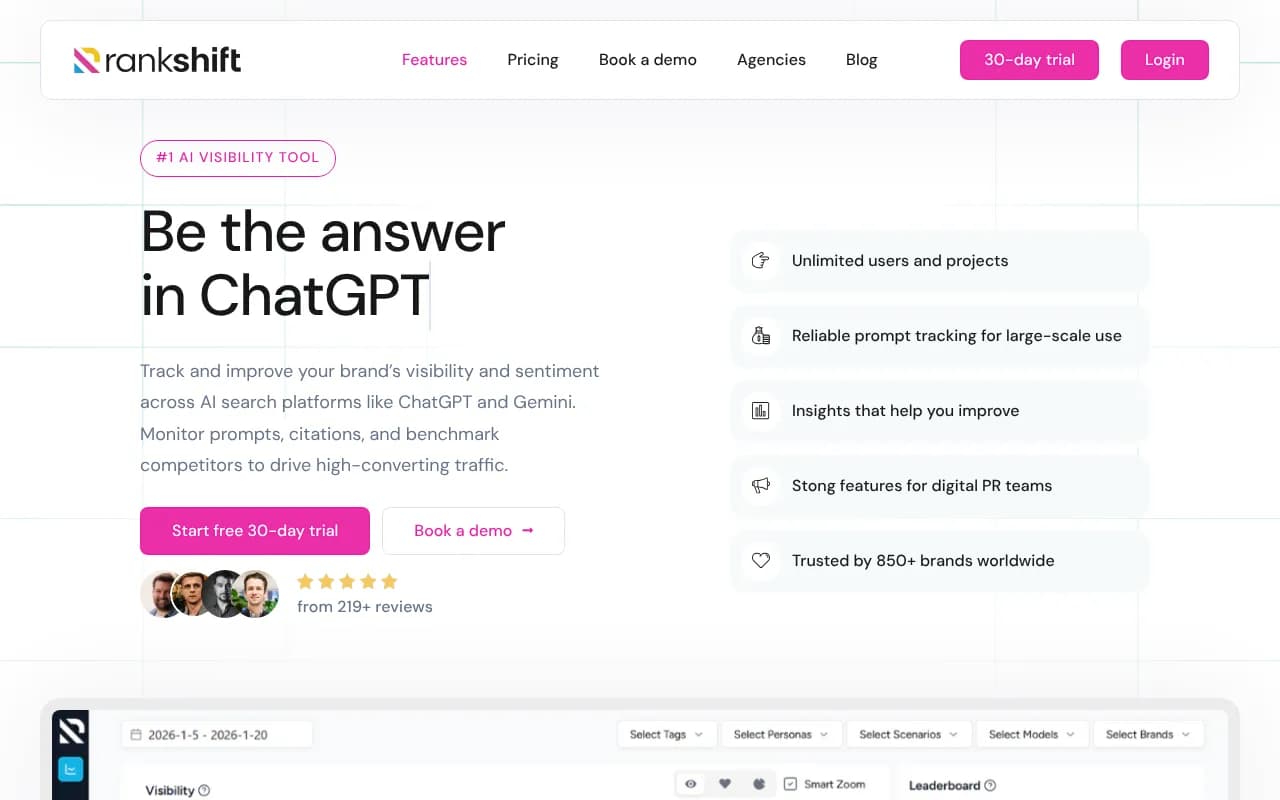

The honest caveat, echoed by multiple practitioners: tracking alone doesn't move the score. Brands that buy a visibility tracker without a content engine to act on the data typically watch flat dashboards for 6 months and churn. The tracker tells you where you're invisible. You still have to fix it.
What actually moves the needle
Based on the data available in 2026, the content characteristics that correlate most strongly with AI citations:
- Long-form content (1,500+ words) with clear structure and FAQ sections -- cited in 60-65% of AI answers
- Pages updated within the last 12 months -- 70% of AI-cited pages fall into this category
- Reddit and community presence -- 21% of Google AI Overview citations come from Reddit threads
- Schema markup and structured data -- makes it easier for AI models to parse and extract specific answers
- Direct, specific answers to conversational questions -- not keyword-stuffed paragraphs, but actual answers
The brands winning at 12 months aren't the ones with the biggest content libraries. They're the ones with the most specifically useful content for the exact questions their customers are asking AI models.
A note on model diversity
One mistake that's easy to make: optimizing for ChatGPT and ignoring everything else. ChatGPT has the largest user base, so it gets the most attention. But Perplexity, Gemini, Google AI Overviews, and Claude each have distinct citation patterns and different content preferences.
A brand that's highly visible in ChatGPT but invisible in Perplexity is missing a significant portion of AI-driven research. And Google AI Overviews -- which trigger for essentially every informational query -- are arguably the highest-volume AI surface of all.
The 12-month benchmark of visibility across 4-6 models isn't arbitrary. It reflects the reality that AI search is fragmented, and that fragmentation is increasing, not decreasing.
The honest conclusion
Most brands are 6-12 months behind where they should be on AI search visibility. The ones that started building in late 2024 or early 2025 have compounding advantages that are genuinely hard to close. The ones starting now aren't too late -- but they need to move faster and measure smarter than the brands ahead of them.
The benchmarks in this guide are meant to give you a realistic picture of what progress looks like, so you don't abandon a working strategy in month 3 because the dashboard looks flat. Flat in month 3 is normal. Flat in month 9 is a problem.
Know the difference, and act accordingly.