Key Takeaways
- Whitebox is enterprise-only with custom pricing and focuses on "agentic GEO" that generates and ships fixes automatically -- Bear AI starts at $100/mo with manual optimization guidance
- Bear AI's Basic plan ($100/mo) only tracks ChatGPT with 30 prompts and 2 blogs/month -- extremely limited compared to multi-platform tracking from competitors
- Whitebox serves major brands (Flipkart, Palo Alto Networks, eToro, Wiz) and positions itself as a full-service solution -- Bear AI targets startups and smaller teams
- Neither platform publicly discloses which AI models they track beyond ChatGPT/Perplexity mentions -- a transparency gap compared to platforms that list all 10+ supported models
- Whitebox's "agentic" approach promises automated content fixes, but no public case studies or proof points exist yet -- Bear AI is more transparent about being a tracking + manual optimization tool
- For teams wanting actionable content gap analysis and AI-generated articles grounded in citation data, Promptwatch offers a middle ground at $99-579/mo with clear feature tiers and proven results across 6,700+ brands
Overview
Whitebox
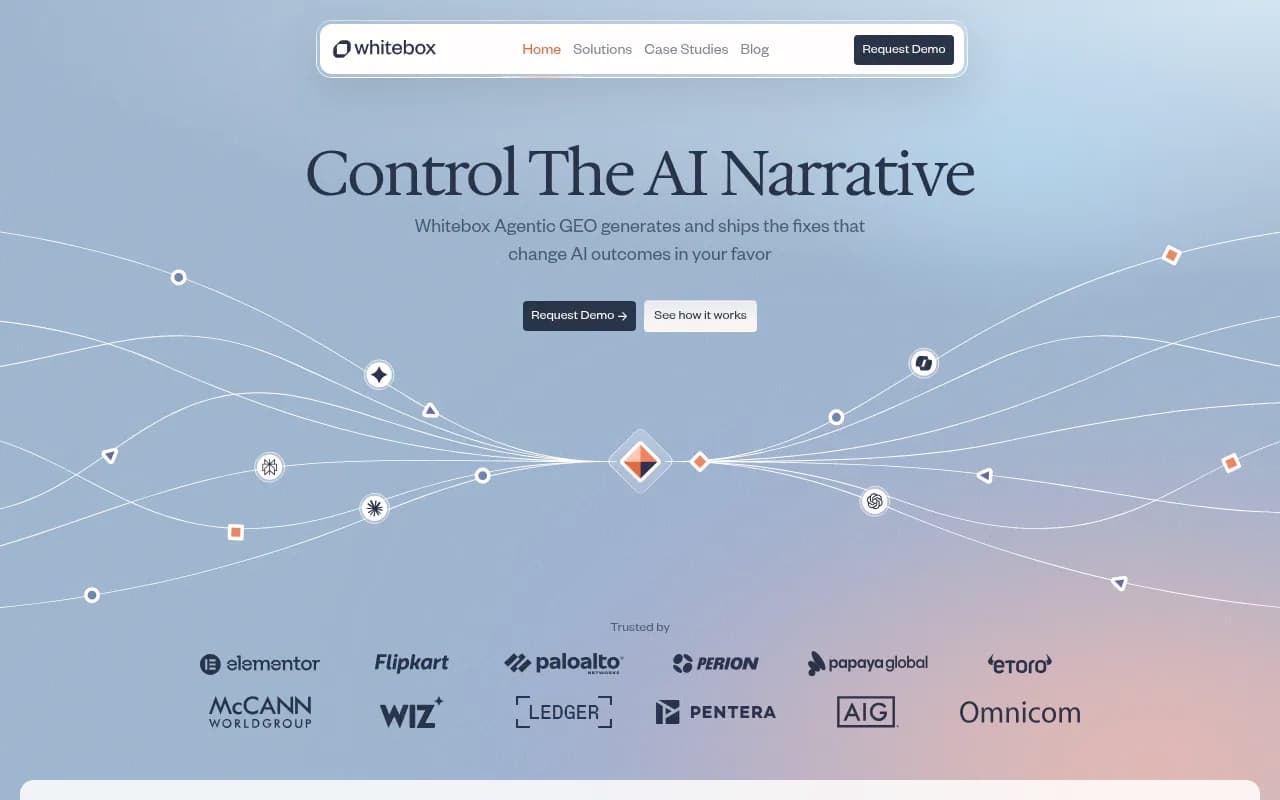
Whitebox positions itself as an "agentic GEO" platform that doesn't just track AI search visibility but generates and ships the fixes that change outcomes. The platform serves enterprise clients including Elementor, Flipkart, Palo Alto Networks, Perion, eToro, McCann, Wiz, Ledger, and AIG. Their pitch: "Control the AI narrative" by getting scientific clarity on how AI systems interpret your brand, measuring real-time shifts in AI perception, and strategically influencing outcomes.
The site emphasizes three pillars -- "See the Truth" (understanding AI interpretation), "Get the Solutions" (real-time measurement), and "Influence Outcomes" (strategic action). Pricing is custom/enterprise-only with no public tiers. The platform is backed by their client roster but lacks public case studies, feature breakdowns, or transparent model coverage.
Bear AI
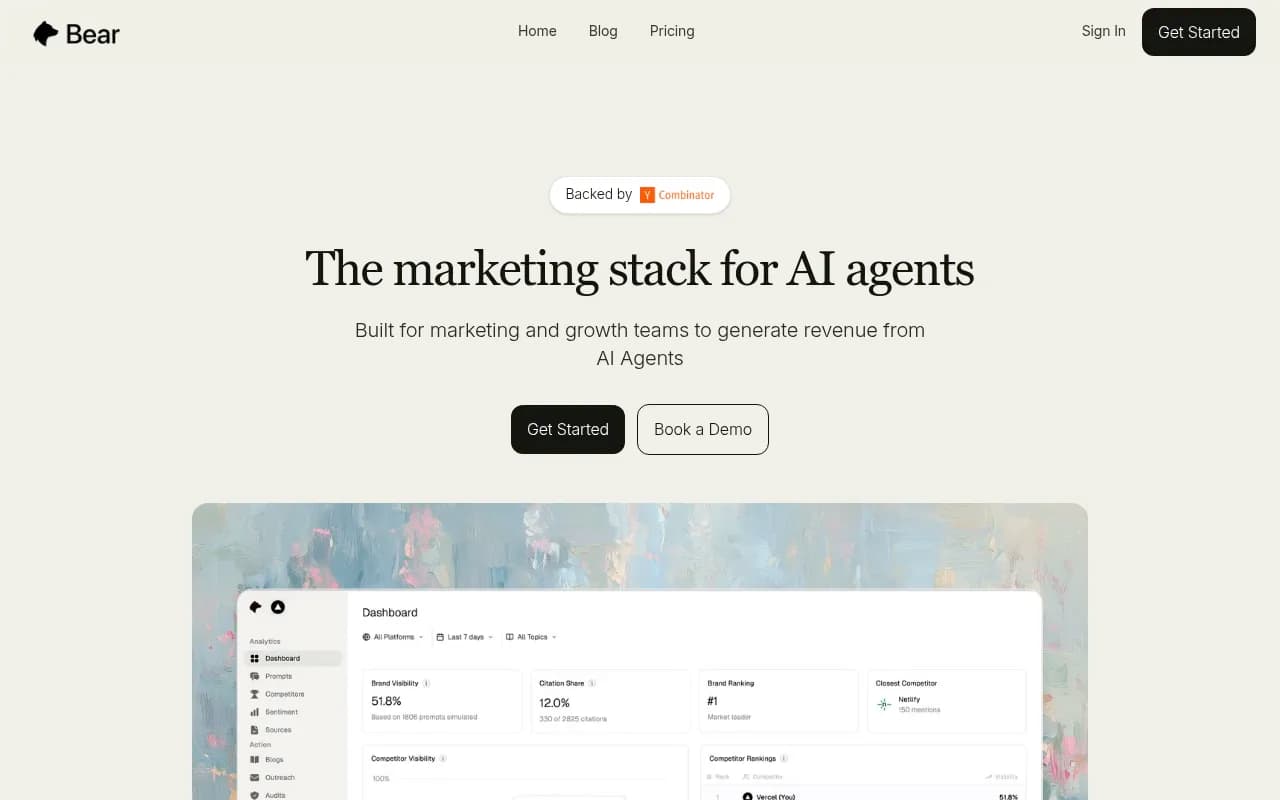
Bear AI calls itself "The marketing stack for AI agents" and targets marketing and growth teams looking to generate revenue from AI search. Y Combinator-backed, the platform serves startups like Peerspace, Medal, Wispr Flow, Slashy, and Dabble. Their focus: helping brands see how AI agents discover and recommend them across ChatGPT, Claude, Google AI Overviews, Perplexity, and other models.
Bear AI offers visibility into "when and how AI agents recommend your brand" and surfaces trending prompts users are asking. Pricing starts at $100/mo for a Basic plan (ChatGPT-only, 30 prompts, 2 blogs/month) with Enterprise custom pricing for all AI platforms and unlimited tracking. The platform is more transparent about pricing structure but still light on detailed feature documentation.
Side-by-side comparison
| Feature | Whitebox | Bear AI |
|---|---|---|
| Starting price | Custom (enterprise-only) | $100/mo (Basic plan) |
| Free tier | No | No |
| AI models tracked | Undisclosed (likely multiple) | ChatGPT, Claude, Gemini, Perplexity, Google AI Overviews (Basic: ChatGPT only) |
| Prompt tracking | Included (volume unknown) | 30 prompts (Basic), unlimited (Enterprise) |
| Content generation | Yes ("agentic" automated fixes) | 2 blogs/month (Basic), more on Enterprise |
| Automation level | High ("generates and ships fixes") | Low (manual optimization guidance) |
| Target audience | Enterprise brands, agencies | Startups, growth teams, SMBs |
| Client roster | Fortune 500 + major tech brands | Y Combinator startups |
| Transparency | Low (no public features/pricing) | Medium (pricing tiers public, features vague) |
| Proven track record | Client logos only, no case studies | Client logos only, no case studies |
| API access | Unknown | Unknown |
| Support | Likely white-glove (enterprise) | Unknown |
Pricing breakdown
This is where things get frustrating. Whitebox doesn't publish any pricing -- you have to request a demo. Bear AI publishes partial pricing but leaves major gaps.
| Plan | Whitebox | Bear AI |
|---|---|---|
| Entry tier | Custom (demo required) | $100/mo (Basic: ChatGPT only, 30 prompts, 2 blogs/mo) |
| Mid tier | Custom | Not disclosed |
| Enterprise | Custom | Custom (all AI platforms, unlimited tracking) |
| Annual discount | Unknown | Unknown |
| Free trial | Unknown | Unknown |
Bear AI's $100/mo Basic plan is essentially a ChatGPT-only tracker with 30 prompts and 2 blog posts per month. That's extremely restrictive -- you can't track Claude, Perplexity, or Google AI Overviews without upgrading to Enterprise (price unknown). For context, Promptwatch offers 10 AI models, 50 prompts, and 5 AI-generated articles for $99/mo on their Essential plan, with clear upgrade paths to $249/mo (Professional) and $579/mo (Business).

Whitebox's custom-only pricing signals they're targeting six-figure annual contracts. If you're a startup or mid-market company, you're probably not in their wheelhouse.
Feature deep-dive
AI model coverage
Whitebox doesn't disclose which AI models they track. Their site mentions "AI systems" and "AI perception" but never lists ChatGPT, Claude, Perplexity, Gemini, or any specific platforms. This is a red flag for transparency.
Bear AI lists ChatGPT, Claude, Google Gemini, Perplexity, and Google AI Overviews on their homepage. But the Basic plan only includes ChatGPT -- you need Enterprise for the rest. That's a bait-and-switch pricing model that makes the $100/mo tier nearly useless if you want comprehensive AI search tracking.
For comparison, most serious GEO platforms track 8-10+ models out of the box. Promptwatch monitors 10 models (ChatGPT, Perplexity, Google AI Overviews, Google AI Mode, Claude, Gemini, Meta/Llama, DeepSeek, Grok, Mistral, Copilot) starting at $99/mo. Whitebox and Bear AI's vagueness here is a problem.
Tracking and analytics
Whitebox promises "scientific clarity on how AI systems interpret your brand" and "real-time shifts in AI perception and ranking with precision." That sounds impressive but tells you nothing about what you actually get. Do you see citation counts? Prompt volumes? Competitor comparisons? Page-level tracking? No idea.
Bear AI shows "trending prompts" and lets you "see what users ask AI agents about your brand." Their dashboard screenshot shows prompt tracking with volume indicators ("High-volume"). That's more concrete but still surface-level. Do you get query fan-outs? Difficulty scores? Citation source analysis? Also unclear.
Both platforms are light on analytics depth compared to tools that offer prompt intelligence (volume estimates, difficulty scoring), citation analysis (which pages/domains AI models cite), and competitor heatmaps.
Content optimization and generation
This is where Whitebox's "agentic GEO" pitch gets interesting. They claim to "generate the fixes" and "ship" them -- implying automated content creation and deployment. If true, that's a major differentiator. But there's zero documentation on how this works, what "fixes" look like, or whether you retain editorial control. Are they auto-publishing blog posts to your site? Updating existing pages? Generating schema markup? The black-box approach is unsettling for something that touches your website.
Bear AI includes "2 blogs/month" on the Basic plan and presumably more on Enterprise. That's manual content generation, not automated. You're getting articles written (likely by AI, possibly with human review) but you're responsible for publishing and optimization. It's a more traditional agency model dressed up as a SaaS product.
Neither platform explains their content methodology. Are they analyzing citation gaps? Using competitor data? Grounding content in actual AI model behavior? Promptwatch's AI writing agent generates articles based on 880M+ citations analyzed, prompt volumes, and competitor gaps -- that's the kind of specificity missing from both Whitebox and Bear AI.
Automation vs manual work
Whitebox's "agentic" branding suggests high automation -- the platform identifies problems and fixes them without much human input. That's appealing if you trust the system, terrifying if you don't. Enterprise clients with dedicated teams might want more control, not less.
Bear AI is clearly manual. You get tracking data and content deliverables, but you're doing the optimization work yourself. That's fine for teams who want hands-on control but frustrating if you're paying for a platform and still doing most of the work.
The middle ground -- platforms that show you exactly what's missing (content gaps, citation opportunities, indexing issues) and give you tools to fix it (AI content generation, optimization recommendations, crawler log analysis) -- is probably the sweet spot for most teams.
Transparency and trust
Whitebox's lack of public information is a major issue. No pricing, no feature list, no case studies, no model coverage disclosure. You're flying blind until you book a demo. For a platform that wants to "control your AI narrative," they're awfully secretive about their own narrative.
Bear AI is better but still vague. They publish a Basic plan price ($100/mo) but hide everything else behind "Enterprise." Their feature descriptions are marketing fluff ("See how AI talks about you") without technical depth. The Y Combinator backing and startup client logos add some credibility, but there's no proof of results.
Compare this to platforms that publish detailed feature matrices, pricing tiers, case studies, and even raw data (like citation databases or prompt volumes). Transparency builds trust. Whitebox and Bear AI are asking you to trust them without showing their work.
Target audience fit
Whitebox is clearly built for enterprise. Their client roster (Flipkart, Palo Alto Networks, eToro, Wiz, AIG, Omnicom) signals they're selling to CMOs and VP-level buyers with big budgets. If you're a startup or mid-market company, you're probably not getting a callback.
Bear AI targets the opposite end -- Y Combinator startups and growth-stage companies. The $100/mo entry point is accessible, but the feature restrictions (ChatGPT-only, 30 prompts, 2 blogs) mean you'll outgrow it fast. It feels like a foot-in-the-door pricing strategy to upsell you to Enterprise.
Neither platform serves the mid-market well. If you're a $5M-50M ARR company that needs serious GEO capabilities but can't afford six-figure enterprise contracts, you're stuck in the gap.
Pros and cons
Whitebox pros
- Enterprise-grade client roster (Flipkart, Palo Alto, eToro, Wiz)
- "Agentic" automation promises hands-off optimization
- Likely includes white-glove support and custom integrations
- Positions itself as a strategic partner, not just a tool
Whitebox cons
- Zero pricing transparency -- custom-only is a barrier
- No public feature documentation or case studies
- Doesn't disclose which AI models it tracks
- "Agentic" automation is a black box -- unclear what it actually does
- Overkill (and overpriced) for startups and mid-market companies
Bear AI pros
- Accessible $100/mo entry point
- Y Combinator backing adds credibility
- Lists specific AI models (ChatGPT, Claude, Gemini, Perplexity, Google AI Overviews)
- Startup-friendly positioning
Bear AI cons
- Basic plan is nearly useless (ChatGPT-only, 30 prompts, 2 blogs/mo)
- Enterprise pricing is hidden -- same transparency problem as Whitebox
- Light on analytics depth and optimization tools
- No proof of results or case studies
- Manual optimization model means you're doing most of the work
Who should pick which tool
Pick Whitebox if:
- You're an enterprise brand with a six-figure marketing budget
- You want a full-service solution with minimal hands-on work
- You're comfortable with custom pricing and black-box automation
- You need a strategic partner, not just a SaaS tool
- You're already working with agencies like McCann or Omnicom and want a similar relationship
Pick Bear AI if:
- You're a Y Combinator startup or early-stage company
- You want to dip your toes into GEO without a huge commitment
- You're willing to do manual optimization work
- You can afford to upgrade to Enterprise quickly (the Basic plan won't cut it long-term)
- You value startup-friendly positioning over enterprise features
Pick neither if:
- You're a mid-market company ($5M-50M ARR) that needs serious GEO capabilities at a reasonable price
- You want transparency in pricing, features, and model coverage
- You need actionable content gap analysis and AI-generated articles grounded in real citation data
- You want to track AI crawler behavior, Reddit/YouTube influence, and ChatGPT Shopping
- You prefer platforms with proven track records and public case studies
For teams in that last category, platforms like Promptwatch ($99-579/mo with clear tiers) or others in the 2026 GEO landscape offer better value and transparency.
Final verdict
Whitebox and Bear AI sit at opposite ends of the market -- enterprise black-box automation vs startup-friendly tracking -- but both suffer from the same core problem: lack of transparency. Whitebox won't tell you what it costs or what it does. Bear AI publishes a $100/mo price but restricts it so heavily (ChatGPT-only, 30 prompts) that it's essentially a trial tier.
If you're an enterprise brand with budget to burn and you trust Whitebox's client roster, book a demo. If you're a cash-strapped startup willing to do manual work, Bear AI's Basic plan is a cheap way to start tracking ChatGPT visibility. But for most companies in between -- or anyone who values knowing what they're buying before they buy it -- these platforms leave too many questions unanswered.
The GEO market in 2026 has better options. Look for platforms that publish pricing, disclose model coverage, show you exactly what content gaps exist, and give you tools to fix them. Whitebox and Bear AI might get there eventually, but right now they're asking for a lot of trust without showing much proof.