Key Takeaways
- Whitebox is enterprise-focused with custom pricing and agentic optimization features that generate and ship fixes automatically. Promptscout starts at $15/mo with a free tier, making it accessible for smaller teams and startups.
- Promptscout monitors 3 AI platforms (ChatGPT, Gemini, Google AI Overviews). Whitebox's exact platform coverage isn't publicly detailed but positions itself as comprehensive.
- Promptscout excels at competitor benchmarking with leaderboards and citation analysis. Whitebox emphasizes "agentic GEO" that diagnoses why AI systems interpret your brand a certain way and generates strategic fixes.
- Promptscout provides actionable insights like "improve G2 reviews" or "engage on Reddit." Whitebox promises to generate and ship the actual fixes, not just identify them.
- For budget-conscious teams wanting quick setup and clear competitor tracking, Promptscout wins. For enterprises needing hands-off optimization and strategic narrative control, Whitebox is built for that.
- Neither platform publicly shares exact LLM coverage details or API access in their marketing materials, which makes direct feature comparison harder than it should be.
Overview
Whitebox
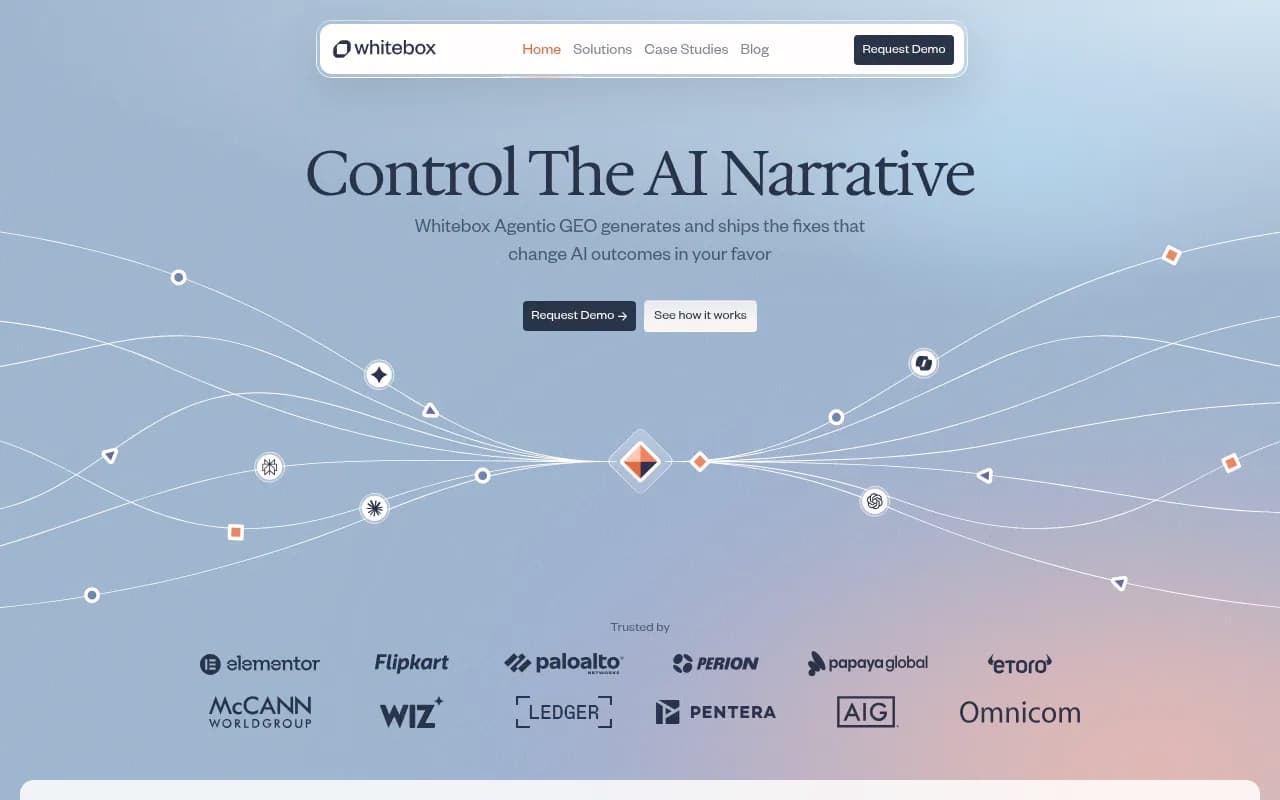
Whitebox positions itself as an "agentic GEO" platform -- meaning it doesn't just show you what AI systems say about your brand, it generates the fixes and ships them. The platform is used by enterprise clients like Elementor, Flipkart, Palo Alto Networks, eToro, Wiz, and AIG. The core pitch: see the truth about how AI interprets your brand, get the solutions in real-time, and influence outcomes strategically. Pricing is custom and enterprise-focused, with no public tiers listed.
The "agentic" angle is the differentiator here. Most AI visibility tools stop at monitoring. Whitebox claims to close the loop by generating content fixes, optimization strategies, and shipping changes that alter AI outcomes in your favor.
Promptscout
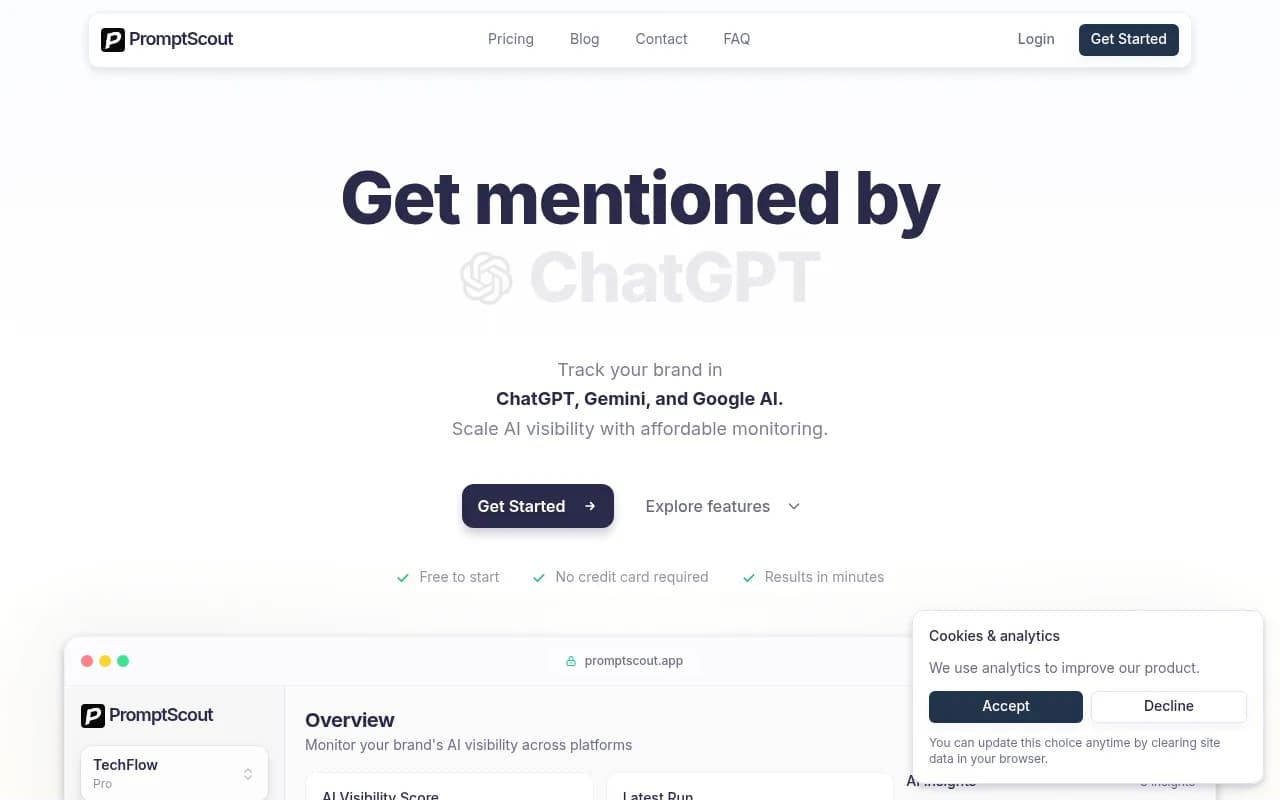
Promptscout is a straightforward AI brand monitoring tool that tracks how ChatGPT, Gemini, and Google AI Overviews mention your brand. It's built for teams that want to see their AI visibility score, benchmark against competitors, analyze which sources AI systems cite, and get actionable insights. Pricing starts at $15/mo with a free tier available, making it one of the most accessible options in the space.
The interface is clean and focused: you see your mention rate across platforms, a competitor leaderboard, top cited domains, and AI-generated insights like "improve your G2 reviews" or "engage on Reddit." It's monitoring-first with recommendations layered on top, but you're still doing the optimization work yourself.
Side-by-Side Comparison
| Feature | Whitebox | Promptscout |
|---|---|---|
| Starting price | Custom (enterprise) | Free tier, $15/mo paid |
| Free tier | No | Yes |
| AI platforms monitored | Not publicly specified | ChatGPT, Gemini, Google AI Overviews (3 total) |
| Competitor tracking | Yes | Yes, with leaderboard |
| Citation analysis | Yes | Yes, shows top domains |
| Content optimization | Agentic (generates fixes) | Insights only (you implement) |
| Automated fixes | Yes (claims to ship fixes) | No |
| Target audience | Enterprise brands, agencies | Startups, SMBs, agencies |
| Setup complexity | Requires demo/onboarding | Self-service signup |
| API access | Not publicly disclosed | Not publicly disclosed |
| Multi-language support | Not publicly disclosed | Not publicly disclosed |
| Reporting | Not publicly disclosed | Dashboard-based |
Pricing
This is where the two platforms diverge completely.
| Plan | Whitebox | Promptscout |
|---|---|---|
| Free | Not available | Free tier (limited monitoring) |
| Starter | N/A | $15/mo |
| Growth | N/A | $39/mo |
| Pro | N/A | $99/mo |
| Agency | Custom pricing | Custom pricing |
| Enterprise | Custom pricing | Custom pricing |
Whitebox doesn't publish pricing tiers. You request a demo and get a custom quote based on your needs. Given the client roster (Flipkart, Palo Alto, AIG), expect enterprise-level pricing -- likely thousands per month.
Promptscout's transparent pricing makes it easy to start small. The free tier lets you test the waters. $15/mo gets you basic monitoring. $99/mo Pro plan is still cheaper than most enterprise platforms' entry points. For early-stage companies or teams with tight budgets, this is a huge advantage.
Monitoring capabilities
Both platforms track brand mentions in AI systems, but the depth and breadth differ.
Promptscout explicitly monitors three platforms: ChatGPT, Gemini, and Google AI Overviews. You see your mention rate across each, which responses included your brand, and what AI systems said about you. The dashboard shows an "AI Visibility Score" (e.g. 78% = mentioned in 31 of 40 responses). You can drill into individual runs to see exactly what each AI said.
The competitor leaderboard is a standout feature. You see how many times each competitor got mentioned compared to you. If "Flowwise" got 38 mentions and you got 47, you know you're winning. If a competitor is ahead, you know where to focus.
Whitebox doesn't specify which AI platforms it monitors in its public materials. The messaging focuses on "AI systems" and "generative engines" broadly. The enterprise positioning suggests comprehensive coverage, but without a feature list or documentation, it's hard to compare directly.
What Whitebox does emphasize is the "why" behind the mentions. It claims to give you "scientific clarity on how AI systems interpret your brand and why" -- not just that you were mentioned, but the reasoning and context. This diagnostic layer is where Whitebox differentiates from pure monitoring tools.
Verdict: Promptscout wins on transparency and specificity. You know exactly what you're getting. Whitebox's vague positioning might hide deeper capabilities, but if you're comparing before buying, clear specs matter.
Competitor analysis
Both platforms offer competitor tracking, but the presentation differs.
Promptscout shows a simple leaderboard: your brand vs competitors, sorted by mention count. You see who's winning in AI recommendations and by how much. It's straightforward and actionable -- if a competitor is ahead, you know you need to close the gap.
The citation analysis adds another layer. You see which domains AI systems cite when mentioning your brand or competitors. If G2.com is heavily cited, you know reviews matter. If Reddit threads drive mentions, you know where to engage. The "AI Insights" feature even suggests actions like "improve visibility on G2 reviews" or "create comparison content vs Flowwise."
Whitebox promises "real-time shifts in AI perception and ranking with precision," which implies competitor tracking, but the specifics aren't detailed on the website. The enterprise focus suggests custom competitor sets and deeper analysis, but again, you'd need to request a demo to see what that actually looks like.
Verdict: Promptscout's competitor leaderboard and citation breakdown are immediately useful. Whitebox might offer more sophisticated analysis, but it's hidden behind a sales process.
Content optimization and fixes
This is where the platforms take completely different approaches.
Promptscout gives you insights and recommendations. The "AI Insights" section flags opportunities like "engage on Reddit r/SaaS community" or "create comparison content vs [competitor]." These are helpful nudges, but you're still responsible for creating the content, publishing it, and tracking the impact. Promptscout is a monitoring and recommendation tool, not an execution platform.
Whitebox claims to generate and ship the fixes. The "agentic GEO" positioning means the platform doesn't just tell you what's wrong -- it creates the content, optimizations, or strategic changes needed to alter AI outcomes. The website says "We Generate The Fixes" and "Influence Outcomes Strategically," which implies automated or semi-automated optimization.
How this works in practice isn't clear from the public website. Does Whitebox write content for you? Does it integrate with your CMS to publish changes? Does it generate schema markup or structured data? The enterprise sales model suggests these details are customized per client, but the lack of transparency makes it hard to evaluate.
Verdict: If you want to do the work yourself with guidance, Promptscout is fine. If you want a platform that handles optimization for you (and you have the budget), Whitebox's agentic approach is the promise. But without seeing it in action, it's hard to judge execution quality.
Ease of use and setup
Promptscout is self-service. You sign up, connect your brand, add competitors, and start monitoring. The interface is clean and dashboard-focused. You don't need a demo or onboarding call to get started. The free tier and $15/mo starter plan make it low-risk to test.
Whitebox requires a demo. You request access via their calendar link, go through a sales process, and get onboarded by their team. This is standard for enterprise software, but it means you can't just try it out on your own. The setup complexity is higher, and you're committing to a relationship, not just a tool.
Verdict: Promptscout wins for speed and simplicity. Whitebox's enterprise approach makes sense for large organizations but adds friction for smaller teams.
Reporting and analytics
Both platforms offer dashboards, but the depth and customization differ.
Promptscout shows your AI visibility score, mention trends, competitor rankings, citation sources, and AI-generated insights. The dashboard is visual and easy to scan. You can drill into individual AI responses to see exact quotes. The "How AI Describes [Your Brand]" section pulls real quotes from ChatGPT, Gemini, and Google AI, which is useful for understanding sentiment and positioning.
Reporting beyond the dashboard isn't detailed on the website. There's no mention of API access, Looker Studio integration, or custom reports. For most teams, the dashboard is probably enough.
Whitebox emphasizes "real-time shifts in AI perception and ranking with precision," which suggests robust analytics, but the specifics aren't public. Enterprise platforms typically offer custom reporting, API access, and integrations, but you'd need to ask during the demo.
Verdict: Promptscout's dashboard is clear and sufficient for most use cases. Whitebox likely offers more for enterprise needs, but without public details, it's speculative.
Who should pick Whitebox
- Enterprise brands with budgets in the thousands per month
- Teams that want hands-off optimization, not just monitoring
- Organizations that need strategic narrative control across AI systems
- Companies with complex brand positioning that requires custom solutions
- Brands that value the "agentic" approach of automated fixes over DIY optimization
Whitebox is built for companies like Flipkart, Palo Alto Networks, and AIG -- large organizations with dedicated budgets and a need for comprehensive AI presence management. If you're a startup or SMB, the custom pricing model and demo-required approach will likely be overkill.
Who should pick Promptscout
- Startups and SMBs with limited budgets
- Teams that want to start monitoring AI mentions quickly without a sales process
- Brands that are comfortable implementing optimization recommendations themselves
- Companies that prioritize competitor benchmarking and citation analysis
- Anyone who wants transparent pricing and a free tier to test the platform
Promptscout is the accessible option. You can start for free, scale up as needed, and get clear insights without enterprise complexity. If you're just getting started with AI visibility tracking, this is the easier entry point.
Pros and cons
Whitebox pros
- Agentic optimization that generates and ships fixes automatically
- Enterprise-grade platform used by major brands
- Focuses on the "why" behind AI interpretations, not just mentions
- Likely offers deeper customization and strategic support
Whitebox cons
- No public pricing -- requires demo and custom quote
- Lack of transparency around features, platform coverage, and capabilities
- High barrier to entry for smaller teams
- No free tier or trial to test before committing
Promptscout pros
- Transparent pricing starting at $15/mo with a free tier
- Clear monitoring of ChatGPT, Gemini, and Google AI Overviews
- Competitor leaderboard and citation analysis are immediately useful
- Self-service setup with no demo required
- Clean, easy-to-understand dashboard
Promptscout cons
- Only monitors 3 AI platforms (vs competitors that cover 10+)
- Insights are recommendations, not automated fixes -- you still do the work
- No public API or advanced integrations mentioned
- Limited depth compared to enterprise platforms
Alternatives worth considering
If neither Whitebox nor Promptscout fits your needs, Promptwatch is worth a look. It monitors 10 AI models (ChatGPT, Perplexity, Claude, Gemini, Google AI Overviews, Meta AI, DeepSeek, Grok, Mistral, Copilot) and goes beyond monitoring to help you fix gaps with content generation, crawler log analysis, and page-level tracking. Pricing starts at $99/mo for the Essential plan, with a free trial available.

Promptwatch sits between Promptscout's simplicity and Whitebox's enterprise focus -- more platforms than Promptscout, more transparent than Whitebox, with built-in tools to actually close the visibility gaps you find.
Final verdict
Whitebox and Promptscout serve different markets. Promptscout is the budget-friendly, transparent option for teams that want to start tracking AI mentions without enterprise complexity. Whitebox is the high-touch, agentic platform for large organizations that want optimization handled for them.
If you're a startup, SMB, or agency testing the waters, Promptscout's $15/mo entry point and free tier make it the obvious choice. You get clear competitor tracking, citation analysis, and actionable insights without a sales process.
If you're an enterprise brand with a serious budget and a need for strategic AI narrative control, Whitebox's agentic approach is compelling -- assuming the execution matches the promise. The lack of public details is frustrating, but the client roster suggests they're delivering value at scale.
For most teams reading this, Promptscout is the practical starting point. You can always upgrade to an enterprise platform later if your needs outgrow it.