Key Takeaways
- Whitebox is enterprise-focused with custom pricing and an "agentic" approach that generates fixes automatically, while Nimt.ai offers accessible pricing starting at $59/mo with a 7-day free trial
- Nimt.ai provides transparent pricing tiers (Starter, Pro, Enterprise) making it easier to budget, whereas Whitebox requires contacting sales for pricing
- Both platforms track AI visibility across major models, but Whitebox emphasizes automated solution generation while Nimt.ai focuses on actionable insights and source tracking
- Whitebox's client roster includes major enterprises (Flipkart, Palo Alto, eToro, Wiz), suggesting it's built for larger organizations with complex needs
- Nimt.ai's freemium model and lower entry price make it more accessible for small to mid-sized businesses testing AI visibility tracking for the first time
- If you need detailed competitor benchmarking and prompt-level tracking with clear ROI visibility, Nimt.ai's transparent approach may be easier to justify internally
Overview
Whitebox: Agentic AI presence management
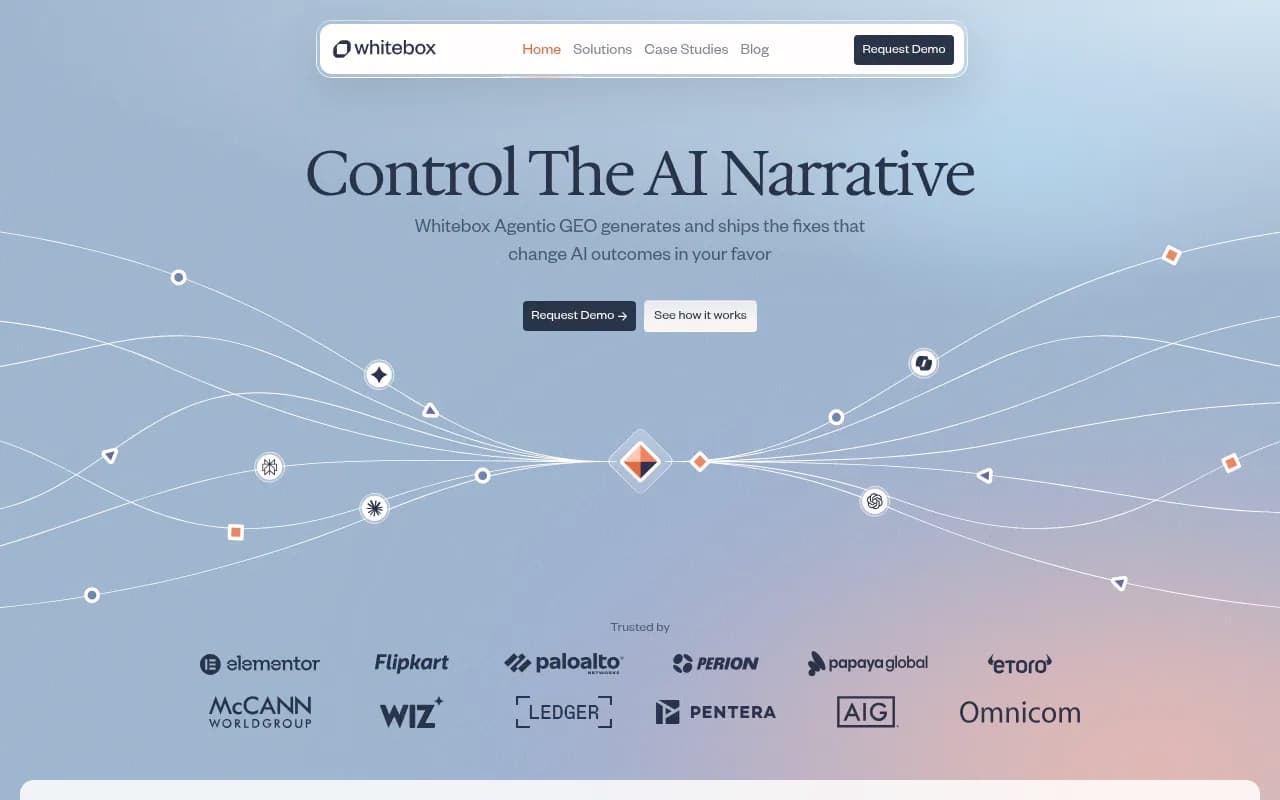
Whitebox positions itself as an "agentic GEO" platform -- meaning it doesn't just show you problems, it generates and ships fixes automatically. The platform promises to help brands "control the AI narrative" by tracking how AI systems interpret your brand and then creating solutions to shift perception. Their client list includes heavy hitters like Flipkart, Palo Alto Networks, eToro, Wiz, and AIG, which tells you this is built for enterprise budgets and complex organizational needs.
The core pitch: see the truth about how AI sees you, get solutions generated automatically, and influence outcomes strategically. It's a black-box-to-white-box approach (ironic given the name) where the platform handles the heavy lifting of figuring out what needs to change.
Nimt.ai: Transparent AI visibility tracking
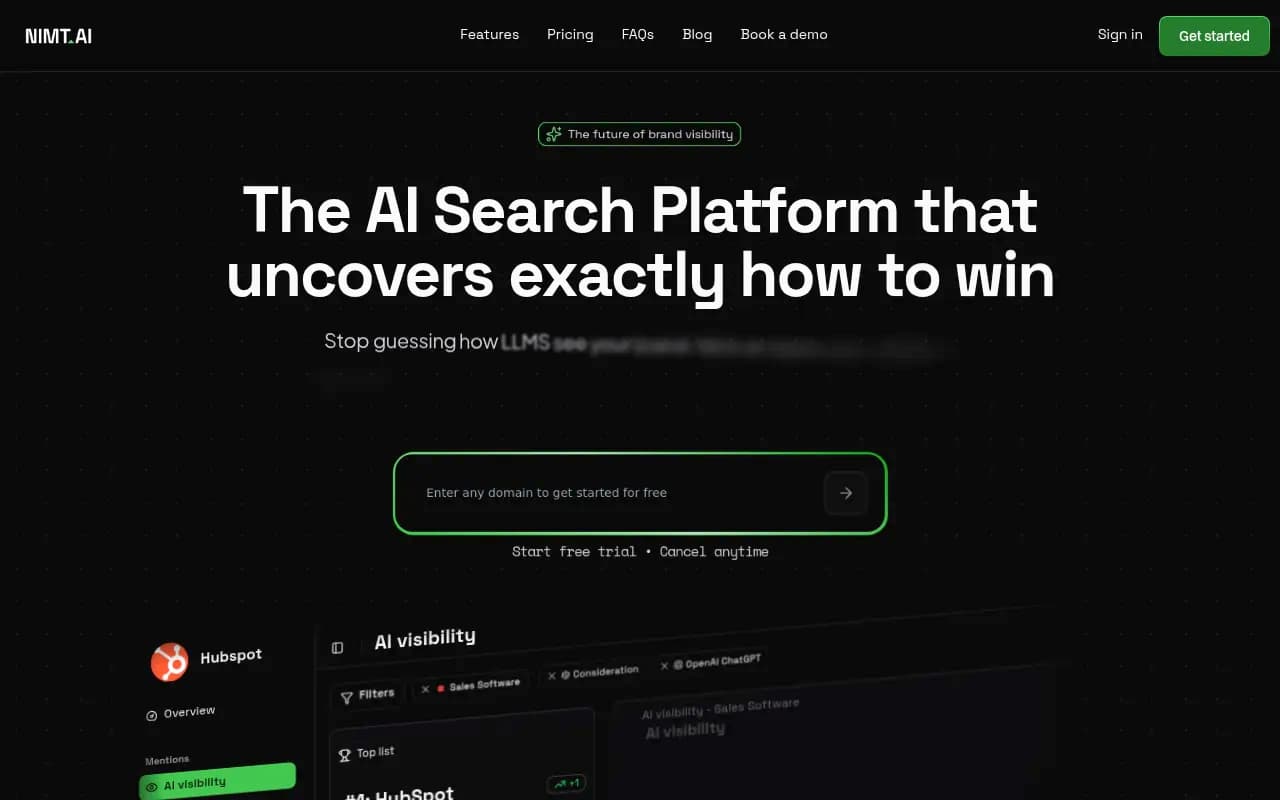
Nimt.ai takes a more straightforward approach: track your brand's visibility across AI platforms in real-time, identify which sources influence AI recommendations, and get clear actions to improve your ranking. The platform monitors how often your brand gets mentioned, your share of voice vs competitors, sentiment analysis, and which domains AI models cite when they talk about you.
What stands out is the transparency. Nimt.ai shows you exactly where you rank ("#1: HubSpot, 70 score"), how your AI Brand Strength compares to competitors, and which media outlets or forums are driving your visibility. The pricing is public and accessible -- $59/mo to start, with a 7-day free trial on the Pro plan. This is clearly designed for marketing teams who need to justify spend and show results quickly.
Side-by-Side Comparison
| Feature | Whitebox | Nimt.ai |
|---|---|---|
| Pricing | Custom (enterprise only) | Starter $59/mo, Pro $69/mo, Enterprise custom |
| Free trial | Demo required | 7-day free trial on Pro |
| Entry barrier | High (sales process) | Low (self-serve signup) |
| AI model coverage | Multiple (not specified) | ChatGPT, likely others |
| Automated fixes | Yes ("agentic" approach) | No (manual actions) |
| Competitor tracking | Yes | Yes (detailed benchmarking) |
| Source identification | Yes | Yes (domain-level tracking) |
| Sentiment analysis | Implied | Yes (explicit feature) |
| Prompt management | Not specified | Yes (built-in) |
| Target audience | Enterprise brands, agencies | SMBs to enterprise |
| Transparency | Low (no public pricing/features) | High (clear dashboards, public pricing) |
| Implementation | Likely requires onboarding | Self-serve setup |
Pricing: Enterprise vs accessible
This is where the two platforms diverge sharply.
| Plan | Whitebox | Nimt.ai |
|---|---|---|
| Entry tier | Custom pricing (contact sales) | Starter: $59/mo (20 prompts) |
| Mid tier | Custom pricing | Pro: $69/mo (20-500 prompts) |
| Enterprise | Custom pricing | Custom pricing |
| Free trial | Demo only | 7-day free trial (Pro plan) |
| Billing | Annual contracts (likely) | Monthly or annual |
Whitebox doesn't publish pricing anywhere on their site. The "Request Demo" CTA and enterprise client list suggest this is a five-figure annual commitment at minimum. If you're a startup or small marketing team, you're probably not the target buyer.
Nimt.ai's pricing is refreshingly clear. $59/mo gets you started with 20 prompts -- enough to test the waters and see if AI visibility tracking matters for your brand. The Pro plan at $69/mo scales up to 500 prompts, which covers most mid-sized businesses. You can trial the Pro plan for 7 days without a credit card, which removes friction.
For budget-conscious teams or anyone who needs to justify spend before committing, Nimt.ai wins on accessibility. For enterprises with complex needs and budget to match, Whitebox's custom approach might deliver more tailored solutions.
Feature depth: Automated fixes vs manual insights
Whitebox's agentic approach
Whitebox's core differentiator is the "agentic GEO" concept. The platform claims to "generate and ship the fixes" automatically. What does that mean in practice?
- See the Truth: Whitebox analyzes how AI systems interpret your brand and identifies gaps
- Get the Solutions: The platform generates fixes and measures real-time shifts in AI perception
- Influence Outcomes: Strategic interventions to change how AI models rank and recommend you
The language is vague ("strategically influence outcomes" could mean anything), but the implication is clear: Whitebox doesn't just hand you a report -- it creates content, optimizes pages, or makes other changes on your behalf. This is appealing if you lack the internal resources to act on insights, but it also means you're trusting a black box to fix your black box problem.
The client roster (Flipkart, Palo Alto, Wiz, AIG) suggests this works at scale, but without case studies or public documentation, it's hard to evaluate how much of the "agentic" promise is automation vs human-in-the-loop consulting.
Nimt.ai's transparency play
Nimt.ai takes the opposite approach: show you everything, let you decide what to do.
- AI Visibility Score: A single number (0-100) that summarizes your brand's presence across AI platforms
- Share of Voice: How often you're mentioned vs competitors in AI responses
- Ranking: Where you place in AI recommendations ("#1: HubSpot, 70 score")
- AI Brand Strength: Performance over time, with trend indicators (+1, +7, -2)
- Sentiment Analysis: Positive, neutral, or negative mentions
- Source Tracker: Which domains, forums, and media outlets AI models cite when discussing your brand
- Domain Comparisons: Benchmark against up to 10 competitors
- Prompt Management: Organize and track specific queries relevant to your business
The dashboard screenshots show a clean, data-forward interface. You see exactly where you rank, which competitors are ahead, and which sources are driving visibility. The "Boost Actions" feature suggests next steps, but you implement them yourself.
This is better for teams that want control and transparency. You're not outsourcing strategy to an algorithm -- you're using data to inform your own decisions. The trade-off is you need internal capacity to act on insights.
AI model coverage
Neither platform publishes a complete list of supported AI models, which is frustrating.
Whitebox's site mentions tracking "how AI systems interpret your brand" but doesn't specify which ones. Given their enterprise focus, it's safe to assume they cover the major players (ChatGPT, Claude, Gemini, Perplexity), but you'll need to ask during the demo.
Nimt.ai explicitly shows ChatGPT in their dashboard screenshots and mentions "major AI platforms" in their copy. The interface includes filters for AI models, suggesting multi-model support, but again -- no public list.
For comparison, Promptwatch tracks 10 AI models explicitly (ChatGPT, Perplexity, Google AI Overviews, Claude, Gemini, Meta AI, DeepSeek, Grok, Mistral, Copilot), which gives you a clear picture of coverage before you sign up.

Both Whitebox and Nimt.ai should publish their model coverage. It's a basic question every buyer asks.
Use cases: Who should pick which?
Choose Whitebox if:
- You're an enterprise brand with a six-figure marketing budget and complex AI visibility needs
- You lack internal resources to implement optimization recommendations and want a platform that does the work for you
- You're comfortable with custom pricing and annual contracts
- You need white-glove onboarding and strategic consulting alongside the software
- Your legal/compliance team is okay with a platform making automated changes to your web presence
- You're tracking AI visibility across multiple brands, regions, or business units
Choose Nimt.ai if:
- You're a small to mid-sized business testing AI visibility tracking for the first time
- You want transparent pricing and the ability to start with a low monthly commitment
- You prefer to maintain control over optimization decisions rather than outsourcing to automation
- You need clear competitor benchmarking and prompt-level tracking to justify budget internally
- You want a self-serve platform you can set up and start using immediately
- You're tracking 20-500 prompts and don't need enterprise-scale complexity
Pros and cons
Whitebox pros:
- Automated fix generation reduces manual work
- Enterprise-grade client roster suggests proven results at scale
- "Agentic" approach may deliver faster improvements if automation works as promised
- Likely includes strategic consulting and hands-on support
Whitebox cons:
- No public pricing makes budgeting impossible without a sales call
- Vague feature descriptions ("strategically influence outcomes") raise questions about what you're actually getting
- High entry barrier excludes small businesses and startups
- Lack of transparency around AI model coverage and methodology
- Automated fixes mean less control over your brand narrative
Nimt.ai pros:
- Transparent pricing with accessible entry point ($59/mo)
- 7-day free trial lets you test before committing
- Clear, data-forward dashboards show exactly what you're tracking
- Source tracking reveals which domains influence AI recommendations
- Competitor benchmarking with up to 10 brands
- Self-serve setup means you can start immediately
Nimt.ai cons:
- No automated fix generation -- you implement recommendations yourself
- Limited to 20 prompts on Starter plan may not be enough for larger brands
- Less clear what "Boost Actions" entails without trying the platform
- No public case studies or client testimonials to validate results
- May lack the strategic depth enterprises need for complex multi-market campaigns
Integration and workflow
Neither platform provides detailed integration documentation publicly.
Whitebox's enterprise focus suggests they likely offer API access, custom integrations, and connections to marketing automation platforms. But you'll need to ask during the sales process.
Nimt.ai's interface shows project management and prompt management features, suggesting it's designed to fit into existing marketing workflows. The "Boost Actions" section implies some level of task management or recommendation tracking, but it's unclear if this integrates with tools like Asana, Slack, or your CMS.
For teams that need AI visibility data flowing into existing dashboards or triggering automated workflows, both platforms fall short on public documentation. This is an area where more transparency would help buyers evaluate fit.
Data accuracy and methodology
This is the black box problem with AI visibility tools generally.
Whitebox promises "scientific clarity on how AI systems interpret your brand" but doesn't explain their methodology. Are they querying AI models directly? Scraping responses? Using synthetic prompts or real user queries? The lack of detail makes it hard to trust the data.
Nimt.ai shows specific scores ("HubSpot: 70, +1") and rankings, which implies a quantitative methodology. But again -- no public explanation of how these scores are calculated, how often data refreshes, or what sample size they're using.
Both platforms would benefit from publishing methodology docs or at least a high-level explanation of their data collection process. Without it, you're trusting a black box to tell you about other black boxes.
Support and onboarding
Whitebox's enterprise positioning suggests you get dedicated account management, strategic consulting, and hands-on onboarding. The "Request Demo" flow likely includes discovery calls, custom setup, and ongoing support. This is valuable if you need guidance, but it also means you can't just sign up and start exploring.
Nimt.ai's self-serve model means you're on your own after signup. The 7-day free trial gives you time to figure out the interface, but there's no indication of live chat, onboarding calls, or dedicated support on the lower-tier plans. Enterprise customers likely get more hands-on help, but that's not documented.
For teams that need training and strategic guidance, Whitebox probably delivers more. For teams that prefer to learn by doing, Nimt.ai's self-serve approach is faster.
Reporting and analytics
Nimt.ai's dashboard screenshots show clean, visual reporting:
- AI Brand Strength over time (line charts)
- Top 10 rankings with trend indicators
- Share of voice comparisons
- Sentiment breakdowns
- Source domain lists
This is the kind of reporting you can screenshot and drop into a board deck. The data is clear, the trends are obvious, and the competitive context is built in.
Whitebox's site shows abstract visuals ("See the Truth", "Get the Solutions") but no actual dashboard screenshots. This makes it impossible to evaluate reporting quality without a demo. Given their enterprise focus, they probably offer custom reporting and data exports, but the lack of transparency is frustrating.
Final verdict
Whitebox and Nimt.ai are solving the same problem -- AI visibility tracking -- but for completely different buyers.
Whitebox is an enterprise play. If you're a large brand with budget, complex needs, and limited internal resources to act on insights, the "agentic" approach might justify the premium. You're paying for automation, strategic consulting, and white-glove support. The lack of pricing transparency and vague feature descriptions are red flags, but the client roster (Flipkart, Palo Alto, Wiz) suggests they deliver results at scale.
Nimt.ai is the accessible option. Transparent pricing, self-serve signup, and a 7-day free trial make it easy to test. The dashboards are clean, the competitor benchmarking is detailed, and the source tracking reveals exactly which domains influence AI recommendations. You're responsible for implementing fixes yourself, but you get full visibility into the data driving those decisions. For small to mid-sized businesses or teams new to AI visibility tracking, this is the safer bet.
If you're still evaluating options, Nimt.ai's free trial is the obvious next step. Sign up, track 20 prompts for a week, and see if the insights justify the cost. If you're an enterprise buyer with a six-figure budget, request a Whitebox demo and push them on methodology, pricing, and what "agentic" actually means in practice.
One sentence summary: Nimt.ai wins on transparency and accessibility, while Whitebox targets enterprises willing to pay a premium for automated fixes and strategic consulting.