Nimt.ai Review 2026
Helps brands track, analyze, and enhance their visibility across major AI platforms by identifying influential media outlets, forums, and websites.
Key Takeaways
- Monitoring-only platform -- lacks content generation, AI crawler logs, and traffic attribution that Promptwatch offers
- Strong sentiment analysis and source tracking, but no gap analysis or content optimization tools to actually fix visibility issues
- Covers 6+ AI models (ChatGPT, Perplexity, Gemini, Claude, Google AI Overviews, Google AI Mode) vs Promptwatch's 10+ model coverage
- Pricing starts at $59/mo for 20 prompts, comparable to competitors but without the optimization capabilities
- Best for brands that want basic visibility tracking, not for teams that need to actively improve their AI search presence
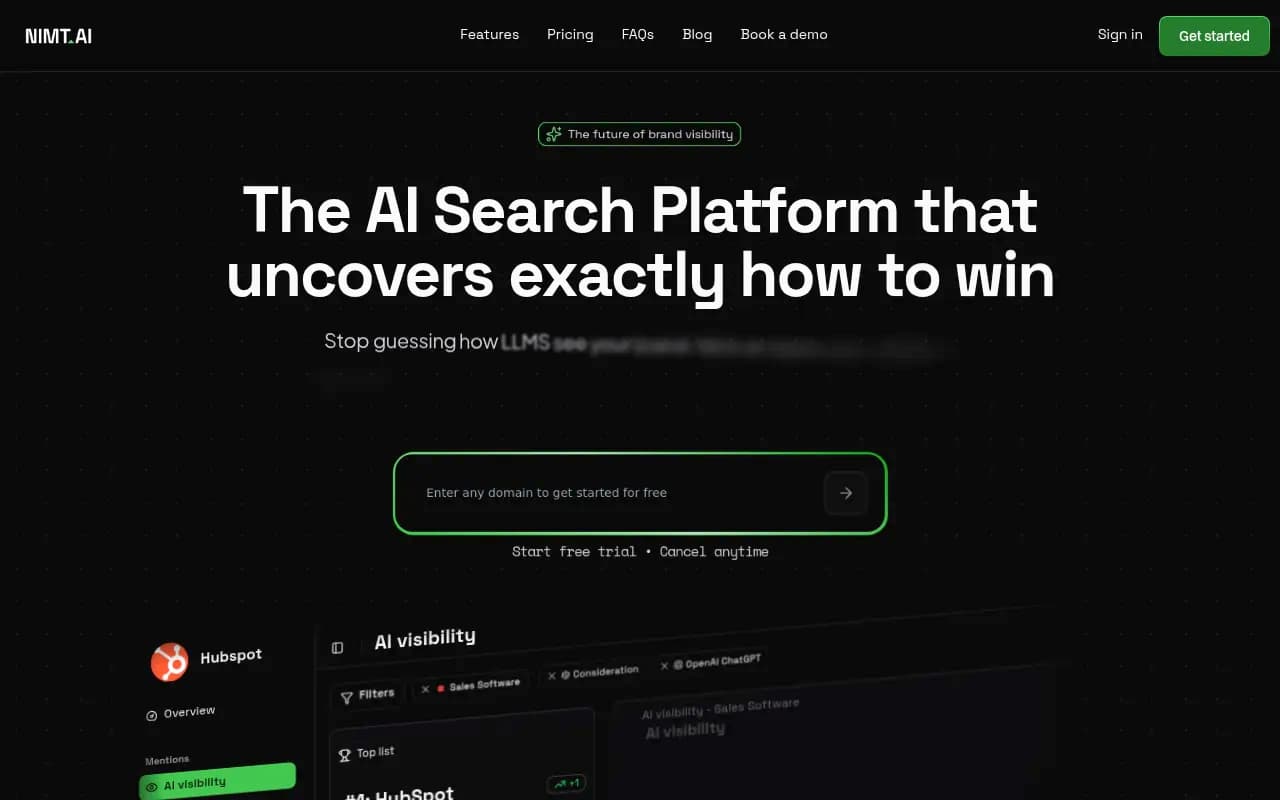
Nimt.ai positions itself as "the AI search platform that uncovers exactly how to win" in AI-generated recommendations. The tool monitors how brands appear across major AI models like ChatGPT, Perplexity, Google Gemini, Claude, and Google AI Overviews. It's aimed at marketing teams, SEO professionals, PR departments, and agencies who need to understand and track their brand's presence in AI search results. The platform launched in 2025 and has attracted over 3,000 brands according to their marketing materials.
The core promise is straightforward: stop guessing how AI models see your brand and start tracking your visibility in real-time. Unlike traditional SEO tools that focus on Google rankings and backlinks, Nimt.ai focuses on mentions, citations, and sentiment in AI-generated answers. The platform claims to help brands become the "#1 recommended answer" when users ask AI models for product or service recommendations.
Real-Time AI Visibility Tracking
The platform's main dashboard shows your brand's visibility score across different AI models. You see a numerical score (0-100) that represents how often and how prominently your brand appears in AI responses. The tracking updates daily, showing week-over-week changes in visibility, share of voice, and ranking position. You can filter by specific AI models, prompt categories (like "Sales Software" or "Customer Relationship Management"), and user intent stages (branded, informational, transactional, consideration, post-purchase).
The ranking view shows where your brand lands in AI-generated lists compared to competitors. If ChatGPT recommends five CRM platforms and you're #3, you see that position and how it's changed over time. The interface displays competitor logos, their visibility scores, and movement indicators (up/down arrows with position changes).
Prompt Management and Auto-Generation
Nimt.ai's AI automatically generates "high opportunity prompts" for your brand -- questions that users are likely asking AI models in your industry. The system tags these prompts by category (e.g. "Marketing Automation", "Sales Software") and intent (consideration, informational, transactional). You can add custom prompts or let the platform suggest them based on your industry and competitors.
Each prompt shows which AI models you're tracking it on, your current ranking, and visibility trends. The prompt library is searchable and filterable, making it easy to focus on specific product categories or buyer journey stages. However, unlike platforms like Promptwatch that provide prompt volume estimates and difficulty scoring, Nimt.ai doesn't surface data on which prompts are actually high-value or winnable -- you're left guessing which ones to prioritize.
Source and Citation Tracking
One of Nimt.ai's stronger features is its source tracker. The platform identifies which websites, Reddit threads, YouTube videos, media outlets, and competitor pages AI models cite when mentioning your brand or competitors. You see the domain, the specific URL, how many times it's been cited, and what percentage of total citations it represents. This helps you understand the "trust graph" -- the network of sources that AI models rely on for your industry.
The citation report breaks down which of your own pages are being cited by AI models. You see the URL, page title, and how many times it's been referenced. This is useful for understanding which content is working, but the platform doesn't provide crawler logs or indexing data to help you fix pages that aren't being discovered by AI models. Promptwatch offers real-time AI crawler logs that show exactly when ChatGPT, Claude, or Perplexity bots hit your site, what pages they read, and any errors they encounter -- critical data for diagnosing indexing issues that Nimt.ai lacks entirely.
Sentiment Analysis
Nimt.ai scores sentiment for each prompt and category on a 0-100 scale. A score of 79 means AI models are speaking positively about your brand 79% of the time in that context. You can see sentiment broken down by product category, AI model, and over time. The sentiment view also shows competitor sentiment scores, letting you benchmark how favorably AI models talk about you versus alternatives.
The platform doesn't explain how sentiment is calculated or provide examples of positive vs negative language, so it's a bit of a black box. You know the score is dropping, but you don't always know why or what specific language is hurting you.
Competitor Comparison
Automatic competitor detection identifies brands that appear alongside yours in AI responses. The competitor heatmap shows visibility scores for each brand across different AI models and prompt categories. You can see who's winning for specific queries, how their share of voice compares to yours, and which sources are driving their citations.
The domain comparison view ranks all tracked brands by visibility score, showing movement week-over-week. This leaderboard format makes it easy to see who's #1 in your category and how far behind (or ahead) you are. However, the platform doesn't provide gap analysis -- it won't tell you which specific prompts competitors are visible for that you're missing, or what content you need to create to close those gaps. Promptwatch's Answer Gap Analysis does exactly this, showing you the precise topics and angles your competitors cover that you don't, then helping you generate content to fill those holes.
Boost Actions (Optimization Recommendations)
Nimt.ai's "Boost Actions" feature generates weekly task lists designed to improve your AI visibility. These are specific, prioritized recommendations like "Host an AMA in r/CRM to influence AI answers on small business CRMs" or "Publish 'The 12 Best CRM Software in January 2026' on your blog". Each action includes a priority level (high/medium/low), estimated effort, and a checklist of sub-tasks.
The recommendations are contextual -- they're based on your current visibility gaps, competitor strategies, and the sources AI models trust in your industry. For example, if the platform detects that Reddit threads are heavily cited for CRM recommendations and you're not mentioned in any of them, it might suggest engaging in specific subreddits or hosting an AMA.
While the Boost Actions are more actionable than generic "improve your content" advice, they're still high-level suggestions. The platform doesn't generate the actual content for you or provide templates. You're told to "publish a listicle" but you have to write it yourself. Promptwatch's built-in AI writing agent generates full articles, comparisons, and listicles grounded in real citation data (880M+ citations analyzed), prompt volumes, and competitor analysis -- content engineered to get cited by AI models, not just generic SEO filler. Nimt.ai stops at the recommendation; Promptwatch helps you execute it.
Multi-Model and Multi-Region Support
Nimt.ai tracks six AI models: ChatGPT (with and without web search), Perplexity, Google AI Overviews, Google AI Mode, Anthropic Claude, and Google Gemini. Claude and Gemini are listed as "add-ons", suggesting they may cost extra or require higher-tier plans. The platform supports tracking in any language and uses local proxies in 230+ countries to capture regional variations in AI responses.
This is solid coverage, but Promptwatch monitors 10+ AI models including Meta/Llama, DeepSeek, Grok, Mistral, and Copilot in addition to the ones Nimt.ai covers. If your audience uses a wider range of AI tools, Nimt.ai's model coverage may feel limited.
Integrations and Reporting
Nimt.ai offers a Google Looker Studio connector that pulls data from your workspace into custom dashboards. This is useful for agencies reporting to clients or marketing teams presenting to executives. The platform also provides an API for custom integrations, though documentation isn't publicly available.
What's missing: traffic attribution. Nimt.ai doesn't help you connect AI visibility to actual website traffic or revenue. You can see that your visibility score improved, but you can't prove that it drove more visitors or conversions. Promptwatch offers multiple traffic attribution methods (code snippet, Google Search Console integration, server log analysis) to close the loop between visibility and business outcomes -- a critical gap for teams that need to prove ROI.
Who Is It For
Nimt.ai is best suited for:
- Brand and PR teams who need to monitor how AI models talk about their company and track sentiment over time. If your main concern is reputation management in AI search, the sentiment tracking and source identification are useful.
- Marketing teams at mid-sized companies (50-500 employees) who want basic visibility into AI search performance. If you're just starting to think about AI visibility and need a dashboard to track progress, Nimt.ai provides that.
- Agencies managing multiple clients who need white-label reporting. The Looker Studio integration and multi-project support make it easier to manage several brands in one workspace.
Nimt.ai is not ideal for:
- Teams that need to actively optimize for AI search, not just monitor it. If you want to close content gaps, generate AI-optimized articles, or fix indexing issues, Nimt.ai doesn't provide those tools. Promptwatch is built around the action loop: find gaps, create content, track results.
- SEO teams that need technical depth. No crawler logs, no page-level indexing diagnostics, no prompt volume or difficulty data. You're flying blind on which prompts are worth targeting and whether AI models can even discover your content.
- Brands that need to prove ROI. Without traffic attribution, you can't connect visibility improvements to revenue. Executives will ask "did this actually drive sales?" and you won't have an answer.
Pricing and Plans
Nimt.ai offers three pricing tiers:
- Starter: $59/month -- 1 project, 1 brand, 20 tracked prompts, daily tracking, Boost Actions, all core features (visibility, share of voice, ranking, sentiment, source tracker, domain comparisons). Covers ChatGPT (web search and standard), Perplexity, Google AI Overviews, and Google AI Mode. Claude and Gemini are add-ons. Intercom and email support.
- Pro: $69/month -- Unlimited projects and brands, 20-500 tracked prompts, same features as Starter. Includes a 7-day free trial.
- Enterprise: Custom pricing -- 500+ prompts, custom tracking frequency, priority support, custom invoicing, and custom setup.
The Starter plan is competitively priced at $59/mo for 20 prompts, but the jump to Pro at $69/mo for the same 20-500 prompt range feels odd -- the pricing page doesn't clarify what you actually get at the $69 tier vs $59. Most competitors charge more as you add prompts, so the flat $69 rate for up to 500 prompts could be a good deal if you need volume.
For comparison, Promptwatch starts at $99/mo (Essential: 1 site, 50 prompts, 5 AI-generated articles), $249/mo (Professional: 2 sites, 150 prompts, 15 articles, crawler logs, state/city tracking), and $579/mo (Business: 5 sites, 350 prompts, 30 articles). Promptwatch is more expensive, but you're paying for content generation, crawler logs, traffic attribution, and optimization tools -- not just monitoring.
Strengths
- Sentiment tracking is more detailed than most competitors. The 0-100 scoring and category-level breakdowns give you a clear picture of how AI models talk about your brand.
- Source identification is solid. Knowing which Reddit threads, YouTube videos, and media outlets drive citations helps you focus your outreach and content efforts.
- Boost Actions provide specific, prioritized recommendations instead of vague advice. The weekly task lists are more actionable than "improve your SEO".
- Multi-language and multi-region support with local proxies in 230+ countries. Good for global brands that need to track AI responses in different markets.
- Looker Studio integration makes it easy to build custom reports for clients or stakeholders.
Limitations
- No content generation or optimization tools. Nimt.ai tells you what to do but doesn't help you do it. Promptwatch generates AI-optimized articles, comparisons, and listicles based on real citation data -- content designed to get cited by AI models.
- No AI crawler logs or indexing diagnostics. You can't see when AI models crawl your site, which pages they read, or errors they encounter. Promptwatch provides real-time crawler logs for ChatGPT, Claude, Perplexity, and other AI bots -- critical for fixing indexing issues.
- No traffic attribution. You can't connect visibility improvements to actual website traffic or revenue. Promptwatch offers code snippet, GSC integration, and server log analysis to prove ROI.
- No prompt volume or difficulty scoring. You don't know which prompts are high-value or winnable. Promptwatch provides volume estimates and difficulty scores so you can prioritize the right prompts.
- No gap analysis. The platform won't tell you which specific prompts competitors are visible for that you're missing. Promptwatch's Answer Gap Analysis shows exactly what content you need to create to catch up.
- Limited model coverage. Six AI models (with two as add-ons) vs Promptwatch's 10+ models including Meta/Llama, DeepSeek, Grok, Mistral, and Copilot.
- No Reddit or YouTube-specific tracking. While the source tracker identifies Reddit threads and YouTube videos, there's no dedicated view or filtering for these channels. Promptwatch surfaces Reddit discussions and YouTube videos that directly influence AI recommendations.
- No ChatGPT Shopping tracking. If your brand sells products, you can't monitor when you appear in ChatGPT's shopping carousels or product recommendations. Promptwatch tracks this.
Bottom Line
Nimt.ai is a monitoring-focused platform that shows you how your brand appears in AI search results. The sentiment tracking, source identification, and competitor comparison features are solid, and the Boost Actions provide more specific recommendations than most competitors. If you're a brand or PR team that primarily needs to track reputation and visibility in AI models, Nimt.ai delivers that.
However, it's a tracking tool, not an optimization platform. You see the data, but you're left to figure out how to act on it yourself. There's no content generation, no crawler logs, no traffic attribution, no gap analysis, and no prompt prioritization data. For teams that want to actively improve their AI search presence -- not just monitor it -- Promptwatch is the stronger choice. Promptwatch is built around the action loop: find gaps with Answer Gap Analysis, generate AI-optimized content with the built-in writing agent, and track results with page-level citation tracking and traffic attribution. Nimt.ai stops at step one.
Best use case in one sentence: Brand and PR teams at mid-sized companies who need a dashboard to monitor AI sentiment and visibility, but don't need deep optimization or content generation tools.
Frequently asked questions
What is Nimt.ai and what does it do?
How much does Nimt.ai cost?
Which AI models does Nimt.ai track?
Who should use Nimt.ai?
What are the limitations of Nimt.ai?
Does Nimt.ai offer a free trial?
Similar and alternative tools to Nimt.ai