Key takeaways
- Rankscale is the cheapest entry point in this category at around $20/month, making it worth a look for solo operators or small teams just starting out with AI visibility tracking.
- ZipTie (ziptie.dev) leans into multi-model monitoring and is better suited for teams that want breadth across AI engines without a steep learning curve.
- Nimt.ai sits in the middle, with a cleaner interface and some optimization features that go slightly beyond pure tracking.
- All three are monitoring-first tools. None of them close the full loop from gap identification to content creation to citation tracking the way more complete platforms do.
- If budget is genuinely the constraint, any of these three beats doing nothing. But know what you're buying: dashboards that show where you stand, not engines that help you improve.
The AI visibility tool market has exploded. There are now dozens of platforms claiming to track your brand across ChatGPT, Perplexity, Google AI Overviews, and the rest. Most of them cost $200-$600/month. That's a real barrier for freelancers, small marketing teams, and agencies that are still figuring out whether AI search visibility even moves the needle for their clients.
Nimt.ai, Rankscale, and ZipTie are three tools that have carved out a niche at the lower end of the pricing spectrum. They're not trying to compete with enterprise platforms. They're trying to answer a simpler question: "Is my brand showing up in AI search results, and how does that compare to my competitors?"
That's a reasonable starting point. The question is which of these three does it best, and where each one falls short.
What these tools actually do (and don't do)
Before getting into specifics, it helps to be clear about the category. AI visibility trackers work by running a set of prompts against AI engines (ChatGPT, Perplexity, Gemini, etc.) and checking whether your brand appears in the responses. They aggregate this into a visibility score or citation count, let you compare against competitors, and show you trends over time.
What they generally don't do: tell you why you're not appearing, generate content to fix the gaps, or connect visibility data to actual traffic and revenue. That's the ceiling of the monitoring-only approach, and it's worth keeping in mind as you evaluate these tools.
Nimt.ai
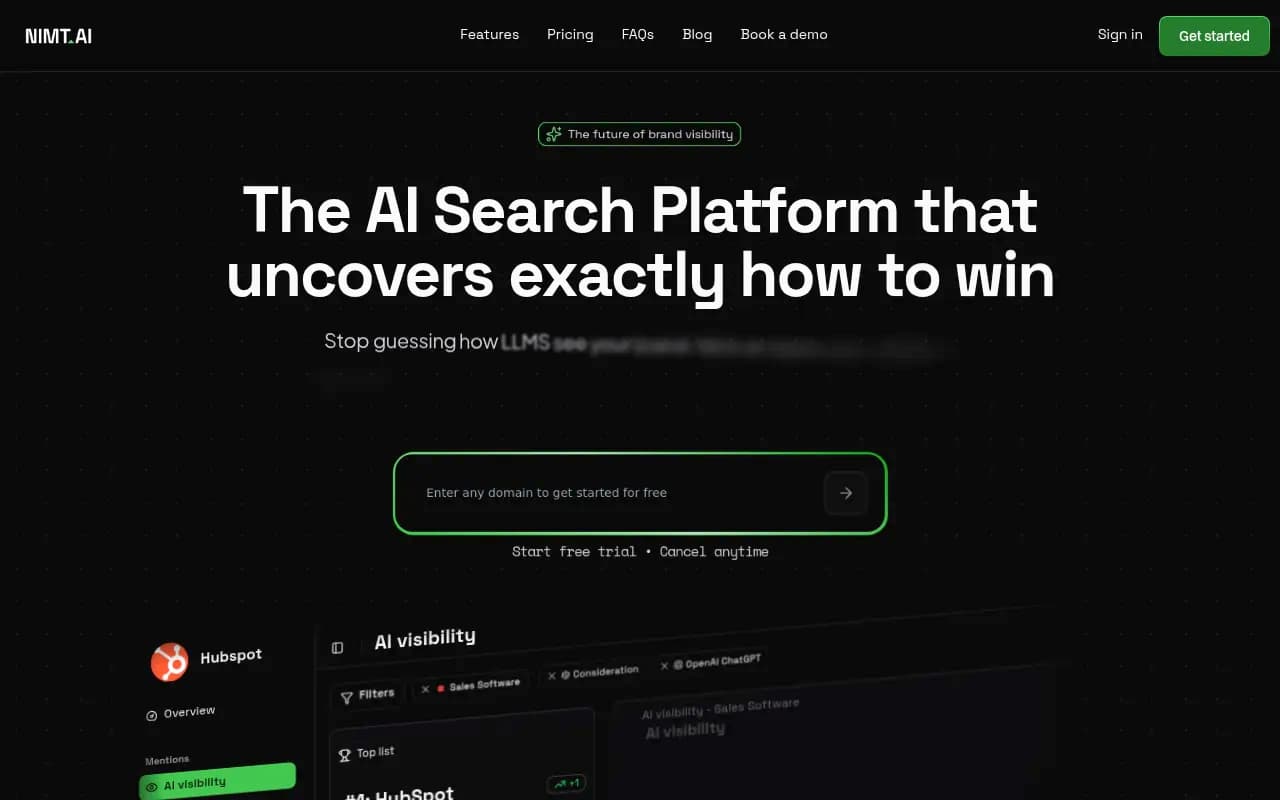
Nimt.ai positions itself as an AI visibility tracking and optimization platform. The interface is clean and the onboarding is fast -- you can set up a brand, add a list of prompts, and start seeing data within a few minutes.
What works
The prompt management is straightforward. You define the queries you care about, Nimt runs them across multiple AI engines, and you get a breakdown of where your brand appears versus competitors. The competitive view is genuinely useful: you can see which brands are consistently outperforming you on specific prompt types, which at least tells you where to focus.
There's also some light optimization guidance baked in. Nimt will surface suggestions around content topics and entity mentions that seem to correlate with better AI visibility. It's not deep, but it's more than a pure tracker gives you.
Where it falls short
The optimization features feel thin in practice. The suggestions are fairly generic ("publish more content about X topic") without the specificity that would make them immediately actionable. There's no content generation, no brief creation, and no way to connect what you publish back to citation changes.
Coverage across AI engines is decent but not comprehensive. If you care about Google AI Mode, DeepSeek, or Grok specifically, check the current model list before committing.
Pricing sits in the $30-$80/month range depending on the plan, which is reasonable for what you get.
Rankscale
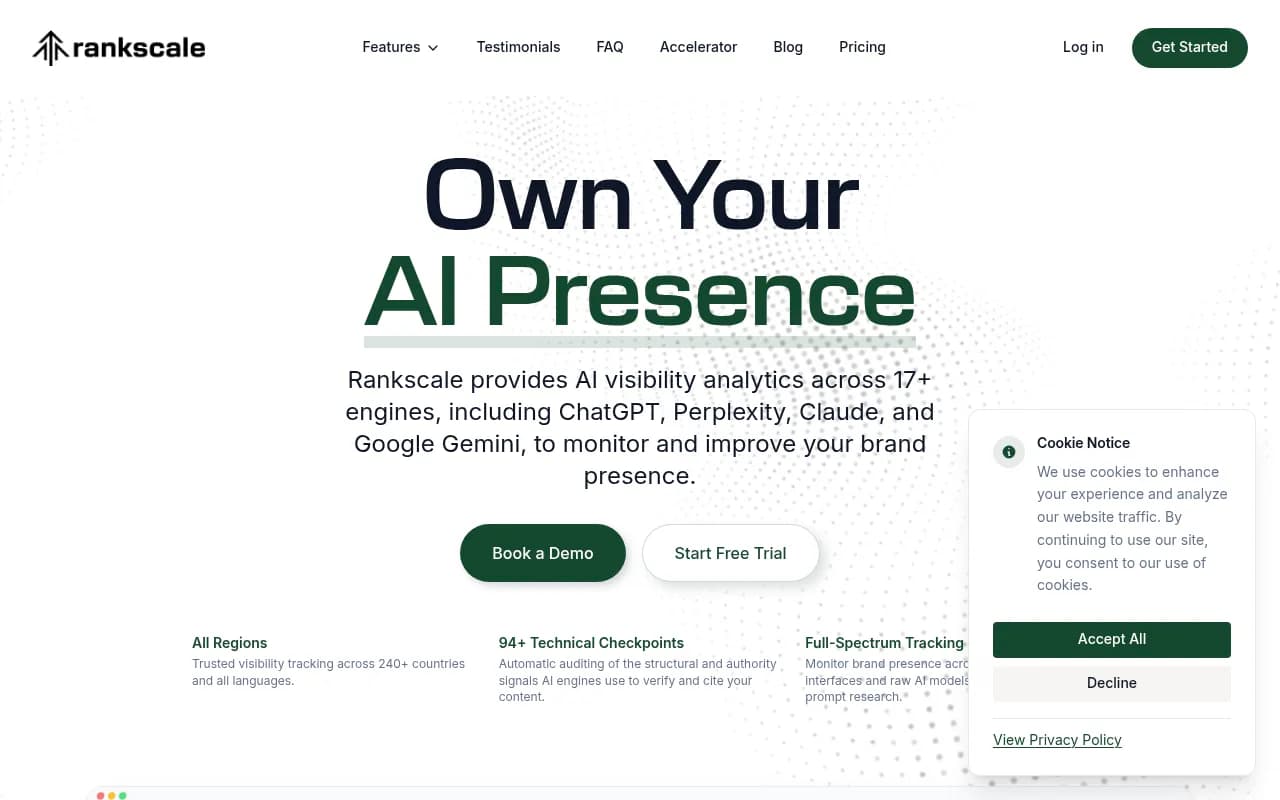
Rankscale is the most affordable option in this comparison. According to testing by AI Advantage Agency, it comes in at roughly $20/month for entry-level access, which is genuinely the lowest price point in the AI visibility tracking category right now.
What works
For $20/month, the core functionality is solid. You get prompt tracking across the main AI engines, a visibility score, and basic competitor comparisons. If you're a solo consultant or a small business owner who just wants to know whether they're appearing in ChatGPT when someone searches their category, Rankscale does that job without requiring a significant budget commitment.
The interface is simple, which is either a feature or a limitation depending on what you need. There's not much to configure, which means you can get up and running quickly.
Where it falls short
Simplicity cuts both ways. Rankscale's low price reflects a genuinely limited feature set. Prompt volume estimates, difficulty scoring, query fan-outs, crawler logs, content gap analysis -- none of that is here. You get a number and a trend line.
For teams that need to report on AI visibility to clients or executives, the reporting capabilities are thin. There's no white-label option at the entry price point, and the data export options are limited.
It's also worth noting that at $20/month, the prompt limits are tight. If you're tracking a competitive category with dozens of relevant queries, you'll hit the ceiling quickly.
ZipTie
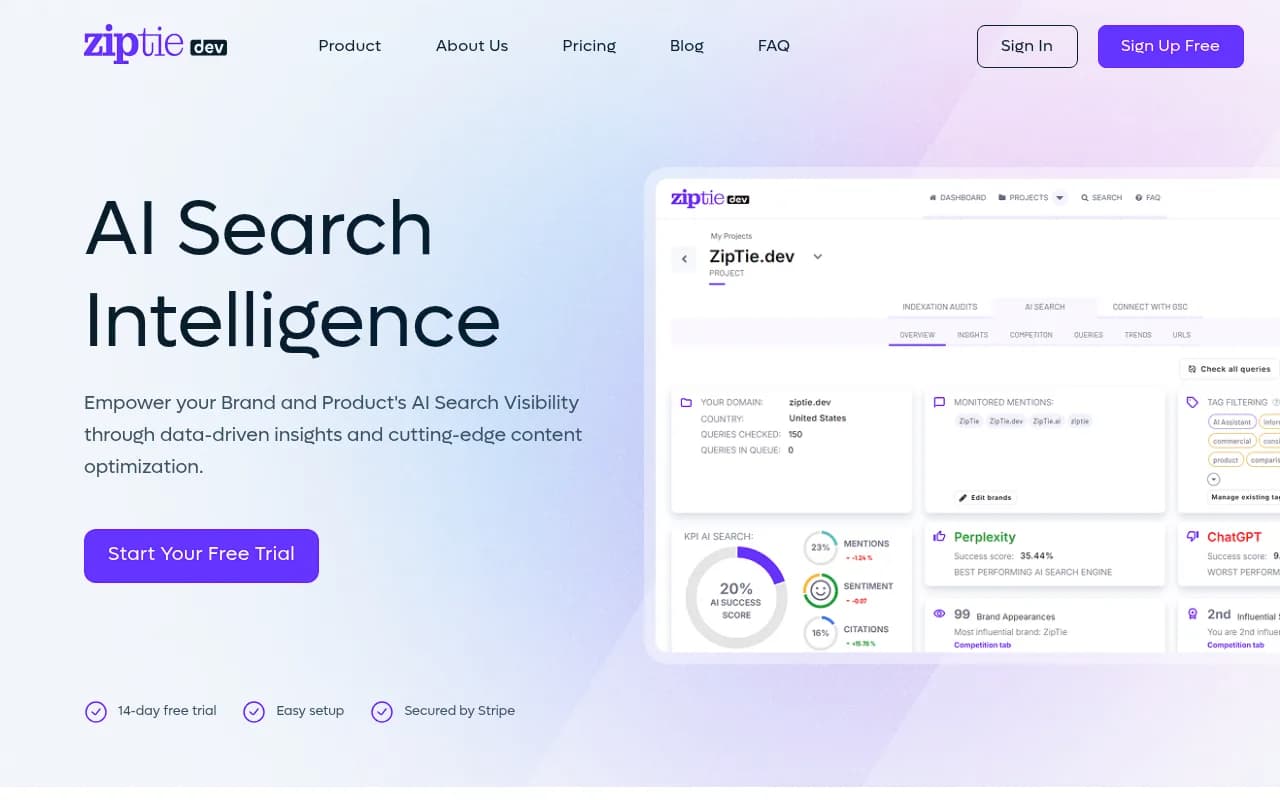
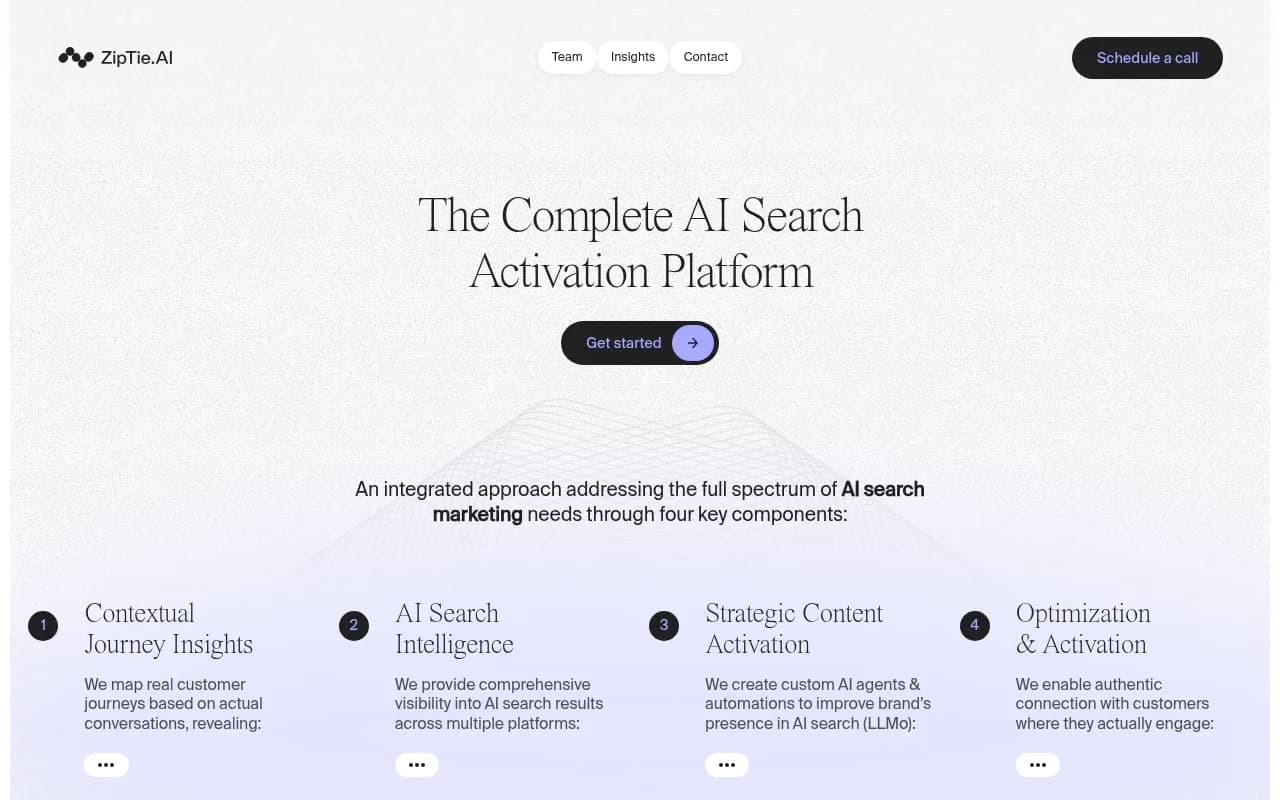
ZipTie (ziptie.dev) is the most technically oriented of the three. It's built with a clear focus on multi-model monitoring -- the ability to track your visibility across many AI engines simultaneously and compare results.
What works
The multi-model coverage is ZipTie's strongest point. It's one of the few budget tools that takes seriously the fact that different AI engines behave differently. A brand that appears consistently in Perplexity might be invisible in ChatGPT, and those discrepancies are worth knowing about.
The diagnostic angle is also more developed than Nimt or Rankscale. ZipTie surfaces some analysis around why visibility differs across models, which gives you a starting point for investigation even if it doesn't hand you a solution.
For teams that are technically comfortable and want to dig into the data, ZipTie gives you more to work with.
Where it falls short
The interface is rougher than Nimt's. ZipTie feels more like a power tool than a polished product, which means there's a steeper learning curve for non-technical users.
Like the others, it's fundamentally a monitoring tool. The diagnostic features are a step in the right direction, but there's still a significant gap between "here's what's happening" and "here's how to fix it."
Pricing is in a similar range to Nimt, though the exact tiers depend on prompt volume and the number of models you track.
Head-to-head comparison
| Feature | Nimt.ai | Rankscale | ZipTie |
|---|---|---|---|
| Starting price | ~$30-$80/mo | ~$20/mo | ~$30-$70/mo |
| Multi-model coverage | Good | Basic | Strong |
| Competitor tracking | Yes | Basic | Yes |
| Content optimization hints | Light | No | Diagnostic only |
| Content generation | No | No | No |
| Crawler logs / AI agent tracking | No | No | No |
| Prompt volume/difficulty data | No | No | No |
| White-label reporting | Limited | No | Limited |
| Best for | Small teams wanting clean UX | Solo operators, tight budgets | Technical users, multi-model depth |
The honest limitation of all three
Here's the thing that none of these tools will tell you in their marketing: knowing you're invisible is only the first step. The harder problem is figuring out what to do about it.
All three tools will show you a visibility score. They'll show you that Competitor X is appearing in 40% of relevant prompts while you're appearing in 8%. That's genuinely useful information. But then what?
The gap between "I know I'm invisible" and "I'm now visible" requires understanding which content is missing from your site, what topics AI models are actively looking for answers to, and then creating content that actually fills those gaps. None of these three tools help you do that.
This is the fundamental trade-off at the budget end of the market. You're paying for monitoring. The optimization work still falls entirely on you.
If that's fine for your current stage -- you just need to establish a baseline and report on trends -- then any of these three tools will serve that purpose. But if you're trying to actually move the needle on AI visibility, you'll eventually need something that closes the loop between tracking and fixing.
Platforms like Promptwatch are built around that full cycle: find the gaps, generate content to fill them, and track whether citations improve as a result. It's a different price point, but it's also a different category of tool.

Which one should you pick?
The right choice depends almost entirely on what you need right now.
If budget is the hard constraint and you just want to establish a baseline, Rankscale at $20/month is the obvious starting point. You'll outgrow it, but it's a low-risk way to start tracking.
If you want a cleaner experience with some light optimization guidance and you're willing to spend a bit more, Nimt.ai is the more polished option. The interface is better and the competitive view is more developed.
If you're technically comfortable and care specifically about understanding how your visibility varies across different AI models, ZipTie's multi-model depth makes it the most interesting of the three from a diagnostic standpoint.
None of them are the right answer if you need to actually improve your AI visibility rather than just measure it. For that, you need a platform that connects the monitoring data to content creation and tracks the results of what you publish. But as entry points into the category, all three are legitimate options for teams that aren't ready to commit to a full-featured platform.
Start with the data. Just know that the data alone won't move the needle.