Key takeaways
- AI search engines don't rank pages -- they synthesize answers from sources they trust. Getting cited means becoming one of those trusted sources.
- The biggest ranking factors are topical authority, structured content, entity clarity, and third-party mentions (especially listicles and review sites).
- Traditional SEO still matters, but it's no longer enough. You need to optimize specifically for how LLMs retrieve and use content.
- Tracking your AI visibility is now a separate discipline from tracking Google rankings -- different tools, different metrics.
- The brands winning in AI search right now are publishing content that directly answers the questions AI models get asked, not just content that targets keywords.
If you've been watching your Google traffic hold steady while wondering why your brand never shows up in ChatGPT or Perplexity responses, you're not alone. AI search is a genuinely different game, and most of the old playbook doesn't transfer cleanly.
This guide covers what actually moves the needle in 2026 -- not theory, but the specific things you can do to get your brand cited, recommended, and visible across AI search engines.
How AI search actually works (and why it matters for your strategy)
Before you can optimize for AI search, you need to understand what these systems are actually doing when someone asks them a question.
Traditional search engines crawl pages, index keywords, and rank results based on relevance signals and authority metrics. AI search engines do something fundamentally different: they process content to understand meaning, context, and relationships between entities. When someone asks ChatGPT "what's the best project management software for remote teams?", it doesn't search for pages containing those keywords. It draws on a synthesized understanding of the web -- what sources consistently say, which brands appear in authoritative contexts, and what the consensus looks like across multiple trusted sources.
This has a few practical implications:
- You can rank #1 in Google and still be completely invisible in AI responses
- AI models look for consensus across sources, not just the single best page
- Being mentioned on third-party sites (review sites, listicles, forums) often matters as much as your own content
- Structured, clearly written content gets cited more than dense, keyword-stuffed pages
Google AI Overviews now appear for roughly 15-20% of searches. ChatGPT processes over 200 million queries daily. Perplexity has built a significant business on AI-first search. These aren't niche products anymore -- they're where a meaningful chunk of your potential customers are looking.
Step 1: Audit your current AI visibility
You can't improve what you can't measure. The first thing to do is find out where you actually stand.
Run a handful of prompts that your target customers would realistically ask. Not keyword searches -- full questions. "What are the best tools for [your category]?" "Who are the leading providers of [your service]?" "What should I look for when choosing [your product type]?"
Do this across multiple AI platforms: ChatGPT, Perplexity, Google AI Overviews, Gemini, and Claude at minimum. Note whether your brand appears, where it appears in the response, and which competitors are consistently showing up.
For anything beyond a manual spot-check, you'll want a dedicated tracking tool. Promptwatch is built specifically for this -- it tracks your visibility across 10+ AI models, shows you which prompts your competitors appear in that you don't, and gives you page-level data on which of your pages are actually being cited.

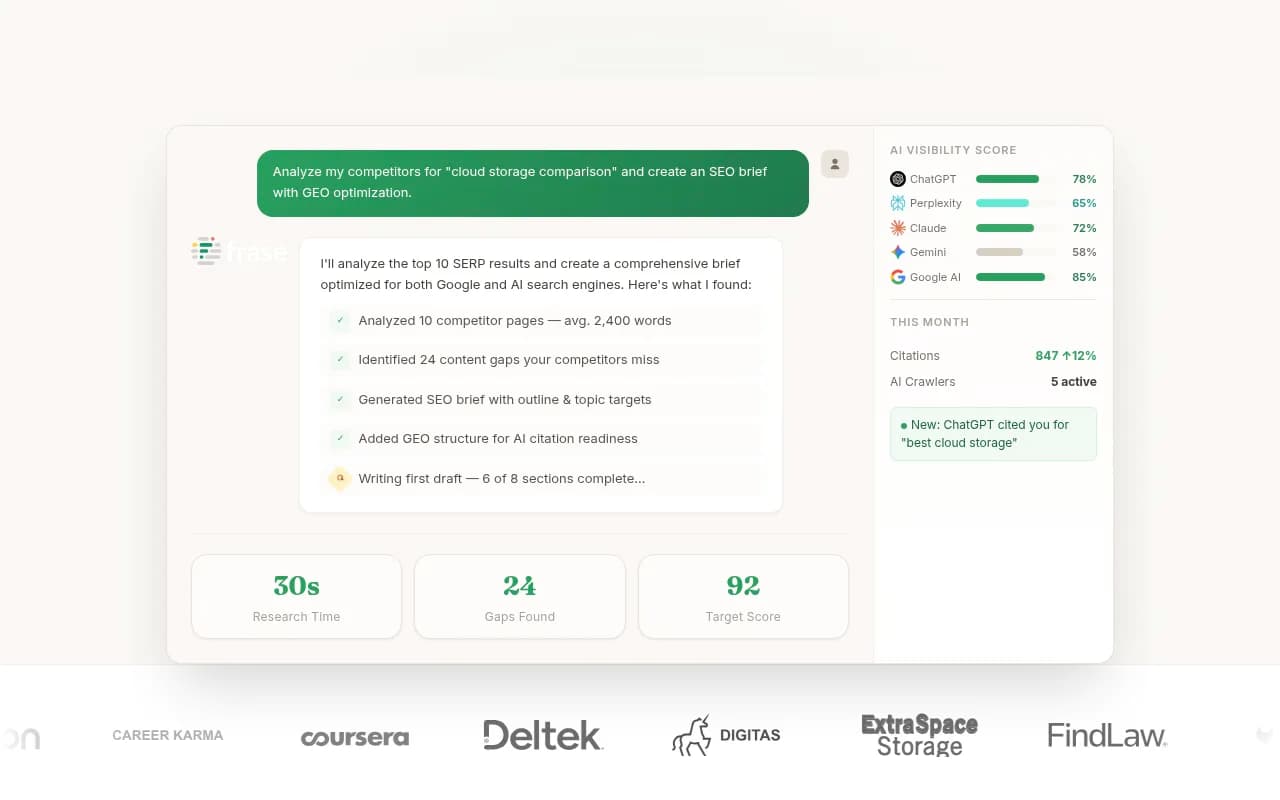
Other options worth knowing about:



The key metric to track isn't just "do we appear" -- it's share of voice across the prompts that matter to your business. How often does your brand appear compared to competitors? In what position? With what sentiment?
Step 2: Build topical authority, not just individual pages
AI models favor sources that demonstrate deep expertise on a topic. A single well-written page rarely gets you cited. What works is a cluster of content that covers a topic from multiple angles -- what practitioners call a "pillar and cluster" structure.
The idea is straightforward: create a comprehensive pillar page that covers your core topic broadly, then build out supporting pages that go deep on specific subtopics. Each sub-page answers a specific question a real user might ask. Together, they signal to AI models that your site is a genuine authority on the subject, not just a page that happens to mention the right words.
For example, if you sell project management software, your pillar might be "project management for remote teams." Your clusters might cover: async communication best practices, how to run remote standups, tools for tracking distributed team progress, managing time zones in project planning, and so on. Each page answers a real question. Together, they build authority.
This structure also helps with something called query fan-out -- when an AI model receives one question, it often breaks it into multiple sub-queries to gather information. If your site has pages that answer those sub-queries, you're much more likely to be cited in the final response.
Step 3: Write content that AI models actually want to cite
There's a specific type of content that gets cited in AI responses, and it's not the same as content that ranks well in traditional search.
AI models are looking for content that:
- Directly answers a specific question, ideally in the first paragraph
- Uses clear, declarative sentences rather than hedged or vague language
- Includes concrete facts, numbers, and examples
- Is structured with logical headings that match how people ask questions
- Doesn't bury the answer behind long introductions or excessive preamble
The "think of AI as a super-smart reader that summarizes helpful sources" framing is actually useful here. If a researcher were going to quote your page in a summary, what would they pull? Write for that. The paragraph that gets cited is usually the one that states something clearly and specifically.
Some practical formatting tips:
- Use question-based H2 and H3 headings (e.g. "How does X work?" rather than "Overview of X")
- Include a clear, direct answer in the first 1-2 sentences after each heading
- Use numbered lists and tables for comparisons -- these get pulled into AI responses frequently
- Add a FAQ section at the bottom of long pages. These get cited constantly.
One thing to avoid: writing content that's clearly optimized for AI rather than for humans. AI models are getting better at detecting thin, formulaic content. Real value-driven content that helps a reader solve a specific problem performs better than content engineered to hit citation triggers.

Step 4: Get mentioned on the right third-party sources
This is probably the most underrated factor in AI search visibility, and it's where a lot of brands are leaving citations on the table.
AI models build their understanding of "what's the best X" by looking at consensus across sources. The sources they weight most heavily tend to be:
- Listicles and "best of" roundups (e.g. "best CRM software for small businesses")
- Review platforms (G2, Capterra, Trustpilot, Product Hunt)
- Industry publications and news sites
- Reddit threads where real users discuss options
- YouTube videos that recommend or compare products
If your brand isn't appearing in these places, you're invisible to AI models even if your own website is excellent. The fix is a deliberate outreach and PR strategy aimed at getting into the right listicles and review conversations.
Practically, this means:
- Identifying which listicles your competitors appear in that you don't
- Reaching out to the authors of those listicles to request inclusion
- Building a strong review presence on the platforms AI models cite
- Participating genuinely in relevant Reddit communities (not spamming -- actually being helpful)
- Getting covered in industry publications with specific, quotable claims about your product
Tools like Promptwatch can show you exactly which external sources are driving AI citations for your competitors -- which makes the outreach targeting much more precise than guessing.
Step 5: Sort out your technical foundations
AI crawlers are different from Google's crawler. They visit pages differently, at different frequencies, and they can encounter errors that Google would handle gracefully but that cause AI models to skip your content entirely.
The basics still apply: fast load times, clean HTML, no crawl errors, proper canonical tags. But there are a few AI-specific things to check:
- Make sure your
robots.txtisn't accidentally blocking AI crawlers. Some common AI crawler user agents include GPTBot (OpenAI), ClaudeBot (Anthropic), and PerplexityBot. - Check that your important content isn't hidden behind JavaScript rendering that crawlers can't access
- Use schema markup (structured data) to help AI models understand what your content is about -- especially FAQ schema, HowTo schema, and Article schema
- Make sure your site has a clear, crawlable site structure with logical internal linking
If you want to see exactly which AI crawlers are hitting your site, which pages they're reading, and whether they're encountering errors, Promptwatch's crawler log feature gives you that data in real time. Most monitoring tools don't have this at all.
Step 6: Establish entity clarity
AI models think in terms of entities -- named things (brands, people, products, places) and their relationships. If AI models are confused about what your brand is, what it does, and how it relates to other entities in your space, you'll struggle to get cited.
Entity clarity means making sure that everywhere your brand is mentioned online, the description is consistent. Your website, your Google Business Profile, your LinkedIn page, your Crunchbase listing, your Wikipedia page (if you have one), your press mentions -- they should all describe your brand in consistent terms.
Specifically:
- Define your brand's core category clearly and use it consistently ("AI search visibility platform" vs "SEO tool" vs "marketing analytics" -- pick the most accurate one and use it everywhere)
- Make sure your founding date, location, and key facts are consistent across sources
- Get your brand mentioned alongside the right competitors and category terms in third-party content
- If you don't have a Wikipedia page, consider whether you're eligible for one -- Wikipedia is heavily weighted by AI models
Schema markup helps here too. Organization schema on your homepage with consistent name, URL, logo, and description signals to AI models exactly what your entity is.
Step 7: Track, measure, and iterate
AI search visibility isn't a one-time optimization -- it's an ongoing process. The models update, the competitive landscape shifts, and new prompts become relevant as your market evolves.
Set up a regular cadence for:
- Checking your visibility across key prompts (weekly or bi-weekly)
- Monitoring which new pages are getting cited and which have dropped off
- Tracking competitor visibility to spot gaps and opportunities
- Reviewing which external sources are driving citations
The gap between "we appear in AI responses" and "we dominate AI responses in our category" is usually content volume and third-party presence. Brands that win are publishing consistently, getting into more listicles, and building more review presence over time.
Here's a quick comparison of some tools you can use to track AI visibility:
| Tool | AI models tracked | Content generation | Crawler logs | Best for |
|---|---|---|---|---|
| Promptwatch | 10+ | Yes (Content Agents) | Yes | Full GEO optimization |
| Profound | 6+ | No | No | Enterprise monitoring |
| Otterly.AI | 5 | No | No | Budget monitoring |
| Peec AI | 5+ | No | No | Multi-language tracking |
| SE Ranking | 5+ | Limited | No | SEO teams adding AI tracking |
| Semrush One | 4 | Limited | No | Existing Semrush users |
Step 8: Don't ignore the channels AI models actually read
One thing that surprises people when they dig into AI citation data: the sources AI models cite are often not the ones you'd expect. Reddit threads, YouTube videos, and niche forum discussions show up constantly in AI responses -- sometimes more than official brand pages.
This means your content strategy needs to extend beyond your own website. A few channels worth investing in:
- Reddit: Participate in relevant subreddits where your potential customers ask questions. Helpful, specific answers that get upvoted will be read by AI crawlers. Don't spam -- genuinely contribute.
- YouTube: Videos that explain how to solve problems in your category get cited in AI responses. A well-structured "how to choose X" video can drive AI visibility even if it doesn't rank highly on YouTube itself.
- Industry forums and communities: Niche communities in your space are often cited by AI models because they represent real user consensus.
- Podcast transcripts: If you're a guest on relevant podcasts, make sure the transcript is published and indexable.
The underlying logic is the same as everything else in this guide: AI models are looking for consensus across trusted, authentic sources. The more places you show up saying consistent, credible things, the more likely you are to be cited.
Putting it all together
Ranking in AI search in 2026 isn't a single tactic -- it's a system. You need good content on your own site, third-party mentions in the right places, technical foundations that AI crawlers can actually navigate, and consistent entity signals across the web.
The brands that are winning right now are the ones that started treating AI visibility as a separate discipline from traditional SEO about 12-18 months ago. They're tracking it, measuring it, and iterating on it the same way they would any other marketing channel.
If you're starting from scratch, the highest-leverage moves are: audit your current visibility, identify the prompts where competitors appear but you don't, and start publishing content that directly answers those questions. That alone will move the needle faster than most technical optimizations.
The tools exist to make this measurable and systematic. Use them.