Key takeaways
- Nimt.ai and Hall are both AI brand monitoring tools, but they serve slightly different use cases and team types
- Neither tool offers content optimization or generation -- they're monitoring-first platforms
- Hall has a cleaner UI and is better suited to smaller teams wanting quick brand pulse checks
- Nimt.ai leans more toward structured visibility tracking with competitive benchmarking
- If you need to go beyond monitoring and actually fix your AI visibility, you'll want a platform that includes content gap analysis and optimization -- not just dashboards
The AI search monitoring space has exploded in 2026. There are now well over 20 tools claiming to track how ChatGPT, Perplexity, Claude, and Gemini talk about your brand. Nimt.ai and Hall are two of the newer entrants -- both worth a look, but neither is the obvious choice for every team.
This guide breaks down what each tool actually does, where they differ, and which one makes more sense depending on your situation.
What problem are these tools solving?
Before comparing features, it's worth being clear about the underlying problem.
When a potential customer types "what's the best [your category] tool?" into ChatGPT or Perplexity, they get a curated answer. Your brand either appears in that answer or it doesn't. Traditional SEO tools -- Ahrefs, Semrush, Google Search Console -- don't track this. They track Google rankings, not LLM responses.
AI brand monitoring tools fill that gap. They run prompts across AI engines on a schedule, parse the responses, and report back on metrics like mention rate, sentiment, citation frequency, and share of voice versus competitors.
That's the core job. Nimt.ai and Hall both do it. The question is how well, and what else they bring to the table.
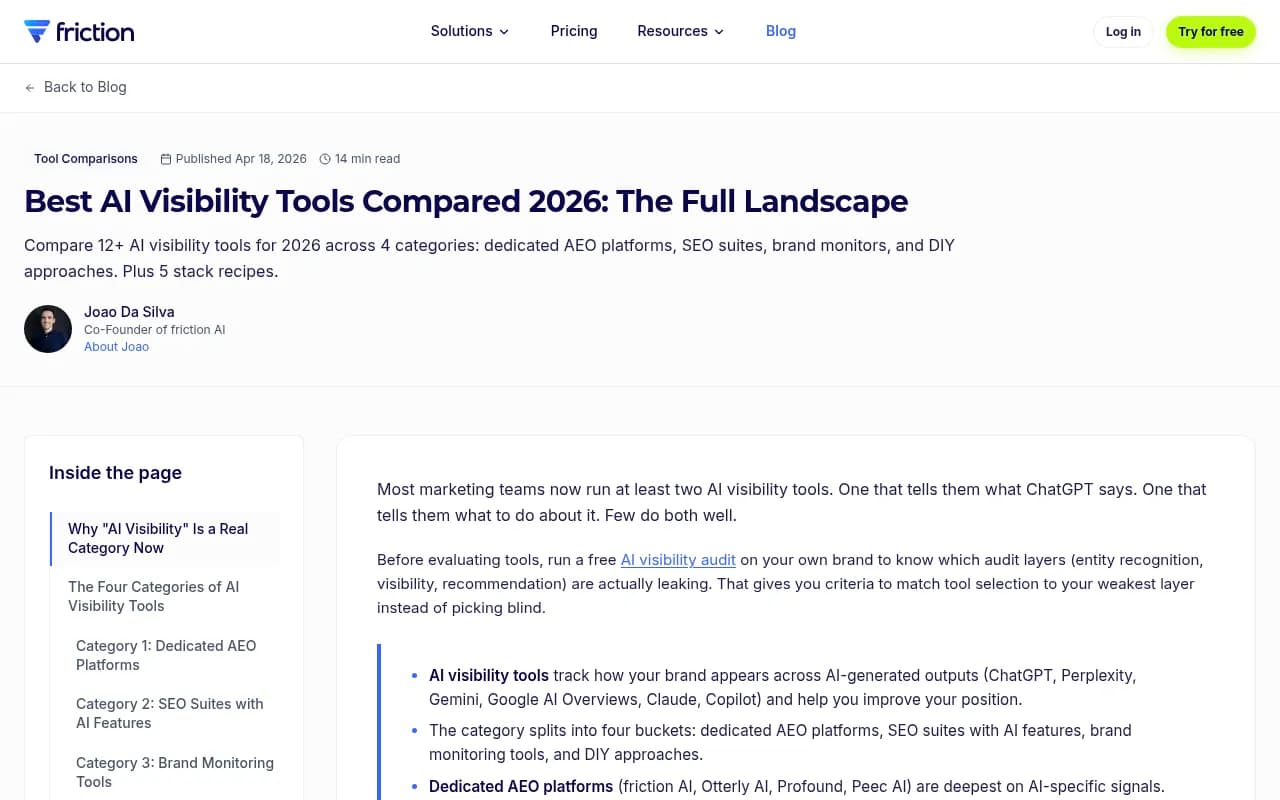
Nimt.ai: what it is and who it's for
Nimt.ai positions itself as an AI visibility tracking and optimization platform. It tracks brand mentions across the major LLMs, shows you how your brand is described, and gives you competitive context -- how often you appear versus named competitors for the same prompts.
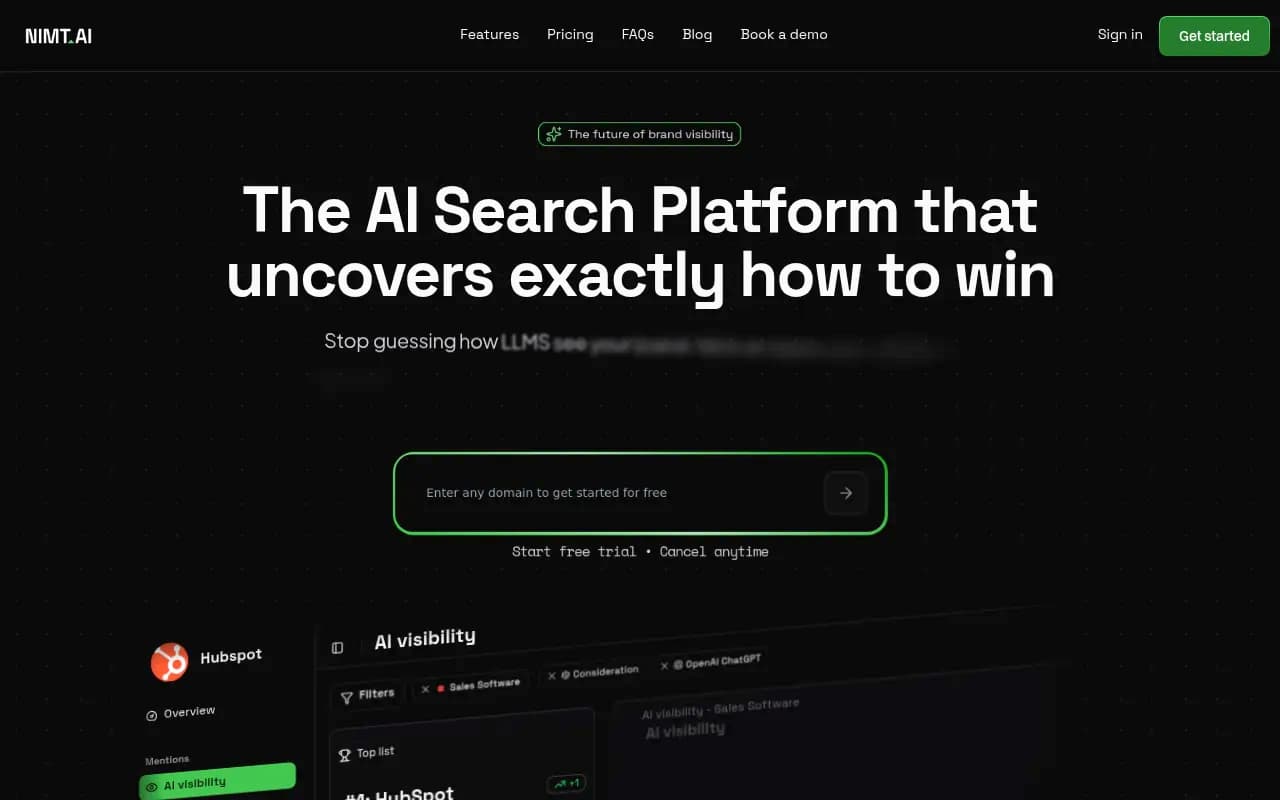
The platform's main value is structured visibility data. You define a set of prompts relevant to your category, Nimt.ai runs them across AI engines, and you get a dashboard showing mention rates, sentiment trends, and citation sources over time.
A few things that stand out about Nimt.ai:
- Competitive benchmarking is built into the core experience, not an add-on
- It tracks multiple AI models, so you can see if you're visible on Perplexity but invisible on ChatGPT
- The prompt setup process is reasonably straightforward for non-technical marketers
The main limitation is that Nimt.ai is primarily a monitoring tool. It tells you where you stand. What to do about it is largely left to you.
Hall: what it is and who it's for
Hall (usehall.com) focuses on tracking how AI platforms cite and talk about your brand. The emphasis is slightly different from Nimt.ai -- Hall leans more toward citation tracking and brand narrative monitoring, rather than share-of-voice competitive analysis.
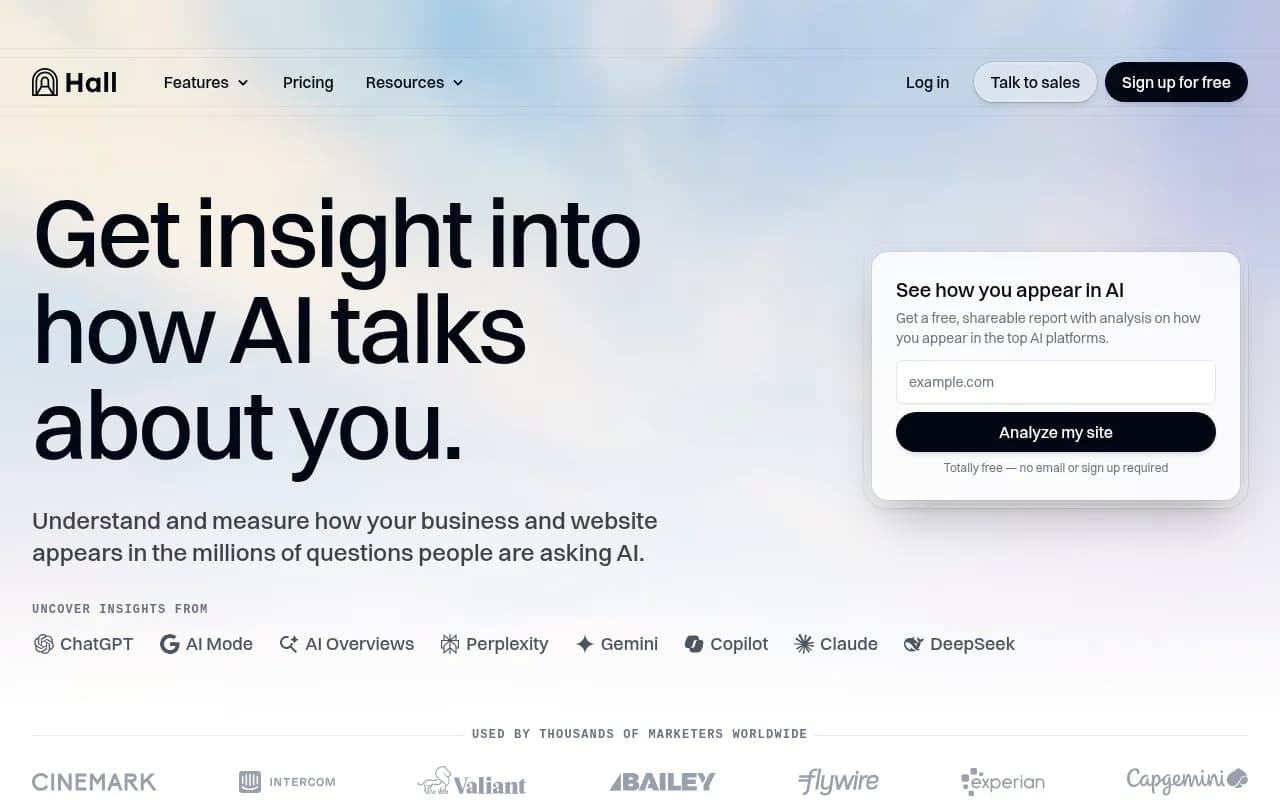
Hall's interface is clean and minimal, which makes it accessible for marketing teams that don't want to spend hours configuring a complex tool. You connect your brand, define your key topics, and Hall starts surfacing how AI engines are describing you.
Where Hall tends to get positive feedback:
- Fast setup -- you can be tracking within minutes
- The citation view is clear and easy to read
- Good for teams that want a quick "pulse check" on AI brand health
Where Hall falls short is depth. It's a lighter tool, which is a feature if you want simplicity, but a limitation if you need granular prompt-level data, competitive heatmaps, or multi-region tracking.
Feature comparison
Here's a direct look at how the two tools compare across the dimensions that matter most to marketing teams:
| Feature | Nimt.ai | Hall |
|---|---|---|
| AI models tracked | Multiple (ChatGPT, Perplexity, Gemini, Claude) | Multiple (ChatGPT, Perplexity, Claude, Gemini) |
| Competitive benchmarking | Yes, built-in | Limited |
| Citation tracking | Yes | Yes, core feature |
| Sentiment analysis | Yes | Basic |
| Prompt customization | Yes | Yes |
| Multi-region / multi-language | Limited | Limited |
| Content gap analysis | No | No |
| Content generation | No | No |
| AI crawler logs | No | No |
| Prompt volume data | No | No |
| Free trial | Yes | Yes |
| Best for | Structured competitive monitoring | Quick brand pulse checks |
The honest summary: both tools are monitoring dashboards. Neither helps you act on what you find. That's the ceiling for this category of tool.
Where they're similar
It's worth acknowledging what Nimt.ai and Hall have in common, because the overlap is significant.
Both tools run scheduled prompts across AI engines and report back on brand visibility. Both show you sentiment -- whether AI models describe your brand positively, neutrally, or negatively. Both give you some view of citation sources, so you can see which pages or domains are being referenced when your brand comes up.
For a marketing team that's just starting to think about AI visibility, either tool gives you a reasonable starting point. You'll know whether ChatGPT is mentioning you, roughly how often, and in what context.
Where they diverge
The differences show up when you push past basic monitoring.
Nimt.ai is better if you care about competitive context. If you want to know not just "are we mentioned?" but "are we mentioned more or less than our top three competitors for this specific prompt?", Nimt.ai has more infrastructure for that.
Hall is better if you prioritize simplicity and speed. The setup friction is lower, the interface is cleaner, and for a team that just wants a weekly snapshot of AI brand health without a steep learning curve, Hall is easier to live with.
Neither tool gives you:
- Prompt volume data (so you can prioritize high-traffic prompts over low-traffic ones)
- Content gap analysis (which specific content is missing from your site that AI models want to cite)
- Content generation (actually creating the articles and pages that would improve your visibility)
- AI crawler logs (understanding how and when AI crawlers are visiting your site)
These aren't minor gaps. If your goal is to improve your AI visibility -- not just measure it -- monitoring alone gets you stuck.
The monitoring-only ceiling
This is the core issue with both Nimt.ai and Hall, and it's worth being direct about it.
Knowing that you appear in 12% of relevant ChatGPT responses while your top competitor appears in 34% is useful information. But it doesn't tell you what to do. It doesn't tell you which prompts to target, which content gaps are causing the problem, or what to write to close the gap.
Most AI visibility tools in 2026 are still monitoring-first. They show you a dashboard. The fixing is your problem.
A platform like Promptwatch takes a different approach -- it's built around the full loop: find the gaps, create content that addresses them, then track whether that content starts getting cited. For teams that want to actually move the needle on AI visibility rather than just watch it, that distinction matters.

Pricing
Both Nimt.ai and Hall offer free trials, which is the right way to evaluate tools like this. Pricing for both sits in the range typical for this category -- entry tiers starting around $50-100/month, with higher tiers for more prompts, more competitors, and more AI models.
Neither publishes fully transparent pricing on their public pages, which is a minor frustration. You'll need to sign up or contact them to get exact numbers for your use case.
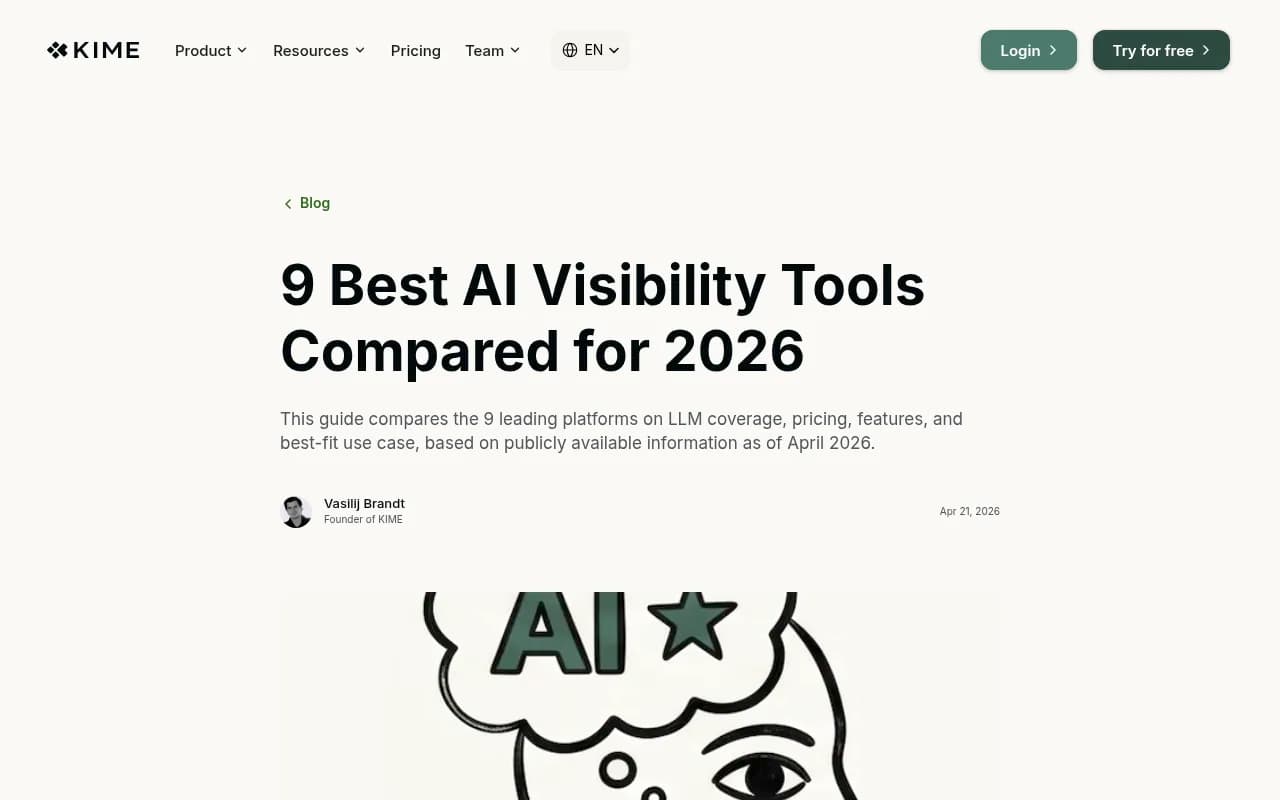
For context on where these tools sit in the broader market, entry-level AI visibility tools generally range from $29/month (Otterly.AI) to $149/month (KIME), with enterprise platforms running significantly higher.
Which one should you pick?
The honest answer depends on what you're trying to accomplish.
If you're a marketing team that wants to add AI brand monitoring to your existing stack and you don't need deep competitive analysis, Hall is the easier starting point. Lower friction, cleaner UI, good for a weekly check-in.
If you want more structured competitive benchmarking and are willing to invest more time in setup, Nimt.ai gives you more to work with.
If you're serious about improving your AI visibility -- not just tracking it -- you'll likely outgrow both tools quickly. The gap between "we can see the problem" and "we can fix the problem" is where most monitoring-only tools leave you stranded.
Other tools worth considering
The AI visibility space has a lot of options beyond these two. A few worth knowing about:
For competitive monitoring with more depth:

Profound has strong prompt research capabilities and is used by larger enterprise teams. More expensive, but more data.

Peec AI offers flexible model selection and multi-language tracking, which is useful if you're operating across markets.
For monitoring + some optimization features:

Otterly.AI is one of the most affordable entry points in the category and covers four AI models at the base tier.
Scrunch AI focuses on AI search visibility monitoring with a clean reporting layer.
For teams that want the full picture:
If you're at the point where monitoring data isn't enough and you need to understand what content to create, which prompts to target, and how to track the impact of your efforts, the comparison shifts to platforms built around optimization rather than observation.
A note on what "AI brand monitoring" actually means in 2026
The category name can be misleading. "AI brand monitoring" sounds like it should tell you everything about how AI talks about your brand. In practice, most tools in this category are running a fixed set of prompts on a schedule and reporting back on whether your brand name appears.
That's useful, but it's a narrow slice of the actual problem. Real AI visibility depends on:
- Which prompts AI users are actually asking (not just the ones you guessed)
- Whether your website content gives AI models something worth citing
- How AI crawlers are indexing your pages
- Whether your brand appears in shopping recommendations, not just informational responses
- How your visibility varies across different AI models and regions
Neither Nimt.ai nor Hall addresses most of these dimensions. They're good for the narrow use case they're built for. Just be clear-eyed about what that use case is before you commit.
Final take
Nimt.ai and Hall are both reasonable tools for teams that want basic AI brand monitoring without a lot of complexity. Hall wins on ease of use. Nimt.ai wins on competitive depth. Neither is a bad choice for what they do.
The more important question is whether monitoring alone is enough for your goals. If you're tracking AI visibility because you want to improve it, you'll need tools that go further than a dashboard. That's not a knock on Nimt.ai or Hall specifically -- it's the honest limitation of the monitoring-only category as a whole.