Key takeaways
- Pages with proper schema markup are 36-44% more likely to appear in AI-generated summaries and citations, based on multiple 2025-2026 studies
- Schema alone won't guarantee citations -- it helps AI models understand entities and relationships, which is a prerequisite for being cited, not a shortcut
- The highest-impact schema types for AI visibility are Organization, FAQPage, Article, Product, and HowTo
- JSON-LD is the only format worth using in 2026; Microdata and RDFa are effectively legacy formats
- Tracking whether your schema is actually driving AI citations requires dedicated tooling, not just Google's Rich Results Test
There's a persistent myth that schema markup is just for getting those star ratings in Google search results. In 2026, that framing misses the point almost entirely.
AI search engines -- ChatGPT, Perplexity, Google AI Overviews, Gemini -- don't rank pages the way traditional search does. They extract information, synthesize it across sources, and decide which sources to cite. Schema markup is one of the clearest signals you can send to help those systems understand what your content is about, who you are as an entity, and why your answer is trustworthy.
A 2025 analysis of 73 websites found that sites with properly implemented structured data were getting cited in AI responses 3.2x more often than those without. A separate study from WPRiders put the citation boost at over 36%. Stackmatix's research found content with proper schema has a 2.5x higher chance of appearing in AI-generated answers.
These numbers aren't magic. They reflect a simple reality: AI models are better at citing content they can actually parse.
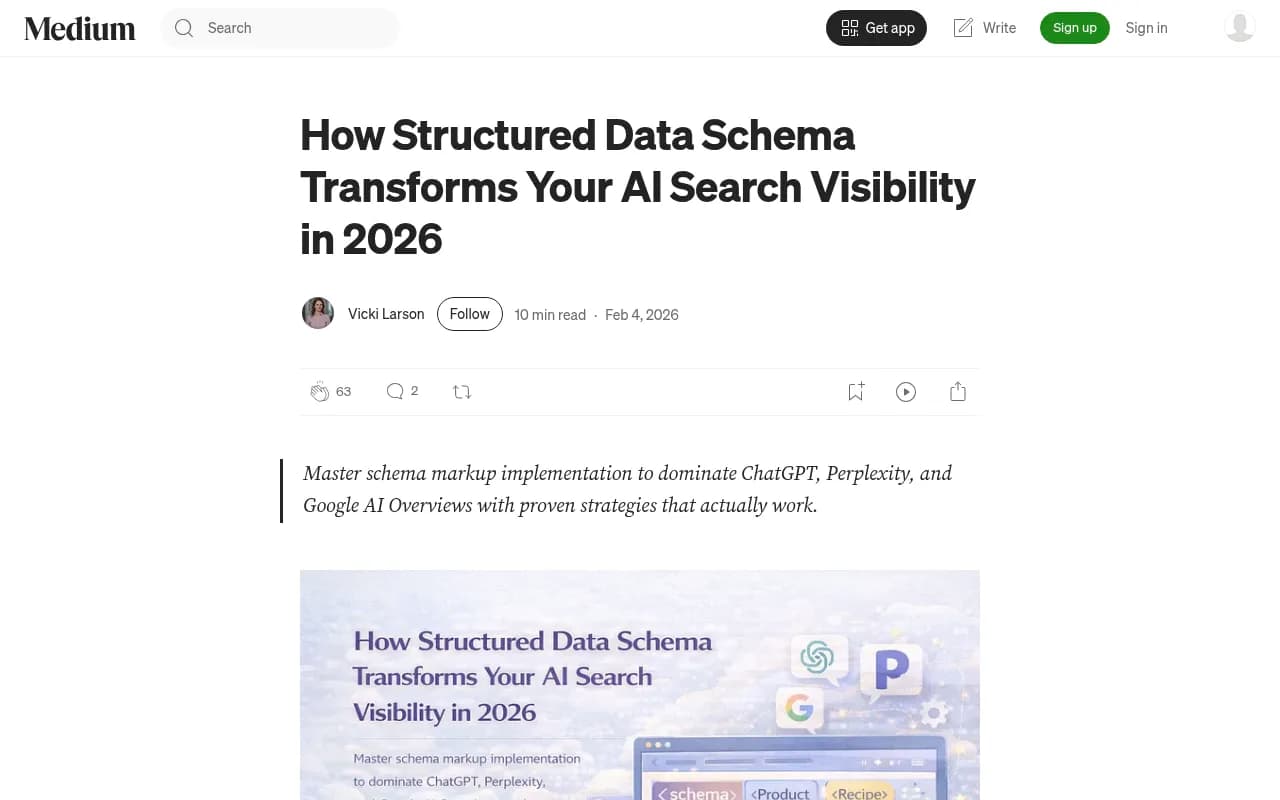
Why schema matters differently for AI search than traditional SEO
Traditional SEO uses schema mostly for rich snippets -- the visual enhancements in Google's SERP like star ratings, FAQ dropdowns, and breadcrumbs. That's still useful, but it's not the main story anymore.
For AI search, the value of schema is semantic. When you mark up your content with structured data, you're telling AI systems:
- What type of thing this page is about (an article, a product, a person, an organization)
- The relationships between entities (this person works for this organization, this product belongs to this category)
- Specific factual claims (this product costs $49, this article was published on this date, this FAQ has these specific answers)
AI language models are trained on vast amounts of text, but when they retrieve information to answer a query, they're looking for sources they can trust and parse quickly. Schema markup makes your content easier to extract and attribute correctly.
The Ahrefs team ran a study tracking 1,885 pages that added schema and found the citation impact was more modest than some headlines suggest -- schema is correlated with AI citations, but adding it doesn't automatically move the needle overnight. What it does is remove friction. Without it, AI models have to infer your content structure from prose alone. With it, you're handing them a structured map.
The schema types that actually drive AI citations
Not all schema is equal. Here's where to focus your effort.
Organization and WebSite schema
This is the foundation. If you haven't told AI models who you are as an entity, everything else is harder. Organization schema should include your name, URL, logo, social profiles, contact information, and a clear description. WebSite schema with a SearchAction property helps AI models understand your site's scope.
{
  "@context": "https://schema.org",
  "@type": "Organization",
  "name": "Acme Corp",
  "url": "https://www.acmecorp.com",
  "logo": "https://www.acmecorp.com/logo.png",
  "sameAs": [
    "https://twitter.com/acmecorp",
    "https://linkedin.com/company/acmecorp"
  ],
  "description": "Acme Corp builds project management software for distributed teams."
}
This goes on your homepage and, ideally, in a sitewide header or footer script.
Article and BlogPosting schema
Every piece of editorial content should have Article or BlogPosting schema. The fields that matter most for AI citation are headline, author, datePublished, dateModified, and description. AI models use publication dates to assess freshness and authors to assess credibility.
{
  "@context": "https://schema.org",
  "@type": "Article",
  "headline": "How to Reduce Churn in SaaS Products",
  "author": {
    "@type": "Person",
    "name": "Sarah Chen",
    "url": "https://www.acmecorp.com/team/sarah-chen"
  },
  "datePublished": "2026-03-15",
  "dateModified": "2026-05-20",
  "publisher": {
    "@type": "Organization",
    "name": "Acme Corp"
  }
}
FAQPage schema
This one punches above its weight for AI citations. FAQ schema maps directly to how AI models respond to questions -- they're looking for authoritative Q&A pairs. If your page answers common questions in your space, marking them up with FAQPage schema makes those answers immediately extractable.
{
  "@context": "https://schema.org",
  "@type": "FAQPage",
  "mainEntity": [
    {
      "@type": "Question",
      "name": "What is churn rate?",
      "acceptedAnswer": {
        "@type": "Answer",
        "text": "Churn rate is the percentage of customers who stop using a product or service within a given time period."
      }
    }
  ]
}
The key here is that your FAQ answers need to be genuinely useful and complete. Thin answers that just tease the full article won't help.
HowTo schema
For instructional content, HowTo schema is one of the most citation-friendly formats. AI models love step-by-step answers, and HowTo schema makes your steps machine-readable. Include name, description, totalTime, and each HowToStep with its own text and image where applicable.
Product and Offer schema
If you sell products or services, Product schema with Offer, AggregateRating, and Review markup significantly improves your chances of appearing in AI shopping recommendations and product comparisons. ChatGPT's shopping features in particular rely heavily on structured product data.
Person schema
Often overlooked, Person schema for your authors and team members builds entity authority. When AI models can verify that a named author is a real, credible person with a track record, that content gets weighted more heavily. Link your Person schema to their social profiles, publications, and employer.
Schema types ranked by AI citation impact
| Schema type | AI citation impact | Implementation complexity | Best for |
|---|---|---|---|
| Organization | Very high | Low | All sites |
| FAQPage | Very high | Low | Informational content |
| Article / BlogPosting | High | Low | Editorial content |
| HowTo | High | Medium | Instructional content |
| Product + Offer | High | Medium | E-commerce, SaaS |
| Person (Author) | Medium-high | Low | Content-heavy sites |
| BreadcrumbList | Medium | Low | All sites |
| LocalBusiness | Medium | Low | Local businesses |
| Review / AggregateRating | Medium | Medium | Products, services |
| Event | Low-medium | Medium | Event organizers |
JSON-LD: the only format worth using
There are three ways to implement schema: JSON-LD, Microdata, and RDFa. Use JSON-LD. Google has recommended it for years, and it's the easiest to maintain because it lives in a <script> tag in your <head> rather than being woven through your HTML.
Microdata and RDFa require you to annotate your actual HTML elements, which makes them brittle -- any template change can break your markup. JSON-LD is decoupled from your HTML structure, which means it's easier to update, audit, and debug.
<script type="application/ld+json">
{
  "@context": "https://schema.org",
  "@type": "Article",
  "headline": "Your Article Title Here"
}
</script>
Place it in the <head> of your page. Multiple JSON-LD blocks on the same page are fine -- you can have an Article block and an Organization block separately.
Common implementation mistakes that kill your AI citation potential
Missing required fields
Each schema type has required and recommended fields. Missing required fields means the schema may be ignored entirely. Use Google's Rich Results Test and Schema.org's documentation to verify you're including everything necessary.
Mismatched content
Your schema must accurately reflect what's on the page. If your Article schema says the datePublished is 2024 but the page clearly shows 2026, AI models and validators will flag the inconsistency. This is worse than having no schema at all because it signals unreliability.
Duplicate or conflicting markup
Having two conflicting Organization schemas on the same page -- one in the header, one in the footer -- creates confusion. Audit your site for duplicates, especially if you're using a CMS with multiple schema plugins.
Generic descriptions
The description field in your schema is not a throwaway. AI models use it to understand what your content covers. Write specific, accurate descriptions that include the key entities and topics your page addresses.
Ignoring sameAs
The sameAs property links your entities to their representations in authoritative databases like Wikidata, LinkedIn, Crunchbase, and social profiles. This is how AI models verify that your "Acme Corp" is the same Acme Corp they've seen mentioned elsewhere. It's one of the most underused fields in schema markup.

Building an entity graph, not just individual pages
The most sophisticated approach to schema in 2026 isn't about optimizing individual pages -- it's about building a coherent entity graph across your entire site.
Here's what that means in practice: your Organization schema on the homepage should link to Person schemas for your team members. Your Article schemas should link back to the Author's Person schema. Your Product schemas should link to your Organization schema. Your LocalBusiness schema (if applicable) should link to your Organization.
When AI models crawl your site, they're not just reading individual pages -- they're building a model of who you are, what you do, and how credible you are. A well-connected entity graph makes that model more complete and more trustworthy.
Think of it as leaving a trail of breadcrumbs that all point back to the same coherent entity. The more consistent and interconnected your schema, the more confidently AI models can cite you as an authoritative source.
Validating your schema
Before you ship anything, validate it. Three tools worth using:
- Google's Rich Results Test (search.google.com/test/rich-results) -- checks if your schema is eligible for rich results and flags errors
- Schema.org Validator (validator.schema.org) -- broader validation against the full Schema.org spec
- Screaming Frog -- can crawl your entire site and extract all structured data for bulk auditing
Run a full site audit quarterly. Schema breaks more often than people expect -- CMS updates, template changes, and plugin conflicts can silently invalidate markup that was working fine.
Tracking whether your schema is actually driving AI citations
This is where most guides stop, and it's the most important part. Implementing schema is step one. Knowing whether it's actually improving your AI citation rate is step two.
Google Search Console shows structured data errors and rich result performance, but it doesn't tell you anything about AI citations specifically. For that, you need tools that actually monitor how AI models are responding to your content.
Promptwatch tracks your citation rate across 10 AI models -- ChatGPT, Perplexity, Google AI Overviews, Claude, Gemini, and more -- and shows you which pages are being cited, how often, and by which models. It also includes crawler logs that show when AI agents are actually visiting your pages, so you can see the timeline from schema implementation to crawl to citation.

That feedback loop matters. If you add FAQPage schema to 20 pages and your citation rate in Perplexity goes up over the following 4 weeks, you know it's working. If it doesn't move, you know to look at other factors -- content quality, topical authority, competitor strength.
For tracking AI visibility more broadly, a few other tools are worth knowing about:
A practical implementation roadmap
If you're starting from scratch or doing a full audit, here's a reasonable sequence:
Week 1: Foundation
- Implement Organization schema on your homepage
- Add WebSite schema with SearchAction
- Add Person schema for key authors and team members
Week 2-3: Content pages
- Add Article or BlogPosting schema to all editorial content
- Prioritize pages that already rank well or get organic traffic -- these are your best candidates for AI citation
- Add FAQPage schema to any page with a Q&A section
Week 4: Product and service pages
- Add Product, Service, or LocalBusiness schema as appropriate
- Include Offer, AggregateRating, and Review markup where you have the data
Ongoing
- Validate schema monthly using Screaming Frog or Google Search Console
- Track AI citation rates to measure impact
- Update
dateModifiedon pages when you refresh content -- freshness signals matter
What schema can't do
It's worth being honest about the limits here. Schema markup helps AI models understand and extract your content. It does not compensate for thin content, low domain authority, or topics where you have no real expertise.
The Search Engine Land analysis from March 2026 put it well: schema won't guarantee citations, but it removes friction. If your content is genuinely useful and authoritative, schema helps AI models recognize that. If your content is weak, schema just makes the weakness more legible.
The sites that see the biggest citation gains from schema are those that already have solid content but were previously hard for AI systems to parse -- dense prose with no structural signals, missing author information, no entity connections. For those sites, schema can be genuinely transformative.
For sites with thin content, the right move is to fix the content first, then implement schema. In that order.
Putting it together
Schema markup in 2026 is table stakes for AI search visibility. The 36-44% citation improvement numbers are real, but they're averages -- the actual impact depends on your starting point, your content quality, and how competitive your topic area is.
Start with Organization and Article schema, get your entity graph connected, and add FAQPage markup to your most question-oriented content. Validate everything, then track your AI citation rates over 60-90 days to see what's actually moving.
The sites that are winning AI citations right now aren't doing anything exotic. They're just making it easy for AI models to understand who they are and what they know.