Key takeaways
- The GEO platform market has fragmented fast, with many newer tools offering monitoring dashboards but little else beyond that
- Promptwatch is the only platform in this comparison that closes the full loop: find gaps, generate content, track results
- Cognizo and Vaylis are solid monitoring tools for teams that just need visibility data without the complexity
- GeoGen leans toward content generation; Nimt.ai is a lightweight entry point for smaller teams or early-stage testing
- If you're serious about improving AI visibility (not just measuring it), you need a platform that helps you act on the data
The GEO space has gone from "niche experiment" to "crowded market" in about 18 months. Every week there's a new tool promising to help you rank in ChatGPT, Perplexity, or Google AI Overviews. Some of them are genuinely useful. A lot of them are monitoring dashboards dressed up with nice UI.
This guide focuses on five platforms that have been getting attention in 2026: Promptwatch, Cognizo, Vaylis, GeoGen, and Nimt.ai. The goal isn't to declare a single winner for everyone -- it's to give you a clear picture of what each tool actually does, where it falls short, and who it's best suited for.
Let's get into it.
What to look for in a GEO platform
Before comparing tools, it helps to know what you're actually evaluating. GEO platforms generally fall into one of three categories:
- Monitoring-only tools that show you where your brand appears (or doesn't) in AI responses
- Analysis tools that go deeper into why you're visible or invisible, which sources AI models cite, and how competitors compare
- Optimization platforms that close the loop by helping you create content that actually improves your AI visibility
Most newer tools sit in the first category. That's not necessarily bad -- if you're just starting out, knowing your baseline visibility is genuinely useful. But if you're trying to move the needle, you need more than a dashboard.
The questions worth asking before committing to any platform:
- Which AI models does it monitor? (ChatGPT and Perplexity are table stakes; Claude, Gemini, Grok, DeepSeek matter too)
- Can it tell you why you're not appearing, not just that you're not appearing?
- Does it help you create content, or just report on gaps?
- Can you track traffic and revenue back to AI-driven visibility?
- Does it monitor AI crawlers hitting your site?
With that framework in mind, here's how the five platforms stack up.
Platform-by-platform breakdown
Promptwatch
Promptwatch is the most complete platform in this comparison by a significant margin. It monitors 10 AI models (ChatGPT, Perplexity, Claude, Gemini, Grok, DeepSeek, Copilot, Meta AI, Mistral, and Google AI Overviews), which already puts it ahead of most tools that cover three or four.
What separates Promptwatch from the others isn't the breadth of monitoring -- it's what happens after you see the data. The Answer Gap Analysis shows you exactly which prompts competitors are appearing for that you're not. Not just "you're missing coverage in this topic area" but the specific questions, angles, and content types that AI models want to cite but can't find on your site.
Then there's the built-in AI writing agent. It generates articles, listicles, and comparisons grounded in real citation data from 880M+ citations analyzed. This isn't generic content -- it's engineered around what actually gets cited by AI models. You find the gap, generate the content, publish it, and then track whether your visibility scores improve. That full cycle is what most competitors skip entirely.
A few other things worth noting: Promptwatch logs real-time AI crawler activity (which pages ChatGPT, Claude, and Perplexity are hitting, how often, and what errors they're encountering), tracks Reddit and YouTube discussions that influence AI recommendations, and monitors ChatGPT Shopping appearances. It also has prompt volume estimates and difficulty scores, so you can prioritize which gaps to fill first rather than guessing.
Pricing starts at $99/month for the Essential plan (1 site, 50 prompts, 5 articles), $249/month for Professional (2 sites, 150 prompts, 15 articles, crawler logs), and $579/month for Business (5 sites, 350 prompts, 30 articles). There's a free trial available.

Cognizo
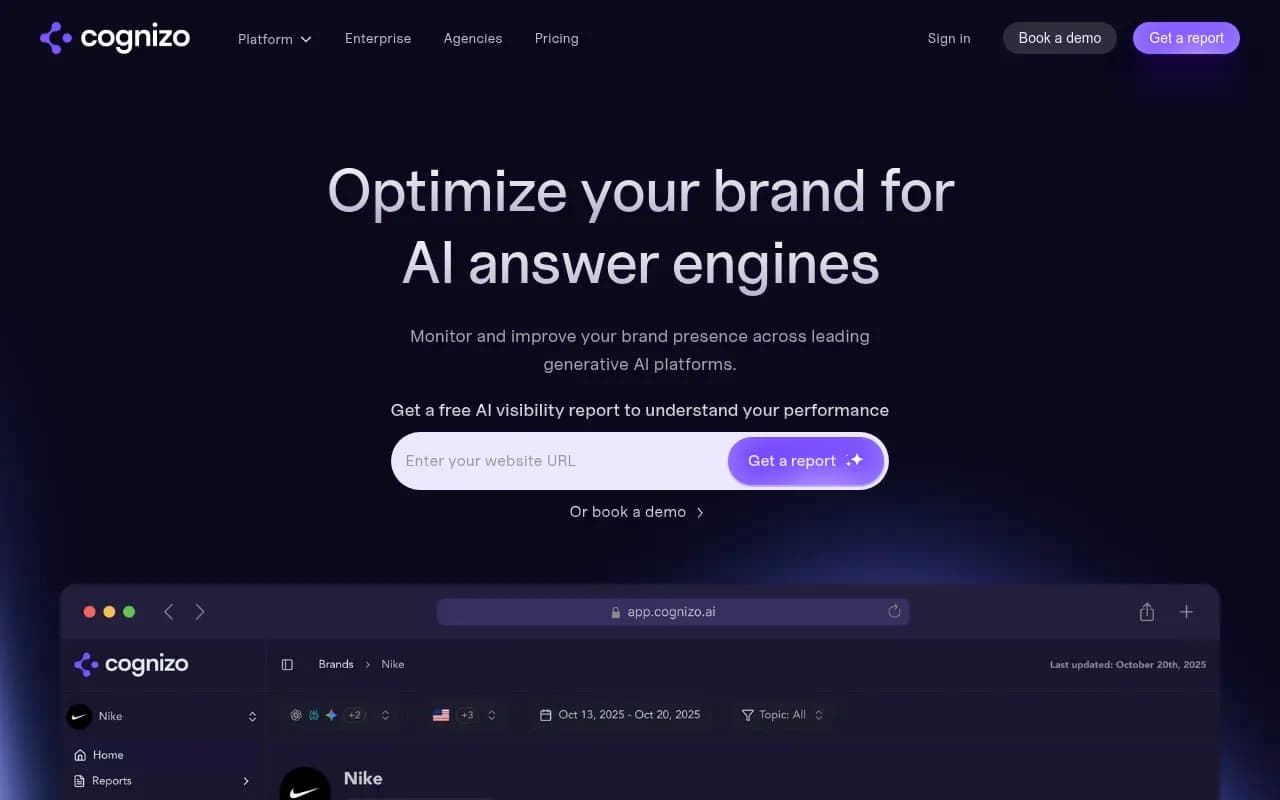
Cognizo is a monitoring and analysis platform that covers the major AI models and gives you a reasonably detailed view of brand visibility, sentiment, and competitor positioning. The interface is clean, and the onboarding is faster than most enterprise-grade tools.
Where Cognizo does well: competitive benchmarking. The side-by-side visibility comparisons across models are clear and actionable enough that you can quickly see where a competitor is outperforming you. It also handles multi-language monitoring, which matters if you're operating in non-English markets.
Where it falls short: Cognizo is fundamentally a monitoring tool. There's no content generation, no crawler log analysis, and no traffic attribution. You'll learn a lot about your current state, but the platform doesn't help you change it. For teams that have a content operation already in place and just need better data to inform it, that's fine. For teams that need the full loop, it's not enough.
Vaylis
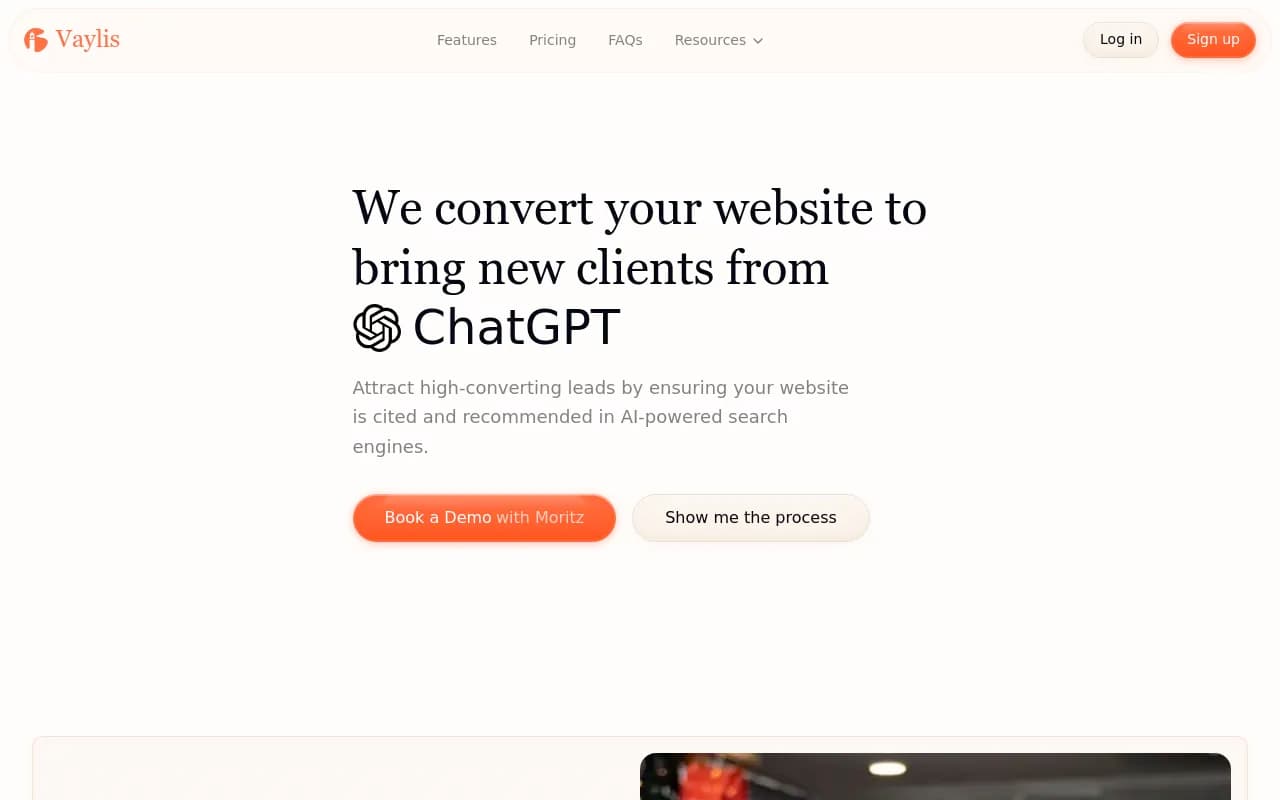
Vaylis positions itself as an AI visibility tracking and optimization platform, though in practice it leans more toward the tracking side. It covers the main AI models, offers brand mention tracking, and has a decent prompt management interface for organizing which queries you want to monitor.
The optimization features exist but feel early-stage. There are content recommendations, but they're more like topic suggestions than actual content briefs or generated drafts. The gap analysis is present but less granular than what you'd get from Promptwatch -- it shows you categories where you're underperforming rather than specific prompts you're missing.
Vaylis is worth considering for mid-sized teams that want something more structured than a basic tracker but aren't ready to invest in a full optimization platform. The pricing is competitive, and the UI is genuinely easy to use.
GeoGen
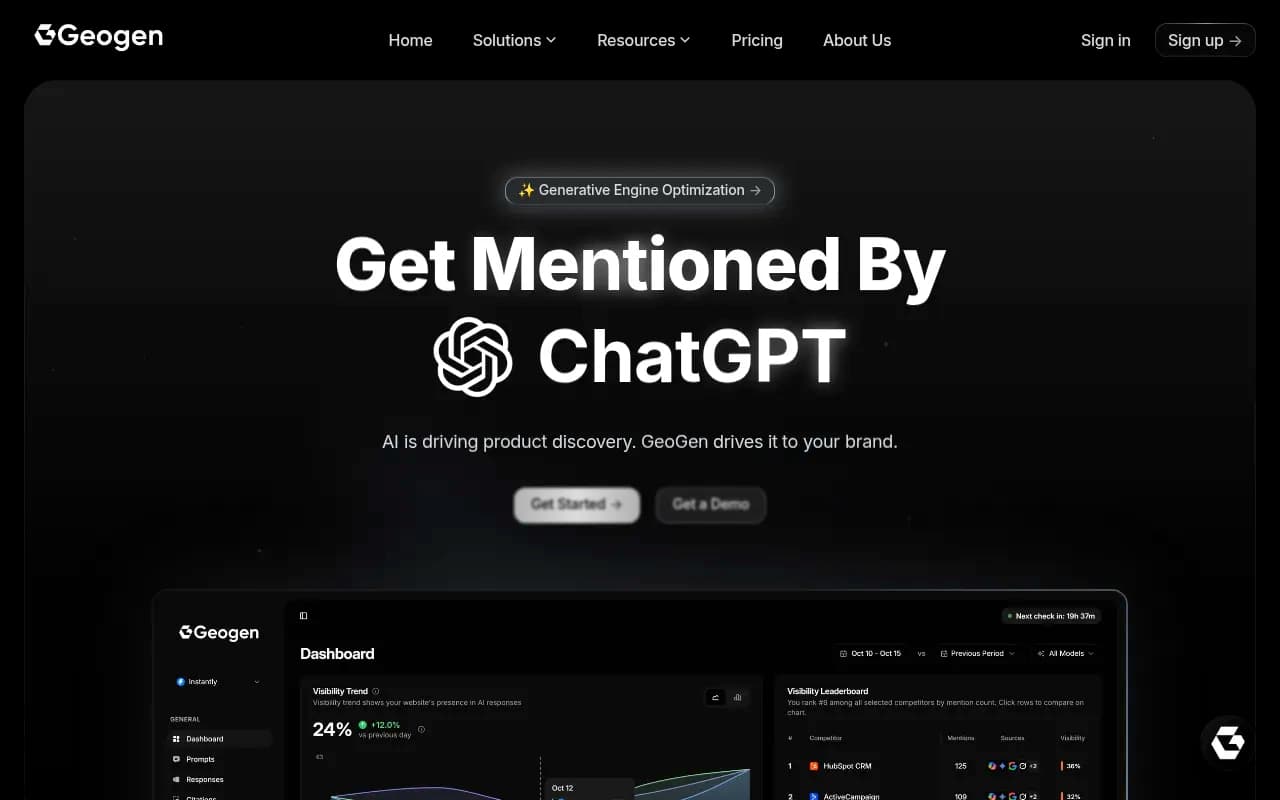
GeoGen leans harder into content generation than the other tools here, which makes it an interesting option for teams where content production is the main bottleneck. The platform can generate AI-optimized content based on visibility gaps, and it integrates with common CMS platforms for publishing.
The monitoring side is less developed. GeoGen covers the major AI models but doesn't go as deep on competitor analysis or source attribution as Promptwatch or even Cognizo. If you want to understand why a competitor is outranking you in AI responses, GeoGen won't give you that level of detail.
The content quality from GeoGen's generator is decent but not specifically grounded in citation data the way Promptwatch's is. That distinction matters: content that's generally well-written isn't the same as content engineered around what AI models actually cite. Still, for teams that are starting from zero and need to build out content coverage quickly, GeoGen is a reasonable starting point.
Nimt.ai
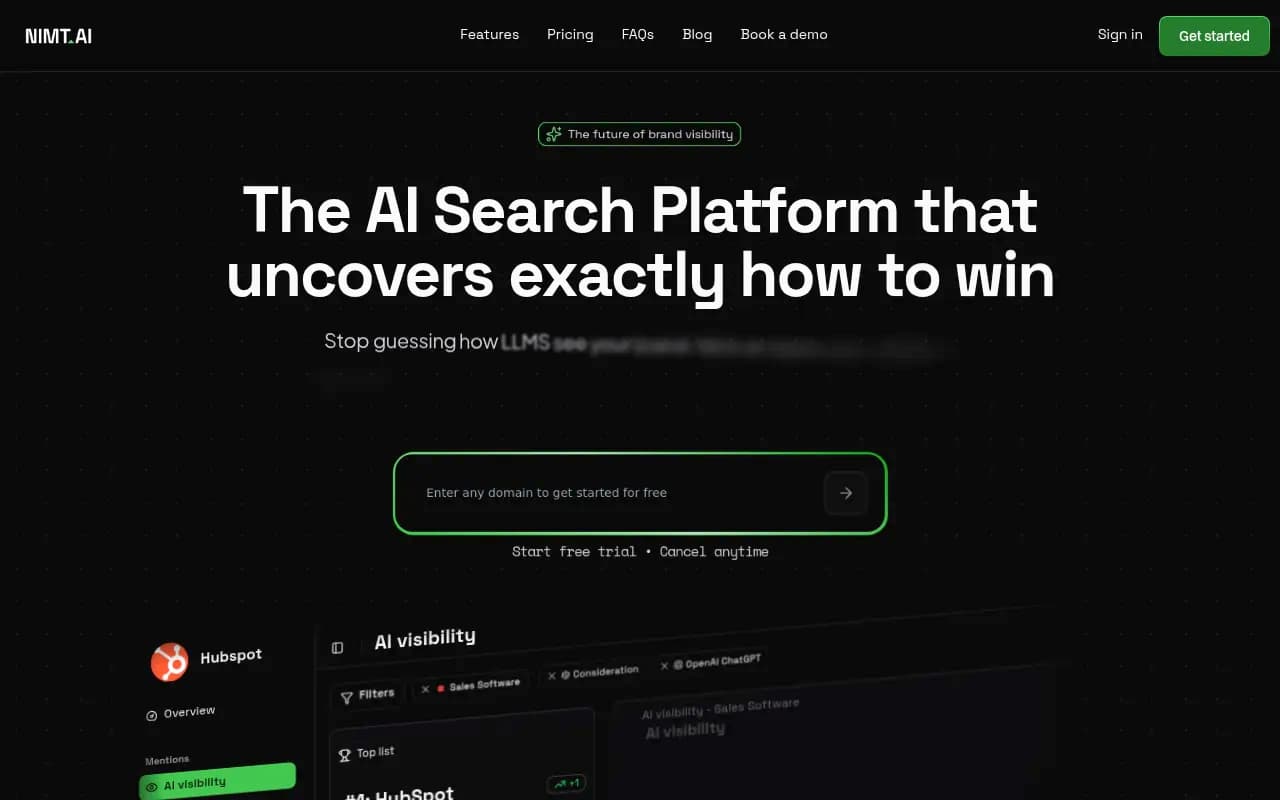
Nimt.ai is the most lightweight option in this group. It's designed as an accessible entry point for brands that are just starting to think about AI visibility -- smaller teams, early-stage companies, or marketers who want to understand their baseline before committing to a more expensive platform.
The feature set reflects that positioning. You get brand mention tracking across the main AI models, basic sentiment analysis, and some competitor comparison. What you don't get: crawler logs, content generation, traffic attribution, prompt volume data, or Reddit/YouTube tracking.
For a team that's genuinely just starting out and wants to answer "do AI models even mention us?", Nimt.ai is a low-friction way to find out. But if you're past that question and trying to actively improve your visibility, you'll outgrow it quickly.
Side-by-side comparison
| Feature | Promptwatch | Cognizo | Vaylis | GeoGen | Nimt.ai |
|---|---|---|---|---|---|
| AI models monitored | 10 | 5-6 | 4-5 | 4-5 | 3-4 |
| Answer gap analysis | Yes (granular) | Partial | Partial | Basic | No |
| Content generation | Yes (citation-grounded) | No | No | Yes (basic) | No |
| AI crawler logs | Yes | No | No | No | No |
| Traffic attribution | Yes (GSC, snippet, logs) | No | No | No | No |
| Reddit/YouTube tracking | Yes | No | No | No | No |
| ChatGPT Shopping tracking | Yes | No | No | No | No |
| Prompt volume & difficulty | Yes | No | Partial | No | No |
| Competitor heatmaps | Yes | Yes | Partial | No | No |
| Multi-language support | Yes | Yes | Yes | Partial | No |
| Starting price | $99/mo | Contact | Contact | Contact | Free/Freemium |
| Best for | Full optimization loop | Competitive monitoring | Mid-market tracking | Content-first teams | Beginners |
How to choose between them
The honest answer is that the right tool depends on where you are in your GEO journey.
If you're just starting out and want to know whether AI models mention your brand at all, Nimt.ai or a free trial of any of these tools will answer that question without a big commitment.
If you're past the "do we exist in AI search?" question and want competitive intelligence, Cognizo does that reasonably well. Vaylis is a solid middle-ground option if you want something between a basic tracker and a full platform.
If content production is your bottleneck and you need help generating AI-optimized content quickly, GeoGen is worth testing -- just know that the monitoring side is thinner.
If you want the full picture -- gaps identified, content generated, results tracked, traffic attributed -- Promptwatch is the only platform here that delivers all of it. The crawler logs alone are something most competitors don't offer at all, and the combination of prompt intelligence, citation data, and built-in content generation means you're not just watching your visibility scores, you're actually moving them.
The GEO market is still maturing, and several of these tools are actively developing new features. But right now, in mid-2026, the gap between a monitoring-only tool and a full optimization platform is significant. If you're investing real time and budget into AI search visibility, that gap matters.
A note on the broader market
It's worth acknowledging that this five-tool comparison is a slice of a much larger market. There are now dozens of GEO platforms, and the research from sites like Bluefish AI and Nudge's roundups shows how quickly the category has expanded.
Most of the newer entrants are monitoring tools that launched quickly to capture early market interest. Some will develop into more complete platforms. Others will stay lightweight and serve teams that don't need the full stack. That's fine -- not every team needs everything.
What's worth being skeptical of: platforms that describe themselves as "optimization" tools but only show you data. Optimization implies action. If a platform can't help you change your visibility, it's a tracker, not an optimizer. That distinction should inform how you evaluate any tool in this space, not just the five covered here.
Bottom line
The GEO platform space in 2026 has something for every stage of AI search maturity. Nimt.ai for beginners. Cognizo for competitive monitoring. Vaylis for mid-market tracking. GeoGen for content-first teams. And Promptwatch for teams that want to close the full loop from gap identification to content creation to traffic attribution.
If you're evaluating these tools, the most useful thing you can do is run a free trial with your actual brand and a handful of real prompts your customers use. The data you get back will tell you more than any comparison table.