Cognizo Review 2026
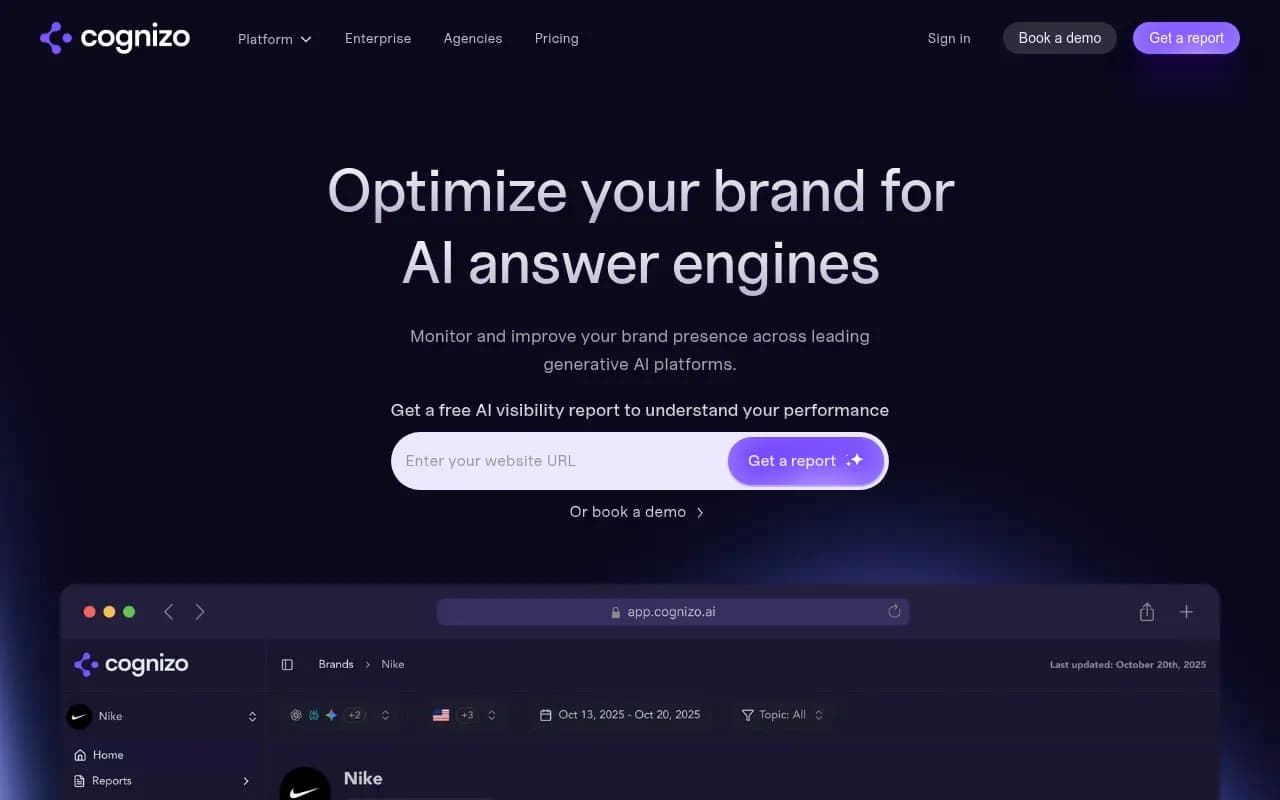
Cognizo is an Answer Engine Optimization (AEO) platform that helps marketing teams monitor and improve brand visibility in AI platforms like ChatGPT, Perplexity, Gemini, and Google AI Overviews. Track real-time citations, sentiment, and competitor performance while automating AI-optimized content creation to maximize reach in generative search.
Summary
- Monitoring-only platform: Cognizo tracks brand mentions and citations across AI answer engines but lacks the content gap analysis, AI crawler logs, and traffic attribution that Promptwatch offers
- Strong multi-platform coverage: Monitors 9+ AI platforms including ChatGPT, Perplexity, Gemini, Claude, Meta AI, Grok, and Google AI Overviews with real-time citation tracking
- Content automation workflows: Built-in content brief and draft generation to create AI-optimized articles, though without the 880M+ citation intelligence that powers Promptwatch's writing agent
- Fast results: Targets 6-week visibility improvements vs traditional SEO's 3-6 month timeline, with some customers seeing upticks within 2 weeks
- Agency-focused: Strong agency partner program with white-label reporting, but missing the Answer Gap Analysis that shows exactly which prompts competitors rank for

Cognizo launched as a dedicated Answer Engine Optimization (AEO) platform built by LLM experts and marketing veterans. The company targets marketing teams, agencies, and enterprises looking to adapt to the shift from traditional search to AI-powered answer engines. With customers like Automox, Inkhouse, and Hat Club (who reported 20x revenue growth), Cognizo positions itself as an all-in-one solution for tracking and improving brand visibility in generative AI platforms.
The platform addresses a real problem: as more buyers use ChatGPT, Perplexity, and Google AI Overviews instead of traditional search, brands risk becoming invisible if they're not cited in AI-generated answers. Cognizo's core promise is helping marketers understand how AI talks about their brand, identify gaps, and optimize content to get mentioned more often.
Answer Engine Insights (Core Monitoring)
Cognizo's primary feature is real-time visibility tracking across 9+ AI platforms. The system continuously runs prompts on each platform, collecting millions of responses daily to track where and how your brand appears. You get citation frequency, sentiment analysis (positive/negative/neutral mentions), and competitive benchmarking showing how you stack up against rivals.
The platform monitors ChatGPT, Perplexity, Gemini, Google AI Overviews, Google AI Mode, Claude, Meta AI, Grok, and Microsoft Copilot. Each tracked prompt shows which platforms mention your brand, how often, and in what context. Sentiment tracking flags negative mentions so you can respond quickly.
Competitor comparison views show side-by-side visibility scores, letting you see which brands dominate specific prompts. This is useful for identifying where competitors are winning, though it doesn't show you the specific content gaps or missing topics that would help you catch up -- a capability Promptwatch provides through Answer Gap Analysis.
Prompt Volume Data
Cognizo estimates query volumes for tracked prompts based on "billions of real-time data signals." The platform shows trending prompts, volume charts over time, and growth percentages for each AI platform. This helps prioritize which prompts to optimize for based on actual user demand.
You can explore conversations relevant to your brand and track your presence across high-volume queries. The system suggests new prompts to monitor based on your industry and keywords, though it's unclear how granular the volume estimates are compared to Promptwatch's prompt intelligence with difficulty scoring and query fan-outs.
Content Optimization Workflows
This is where Cognizo moves beyond monitoring into action. The platform identifies "content opportunities" -- prompts where you're underperforming or missing entirely. For each opportunity, you can trigger automated workflows that generate content briefs, draft articles, FAQs, and content updates.
The content creation process includes technical audits of existing pages, tailored recommendations, and AI-powered drafting. Briefs include target keywords, structure suggestions, and citation-worthy facts. Drafts are generated in a format designed to be easily ingested by LLM crawlers.
This is a solid feature for teams that need to produce AI-optimized content at scale. However, it lacks the depth of citation intelligence that Promptwatch's writing agent uses -- Promptwatch analyzes 880M+ citations to understand exactly what content patterns get cited by AI models, then generates articles grounded in that data. Cognizo's content workflows appear more template-driven.
AI Traffic Analytics
Cognizo tracks AI crawler activity on your website, showing which bots (indexing, citation, training) visit your pages and how often. You get historical traffic charts broken down by bot type, helping you understand how AI platforms discover and access your content.
The platform also tracks referral traffic from AI platforms, measuring how many visitors arrive from ChatGPT, Perplexity, etc. This helps attribute traffic and conversions to AI visibility improvements.
What's missing: Cognizo doesn't offer the granular AI crawler logs that Promptwatch provides -- real-time logs showing exactly which pages AI crawlers read, errors they encounter, and how often they return. Promptwatch's crawler logs help you fix indexing issues and optimize for AI discovery at a much deeper level. Cognizo also lacks visitor analytics that show how human users arriving from AI platforms behave on your site.
Customization and Prompt Management
You start with a premade prompt set based on your industry, then customize from there. The prompt generation engine suggests new prompts based on topics and keywords you provide. You can edit, disable, or add custom prompts anytime.
This flexibility is important because every brand has unique buyer questions and competitive angles. The ability to tailor your prompt set ensures you're tracking what actually matters to your business, not just generic industry queries.
Onboarding and Support
Cognizo promises instant onboarding -- analysis starts immediately with your premade prompt set. A customer success partner schedules an onboarding call to review your AI search strategy and answer questions. Multiple customer testimonials praise the hands-on support and strategic guidance from the Cognizo team.
This white-glove approach is a differentiator for agencies and enterprise teams that need help building an AEO strategy from scratch, not just a dashboard to log into.
Who Is Cognizo For
Cognizo targets three primary audiences:
Marketing teams at B2B SaaS and tech companies managing brand visibility and content strategy. If you're a demand gen manager or content lead at a company with 50-500 employees, Cognizo gives you the data to prove AI visibility matters and the tools to improve it. The platform works best for teams already producing content regularly who need to optimize for AI discovery.
Digital marketing agencies offering AEO as a service to clients. Cognizo has a dedicated agency partner program with white-label reporting, multi-client management, and revenue-sharing opportunities. Agencies can expand their service offerings beyond traditional SEO without building AEO expertise in-house. The platform's automated content workflows help agencies scale content production across multiple clients.
Enterprise brands with established marketing teams and budgets for emerging channels. Companies like Automox (endpoint security) and Hat Club (retail) use Cognizo to track AI visibility across product categories and competitive landscapes. Enterprise teams benefit from the competitive benchmarking and sentiment tracking to protect brand reputation in AI answers.
Who should NOT use Cognizo: Early-stage startups with limited content and no existing SEO presence won't see much value -- you need a baseline of content and brand awareness for AI platforms to cite you. Local businesses focused on geographic search also won't benefit much, as most AI answer engines don't prioritize local results the way Google Maps does.
Integrations and Ecosystem
Cognizo doesn't publicly list specific integrations, which is a gap. Most AEO platforms integrate with Google Search Console for traffic attribution, content management systems like WordPress for publishing workflows, and analytics platforms like Google Analytics for conversion tracking. The website mentions "AI traffic analytics" and "referral traffic" tracking, suggesting some level of analytics integration, but details are sparse.
No mention of API access, browser extensions, or mobile apps. The platform appears to be web-only with no developer tools for custom workflows or data exports beyond standard reporting.
Pricing and Value
Cognizo uses custom pricing with a "book a demo" model -- no public pricing tiers. Based on competitor research mentions, plans start around $89/month, but this is unverified. The website emphasizes "scalable pricing for teams of all sizes," suggesting tiered plans based on prompt volume, tracked platforms, or number of users.
The lack of transparent pricing is a barrier for smaller teams evaluating multiple tools. Most competitors (including Promptwatch with clear $99/$249/$579 tiers) publish pricing upfront, making it easier to budget and compare.
Cognizo offers a free AI visibility report to understand your current performance before committing. This is a smart lead magnet that gives prospects a taste of the data without requiring a full demo.
Value assessment: For agencies managing multiple clients, Cognizo's white-label reporting and partner program likely justify the cost. For individual brands, the value depends on how much you're already investing in content -- if you're spending $10K+/month on content production, adding Cognizo to optimize that content for AI visibility makes sense. If you're producing one blog post a month, the ROI is questionable.
Strengths
Multi-platform coverage: Tracking 9+ AI platforms in one dashboard is genuinely useful. Most brands don't have time to manually check ChatGPT, Perplexity, Gemini, Claude, and Google AI Overviews separately. Cognizo consolidates this into a single visibility score.
Fast results: The 6-week timeline for visibility improvements is realistic for AEO, which moves faster than traditional SEO. Customer testimonials back this up -- Automox and others report measurable visibility increases within months, not years.
Content automation: The ability to go from visibility gap to published article within the platform streamlines workflows for content teams. Generating briefs and drafts based on AI visibility data is more strategic than generic content calendars.
Agency support: The dedicated agency program with white-label reporting and hands-on customer success is a real differentiator. Agencies can offer AEO services without building the tech stack themselves.
Sentiment tracking: Monitoring positive vs negative brand mentions in AI answers helps protect reputation. If an AI platform starts citing negative reviews or outdated information, you can respond quickly.
Limitations
No content gap analysis: Cognizo shows you where you're underperforming but doesn't show you the specific content your website is missing. Promptwatch solves this with Answer Gap Analysis -- it identifies exactly which prompts competitors rank for that you don't, then shows you the topics, angles, and questions AI models want answers to but can't find on your site. This is the difference between "you're losing" and "here's exactly what to fix."
No AI crawler logs: Cognizo tracks aggregate crawler traffic but doesn't provide real-time logs showing which pages AI crawlers read, errors they encounter, or how often they return. Promptwatch's crawler logs help you fix indexing issues and optimize for AI discovery at a granular level.
No traffic attribution beyond referrals: Cognizo tracks referral traffic from AI platforms but lacks visitor analytics showing how users arriving from AI behave on your site. Promptwatch offers code snippet, GSC integration, or server log analysis to connect visibility to actual revenue.
Limited citation intelligence: The content generation workflows don't appear to be grounded in deep citation analysis. Promptwatch's writing agent analyzes 880M+ citations to understand what content patterns actually get cited by AI models, then generates articles based on that intelligence.
No Reddit or YouTube tracking: AI models heavily cite Reddit discussions and YouTube videos when answering questions. Promptwatch surfaces these sources so you know where to engage. Cognizo doesn't mention this capability.
No ChatGPT Shopping tracking: As ChatGPT adds product recommendations and shopping carousels, tracking your brand's presence in these features becomes critical for e-commerce. Promptwatch monitors this; Cognizo doesn't mention it.
No prompt difficulty scoring or query fan-outs: Cognizo shows prompt volumes but doesn't help you prioritize based on difficulty or show how one prompt branches into sub-queries. Promptwatch's prompt intelligence includes both, helping you target winnable prompts.
Opaque pricing: The lack of public pricing makes it hard to evaluate ROI before booking a demo. Competitors with transparent pricing (Promptwatch, Otterly.AI, Peec.ai) make it easier for prospects to self-qualify.
Bottom Line
Cognizo is a solid monitoring platform for marketing teams and agencies that want to track brand visibility across AI answer engines. The multi-platform coverage, sentiment tracking, and content automation workflows provide real value for teams already producing content regularly. The agency program and white-label reporting make it a good fit for digital marketing agencies expanding into AEO services.
However, Cognizo is fundamentally a monitoring tool that shows you where you're losing but doesn't help you fix it at a deep level. It lacks the content gap analysis, AI crawler logs, citation intelligence, and traffic attribution that Promptwatch provides. If you want to understand your AI visibility, Cognizo works. If you want to systematically improve it with data-driven content optimization, Promptwatch is the stronger choice.
Best use case: Agencies managing 5-20 clients who need white-label AEO reporting and automated content workflows to scale across multiple brands.
Tags:
Frequently asked questions
What is Cognizo and what does it do?
How much does Cognizo cost?
Is Cognizo free to use?
Which AI platforms does Cognizo monitor?
Who is Cognizo designed for?
How long does it take to see results with Cognizo?
What is Answer Engine Optimization (AEO)?
Does Cognizo help create content?
How is Cognizo different from Promptwatch?
Similar and alternative tools to Cognizo