Key Takeaways
- Omnia starts at €79/mo with a 14-day trial, while Cognizo's pricing starts around $89/mo but requires booking a demo -- Omnia is more transparent and accessible for smaller teams
- Both platforms monitor the same core AI engines (ChatGPT, Perplexity, Gemini, Copilot), but Omnia emphasizes actionable roadmaps while Cognizo focuses on automated content creation
- Cognizo claims to analyze "millions of data points daily" and offers AI-driven traffic measurement, which Omnia doesn't explicitly advertise
- Omnia provides a clearer step-by-step visibility roadmap with content creation, technical SEO, and placement guidance mapped to specific gaps
- For teams that want to start monitoring quickly without a sales call, Omnia is the easier entry point. For teams prioritizing automated content generation at scale, Cognizo may be worth the demo.
- If you're also looking to track AI visibility with deeper citation analysis and content gap identification, Promptwatch offers a more comprehensive action loop -- it shows you exactly which prompts competitors rank for but you don't, then generates content engineered to get cited by AI models.
Overview
Both Omnia and Cognizo are Answer Engine Optimization (AEO) platforms built for the same problem: helping brands show up when people ask AI engines for recommendations. The shift from Google links to ChatGPT answers means traditional SEO isn't enough anymore. These tools track where your brand appears in AI responses, how you compare to competitors, and what you need to do to improve.
Omnia
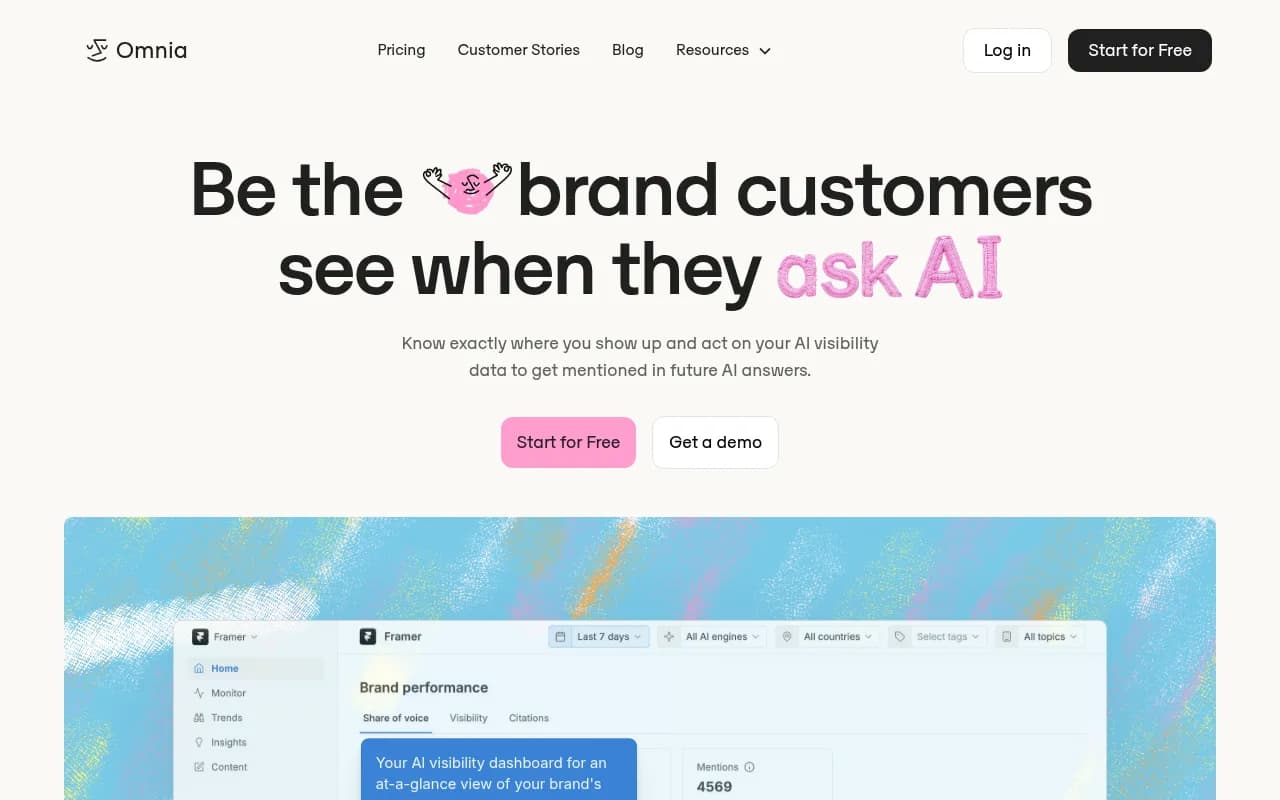
Omnia positions itself as a platform "built for SEO and marketing experts." It monitors citations and mentions across ChatGPT, Perplexity, Google Gemini, and Microsoft Copilot. The pitch is simple: discover what questions people are asking AI, see where your brand shows up, and get a roadmap to fill the gaps. Omnia emphasizes turning tracking data into action with content creation, technical SEO, and content placement guidance. Trusted by brands like Exoticca, Ironhack, and Pleo.
Cognizo
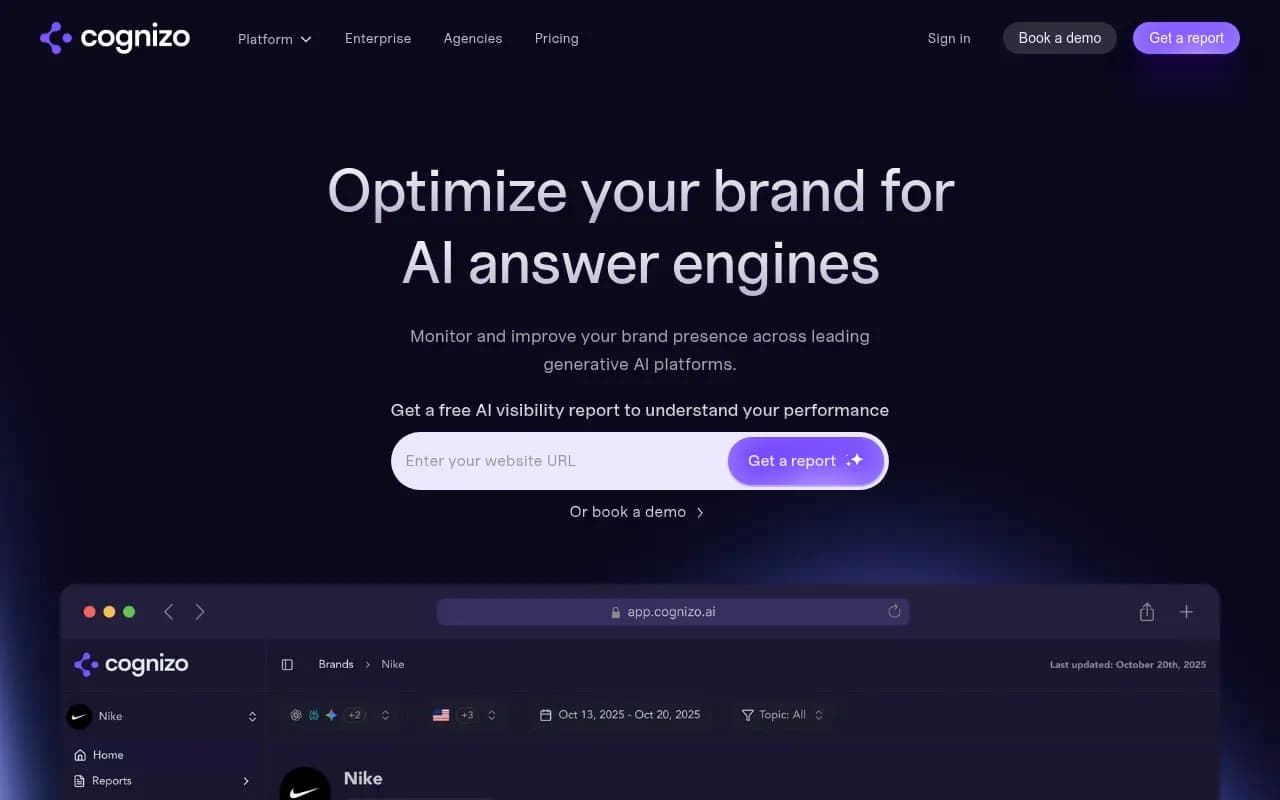
Cognizo calls itself a "complete platform to win in AI search." It tracks visibility, sentiment, and competitor performance across the same set of AI engines, but leans harder on automated content creation. Cognizo claims to analyze "millions of data points daily" and offers AI-driven traffic measurement -- showing how AI engines interact with your site and drive human traffic. The platform promises to turn "deep visibility insights into high-quality content that gets your brand seen."
Side-by-Side Comparison
| Feature | Omnia | Cognizo |
|---|---|---|
| Starting price | €79/mo (~$85/mo) | ~$89/mo (estimated) |
| Free trial | 14 days | Not advertised |
| Pricing transparency | Clear tiers on website | Custom pricing, demo required |
| AI engines monitored | ChatGPT, Perplexity, Gemini, Copilot | ChatGPT, Perplexity, Gemini, Google AI Overviews |
| Prompt discovery | ✓ Real customer questions | ✓ Buyer question identification |
| Citation tracking | ✓ | ✓ Real-time citations |
| Sentiment analysis | Not advertised | ✓ |
| Competitor benchmarking | ✓ Share of voice | ✓ Performance tracking |
| Content optimization | ✓ Roadmap with content creation guidance | ✓ Automated AI-optimized content creation |
| AI traffic measurement | Not advertised | ✓ Site interaction tracking |
| Technical SEO guidance | ✓ Included in roadmap | Not emphasized |
| Content placement strategy | ✓ | Not emphasized |
Head-to-head feature breakdown
Monitoring and tracking
Both platforms cover the same core AI engines. Omnia lists ChatGPT, Perplexity, Google Gemini, and Microsoft Copilot. Cognizo adds Google AI Overviews explicitly and emphasizes "real-time" tracking.
The difference is in what they do with the data. Omnia shows you "where you show up in AI search results, how you benchmark against competitors, and what citations AI engines pull information from." Cognizo adds sentiment analysis on top of mentions and citations -- you can see not just if you're mentioned, but how AI engines talk about you (positive, neutral, negative).
Cognizo also claims to measure AI-driven traffic: "See how AI interacts with your site and drives human traffic." This is a unique angle. Most AEO tools stop at visibility tracking. If Cognizo can actually connect AI mentions to downstream traffic, that's a real differentiator. Omnia doesn't advertise this capability.
Verdict: Cognizo has a slight edge here with sentiment analysis and traffic measurement. Omnia covers the basics well but doesn't go as deep on analytics.
Prompt and question discovery
Omnia promises to help you "know what prompts you should monitor and discover real questions customers are asking about your industry or product." Cognizo frames this as "Identify buyer questions: Discover what billions of customers are asking AI."
Both platforms recognize that you can't optimize for AI search if you don't know what people are asking. The language is similar, but Cognizo's "billions of customers" claim suggests a larger dataset or more aggressive data collection. Omnia doesn't quantify its prompt database.
Neither platform gives specifics on how many prompts they track or how they source them. This is a black box for both.
Verdict: Tie. Both offer prompt discovery, but neither provides enough detail to judge depth or quality.
Content optimization and creation
This is where the platforms diverge most clearly.
Omnia translates tracking data into a "step-by-step AI visibility roadmap." The roadmap includes three pillars: content creation, technical SEO, and content placement. Each action is "mapped to fill your brand's real gaps." The emphasis is on guidance -- Omnia tells you what to do, and you (or your team) do it.
Cognizo takes a more automated approach: "Automate AI-optimized content creation that moves the needle." The platform promises to turn insights into action by generating content for you. Screenshots show a content optimization tool with sections, key advantages, SEO overview, word count, and content scores. There's also a workflow interface with statuses like "Generating brief," "Drafting content," "Researching," and "Review brief."
If you want a roadmap and prefer to control content creation yourself, Omnia is the better fit. If you want the platform to draft content for you based on visibility gaps, Cognizo is built for that.
Verdict: Depends on your workflow. Omnia for strategic guidance, Cognizo for automated execution.
Technical SEO and content placement
Omnia explicitly includes "technical SEO" and "content placement" in its roadmap. This suggests the platform helps you optimize your site for AI crawlers and figure out where to publish content (owned channels, earned media, etc.).
Cognizo doesn't emphasize these areas. The focus is on content creation and visibility tracking. There's a screenshot showing "Owned or Earned" content opportunities, which implies some placement strategy, but it's not a core selling point.
If you need help with technical optimization (site structure, crawlability, schema markup) or placement strategy (guest posts, partnerships, Reddit, YouTube), Omnia is more explicit about offering that.
Verdict: Omnia wins on technical SEO and placement guidance.
User interface and experience
Omnia's website shows a clean, colorful interface with illustrations (speech bubble, magnifying glass, golf flag) and a tabbed layout for different features. The design feels approachable and marketing-team-friendly.
Cognizo's screenshots show a more data-dense interface with tables, metrics, and workflow statuses. It looks more like a power-user tool for teams that want to dig into the numbers.
Both platforms are web-based. Neither advertises a mobile app.
Verdict: Omnia for ease of use, Cognizo for depth.
Pricing and accessibility
Omnia is transparent: €79/mo starting price, 14-day free trial, no demo required. You can sign up and start tracking immediately.
Cognizo lists "Custom pricing - book a demo" on its site. Third-party sources suggest plans start around $89/mo, but you can't see pricing or start a trial without talking to sales first. This is a friction point for smaller teams or individual marketers who want to test before committing.
Verdict: Omnia is far more accessible. Cognizo's demo-gated pricing is a barrier.
Pricing comparison
Omnia provides clear pricing on its website. Cognizo does not, but estimates suggest similar starting prices.
| Plan | Omnia | Cognizo |
|---|---|---|
| Entry tier | €79/mo (~$85/mo) | ~$89/mo (estimated, demo required) |
| Free trial | 14 days | Not advertised |
| Transparency | Public pricing | Custom pricing only |
| Payment | Monthly or annual (likely) | Unknown |
Omnia's pricing is more transparent and accessible. Cognizo's demo requirement adds friction but may indicate more customization or higher-tier features.
Pros and cons
Omnia pros
- Transparent pricing with a 14-day free trial
- Clear step-by-step roadmap for improving AI visibility
- Includes technical SEO and content placement guidance
- Easy to start without a sales call
- Trusted by recognizable brands (Exoticca, Ironhack, Pleo)
Omnia cons
- No sentiment analysis advertised
- No AI-driven traffic measurement
- Less emphasis on automated content creation
- Prompt database size unknown
Cognizo pros
- Sentiment analysis included
- AI-driven traffic measurement (unique feature)
- Automated content creation with workflow management
- Claims to analyze "millions of data points daily"
- Tracks Google AI Overviews explicitly
Cognizo cons
- Demo-gated pricing creates friction
- No free trial advertised
- Less emphasis on technical SEO
- Content placement strategy not a core focus
- Pricing and feature details less transparent
Who should pick which tool
Choose Omnia if:
- You want to start monitoring AI visibility today without a sales call
- You prefer a clear roadmap over automated content generation
- Technical SEO and content placement strategy are priorities
- You're a smaller team or solo marketer on a budget
- You want to control content creation in-house
Choose Cognizo if:
- You need automated content creation at scale
- Sentiment analysis and AI-driven traffic measurement are must-haves
- You're comfortable with a demo process and custom pricing
- You want a more data-dense, power-user interface
- Your team can handle less guidance on technical SEO and placement
Consider Promptwatch if:

You want a platform that goes beyond monitoring to actually help you close visibility gaps. Promptwatch shows you exactly which prompts competitors rank for but you don't (Answer Gap Analysis), then generates content engineered to get cited by AI models -- grounded in 880M+ citations analyzed, prompt volumes, and competitor data. You also get AI crawler logs to see how ChatGPT, Claude, and Perplexity interact with your site, plus Reddit/YouTube tracking, ChatGPT Shopping monitoring, and page-level citation tracking. It's the only platform rated as a "Leader" across all categories in a 2026 comparison of 12 GEO tools. Plans start at $99/mo with a free trial.
Final verdict
Omnia is the better choice for most teams. The transparent pricing, free trial, and clear roadmap make it easy to start improving AI visibility without friction. The emphasis on technical SEO and content placement gives you a complete strategy, not just tracking data.
Cognizo has real strengths -- sentiment analysis, traffic measurement, and automated content creation -- but the demo-gated pricing and less transparent feature set make it harder to evaluate. If you need those specific features and don't mind a sales process, it's worth exploring.
For teams serious about AI visibility, Omnia gets you started faster. For teams that want automation and deeper analytics, Cognizo may be worth the extra effort. And if you want a platform that combines monitoring, content gap analysis, and AI-optimized content generation in one action loop, Promptwatch is the most complete option on the market.