Key takeaways
- Goodie is a monitoring-first tool: it tracks brand mentions and visibility scores across ChatGPT, Perplexity, Gemini, and Claude, but stops there. Cognizo adds content creation, buyer question discovery, and AI traffic measurement on top of monitoring.
- Cognizo is significantly cheaper to start: reportedly from ~$89/month vs Goodie's ~$495/month entry point. That's a meaningful gap for smaller marketing teams.
- Goodie's domain (goodie.ai) is currently listed for sale at $80,000, which raises real questions about the product's continuity and long-term viability.
- Cognizo offers a free AI visibility report before you commit to anything. Goodie requires a sales demo to even see the product.
- Neither tool covers the full breadth of AI models that enterprise teams need. Both are limited to 3-4 platforms compared to tools that monitor 10+.
- If you're choosing between the two purely on features and stability, Cognizo is the safer bet in 2026 -- but both tools sit in the lighter end of the AEO market.
Overview
Goodie
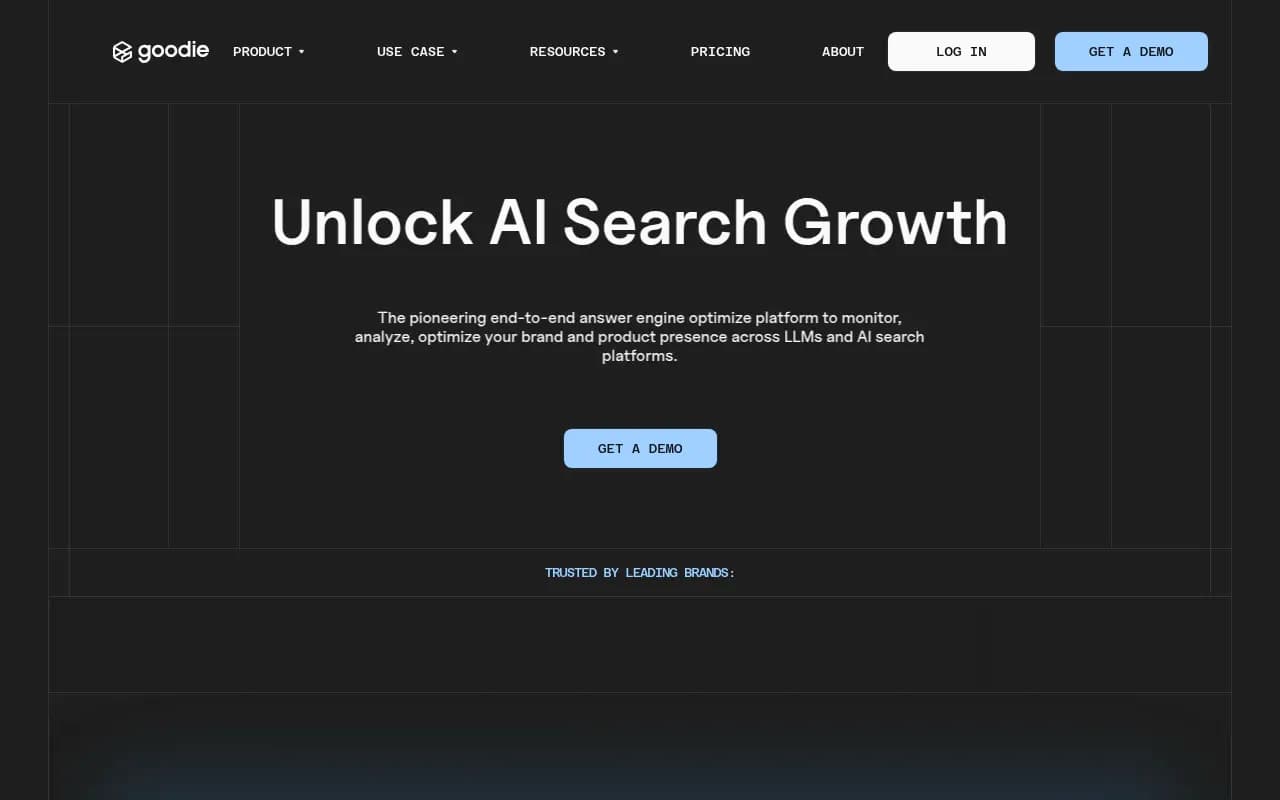
Goodie launched as a brand tracking tool for AI search, targeting marketing teams who wanted to know when and how their brand appeared in ChatGPT, Perplexity, Gemini, and Claude responses. The pitch was simple: visibility scoring, mention alerts, and competitor comparisons without a lot of complexity. It found a niche among mid-market brands that wanted to dip their toes into AI monitoring without committing to a full-blown GEO platform.
That said, there's a significant red flag worth addressing upfront: as of April 2026, goodie.ai is listed for sale on Spaceship.com for $80,000. The domain being on the market doesn't necessarily mean the product is dead, but it's not a reassuring sign for anyone considering a long-term subscription. Proceed with caution and verify the product's current status before signing any contract.
Cognizo
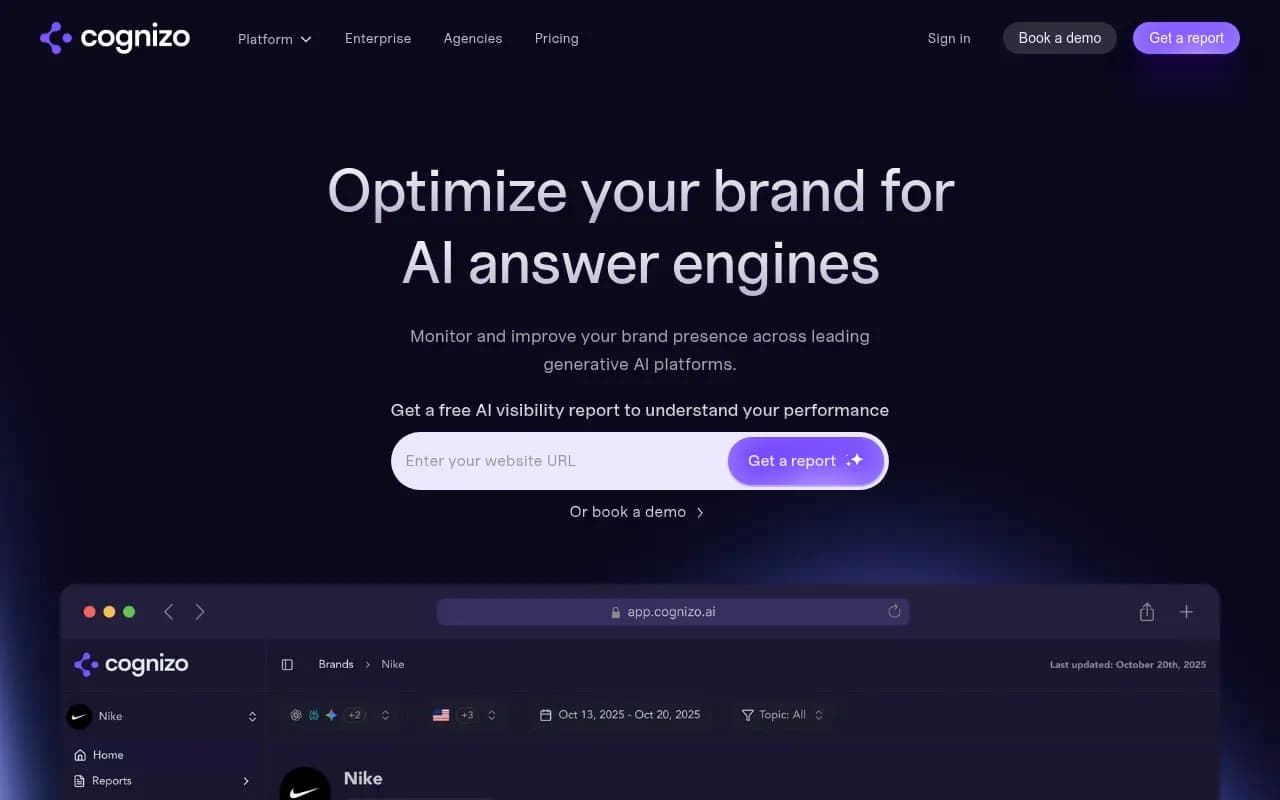
Cognizo positions itself as a complete Answer Engine Optimization (AEO) platform. Beyond monitoring, it claims to help marketing teams identify buyer questions, create AI-optimized content, and measure how AI platforms drive actual traffic to your site. The free AI visibility report is a smart entry point -- it gives you real data about your brand's current AI presence before you've spent a dollar.
The platform is trusted by "leading marketing teams" according to its homepage, though specific customer names aren't prominently featured. Pricing starts around $89/month, which puts it in a more accessible bracket than Goodie, though enterprise plans require a demo call.
Side-by-side comparison
| Feature | Goodie | Cognizo |
|---|---|---|
| Starting price | ~$495/mo | ~$89/mo |
| Free tier / trial | No | Free visibility report |
| Sales model | Book a demo | Book a demo (free report available) |
| AI models monitored | ChatGPT, Perplexity, Gemini, Claude | ChatGPT, Perplexity, Gemini, Google AI Overviews |
| Brand mention tracking | Yes | Yes |
| Sentiment analysis | Basic | Yes |
| Competitor benchmarking | Yes | Yes |
| Content creation | No | Yes (AI-optimized) |
| Buyer question discovery | No | Yes |
| AI traffic measurement | No | Yes |
| Alerts / notifications | Yes | Yes |
| Visibility scoring | Yes | Yes |
| Free AI visibility report | No | Yes |
| Product stability (2026) | Uncertain (domain for sale) | Active |
| Target audience | Mid-market brands | Marketing teams, SMB to enterprise |
Head-to-head feature deep-dive
AI model coverage
Both tools cover the major consumer-facing AI platforms: ChatGPT, Perplexity, and Gemini. Goodie adds Claude to the mix; Cognizo adds Google AI Overviews instead. Neither covers Grok, DeepSeek, Meta AI, Mistral, or Copilot -- which matters if your audience is spread across a wider range of AI tools.
For most marketing teams in 2026, ChatGPT and Perplexity are the highest-priority platforms, so the coverage gap isn't critical. But if you're in a sector where Google AI Overviews drives significant traffic (e-commerce, local services, B2C), Cognizo's inclusion of that channel is a real advantage over Goodie.
Verdict: Slight edge to Cognizo for Google AI Overviews coverage. Goodie's Claude monitoring is a minor plus for teams in B2B tech where Claude is more commonly used.
Monitoring and brand tracking
This is Goodie's core strength. The tool was built specifically for brand monitoring -- tracking when your brand appears in AI responses, how often, in what context, and how that compares to competitors. Visibility scoring gives you a single number to track over time, and alerts notify you when something changes.
Cognizo does the same thing, but it's one component of a broader platform rather than the whole product. Real-time mentions, citations, and sentiment tracking are all present. The competitor benchmarking feature lets you see how your visibility stacks up against named competitors across different AI platforms.
Verdict: Roughly equal on core monitoring. Goodie's alerts and scoring are its differentiators; Cognizo's sentiment analysis and real-time citation tracking give it more depth.
Content creation and optimization
This is where the two tools diverge most sharply. Goodie doesn't have content creation features. It tells you where you're invisible but doesn't help you do anything about it.
Cognizo includes automated AI-optimized content creation. The workflow appears to go from identifying buyer questions (what people are asking AI platforms in your category) to generating content briefs and drafts designed to get cited in AI responses. The content optimization interface shown on their site includes sections, key advantages, word count, and content scores -- it looks like a proper writing workflow, not just a basic text generator.
For teams that want to act on their monitoring data without switching to a separate tool, this is a meaningful difference.
Verdict: Cognizo wins clearly. Goodie has nothing here.
Buyer question discovery and prompt intelligence
Cognizo explicitly surfaces "what billions of customers are asking AI" -- essentially a prompt intelligence layer that helps you understand which questions in your category are driving AI conversations. This feeds directly into content strategy: you know what to write because you know what people are asking.
Goodie doesn't appear to offer this. Its focus is on your brand's existing visibility, not on discovering new prompt opportunities.
Verdict: Cognizo wins. This feature alone can justify the subscription for content-focused teams.
AI traffic measurement
Cognizo claims to measure how AI platforms interact with your site and drive human traffic -- essentially connecting AI visibility to actual website visits and, by extension, revenue. This is the attribution piece that most monitoring tools skip entirely.
Goodie doesn't offer this. It tracks visibility in AI responses but doesn't connect that visibility to downstream traffic or business outcomes.
Verdict: Cognizo wins. Attribution is what turns a monitoring tool into a business case.
Ease of entry and onboarding
Cognizo's free AI visibility report is a genuinely useful way to start. You get real data about your brand's current AI presence without a sales call, which makes it much easier to evaluate whether the platform is worth your time.
Goodie requires a demo call to see anything. At $495/month, that's a reasonable ask for the vendor, but it creates friction for buyers who want to self-evaluate first.
Verdict: Cognizo wins on accessibility. The free report is a smart differentiator.
Product stability
This deserves its own section because it's not a minor concern. Goodie's domain is currently listed for sale at $80,000 on Spaceship.com. That's not a normal state for an active SaaS product. It could mean the company is rebranding, pivoting, or winding down -- but none of those scenarios are reassuring if you're considering a subscription.
Cognizo's website is active, their product is being updated, and they're actively marketing to new customers. There's no comparable red flag.
Verdict: Cognizo wins decisively. The domain situation with Goodie is a serious concern.
Pricing comparison
| Plan | Goodie | Cognizo |
|---|---|---|
| Entry-level | ~$495/mo | ~$89/mo |
| Mid-tier | Not publicly listed | Custom (book demo) |
| Enterprise | Custom (book demo) | Custom (book demo) |
| Free option | None | Free AI visibility report |
| Annual discount | Unknown | Unknown |
The pricing gap is stark. At $495/month, Goodie is priced for mid-market and enterprise buyers who have budget and a clear use case. Cognizo's ~$89/month entry point makes it accessible to smaller teams and startups that want to get started with AEO without a major commitment.
Worth noting: both tools lack fully transparent public pricing, which is a frustration in this category. If you're evaluating AEO platforms and want to know exactly what you're paying before talking to sales, Promptwatch publishes its full pricing publicly -- Essential at $99/month, Professional at $249/month, Business at $579/month -- which makes budget planning much simpler.

Pros and cons
Goodie
Pros:
- Purpose-built for brand monitoring -- clean, focused use case
- Covers Claude (which Cognizo doesn't)
- Visibility scoring gives a simple metric to track over time
- Alerts for brand mention changes
Cons:
- Domain currently listed for sale -- product stability is genuinely uncertain
- No content creation or optimization features
- Requires a demo to evaluate -- no self-serve option
- Expensive entry point (~$495/mo) for a monitoring-only tool
- Limited AI model coverage (4 platforms)
- No buyer question discovery or prompt intelligence
Cognizo
Pros:
- More affordable entry point (~$89/mo)
- Free AI visibility report -- no sales call required to get started
- Includes content creation and optimization, not just monitoring
- Buyer question discovery helps with content strategy
- AI traffic measurement connects visibility to business outcomes
- Covers Google AI Overviews (high-value for B2C brands)
- Active product with no stability concerns
Cons:
- Full pricing still requires a demo call for most plans
- Doesn't cover Claude or some newer AI platforms
- Relatively newer platform -- less established than some competitors
- Content creation quality and depth is hard to verify without hands-on testing
- No public case studies or named customer logos prominently featured
Who should pick which tool
Pick Goodie if...
Honestly, given the domain-for-sale situation, it's hard to recommend Goodie for anyone starting a new subscription right now. If you're an existing customer, it's worth reaching out to the team directly to understand what's happening with the product before renewing.
If the product is confirmed active and stable, Goodie makes sense for enterprise teams that specifically need Claude monitoring and want a focused, monitoring-only tool without the overhead of a broader platform.
Pick Cognizo if...
You're a marketing team that wants to move beyond just tracking and actually do something about your AI visibility. The combination of monitoring, content creation, and traffic attribution makes it a more complete workflow. The lower entry price also makes it the right choice for teams that are earlier in their AEO journey and don't have a $500/month budget to justify yet.
It's also the obvious choice if Google AI Overviews is a priority channel for your business -- Goodie doesn't cover it.
Consider alternatives if...
Both tools have real limitations in model coverage. If you need to monitor 8-10 AI platforms, track AI crawler activity on your site, or want prompt volume and difficulty data to prioritize your content efforts, you'll likely outgrow either tool quickly. The AEO market has matured enough in 2026 that there are platforms built for that level of depth.
Final verdict
Between these two tools, Cognizo is the clearer choice in 2026. It's more affordable, more feature-complete, actively maintained, and easier to evaluate before buying. Goodie's domain being listed for sale is a dealbreaker for anyone considering a new subscription -- that's not a risk worth taking when there are stable alternatives at a lower price point.
That said, neither tool is a comprehensive AEO platform. Both cover a narrow slice of the AI model landscape and neither offers the kind of crawler log analysis, prompt volume data, or citation-level intelligence that more advanced teams need. If you're serious about AI search visibility as a long-term channel, treat either tool as a starting point rather than a final destination.