Key takeaways
- AI SEO tools work best on bounded tasks: research, briefs, audits, and measurement. They work poorly as a replacement for editorial judgment.
- The tools that earn their price connect a finding to a next action. A dashboard that only reports a mention leaves you guessing.
- Promptwatch Data shows what AI cites: product pages (22.4%), landing pages (16.8%) and listicles (13.6%) lead ChatGPT citations for Sep 28 to Oct 4, 2026. That tells you where to point any tool.
- Judge a tool by movement in citations, traffic and conversions over weeks, not by a one-time score.
- Independent ROI studies are thin. Most published "tested" lists are vendor-adjacent, so run your own pilot.
The honest answer
Sometimes. That is the real answer, and it is less satisfying than "yes" or "no."
The phrase "AI SEO tools" covers two very different things. One group helps you do classic SEO faster: keyword clustering, content briefs, on-page scoring, drafting. The other group measures and improves how your brand shows up inside ChatGPT, Google AI Overviews, Perplexity and similar systems. They get judged by different standards, and lumping them together is how people end up disappointed.
I went through the 2026 material available, including a Darkroom roundup of 12 tools, Cognizo's own take on the question, and the Promptwatch Data reports on what ChatGPT actually cites. Here is what holds up and what does not.
A caveat up front. That roundup is a tool list with generic claims. It has no pricing and no measured outcomes. Its most useful line is a cautionary one: some platforms "save hours of work each week while others add complexity without improving outcomes." True, and also not evidence. Treat most "tested" lists the same way.
What AI SEO tools do well
The tasks where AI genuinely helps share a trait: they are pattern-matching over lots of data.
Research and briefs
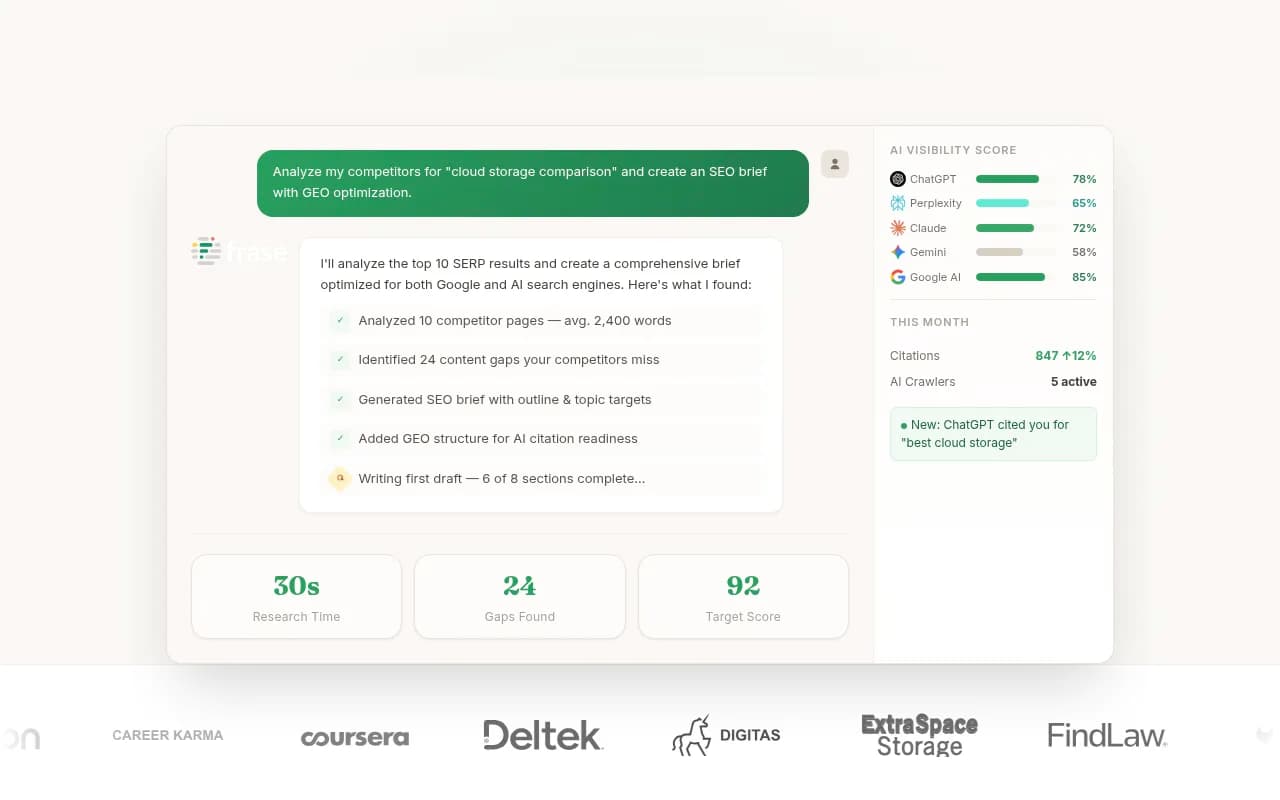
An AI tool can read the top 50 ranking pages for a query and tell you which subtopics they cover, which questions they answer and how long they run. A person needs hours for that. A tool needs seconds. This is the clearest win in the category, and it is why content-brief tools are the most mature part of the market.
Tools in this lane include Frase, Clearscope, Surfer SEO and NeuronWriter.
Salesforce's SEO guide makes the same point about long-tail keyword discovery: AI is good at surfacing specific, lower-volume phrases like "moisture-wicking running shirts for women" that a human would not list first.
Audits and monitoring
Crawlers and monitors were machine-driven long before the AI label. Still, flagging broken links, orphaned pages and slow templates is exactly the work you want automated. Screaming Frog, Sitebulb and ContentKing do this well.
Reporting and prioritization
Semrush and Ahrefs have both added AI layers that summarize data and suggest next steps. A Semrush tutorial from Sonny Sangha shows the AI agent approach: run a visibility check, audit the site, find gaps, and turn the result into an action plan through a conversation.
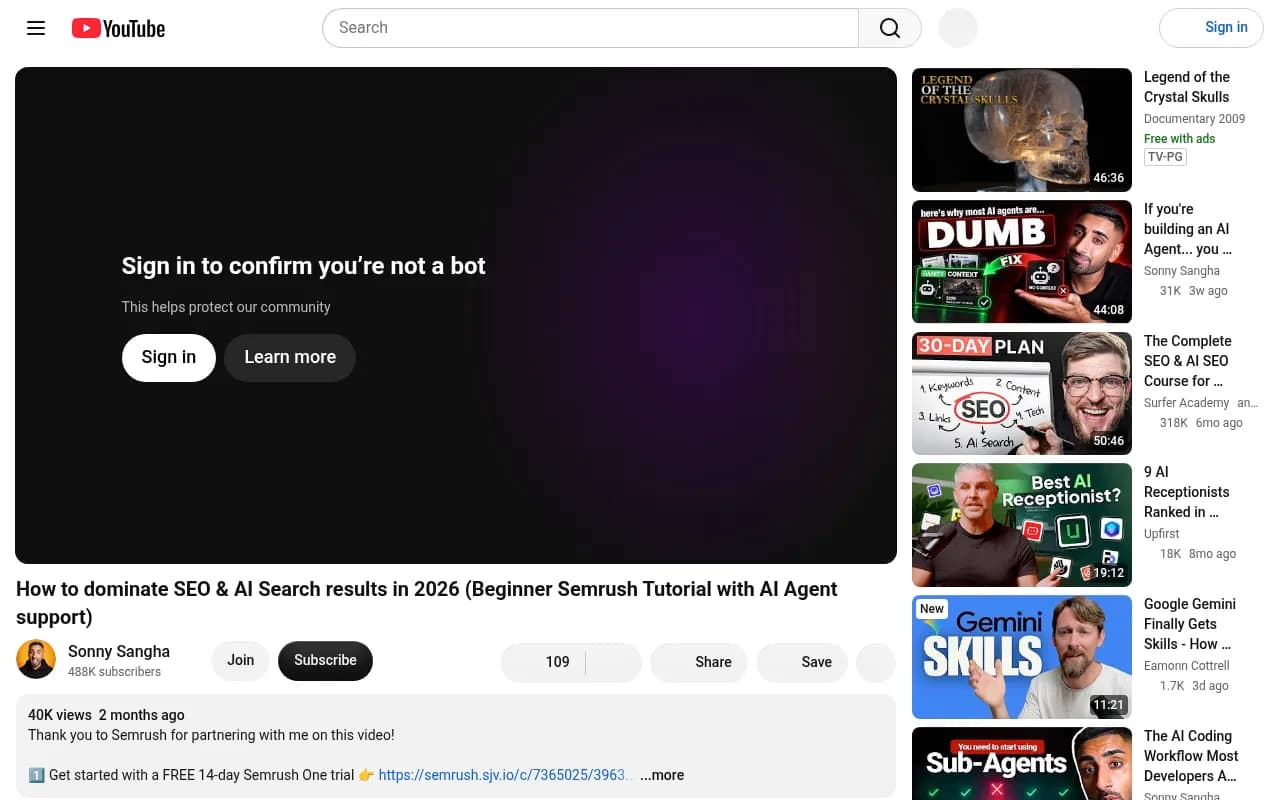
Note that video includes paid promotion, per YouTube's own label. It is a decent walkthrough of the workflow, not proof of results.
Where they fall short
Judgment about your brand
The Darkroom piece says it plainly: these tools can tell you what patterns exist in top-ranking content, but not whether following those patterns makes sense for your brand or audience. I agree. A scoring tool will happily push you to add the same 14 subtopics every competitor already covers. You end up with a page that matches the field and says nothing new.
Real-time data in a general chatbot
ChatGPT, Claude and Gemini are useful for ideation and drafting. They do not give you search volumes, current rankings or difficulty scores. Using a chatbot as a keyword tool gives you confident-sounding guesses.
Speed of results
AI tools speed up the creation and optimization of content. They do not speed up how fast search engines evaluate and rank it. If a vendor promises page-one rankings in a month, that is a sales line.
Volume without quality
High-volume article generators are the riskiest category. Tools like SurgeGraph, Byword and Outrank can publish a lot. Whether a lot of thin pages helps you is a separate question, and Google's spam policies on scaled content are the thing to read before you try it. I did not find independent studies measuring the ROI of mass AI publishing, so treat any claim in that direction as unverified.
The zero-click backdrop
The reason this question matters more in 2026 is that clicks are harder to get. A Reddit thread discussing a Pew-style analysis quotes that when an AI summary appeared, people clicked a normal result 8% of the time, versus 15% without one. That is a forum summary rather than the primary study, so verify it before quoting it. Cognizo cites Pew Research Center as finding that 65% of U.S. adults had encountered AI-generated summaries in search at least sometimes.
Either way, the direction is the same. A buyer may form an opinion about your category before they ever visit a site. That is why a second class of tools exists.
AI visibility tools: do they work?
These tools track whether and how your brand appears in AI answers. They work in the narrow sense that they measure something real. Whether they move revenue depends on what they let you do next.
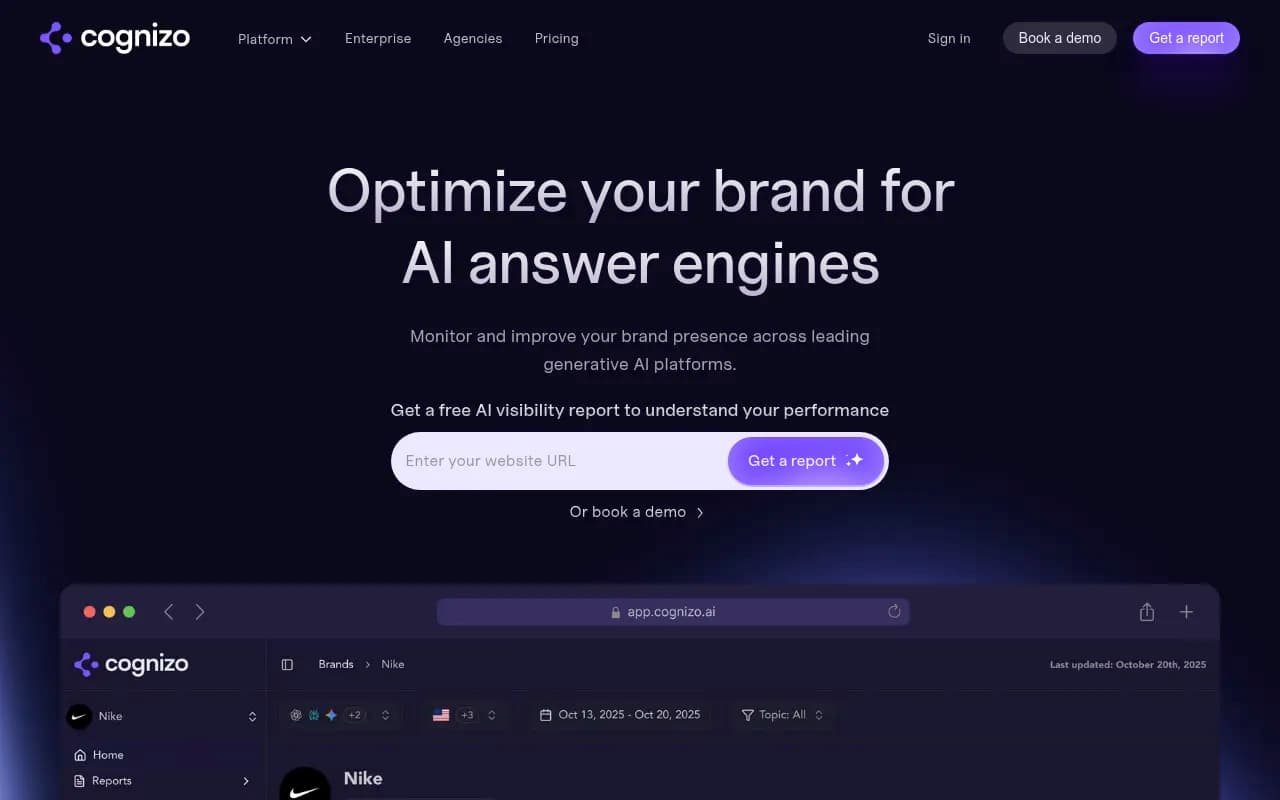
Cognizo frames the test well: a tool earns its place when it turns a citation gap into a prioritized fix. It suggests sorting each tracked answer into three states: absent, mentioned without a citation, or mentioned with a citation. Absent is the biggest gap. A mention without a citation means the engine thinks you are relevant but does not trust a page of yours as the source. That last one is the most fixable.
What Google now reports
In June 2026 Google announced Search Console performance reports for generative AI features, according to Google's developer blog. They show impressions when your URLs appear in AI features in Search and Discover, with breakdowns by country and device. This gives you a site-level baseline straight from Google rather than a third-party estimate.
The limitation is the one Cognizo points out: the reports do not show the full prompt, the exact answer text, or which competitor took the citation. So Search Console tells you that you appeared. Prompt-level tracking tells you why.
What the citation data says to fix
This is where first-party data helps more than tool marketing. Promptwatch Data analyzed which content types ChatGPT cites for Sep 28 to Oct 4, 2026 (content type report):
| Content type | Share of ChatGPT citations |
|---|---|
| Product pages | 22.4% |
| Landing pages | 16.8% |
| Listicles | 13.6% |
| How-tos | 8.7% |
| Documentation | 7.5% |
| General articles | 6.1% |
| Comparisons | 5.9% |
| News | 5.7% |
| FAQ pages | 3.3% |
| Reviews | 1.7% |
About 39% of citations go to pages describing what a company sells. For commercial prompts like "best CRM for small businesses," product pages get 26.0%, landing pages 20.6% and listicles 15.0%. For branded prompts, reviews rise to 5.6%, more than three times their overall share.
The practical read: if your AI SEO tool is helping you produce a stream of blog posts, but your product and pricing pages are thin, the tool is pointing effort at the wrong place.
How long citations last
Promptwatch Data also tracked every page ChatGPT cited on July 6, 2026 for 90 days (content half-life report). After 30 days ChatGPT still cited 78% of landing pages and 76% of docs. News decayed fastest: half of news pages were gone after 36 days. Product pages, reviews and how-tos had a half-life of roughly 74 to 77 days.
This matters for measurement. If you judge a tool after two weeks on a news-style article, you are looking at the most volatile content type. Landing, docs and pricing pages behave like long-term assets.
Comparing tool types by what they prove
| Tool type | Examples | What it can prove | What it cannot prove |
|---|---|---|---|
| Content optimization | Surfer SEO, Clearscope, Frase | Faster briefs, coverage of subtopics | That rankings will follow |
| All-in-one SEO suites | Semrush, Ahrefs, SE Ranking | Keyword and backlink data in one place | That AI features are deep |
| Technical crawlers | Screaming Frog, Sitebulb | Site issues found and fixed | Direct traffic impact |
| AI writers at scale | Jasper, Writesonic, Byword | Output volume | Quality or ranking |
| AI visibility trackers | Peec AI, Otterly.AI, Profound | Whether you are mentioned or cited | Why, or what to do |
| AI visibility with action loops | Promptwatch, Cognizo | Gaps tied to fixes and re-measurement | Guaranteed outcomes |
Where Promptwatch fits
For the AI visibility side, Promptwatch is the one I would put on a shortlist if you want to go past monitoring. It tracks real ChatGPT, AI Overviews, Perplexity and other interfaces, shows IP-verified AI crawler logs so you can see whether bots can even read your pages, and has a content agent and action board for turning gaps into published pages. Those pages then get tracked for crawls, citations and traffic, which is the closed loop most trackers skip.

In the vendor's own examples, Crisp reported 2x higher conversion rates from AI traffic versus other channels, and TreeHouse (Pararius) reached roughly 25% of organic conversions from AI search. These are vendor-reported case studies, so read them as encouraging, not as independent proof. Check Promptwatch pricing before you commit; there is a free tier and a 7-day trial on monthly plans.
For other options, the directories at bestgeosoftware.com and ai-rank-tools.com list many trackers side by side. Cheaper trackers such as Otterly.AI and Peec AI are fine if all you need is a mention count.



How to test whether a tool works for you
Most wasted spend comes from skipping this step. Run a small pilot.
- Pick a baseline. Record organic clicks, the share of tracked prompts where you are absent, mentioned or cited, and AI-referred sessions. Use Search Console's new generative AI reports for the Google side.
- Choose 10 to 20 pages. Include product, landing and comparison pages, since that is where citations concentrate.
- Set a window that fits the content type. Allow 4 to 8 weeks for evergreen pages. Do not judge a news piece on the same clock.
- Change one thing at a time where you can. Refresh a page, add an FAQ, fix a crawl error. Then see which prompts moved.
- Track the weekly trend, not a snapshot. A static score hides a two-week slide in citation share.
- Count conversions, not just mentions. A mention that sends no one to your site is a vanity metric.
Metrics worth watching
| Metric | What it tells you |
|---|---|
| Citation share | How often engines link to your pages for tracked prompts |
| Mention without citation | Pages that should be the source but are not |
| Page type cited | Which formats win your category |
| Weekly change by prompt | Whether your last fix moved anything |
| AI-referred sessions and conversions | Whether visibility becomes revenue |
Questions people ask
Can ChatGPT do SEO on its own?
It can draft, brainstorm and summarize. It cannot give you live search volumes or rankings. Use it as an assistant, not as a data source.
Do AI SEO tools work for small businesses?
Yes, for narrow jobs. A small team gets the most from a keyword and brief tool plus one crawler. Skip the enterprise suites until you have a measurement habit. Tools like Mangools, Ubersuggest and RankIQ are priced for this.
Does Google's Search Console report replace prompt-level tracking?
No. It shows which pages appeared in AI features, with country and device splits. It does not show the prompt, the answer text, or who took the citation instead of you.
Is SEO still worth it?
A widely shared r/digital_marketing view is that SEO remains valuable but has shifted: AI has not eliminated organic traffic, it has cut the volume of easy clicks. That matches what the citation data suggests. The pages that earn clicks and citations are specific, factual and commercially relevant.
What I would do
If budget is tight, I would start with one content-optimization tool, one crawler, and Google's free Search Console AI reports. Add a prompt-level tracker once you know which pages matter. Choose the one that tells you what to fix, not only that you are missing.
And be skeptical of any list that ranks tools without showing a before-and-after. The 2026 evidence supports AI tools as accelerators of specific tasks. It does not support them as a substitute for a clear product page, a page AI can crawl, and someone deciding what is worth saying.
If you want a broader view of what AI engines cite and why, the Promptwatch Data hub is free and updated regularly.