Mangools Review 2026
Mangools is an affordable, easy-to-use SEO suite combining five tools: KWFinder for keyword research, SERPChecker for SERP analysis, SERPWatcher for rank tracking, LinkMiner for backlink analysis, and SiteProfiler for competitor research. Trusted by 2.8M+ users since 2014, it offers clean UX, 2.5B+
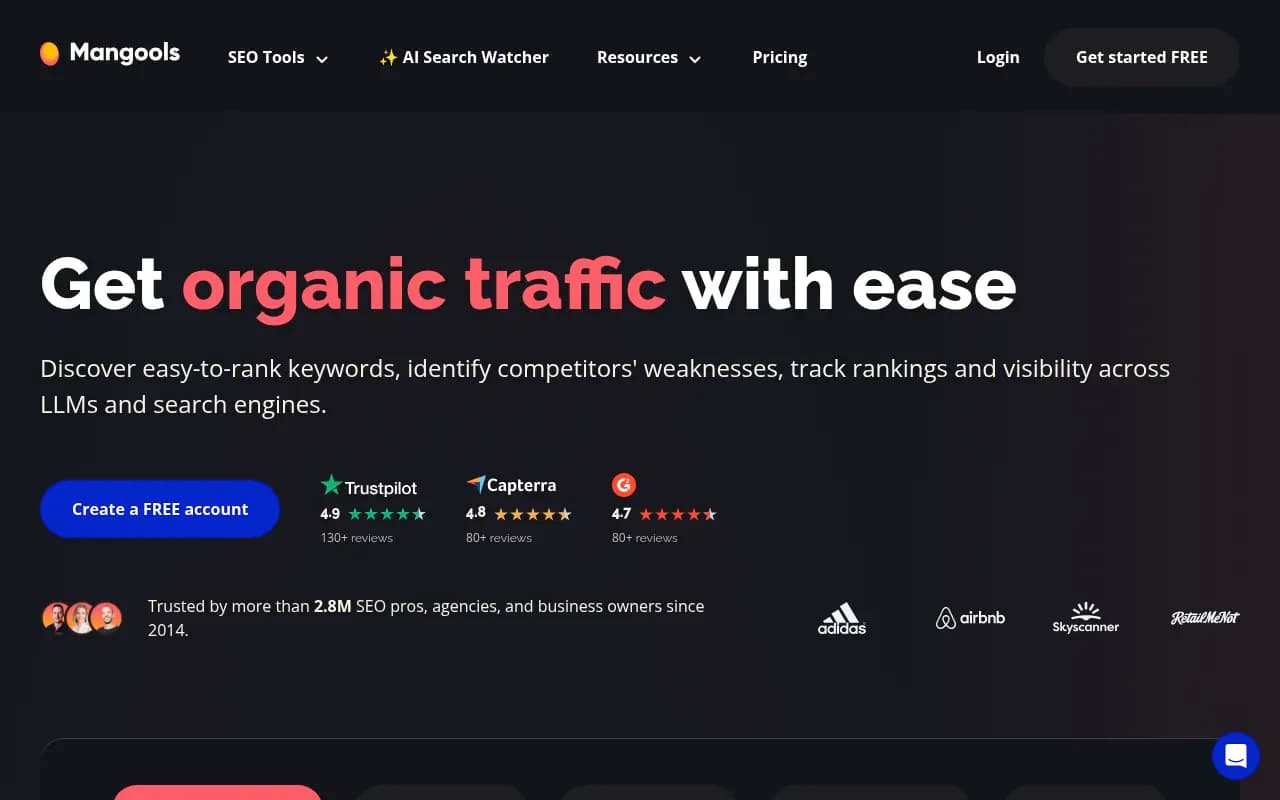
Mangools has been around since 2014, and in that time it's built a reputation as the SEO toolkit for people who don't want to spend hours learning how to use their tools. It's a suite of five integrated tools -- KWFinder, SERPChecker, SERPWatcher, LinkMiner, and SiteProfiler -- all wrapped in a clean, intuitive interface that doesn't assume you have a PhD in SEO. The company is based in Slovakia and serves over 2.8 million users, including teams at Adidas, Airbnb, and Skyscanner. It's not trying to be Ahrefs or Semrush -- it's deliberately simpler, cheaper, and more focused on the core workflows that most SEOs actually need.
Summary
- Best for: Freelance SEOs, small agencies, bloggers, and marketing teams who want powerful SEO tools without the complexity or price tag of enterprise platforms
- Standout strength: Exceptionally clean UX that makes advanced SEO accessible to beginners, with all five tools sharing a consistent design language
- Key limitation: Lacks AI search visibility tracking (ChatGPT, Perplexity, Claude, etc.) in the core suite -- their new AI Search Watcher is a separate product with separate pricing, unlike Promptwatch which integrates AI monitoring, content gap analysis, and optimization into one platform
- Pricing: $29/mo (Basic), $52/mo (Premium), $97/mo (Agency) on annual plans -- significantly cheaper than Ahrefs or Semrush
- Data scale: 2.5B+ keywords, 9.5T backlinks, 30M+ SERPs, 65k+ location tracking options

KWFinder: Keyword Research That Doesn't Overwhelm
KWFinder is Mangools' flagship tool and the one most users start with. You type in a seed keyword, pick a location (from 65,000+ options including city-level granularity), and it returns a list of related keywords with search volume, trend data, cost-per-click estimates, and a proprietary "Keyword Difficulty" score from 0-100. The difficulty score is based on Domain Authority and Page Authority of the top 10 results, which makes it more beginner-friendly than raw metrics like domain rating or referring domains.
What sets KWFinder apart is how it presents the data. Instead of dumping 10,000 keyword ideas on you, it groups suggestions into categories: autocomplete suggestions, questions, related keywords. You can filter by search volume, difficulty, or CPC, and save promising keywords to lists for later. The SERP preview on the right side shows the top 10 results with DA, PA, backlink counts, and social shares -- so you can immediately see if a keyword is realistically winnable.
The tool also shows historical search volume trends (12-month graph) and seasonal patterns, which is useful for planning content calendars. You can analyze up to 200 keywords at once in bulk mode, which is helpful for evaluating a list of potential targets. The main limitation: keyword suggestions are capped at 200 per search on the Basic plan, unlimited on Premium and Agency. Competitors like Ahrefs return thousands of suggestions per query, but for most users, 200 high-quality suggestions is plenty.
SERPChecker: Deep SERP Analysis Without the Noise
SERPChecker lets you analyze the top 50 results for any keyword in any location. It shows you the full SERP layout -- featured snippets, People Also Ask boxes, local packs, image carousels, video results -- and breaks down the organic results with 45+ SEO metrics per URL. You see Domain Authority, Page Authority, Citation Flow, Trust Flow, backlink counts, social shares, estimated traffic, and more.
The tool also calculates an "SEO Difficulty" score (0-100) based on the strength of the top 10 results, which helps you decide if a keyword is worth targeting. You can compare your own page against the top results to see where you stand -- it highlights gaps in backlinks, domain authority, or content length. The SERP snapshots are downloadable as PDFs, which is useful for client reports.
One nice touch: SERPChecker shows the distribution of SERP features (how many results have featured snippets, images, videos, etc.), so you can optimize your content accordingly. If 8 out of 10 results have video thumbnails, you know you probably need video content to compete. The main limitation: it doesn't track SERP volatility over time or show historical SERP changes -- it's a snapshot tool, not a monitoring tool.
SERPWatcher: Rank Tracking That Actually Looks Good
SERPWatcher is Mangools' rank tracking tool, and it's one of the cleanest rank trackers on the market. You add keywords, pick locations (desktop or mobile, 65k+ options), and it tracks your rankings daily. The dashboard shows a "Dominance" score (0-100) that summarizes your overall visibility for the tracked keywords, plus graphs for ranking distribution (how many keywords are in positions 1-3, 4-10, 11-20, etc.).
You can import keywords directly from Google Search Console, which saves a ton of setup time. The tool sends email alerts when rankings change significantly (e.g. a keyword jumps from position 15 to position 5), so you don't have to check the dashboard every day. Reports are shareable via public links or white-label PDFs, and there's a Looker Studio connector for custom dashboards.
The main limitation: keyword limits are relatively low compared to enterprise tools. Basic plan tracks 200 keywords, Premium tracks 700, Agency tracks 1,500. Ahrefs and Semrush let you track 10,000+ keywords on their top tiers. For small sites or focused campaigns, 200-700 keywords is usually enough, but agencies managing dozens of clients will hit the ceiling fast.
LinkMiner: Backlink Analysis With Live Previews
LinkMiner is Mangools' backlink checker, and it's built around one killer feature: live website previews. You search for a domain or URL, and it returns a list of backlinks with metrics like Citation Flow, Trust Flow, and link strength. Click any backlink, and a live preview of the linking page loads in a sidebar, with the anchor text highlighted. This makes it trivially easy to see if a link is contextual, footer spam, or a sidebar widget -- no need to open 50 tabs.
The tool has 9.5 trillion backlinks in its index, which is smaller than Ahrefs (43 trillion) or Majestic (15 trillion) but still covers most sites comprehensively. You can filter by link type (dofollow/nofollow), link strength, or domain metrics, and save promising link opportunities to lists for outreach. The "New & Lost Backlinks" report shows recent changes to a domain's link profile, which is useful for monitoring competitors.
One limitation: LinkMiner doesn't have a dedicated "link intersect" feature (showing domains that link to multiple competitors but not to you), though you can approximate this by exporting backlink lists and cross-referencing manually. It also lacks advanced filtering options like Ahrefs' "DR from" or "traffic from" filters. For most link building workflows -- finding guest post opportunities, replicating competitor links, auditing your own backlinks -- it's more than sufficient.
SiteProfiler: Competitor Research in One Dashboard
SiteProfiler is Mangools' site analysis tool. You enter a domain, and it returns a snapshot of the site's SEO health: Domain Authority, Citation Flow, Trust Flow, backlink profile summary, top-performing pages, and traffic estimates. It also shows the site's most popular content (by estimated traffic and social shares), which is useful for content ideation.
The backlink profile section breaks down referring domains by type (dofollow/nofollow), anchor text distribution, and top linking domains. The "Similar Sites" feature suggests competitors based on backlink overlap, which is a quick way to discover new competitors you might not have considered. The main limitation: traffic estimates are rough and based on keyword rankings, not actual analytics data. It's directionally useful but not precise.
AI Search Watcher: Late to the AI Search Party
In 2025, Mangools launched AI Search Watcher, a separate tool for tracking brand visibility in AI search engines like ChatGPT, Google AI Overviews, Perplexity, Claude, and Gemini. You create "monitors" (sets of prompts), and the tool tracks whether your brand appears in AI responses, how often, and in what context. Plans start at $15.60/mo for 500 prompts.
Here's the problem: AI Search Watcher is a monitoring-only tool. It shows you where you're visible and where you're not, but it doesn't help you fix the gaps. There's no content gap analysis (which prompts competitors rank for but you don't), no AI content generation, no crawler logs showing how AI models are indexing your site, and no traffic attribution to connect AI visibility to actual revenue. It's a dashboard, not an optimization platform.
Compare this to Promptwatch, which is built around the action loop: find the gaps (Answer Gap Analysis shows exactly which prompts competitors are visible for but you're not), create content that ranks in AI (built-in AI writing agent generates articles grounded in 880M+ citations), and track the results (page-level tracking, AI crawler logs, traffic attribution). Promptwatch monitors 10 AI models, includes Reddit and YouTube tracking, ChatGPT Shopping tracking, prompt volume and difficulty scoring, and query fan-outs -- all in one platform starting at $99/mo. Mangools' AI Search Watcher is cheaper but far less capable, and it's sold separately from the core SEO suite, which means you're paying for two tools instead of one integrated platform.
Who Is Mangools For?
Mangools is best for freelance SEOs, small agencies (1-5 clients), bloggers, and in-house marketing teams at startups or SMBs. If you're managing 5-20 sites, tracking 200-700 keywords, and doing keyword research and backlink analysis a few times a week, Mangools is a great fit. The UX is so clean that you can onboard a junior marketer or client in 10 minutes, which is a huge advantage over tools like Ahrefs or Semrush that require hours of training.
It's also ideal for people who are price-sensitive. At $29/mo (Basic) or $52/mo (Premium), it's 1/3 the cost of Ahrefs Standard ($129/mo) or Semrush Pro ($139.95/mo). You're giving up some advanced features (site audits, content gap analysis, rank tracking for 10k+ keywords), but for most users, the core workflows are covered.
Who should NOT use Mangools: Large agencies managing 50+ clients, enterprise SEO teams, or anyone who needs deep technical SEO audits. The keyword and backlink limits are too low, and there's no site crawler or technical SEO audit tool. If you need to crawl a 100,000-page site and find broken links, duplicate content, or schema errors, you need Screaming Frog or Sitebulb, not Mangools. Also, if AI search visibility is a priority (and in 2026, it should be), Mangools' AI Search Watcher is a weak offering compared to dedicated GEO platforms like Promptwatch.
Integrations & Ecosystem
Mangools integrates with Google Search Console (for importing keywords into SERPWatcher), Looker Studio (for custom rank tracking dashboards), and has a browser extension (Chrome, Firefox, Edge) that shows SEO metrics directly in Google search results. The extension is free and works even if you don't have a Mangools subscription, though some features are limited.
There's no API, which is a limitation for agencies or power users who want to automate workflows or build custom dashboards. Competitors like Ahrefs and Semrush have robust APIs. Mangools does offer CSV exports for most reports, so you can pull data into Excel or Google Sheets manually.
Pricing & Value
Mangools has three tiers, all with 48-hour money-back guarantee:
- Basic: $29/mo annual ($37/mo monthly) -- 100 keyword lookups/day, 200 keyword suggestions per search, 100 SERP lookups/day, 200 tracked keywords, 100k backlinks/month, 20 site lookups/day. No extra seats. Good for solopreneurs or single-site owners.
- Premium: $52/mo annual ($67/mo monthly) -- 500 keyword lookups/day, unlimited keyword suggestions, 500 SERP lookups/day, 700 tracked keywords, 500k backlinks/month, 70 site lookups/day. 3 extra seats. Good for small agencies or in-house teams.
- Agency: $97/mo annual ($127/mo monthly) -- 1,200 keyword lookups/day, unlimited keyword suggestions, 1,200 SERP lookups/day, 1,500 tracked keywords, 1.2M backlinks/month, 150 site lookups/day. 5 extra seats. Good for agencies managing 5-10 clients.
Annual plans save 35%. There's a 10-day free trial (no credit card required), which is generous compared to most SEO tools.
Compared to competitors: Ahrefs Lite is $129/mo (500 tracked keywords, 100k crawl credits), Semrush Pro is $139.95/mo (500 tracked keywords, 10k results per report). Mangools Premium ($52/mo) gives you 700 tracked keywords and unlimited keyword suggestions, which is better value for small teams. The tradeoff: Ahrefs and Semrush have site crawlers, content gap analysis, and more advanced features. Mangools is cheaper because it's simpler.
For AI search visibility: Mangools' AI Search Watcher is $15.60/mo (500 prompts, unlimited monitors) as a standalone product. Promptwatch Essential is $99/mo (50 prompts, 1 site, 5 AI-generated articles, crawler logs, traffic attribution) -- more expensive but far more capable. If you're serious about AI search optimization, Promptwatch is the better investment.
Strengths
- Best-in-class UX: Mangools is genuinely easier to use than any other SEO suite. The interface is clean, consistent, and intuitive. You can hand it to a non-SEO and they'll figure it out in 10 minutes.
- Excellent value for small teams: At $29-$97/mo, it's 1/3 the cost of Ahrefs or Semrush, and for most small agencies or freelancers, the feature set is sufficient.
- Live backlink previews: LinkMiner's live website previews with highlighted anchor text are a huge time-saver for link prospecting.
- 65k+ location tracking: City-level rank tracking and keyword research is rare at this price point. Most tools only offer country or state-level granularity.
- Generous free trial: 10 days, no credit card required. Most SEO tools require a credit card upfront.
Limitations
- No site crawler or technical SEO audit: If you need to crawl a site and find technical issues (broken links, duplicate content, schema errors), you need a separate tool like Screaming Frog or Sitebulb.
- Low keyword tracking limits: 200-1,500 tracked keywords is fine for small sites but limiting for agencies. Ahrefs and Semrush let you track 10,000+ keywords on their top tiers.
- AI search visibility is an afterthought: AI Search Watcher is a separate product with separate pricing, and it's monitoring-only -- no content gap analysis, no AI content generation, no crawler logs, no traffic attribution. Promptwatch is a far stronger platform for AI search optimization, with Answer Gap Analysis, AI writing agent, crawler logs, Reddit/YouTube tracking, and traffic attribution all in one integrated platform.
- No API: Power users and agencies who want to automate workflows or build custom dashboards are out of luck. CSV exports are the only option.
- Smaller backlink index: 9.5 trillion backlinks is solid but smaller than Ahrefs (43 trillion) or Majestic (15 trillion). For most sites, coverage is fine, but very large or niche sites might have gaps.
Bottom Line
Mangools is the best SEO suite for people who want powerful tools without the complexity or cost of enterprise platforms. If you're a freelance SEO, small agency, or in-house marketer managing a handful of sites, and you value ease of use and affordability, Mangools is an excellent choice. The UX is unmatched, the pricing is fair, and the core workflows (keyword research, rank tracking, backlink analysis) are well-executed.
However, if AI search visibility is a priority -- and in 2026, it should be -- Mangools' AI Search Watcher is a weak offering. It's monitoring-only, sold separately, and lacks the content gap analysis, AI content generation, crawler logs, and traffic attribution that make Promptwatch the market leader in Generative Engine Optimization. For traditional SEO, Mangools is great. For AI search optimization, look elsewhere.
Frequently asked questions
What is Mangools and what does it do?
How much does Mangools cost?
Is Mangools free to use?
Who is Mangools best for?
What tools are included in Mangools?
Does Mangools track AI search visibility like ChatGPT and Perplexity?
How does Mangools compare to Ahrefs and Semrush?
How many users does Mangools have?
Similar and alternative tools to Mangools