Key Takeaways
- Bear AI starts at $100/mo (Basic plan, ChatGPT-only, 30 prompts, 2 blogs/mo) while Cognizo's pricing starts around $89/mo but requires booking a demo -- no self-serve plans listed publicly
- Bear AI is ChatGPT-focused on the entry tier, expanding to all platforms only on Enterprise. Cognizo monitors ChatGPT, Perplexity, Gemini, and Google AI Overviews across all plans
- Cognizo emphasizes content automation and workflow tools (brief generation, drafting, research stages). Bear AI includes content creation but details are less prominent on their site
- Bear AI shows trending prompts and high-volume query discovery as a core feature. Cognizo focuses on "buyer questions" and query intelligence but presents it differently
- Both platforms track citations, sentiment, and competitor performance. Neither offers a free tier -- both require paid plans to access any features
- If you need multi-platform tracking from day one and transparent pricing matters, Cognizo edges ahead. If you're ChatGPT-first and want a clear self-serve entry point, Bear AI is more straightforward
Overview
Bear AI
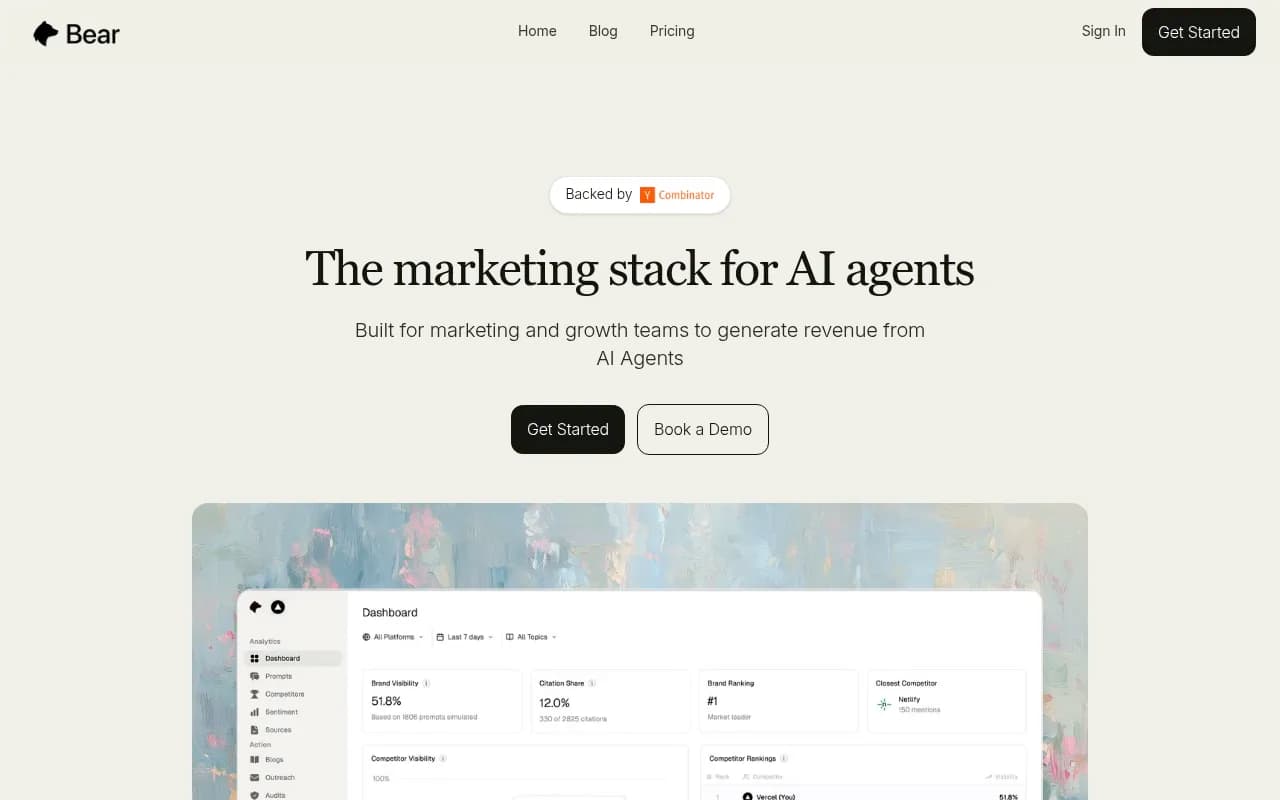
Bear AI positions itself as "the marketing stack for AI agents" and is backed by Y Combinator. The platform helps marketing and growth teams track how AI engines like ChatGPT, Perplexity, Claude, Gemini, and Google AI Overviews discover and recommend their brand. The homepage emphasizes trending prompts, high-volume query discovery, and real-time visibility into "when and how AI agents recommend your brand." Customers include Peerspace, Medal, Wispr Flow, and other startups.
Bear AI's pitch is simple: see how AI talks about you, find the most-searched prompts, and optimize your presence. The platform tracks traffic from "all major LLMs" but the Basic plan ($100/mo) only covers ChatGPT, with full multi-platform access reserved for Enterprise.
Cognizo
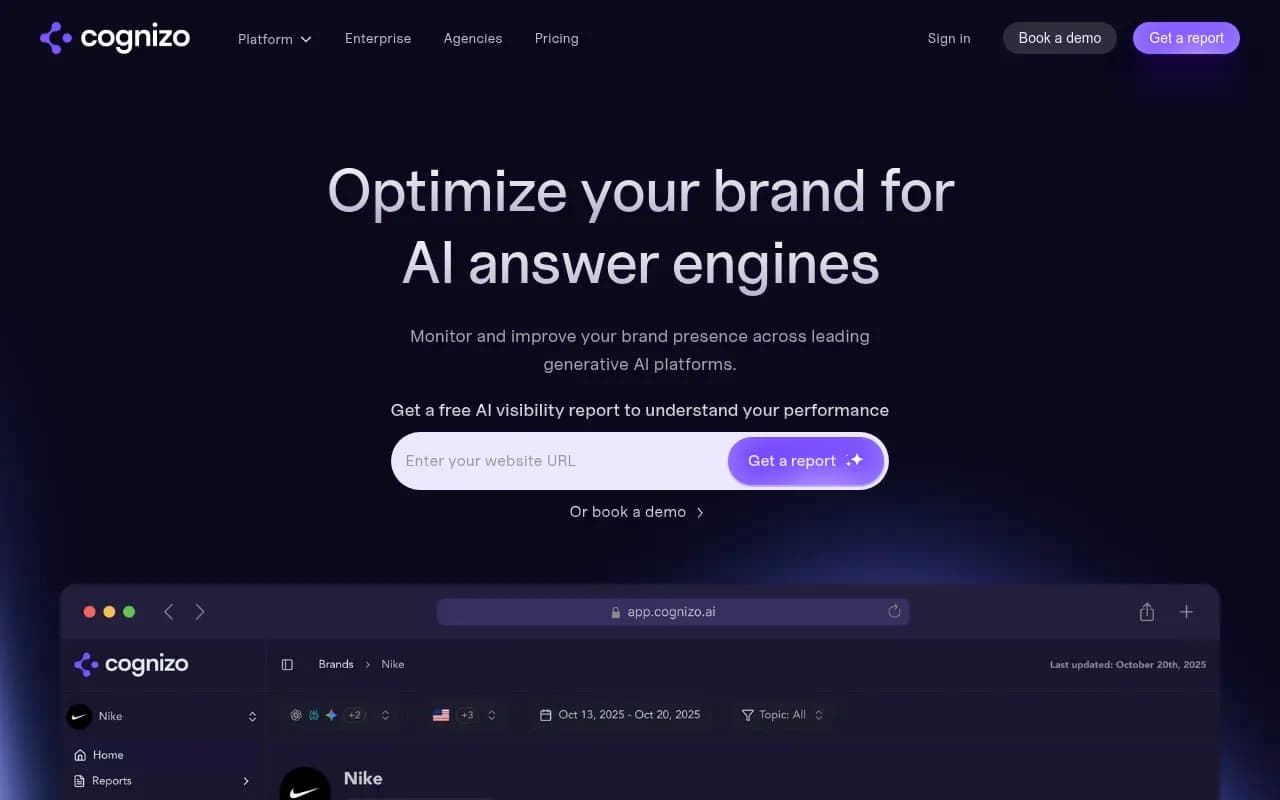
Cognizo calls itself an Answer Engine Optimization (AEO) platform built for marketing teams who want to "be the answer in AI conversations." It monitors brand visibility across ChatGPT, Perplexity, Gemini, and Google AI Overviews, tracking citations, sentiment, and competitor performance in real time. The platform's tagline is "customers today want answers, not links" -- a direct nod to the shift from traditional search to generative AI.
Cognizo's feature set revolves around four pillars: identify buyer questions, understand your visibility, turn insights into action (automated content creation), and measure AI-driven traffic. The site highlights workflow automation for content briefs, drafting, and research. Pricing isn't listed publicly; you have to book a demo, though reports suggest plans start around $89/mo.
Side-by-side comparison
| Feature | Bear AI | Cognizo |
|---|---|---|
| Starting price | $100/mo (Basic) | ~$89/mo (reported, demo required) |
| Free tier | No | No |
| AI platforms tracked (entry plan) | ChatGPT only (Basic) | ChatGPT, Perplexity, Gemini, Google AI Overviews |
| AI platforms tracked (top plan) | All major LLMs (Enterprise) | ChatGPT, Perplexity, Gemini, Google AI Overviews |
| Prompt tracking (entry plan) | 30 prompts | Unknown (demo required) |
| Content generation (entry plan) | 2 blogs/mo | Included (workflow automation) |
| Citation tracking | ✓ | ✓ |
| Sentiment analysis | ✓ | ✓ |
| Competitor tracking | ✓ | ✓ |
| Trending prompts / query discovery | ✓ (prominent feature) | ✓ ("buyer questions") |
| AI traffic measurement | ✓ | ✓ ("measure AI-driven traffic") |
| Content workflow automation | Limited info | ✓ (brief generation, drafting, research stages) |
| Self-serve signup | ✓ | No (demo required) |
| Transparent pricing | ✓ (Basic and Enterprise listed) | No (custom pricing) |
Platform coverage and tracking capabilities
Bear AI's Basic plan locks you into ChatGPT-only tracking. If you're a startup testing the waters and ChatGPT is your primary concern, this works. But if you need Perplexity, Claude, or Gemini data from day one, you're forced into the Enterprise tier with custom pricing. The site lists "all major LLMs" for Enterprise but doesn't break down exactly which models or how many prompts you can track.
Cognizo monitors ChatGPT, Perplexity, Gemini, and Google AI Overviews across all plans (as far as the site indicates). This is a meaningful difference if you're trying to understand cross-platform visibility without jumping to an enterprise contract. The platform also emphasizes "millions of data points analyzed daily" -- a scale claim that suggests broader coverage, though without specifics it's hard to verify.
Both platforms track citations, sentiment, and competitor performance. Bear AI's dashboard screenshots show trending prompts with volume labels ("High-volume") and a clean interface for seeing "what users ask AI agents about your brand." Cognizo's screenshots highlight content opportunities, workflow statuses ("Run workflow," "Generating brief," "Drafting content"), and a more process-oriented view.
Verdict: Cognizo wins on multi-platform coverage at the entry level. Bear AI's ChatGPT-only Basic plan is a bottleneck unless you're willing to pay Enterprise pricing upfront.
Content creation and optimization
Bear AI includes 2 blogs per month on the Basic plan. The site doesn't detail how content generation works -- whether it's AI-written, human-assisted, or just optimization suggestions. The focus is more on tracking and visibility than on content workflows.
Cognizo makes content automation a headline feature. The platform promises "AI-optimized content creation that moves the needle" and shows workflow stages: researching, generating briefs, drafting content. The screenshots suggest a structured process where you identify content gaps, generate a brief, and move through drafting stages with AI assistance. This is closer to a content ops tool than a pure monitoring dashboard.
If your team needs help actually creating content that ranks in AI search, Cognizo's workflow approach is more developed. Bear AI's 2 blogs/mo feels like an add-on rather than a core capability. That said, neither platform shows the depth of content generation you'd get from a tool like Promptwatch, which builds content grounded in 880M+ citations and real prompt volumes.

Verdict: Cognizo has the edge if content creation is a priority. Bear AI's content offering is minimal on the Basic plan.
Pricing and plan structure
Bear AI's pricing is straightforward: $100/mo for Basic (ChatGPT, 30 prompts, 2 blogs/mo) and custom pricing for Enterprise (all platforms, unlimited tracking). This is transparent but limiting -- the jump from Basic to Enterprise is steep, with no middle tier.
Cognizo doesn't list pricing publicly. You have to book a demo to get a quote. Reports suggest plans start around $89/mo, which would undercut Bear AI's Basic plan, but without knowing what's included at that price point it's hard to compare directly. The lack of transparent pricing is frustrating if you're trying to budget or compare options quickly.
Both platforms are in the $100-ish/mo range for entry-level access, but Bear AI's Basic plan is handicapped by ChatGPT-only tracking. If Cognizo's ~$89/mo plan includes multi-platform tracking, it's a better deal. If it doesn't, and you have to pay more for full coverage, the value proposition shifts.
Verdict: Bear AI wins on transparency. Cognizo wins on likely value (multi-platform at entry level) but loses points for hiding pricing behind a demo wall.
Pricing comparison
| Plan | Bear AI | Cognizo |
|---|---|---|
| Entry tier | $100/mo (Basic: ChatGPT only, 30 prompts, 2 blogs/mo) | ~$89/mo (reported, demo required, likely multi-platform) |
| Mid tier | Not available | Unknown (custom pricing) |
| Enterprise | Custom pricing (all platforms, unlimited tracking) | Custom pricing |
| Free trial | Not mentioned | Free AI visibility report available |
User interface and ease of use
Bear AI's screenshots show a clean, modern dashboard with trending prompts, volume labels, and AI platform icons (ChatGPT, Claude, Perplexity, etc.). The interface looks straightforward -- you can see at a glance which prompts are high-volume and how AI platforms are talking about your brand. The design is startup-friendly: minimal clutter, clear CTAs, and a focus on actionable data.
Cognizo's screenshots are more complex. The dashboard shows content opportunities, workflow statuses, and a table-based view of actions and impact. This is more powerful if you're managing a content pipeline, but it's also busier. The interface suggests a tool built for teams who want to dig into workflows, not just monitor metrics.
Both platforms require a learning curve. Bear AI feels lighter and faster to onboard. Cognizo feels more robust but potentially overwhelming if you just want quick visibility checks.
Verdict: Bear AI is easier to grasp quickly. Cognizo is more feature-rich but demands more setup and process thinking.
Query intelligence and prompt discovery
Bear AI highlights "trending prompts" as a core feature. The homepage shows examples like "What are the best business credit cards?" and "Best credit card for small businesses" with volume labels. This is useful for understanding what people are actually asking AI agents, and the interface makes it easy to spot high-volume opportunities.
Cognizo frames this as "identify buyer questions" and claims to analyze "what billions of customers are asking AI." The language is more B2B-focused ("buyer questions" vs "trending prompts"), but the underlying capability seems similar: discover the queries that matter, prioritize based on volume or impact, and optimize for them.
Both platforms offer query intelligence, but Bear AI's presentation is more visual and immediate. Cognizo's approach is embedded in a broader workflow (identify questions → create content → measure results), which is more comprehensive but less snackable.
Verdict: Tie. Bear AI is better for quick prompt discovery. Cognizo is better if you want query intelligence tied to a content creation workflow.
Competitor analysis
Both platforms track competitor performance. Bear AI's site mentions "see how AI agents are discovering your brand and optimize visibility" but doesn't show competitor comparison screenshots. Cognizo explicitly says "understand how you stack up against competitors" and shows this as part of the Answer Engine Insights feature.
Without detailed screenshots or feature breakdowns from either platform, it's hard to judge depth. Both claim competitor tracking; neither shows enough detail to evaluate how granular or actionable it is.
Verdict: Tie based on available information. Both claim the feature; neither proves superiority.
AI traffic measurement
Bear AI says "analyze traffic from all major LLMs" and "see how AI agents are discovering your brand." The site doesn't detail how traffic attribution works -- whether it's via tracking pixels, server logs, or something else.
Cognizo has a dedicated feature called "Measure AI-driven traffic" with the tagline "See how AI interacts with your site and drives human traffic." This suggests some form of attribution or analytics integration, but again, no technical details are provided.
Both platforms claim AI traffic measurement. Without knowing the implementation (tracking code, GSC integration, log analysis), it's impossible to compare accuracy or ease of setup.
Verdict: Tie. Both claim the feature; neither provides enough detail to differentiate.
Support and onboarding
Bear AI offers a "Book a Demo" CTA alongside "Get Started," suggesting some level of onboarding support. The site doesn't mention documentation, live chat, or support tiers.
Cognizo requires booking a demo to even see pricing, which implies a sales-assisted onboarding process. This can be helpful if you need hand-holding, but it's a barrier if you just want to sign up and start testing.
Verdict: Bear AI is more self-serve friendly. Cognizo is more hands-on but forces you through a sales process.
Pros and cons
Bear AI pros
- Transparent pricing with a clear $100/mo entry point
- Clean, easy-to-understand interface
- Self-serve signup available
- Trending prompts feature is visually intuitive
- Y Combinator backing signals credibility
Bear AI cons
- Basic plan is ChatGPT-only -- severely limits multi-platform visibility
- Only 2 blogs/mo on Basic plan, minimal content generation support
- No middle tier between $100/mo and Enterprise
- Limited information on content workflows or optimization guidance
Cognizo pros
- Multi-platform tracking (ChatGPT, Perplexity, Gemini, Google AI Overviews) likely included at entry level
- Strong content workflow automation (brief generation, drafting, research stages)
- Emphasis on turning insights into action, not just monitoring
- Free AI visibility report available for evaluation
Cognizo cons
- No transparent pricing -- requires booking a demo
- More complex interface, steeper learning curve
- No self-serve signup option
- Reported ~$89/mo starting price is unverified and may not include all features
Who should pick which tool
Pick Bear AI if you're a startup or small team that wants a simple, self-serve entry into AI visibility tracking. You're primarily focused on ChatGPT, you want to see trending prompts quickly, and you don't need deep content workflows. The $100/mo price is clear, and you can sign up without talking to sales. Just know you're locked into ChatGPT-only tracking unless you jump to Enterprise.
Pick Cognizo if you need multi-platform visibility from day one and you're serious about content creation. You're willing to book a demo to see pricing, and you want a platform that helps you go from query discovery to published content with workflow automation. The interface is more complex, but the feature set is more complete for teams that want to optimize, not just monitor.
If you're also looking to track how your brand shows up in AI search results and need a platform that combines monitoring with actionable content generation, Promptwatch is worth considering alongside either option -- it covers 10 AI models, includes crawler logs, and has a built-in AI writing agent grounded in 880M+ citations.
Final verdict
Cognizo is the better choice for most marketing teams in 2026. Multi-platform tracking at the entry level, content workflow automation, and a focus on turning insights into action make it more complete than Bear AI's ChatGPT-only Basic plan. Bear AI wins on transparency and ease of onboarding, but the platform limitations at $100/mo are too restrictive for teams that need cross-platform visibility. If Cognizo's reported ~$89/mo pricing holds and includes the features shown on their site, it's the smarter investment. Bear AI is fine for ChatGPT-first startups who want a quick, self-serve entry, but most teams will outgrow it fast.