Key Takeaways
- Gauge offers more aggressive pricing with a $99/mo starter plan (ChatGPT only) vs Cognizo's reported $89/mo entry point, but Cognizo's base tier includes all AI models from the start
- Gauge provides up to 18 AI-generated articles per month on Growth plan ($599/mo), while Cognizo's content automation capabilities are less clearly defined in public materials
- Both platforms track the same core AI engines (ChatGPT, Perplexity, Gemini, Claude, Copilot, AI Overviews), but Gauge explicitly limits ChatGPT-only tracking to the starter tier
- Cognizo emphasizes traffic measurement and AI crawler analytics more prominently, while Gauge focuses on competitive intelligence and clear optimization roadmaps
- Neither platform offers a true free tier -- both require paid plans to access meaningful functionality, though Gauge has a freemium model and Cognizo offers free visibility reports
- For teams that need high prompt volumes and multi-model tracking out of the gate, Cognizo's structure may be more cost-effective; for teams scaling up gradually, Gauge's tiered approach offers more flexibility
Overview
Gauge: Strategic competitive intelligence for AI visibility
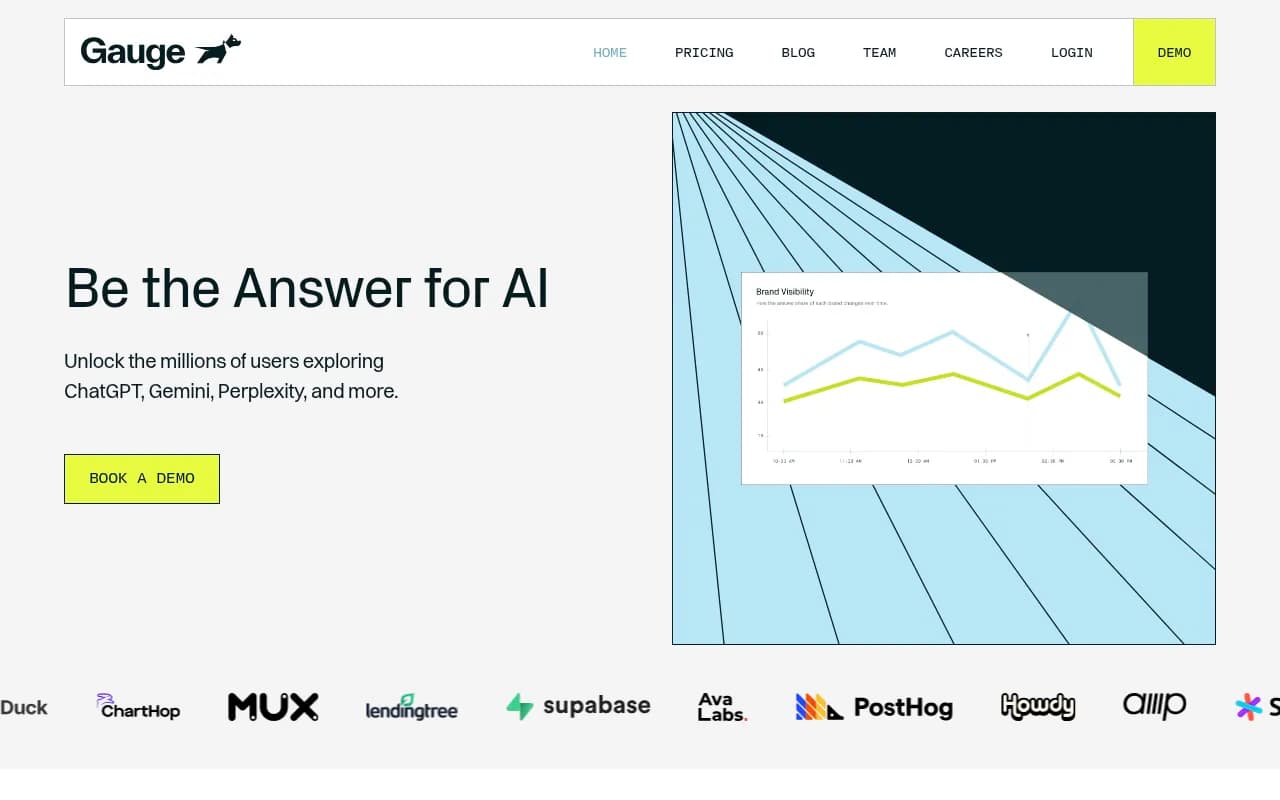
Gauge positions itself as a strategic competitive intelligence platform for AI visibility. The core pitch: track your brand against competitors across AI engines and get clear roadmaps to improve visibility. Gauge monitors ChatGPT, Claude, Gemini, Perplexity, Copilot, AI Mode, and AI Overviews to detect brand mentions, analyze what content gets cited, and provide onsite and offsite recommendations.
The platform breaks down into three phases: Track (monitor AI-generated answers), Understand (analyze citations and competitor gaps), and Act (implement recommendations to improve presence). Gauge serves customers like MotherDuck, Supabase, and Howdy, focusing on B2B SaaS and tech companies that need to own their category in AI search.
Pricing starts at $99/mo for a Starter plan (100 prompts, ChatGPT only, 3 articles), scales to $599/mo for Growth (600 prompts, all models, 18 articles), with custom Enterprise pricing available.
Cognizo: Answer Engine Optimization platform
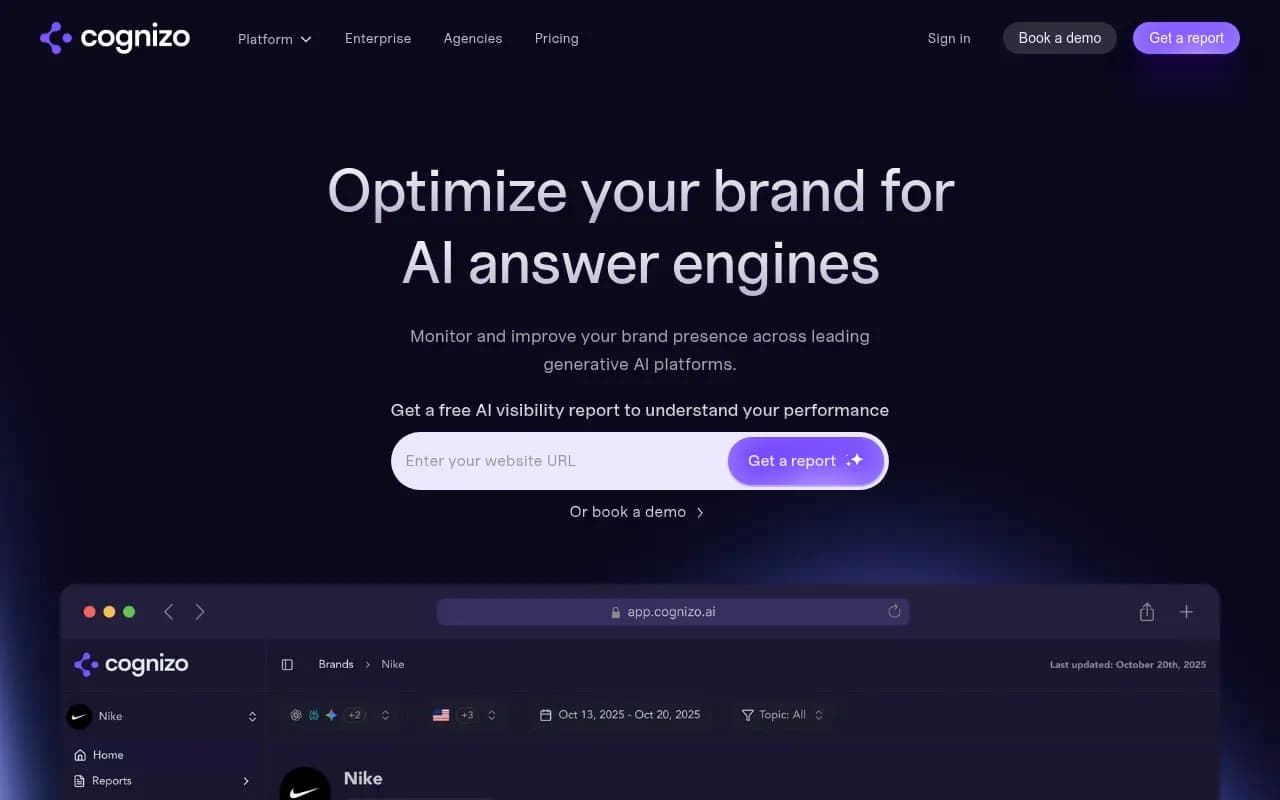
Cognizo frames itself as a complete Answer Engine Optimization (AEO) platform. The focus: help marketing teams monitor and improve brand visibility across AI platforms while automating AI-optimized content creation. Cognizo tracks real-time citations, sentiment, and competitor performance across the same set of AI engines.
The platform emphasizes four capabilities: identifying buyer questions (discover what customers ask AI), understanding visibility (monitor mentions and sentiment), turning insights into action (automate content creation), and measuring AI-driven traffic (see how AI interacts with your site). Cognizo markets to marketing teams adapting to the shift from link-based search to answer-based search.
Pricing is custom -- you book a demo to get a quote. Reports suggest plans start around $89/mo, but there's no public pricing page with clear tiers.
Side-by-Side Comparison
| Feature | Gauge | Cognizo |
|---|---|---|
| Starting price | $99/mo (Starter) | ~$89/mo (reported, custom pricing) |
| Free tier | Freemium model | Free visibility reports only |
| AI models tracked | ChatGPT, Claude, Gemini, Perplexity, Copilot, AI Mode, AI Overviews | ChatGPT, Perplexity, Gemini, Claude, Copilot, AI Overviews |
| Prompt limits (base tier) | 100 prompts (ChatGPT only) | Not publicly specified |
| Content generation | 3 articles/mo (Starter), 18 articles/mo (Growth) | Automated content creation (volume unclear) |
| Competitor tracking | ✓ Competitive intelligence focus | ✓ Competitor performance monitoring |
| Traffic attribution | Not prominently featured | ✓ AI-driven traffic measurement |
| Sentiment analysis | Not explicitly mentioned | ✓ Real-time sentiment tracking |
| Citation tracking | ✓ Analyze what content is cited | ✓ Real-time citations |
| API access | Not mentioned | Not mentioned |
| Multi-model access (entry tier) | ✗ ChatGPT only on Starter | ✓ All models (assumed) |
| Public pricing transparency | ✓ Clear tiers on website | ✗ Demo required |
Pricing comparison
Gauge publishes clear pricing tiers. Cognizo does not, which makes direct comparison difficult. Based on available information:
| Plan | Gauge | Cognizo |
|---|---|---|
| Entry tier | $99/mo: 100 prompts, ChatGPT only, 3 articles | ~$89/mo (reported): prompts/models unclear, demo required |
| Mid tier | $599/mo: 600 prompts, all models, 18 articles | Unknown -- custom pricing |
| Enterprise | Custom pricing | Custom pricing |
| Free option | Freemium (limited features) | Free visibility report (not a plan) |
Gauge's pricing is more transparent but potentially more expensive if you need all AI models from day one. The $99/mo Starter plan locks you into ChatGPT-only tracking, which limits usefulness for teams that need cross-platform visibility. You have to jump to $599/mo to get all models and meaningful content generation (18 articles).
Cognizo's lack of public pricing is frustrating. The reported $89/mo starting point is cheaper than Gauge's $99/mo, but without knowing what you get (prompt limits, model access, content generation volume), it's hard to evaluate value. The demo-required approach suggests Cognizo is targeting larger teams with custom needs rather than self-serve buyers.
User interface and experience
Gauge's website shows a clean, modern interface with clear visual hierarchy. The dashboard appears organized around the Track > Understand > Act framework, with competitor heatmaps and citation analysis front and center. The design feels polished and purpose-built for competitive intelligence workflows.
Cognizo's screenshots show a similar modern aesthetic with a focus on content optimization workflows. The interface highlights content opportunities, workflow statuses ("Run workflow", "Generating brief", "Drafting content"), and prompt metrics. The design emphasizes the content creation loop more than pure monitoring.
Both platforms look professional and usable. Gauge feels more analytics-focused, Cognizo feels more content-workflow-focused. Without hands-on access, it's hard to judge which is more intuitive day-to-day.
AI model coverage
Both platforms track the same core set of AI engines:
- ChatGPT (OpenAI)
- Perplexity
- Google Gemini
- Claude (Anthropic)
- Microsoft Copilot
- Google AI Overviews
Gauge also mentions "AI Mode" as a separate tracked engine, which likely refers to Google's AI Mode in Search. Cognizo's materials don't explicitly call this out, but it's unclear if that's a real gap or just marketing copy differences.
The critical difference: Gauge's Starter plan ($99/mo) only tracks ChatGPT. You need the Growth plan ($599/mo) to monitor all models. Cognizo's pricing structure is opaque, but there's no indication they limit model access by tier. If Cognizo's base plan includes all models, that's a significant advantage for teams that need comprehensive coverage without jumping to a $600/mo commitment.
Content generation capabilities
Gauge explicitly includes AI-generated articles in its pricing:
- Starter: 3 articles/month
- Growth: 18 articles/month
- Enterprise: custom volume
The platform promises content that helps improve AI visibility, though the website doesn't detail how the content generation works (templates, customization, quality controls, etc.).
Cognizo emphasizes "automated AI-optimized content creation" and shows workflow statuses like "Generating brief" and "Drafting content" in its interface. The platform clearly has content automation built in, but there's no public information about monthly article limits, content types, or how much human oversight is required.
Without knowing Cognizo's content generation limits, Gauge's explicit article counts are easier to plan around. 18 articles per month on the Growth plan is substantial -- that's enough to build a meaningful content pipeline. If Cognizo's content automation is unlimited or significantly higher volume, that changes the equation, but you'd need to ask during the demo.
If you're also looking to understand how your content performs once it's published and track your overall AI search visibility across models, Promptwatch offers a complementary angle with citation analysis, crawler logs, and content gap identification based on 880M+ citations analyzed.

Competitive intelligence and benchmarking
Gauge makes competitive intelligence a core selling point. The platform explicitly promises to show "how your brand stacks up against competitors" and provides "clear onsite and offsite recommendations to own your category." The website highlights competitor analysis as part of the "Understand" phase.
Cognizo also tracks competitor performance but frames it more as part of overall visibility monitoring rather than a dedicated competitive intelligence workflow. The emphasis is on understanding your own visibility gaps and sentiment rather than deep competitor teardowns.
For teams where competitive positioning is the primary concern -- "Are we mentioned more than Competitor X?" -- Gauge's positioning suggests a more competitor-focused feature set. For teams focused on improving their own visibility with competitors as context, either platform works.
Traffic measurement and attribution
Cognizo explicitly calls out "Measure AI-driven traffic" as one of its four core capabilities. The platform promises to "see how AI interacts with your site and drives human traffic." This suggests traffic attribution features similar to what you'd find in analytics platforms -- connecting AI visibility to actual website visits and conversions.
Gauge's materials don't prominently mention traffic attribution or measurement. The focus is on monitoring AI responses and improving visibility, but there's no clear indication the platform tracks downstream traffic impact.
If proving ROI and connecting AI visibility to business outcomes is critical, Cognizo's traffic measurement features are a potential advantage. If you're primarily focused on improving visibility and citations without needing to track traffic attribution, Gauge's feature set may be sufficient.
Sentiment analysis
Cognizo explicitly mentions real-time sentiment tracking as a feature. This means the platform analyzes whether AI responses about your brand are positive, negative, or neutral -- useful for reputation monitoring and identifying potential PR issues.
Gauge's materials don't mention sentiment analysis. The focus is on presence/absence (are you mentioned?) and citation analysis (what content is being cited?) rather than tone or sentiment.
For brand reputation monitoring, Cognizo's sentiment tracking is a clear differentiator. For teams focused purely on increasing visibility and citations, sentiment analysis is nice-to-have but not essential.
Prompt intelligence and query discovery
Cognizo emphasizes "Identify buyer questions" and promises to "discover what billions of customers are asking AI." This suggests a prompt discovery or query intelligence feature that surfaces high-value questions your target audience is asking AI engines.
Gauge's materials focus on tracking specific prompts and analyzing results but don't explicitly highlight prompt discovery or query intelligence as a standalone feature.
If you're starting from scratch and need help identifying which prompts to track, Cognizo's buyer question discovery could save significant research time. If you already know which prompts matter for your business, both platforms will track them.
Reporting and integrations
Neither platform provides detailed information about reporting capabilities, export options, or third-party integrations on their public websites. Both appear to be standalone platforms without explicit mentions of API access, Looker Studio connectors, or integrations with marketing tools.
This is an area where you'd need to ask during demos to understand capabilities. For teams that need to pipe AI visibility data into existing dashboards or reporting workflows, lack of API/integration options could be a dealbreaker.
Pros and cons
Gauge pros
- Transparent pricing with clear tiers and feature breakdowns
- Explicit content generation limits (3-18 articles/month) make planning easier
- Strong focus on competitive intelligence and benchmarking
- Freemium model allows testing before committing
- Clear three-phase framework (Track > Understand > Act) for optimization
Gauge cons
- Starter plan locks you into ChatGPT-only tracking -- not useful for comprehensive monitoring
- $500 jump from Starter to Growth is steep for teams that need all AI models
- No explicit mention of sentiment analysis or traffic attribution
- Limited information about integrations or API access
- Content generation capabilities not deeply explained (quality, customization, etc.)
Cognizo pros
- Reported lower entry price (~$89/mo vs $99/mo)
- All AI models likely included in base tier (not explicitly limited like Gauge)
- Explicit traffic measurement and attribution features
- Real-time sentiment analysis for reputation monitoring
- Buyer question discovery helps identify high-value prompts to track
- Content workflow automation with clear status tracking
Cognizo cons
- No public pricing transparency -- demo required to get quotes
- Content generation limits unclear (could be unlimited or severely restricted)
- Less emphasis on competitive intelligence vs Gauge
- No free tier or trial mentioned (only free visibility reports)
- Opaque feature details make pre-demo evaluation difficult
Who should choose which tool
Choose Gauge if:
- You need transparent pricing and want to self-serve without a sales call
- Competitive intelligence and benchmarking are your primary use cases
- You're willing to start with ChatGPT-only tracking and scale up later
- You want a clear, structured optimization framework (Track > Understand > Act)
- You value knowing exactly how many articles you'll get per month (3-18 depending on tier)
- You're a B2B SaaS or tech company focused on owning your category in AI search
Choose Cognizo if:
- You need all AI models tracked from day one without a $600/mo commitment
- Traffic attribution and ROI measurement are critical for your team
- Sentiment analysis and reputation monitoring matter for your brand
- You want help discovering high-value buyer questions to track
- You're comfortable with demo-based sales and custom pricing
- You're a marketing team adapting to answer-based search and need content automation at scale
Consider both if:
- You're evaluating multiple AEO platforms and want to compare demos side-by-side
- Your budget is flexible and you're optimizing for features over price
- You need advanced capabilities neither platform clearly advertises (API access, custom integrations, white-label reporting)
Final verdict
Gauge wins on transparency and competitive intelligence focus. You know exactly what you're getting, how much it costs, and how many articles you'll generate each month. The three-phase framework is clear and the platform feels purpose-built for teams that need to outrank competitors in AI search. The downside: the pricing structure forces you into either ChatGPT-only tracking or a $600/mo commitment, with no middle ground.
Cognizo wins on feature breadth and likely better value for teams needing comprehensive coverage. Traffic attribution, sentiment analysis, and buyer question discovery are all useful capabilities Gauge doesn't explicitly offer. The reported lower entry price combined with (likely) all-models access makes Cognizo potentially more cost-effective for teams that need full platform coverage. The downside: opaque pricing and limited public information make evaluation harder without a demo.
For most teams, the decision comes down to this: if you value pricing transparency and competitive intelligence, start with Gauge. If you need traffic attribution and sentiment tracking, start with Cognizo. Both platforms will track your brand across AI engines and help you improve visibility -- the differences are in workflow emphasis and pricing structure, not core capability.
Neither platform is a clear winner across all dimensions. Gauge is better for teams that want to self-serve and scale gradually. Cognizo is better for teams that need advanced analytics and are comfortable with custom pricing. Test both if your budget allows.