GeoGen Review 2026
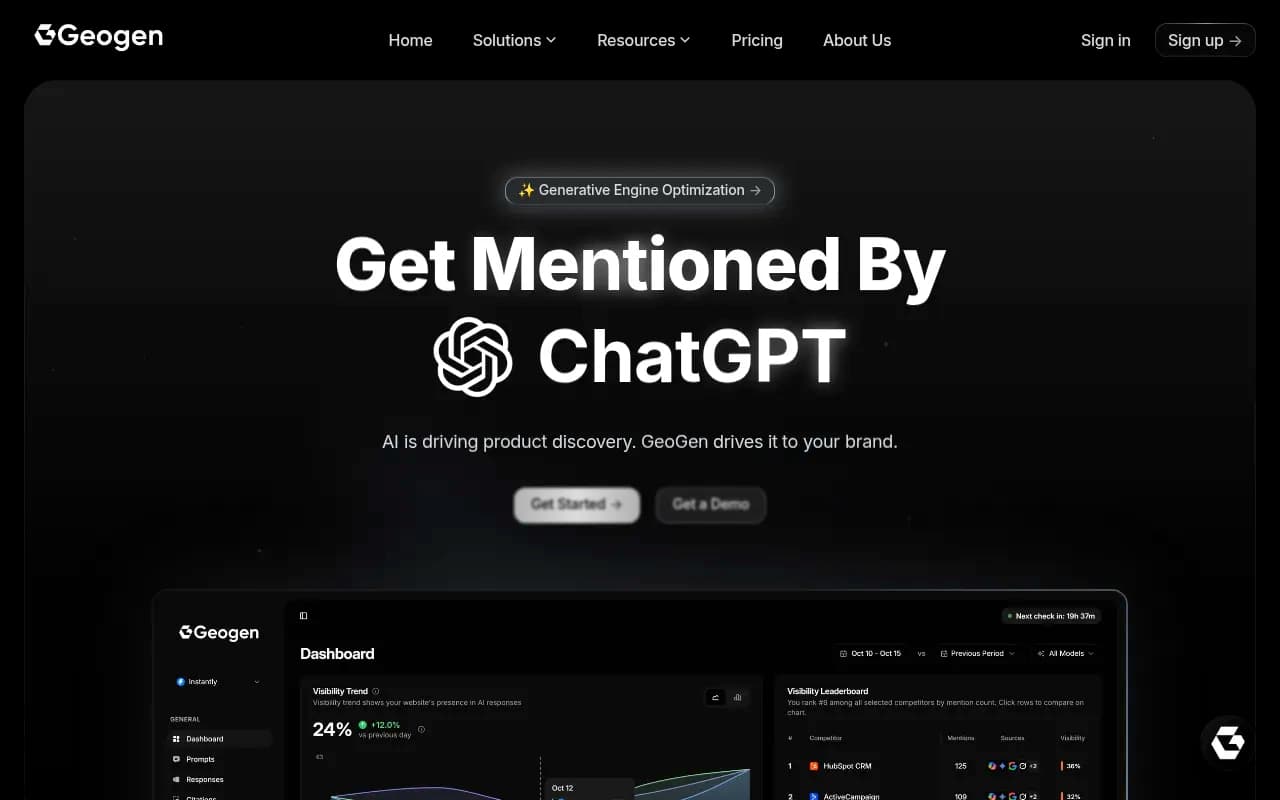
GeoGen is a Generative Engine Optimization (GEO) platform that helps brands monitor, analyze, and improve their presence in AI-powered search engines like ChatGPT, Perplexity, Gemini, and Copilot. Track brand mentions, analyze citations, compare competitor rankings, and optimize content to get recom
Key Takeaways:
- GeoGen tracks brand mentions across 7+ AI models (ChatGPT, Perplexity, Gemini, Copilot, Grok, Google AIO, Google AI Mode) but lacks the content generation and optimization tools that Promptwatch offers
- Monitoring-only platform -- shows you where you're mentioned but doesn't help you fix gaps or create content that ranks in AI search
- Missing AI crawler logs, traffic attribution, Reddit/YouTube tracking, and prompt volume/difficulty scoring that Promptwatch provides
- Pricing starts at €20/mo (Micro) up to €399/mo (Pro), with credits-based system that limits how many checks you can run
- Best for brands that want basic AI visibility tracking but aren't ready to actively optimize their content for AI search

GeoGen positions itself as "the first all-in-one platform for Generative Engine Optimization," but in practice it's a monitoring dashboard that shows you how often your brand gets mentioned in AI-generated answers. The company doesn't disclose when it launched or who's behind it beyond three team members shown on the site (Patrick, Mauro, Alessandro). The client list includes smaller European brands like CloudBlast, GdprWise, ProxyScrape, TextBroker, and HostingPerte -- not exactly household names, which tells you something about market traction.
The core pitch is simple: AI search engines like ChatGPT and Perplexity are replacing Google for product discovery, so you need to know when and how your brand appears in their answers. GeoGen tracks that. But tracking alone doesn't move the needle -- you need to know what's missing and how to fix it. That's where GeoGen falls short compared to platforms like Promptwatch that close the loop from insight to action.
Brand Mention Tracking
GeoGen monitors your brand across ChatGPT, Google AI Overviews, Copilot, Grok, Perplexity, Gemini, and Google AI Mode. You create custom prompts (questions users might ask) and GeoGen runs them against each model to see if your brand appears in the response. The dashboard shows your "Reach" (how often you're mentioned), "Share-of-Voice" (your mentions vs competitors), and "Citation Rate" (how often you're cited as a source).
The interface displays a live feed of mentions with the LLM logo, the prompt, a snippet of the response, and your ranking position. You can filter by model, region, language, and sentiment (positive/negative/neutral). This is useful for understanding baseline visibility but doesn't tell you why you're ranking where you are or what content is missing.
Competitor Comparison
You can add up to 4 competitors (depending on your plan) and see how your AI visibility stacks up. The dashboard shows a bar chart with each brand's visibility percentage and ranking position. This is helpful for benchmarking but again, it's descriptive, not prescriptive. You see that Competitor A ranks #1 for a prompt but GeoGen doesn't explain what content or strategy they're using to get there.
Promptwatch's Answer Gap Analysis, by contrast, shows you the specific prompts competitors are visible for that you're not, then helps you create the missing content.
Citation Insights
GeoGen tracks which domains AI models cite most often in their responses. The dashboard shows a table with domain name, category (Social Networks, News & Media, etc.), and citation count. Reddit and YouTube typically dominate the top spots. This data is interesting but not actionable -- knowing that Reddit gets cited 1,326 times doesn't tell you which Reddit threads matter or how to get your brand into those conversations.
Promptwatch goes deeper with Reddit & YouTube tracking that surfaces specific discussions influencing AI recommendations, plus ChatGPT Shopping tracking for product mentions.
Multi-Language and Multi-Region Support
GeoGen supports 30+ languages and lets you track prompts by region (country/state/city level). This is genuinely useful for global brands that need to understand how AI visibility varies across markets. You can create separate prompt sets for different languages and regions, then compare performance.
The downside: each prompt check consumes credits from your annual allowance. The Micro plan gives you 7,440 credits/year (about 20 checks per day), Standard gives you 74,400 (about 200/day), Growth gives you 334,800 (about 900/day). If you're tracking 50 prompts across 4 models in 3 regions, you burn through credits fast.
Sentiment Analysis
GeoGen analyzes whether AI mentions are positive, negative, or neutral. This is a nice-to-have but the implementation seems basic -- likely keyword-based rather than true sentiment understanding. The dashboard shows a sentiment breakdown but doesn't provide recommendations for improving negative mentions.
Workspaces and Team Collaboration
You can create multiple workspaces (separate projects) and invite team members with granular permissions. Each workspace can be upgraded independently, which is useful for agencies managing multiple clients. The Standard plan includes 2 team seats, Growth includes 10, Pro includes 10, and Custom (enterprise) includes unlimited.
Integrations
The site mentions "easily connect your edge platform and CMS's to track AI crawlers" but doesn't specify which integrations are available. The screenshots show logos for Cloudflare, WordPress, Webflow, Shopify, Wix, Squarespace, and Vercel, but there's no documentation on what these integrations actually do. Presumably they help track when AI crawlers visit your site, but GeoGen doesn't offer the detailed AI crawler logs that Promptwatch provides -- real-time logs showing which pages crawlers read, errors they encounter, and how often they return.
What's Missing (vs Promptwatch)
GeoGen is a monitoring tool, not an optimization platform. Here's what it lacks:
- Content Gap Analysis: No way to identify which prompts competitors rank for that you don't, or what content you need to create
- AI Content Generation: No built-in writing agent to create articles, listicles, or comparisons optimized for AI search
- AI Crawler Logs: No visibility into how AI crawlers interact with your website (which pages they read, indexing errors, crawl frequency)
- Traffic Attribution: No way to connect AI visibility to actual website traffic or revenue (Promptwatch offers code snippet, GSC integration, or server log analysis)
- Prompt Intelligence: No volume estimates, difficulty scores, or query fan-outs to help you prioritize high-value prompts
- Reddit & YouTube Deep Tracking: Citations data is surface-level; doesn't surface specific threads or videos influencing AI recommendations
- ChatGPT Shopping Tracking: No monitoring of product recommendations or shopping carousels
- Page-Level Tracking: Can't see which specific pages on your site are being cited by AI models
Promptwatch closes the action loop: find gaps, generate content, track results. GeoGen stops at step one.
Who Is It For
GeoGen makes sense for:
- Brand managers at mid-sized companies (50-500 employees) who need basic AI visibility reporting for quarterly reviews but don't have resources to act on the data
- Marketing teams that want to monitor AI mentions as part of broader brand tracking but aren't ready to invest in AI search optimization
- European brands (GeoGen appears to be based in Europe given the Euro pricing and client list) that want a local provider
It's NOT a good fit for:
- SEO teams and agencies that need to actively improve AI visibility -- you'll hit the limits of monitoring-only quickly
- Content teams that want to create AI-optimized content -- GeoGen doesn't help with content creation or gap analysis
- Brands serious about AI search -- if AI visibility is a strategic priority, you need a platform like Promptwatch that helps you optimize, not just observe
- High-volume users -- the credits-based pricing model gets expensive fast if you're tracking many prompts across multiple models and regions
Pricing & Value
GeoGen uses a credits-based system where each prompt check consumes credits. Pricing (billed annually):
- Micro: €20/mo (€240/year) -- 1 entity, 7,440 credits/year, 2 models, 10 prompts, 1 seat
- Standard: €60/mo (€720/year) -- 2 entities, 74,400 credits/year, 4 models, 50 prompts, 2 seats
- Growth: €199/mo (€2,388/year) -- 5 entities, 334,800 credits/year, 6 models, 150 prompts, 10 seats
- Pro: €399/mo (€4,788/year) -- 15 entities, 892,800 credits/year, 7 models, 300 prompts, 10 seats
- Custom: Contact for pricing -- unlimited entities, credits, models, prompts, seats
All plans include daily checks, competitor overview, website citations, LLM traffic tracking, unlimited countries/languages/tags, and 24/7 email/ticket support.
The credits system is confusing -- it's not clear how many credits a single prompt check costs or how credits are consumed across different models and regions. This makes it hard to estimate whether a plan will meet your needs. By comparison, Promptwatch uses straightforward prompt limits (50, 150, 350) with clear pricing.
Value-wise, GeoGen is cheaper than Promptwatch's Essential plan ($99/mo) but offers significantly less functionality. You're paying for monitoring, not optimization. If you just want to track AI mentions for reporting purposes, GeoGen is adequate. If you want to actually improve your AI visibility, Promptwatch is the better investment.
Strengths & Limitations
Strengths:
- Clean, modern interface that's easy to navigate
- Multi-language and multi-region support is genuinely useful for global brands
- Competitor comparison gives you benchmarking context
- Sentiment analysis adds a layer of insight beyond raw mention counts
- Workspace and team collaboration features are well-designed
Limitations:
- Monitoring-only -- no content gap analysis, no AI content generation, no optimization tools
- Credits-based pricing is confusing and potentially expensive for high-volume users
- Missing AI crawler logs, traffic attribution, Reddit/YouTube deep tracking, ChatGPT Shopping, prompt intelligence
- No page-level tracking to see which specific pages are being cited
- Limited integrations with unclear functionality
- Small client base and unclear company background raise questions about long-term viability
Bottom Line
GeoGen is a basic AI visibility tracker that shows you where your brand appears in AI-generated answers. It's useful for monitoring and benchmarking but doesn't help you actually improve your AI search rankings. If you're serious about AI visibility, Promptwatch is the stronger choice -- it not only tracks mentions but helps you identify content gaps, generate optimized content, and measure the impact on traffic and revenue. GeoGen is fine for passive monitoring; Promptwatch is built for active optimization.
Frequently asked questions
What is GeoGen and what does it do?
How much does GeoGen cost?
Does GeoGen offer a free plan?
Which AI search engines does GeoGen track?
Who is GeoGen best for?
What are the limitations of GeoGen?
Similar and alternative tools to GeoGen