Key Takeaways
- Pricing: Mentions.so starts at $99/mo with a free tier; GeoGen starts at €20/mo (~$22) but uses a credits-based system that can get expensive fast
- LLM coverage: Both track the same 7-8 major models (ChatGPT, Claude, Gemini, Perplexity, Grok, DeepSeek, Meta AI), but GeoGen adds Microsoft Copilot
- Traffic attribution: Mentions.so includes AI traffic tracking to see actual visitor numbers; GeoGen focuses on visibility metrics without direct traffic measurement
- Sentiment analysis: Mentions.so shows sentiment trends (positive/neutral/negative) across responses; GeoGen doesn't emphasize sentiment tracking
- Best for startups: Mentions.so's free tier and flat monthly pricing make it more predictable for small teams
- Best for agencies: GeoGen's credit system and lower entry price can work for agencies managing multiple clients, but costs scale unpredictably
Overview
Mentions.so
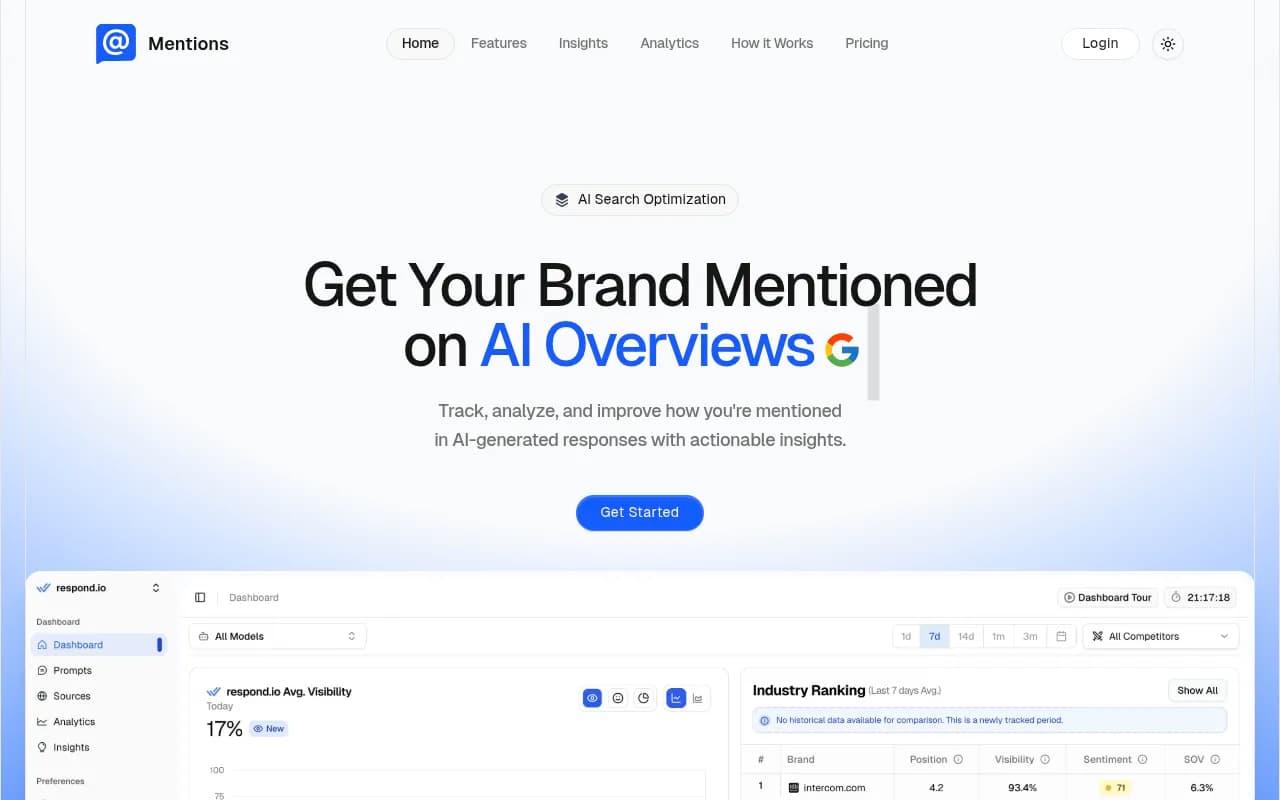
Mentions.so positions itself as a brand mention tracker for AI search engines. It monitors how ChatGPT, Claude, Gemini, Perplexity, and other LLMs talk about your brand, tracks sentiment, and shows you what competitors are doing. The platform includes AI traffic analytics so you can connect visibility to actual website visits. Mentions.so uses a straightforward monthly subscription model with a free tier for testing.
GeoGen
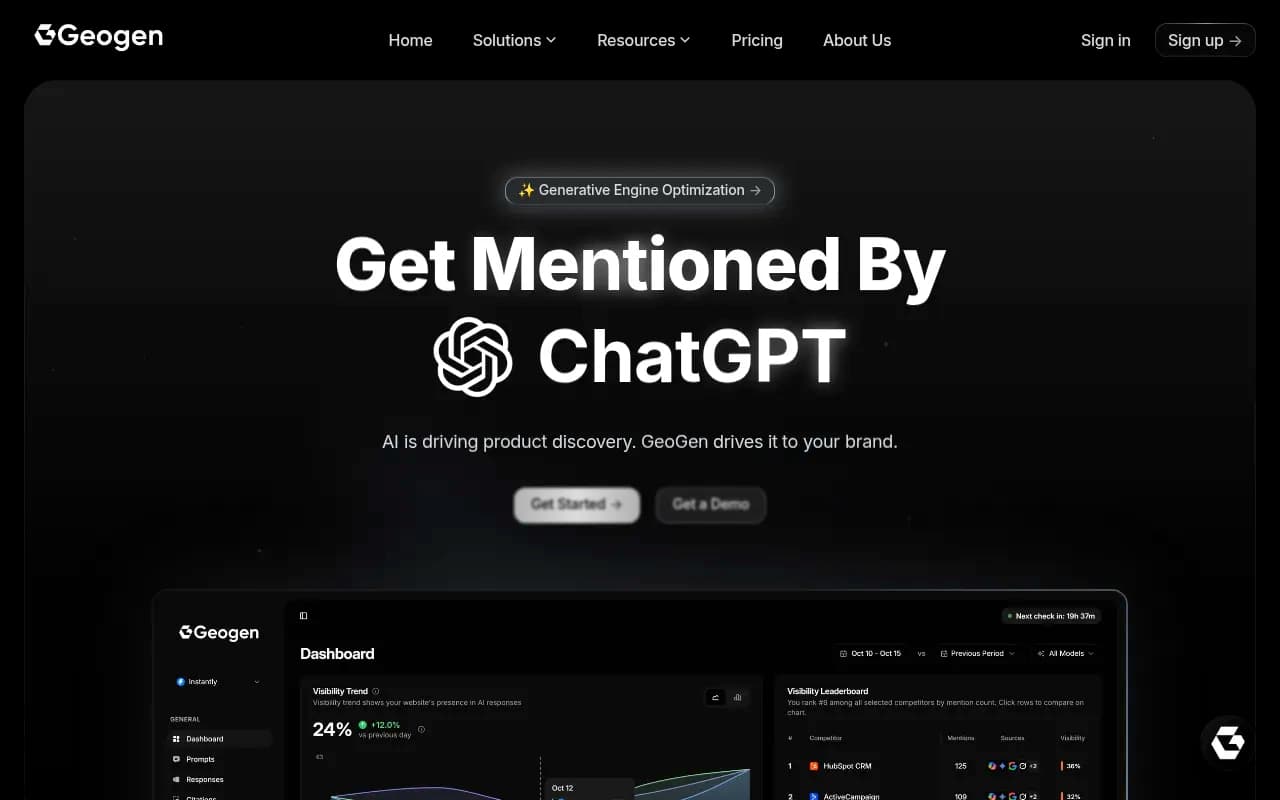
GeoGen is a Generative Engine Optimization (GEO) platform that tracks brand visibility across AI-powered search engines. It covers ChatGPT, Perplexity, Gemini, Grok, and Microsoft Copilot. GeoGen uses a credits-based pricing system where each query costs credits, and you buy credit bundles at different tiers. The platform focuses on citation analysis and competitor comparisons but doesn't include traffic attribution or sentiment tracking.
Side-by-side comparison
| Feature | Mentions.so | GeoGen |
|---|---|---|
| Starting price | $99/mo (Starter) | €20/mo (~$22, Micro) |
| Free tier | Yes | No |
| Pricing model | Flat monthly subscription | Credits-based (queries cost credits) |
| LLMs tracked | ChatGPT, Claude, Gemini, Perplexity, Grok, DeepSeek, Meta AI, Google Overview | ChatGPT, Gemini, Perplexity, Grok, Microsoft Copilot |
| AI traffic tracking | Yes (see actual visitor numbers) | No |
| Sentiment analysis | Yes (positive/neutral/negative trends) | Not emphasized |
| Competitor comparison | Yes (visibility percentages) | Yes (citation analysis) |
| Daily reports | Yes | Not specified |
| Custom prompts | Yes (manual + AI-suggested) | Yes |
| Annual discount | 16% | Included in pricing |
| Best for | Brands wanting traffic data + sentiment | Agencies needing flexible credit allocation |
Pricing breakdown
| Plan | Mentions.so | GeoGen |
|---|---|---|
| Free/Entry | Free tier available | No free tier |
| Starter | $99/mo | €20/mo (~$22, Micro) |
| Mid-tier | Not specified | €99/mo (~$109, Starter) |
| Professional | $599/mo (Agency) | €399/mo (~$439, Pro) |
| Enterprise | Custom | Custom |
| Billing | Monthly or annual (-16%) | Annual only |
| Credit system | No (unlimited queries per plan) | Yes (queries consume credits) |
Mentions.so uses predictable flat-rate pricing. You know exactly what you'll pay each month. GeoGen's credit system means your costs depend on how many queries you run -- if you track a lot of prompts or check frequently, you'll burn through credits faster and need to upgrade.
LLM coverage and tracking
Both platforms cover the major AI models, but with slight differences.
Mentions.so tracks:
- ChatGPT (OpenAI)
- Claude (Anthropic)
- Gemini (Google)
- Perplexity AI
- Grok (X/Twitter)
- DeepSeek
- Meta AI
- Google Overview (AI Overviews in search)
GeoGen tracks:
- ChatGPT
- Gemini
- Perplexity
- Grok
- Microsoft Copilot
GeoGen adds Copilot, which Mentions.so doesn't explicitly list. Mentions.so includes DeepSeek, Meta AI, and Google Overview, which GeoGen doesn't mention. In practice, both platforms cover the models that matter most for brand visibility in 2026. The real difference is how they present the data, not which models they track.
Traffic attribution and analytics
This is where Mentions.so pulls ahead.
Mentions.so includes AI traffic tracking. You can see how many visitors are coming from AI-generated responses and which prompts are driving that traffic. This connects visibility to actual business outcomes -- you're not just tracking mentions, you're measuring whether those mentions turn into website visits.
GeoGen doesn't offer traffic attribution. It shows you visibility scores and citation analysis, but you won't know if anyone actually clicked through to your site. For brands that need to justify GEO spend with ROI data, this is a problem.
If you're running paid campaigns or need to report on AI-driven traffic, Mentions.so gives you the numbers. GeoGen leaves you guessing.
Sentiment analysis
Mentions.so tracks sentiment across AI responses. You'll see whether mentions are positive, neutral, or negative, with trend lines over time. This matters when you're monitoring brand reputation -- a spike in negative sentiment tells you something went wrong, and you can dig into which prompts triggered it.
GeoGen doesn't emphasize sentiment tracking. The platform focuses on citation counts and visibility percentages, not the tone of those mentions. If you're in a reputation-sensitive industry (finance, healthcare, consumer brands), sentiment data is non-negotiable.
Competitor comparison
Both platforms let you compare your brand's visibility to competitors.
Mentions.so shows competitor visibility as percentages across different prompts. You can see which brands are dominating specific queries and track changes over time. The interface presents this as a simple bar chart or percentage comparison.
GeoGen offers citation analysis and competitor rankings. You can see which brands are getting cited most often and analyze why. The platform positions this as a core feature, with detailed breakdowns of competitor mentions.
Both approaches work. Mentions.so is more visual and easier to scan. GeoGen gives you more granular citation data if you want to dig deeper.
Prompt management
Mentions.so offers AI-suggested prompts based on your industry and domain, plus manual prompt entry. The AI suggestions save time -- you don't have to brainstorm every possible query yourself. You can accept or reject suggested prompts, then add your own custom ones.
GeoGen supports custom prompts but doesn't emphasize AI-generated suggestions. You're expected to know which prompts matter for your brand and add them manually.
For teams new to GEO, Mentions.so's AI suggestions are helpful. For experienced teams with a clear prompt strategy, either platform works.
Daily reporting and insights
Mentions.so sends daily performance reports with actionable insights. The reports highlight changes in visibility, sentiment shifts, and specific recommendations for improving rankings. This is useful for teams that want a daily pulse check without logging into the dashboard.
GeoGen doesn't advertise daily reporting as a core feature. You'll need to log in and check the dashboard manually to see updates.
If you want automated alerts and regular summaries, Mentions.so delivers. If you prefer to check on your own schedule, GeoGen's approach is fine.
Pricing model: flat-rate vs credits
This is a bigger difference than it looks.
Mentions.so charges a flat monthly fee. You get unlimited queries within your plan's limits (number of prompts, workspaces, etc.). Your bill is predictable. If you run 100 queries or 1,000 queries in a month, you pay the same amount.
GeoGen uses a credits-based system. Each query costs credits. If you run more queries, you burn through credits faster and need to buy more. This can work for agencies that want to allocate credits across multiple clients, but it makes budgeting harder. A busy month with lots of tracking can blow through your credit allocation.
For most brands, flat-rate pricing is easier to manage. You know what you're paying, and you won't get surprised by a credit overage.
Pros and cons
Mentions.so pros
- AI traffic tracking shows actual visitor numbers from AI sources
- Sentiment analysis tracks positive/neutral/negative mentions over time
- Flat monthly pricing with no credit system -- predictable costs
- Free tier available for testing
- AI-suggested prompts save time on setup
- Daily performance reports with actionable insights
Mentions.so cons
- Starting price ($99/mo) is higher than GeoGen's entry tier
- Doesn't explicitly track Microsoft Copilot
- Limited information on enterprise features or custom integrations
GeoGen pros
- Lower entry price (€20/mo) for small-scale tracking
- Credits-based system can work for agencies managing multiple clients
- Tracks Microsoft Copilot, which Mentions.so doesn't list
- Focus on citation analysis and competitor rankings
GeoGen cons
- No AI traffic attribution -- you can't measure actual website visits
- No sentiment tracking -- you won't know if mentions are positive or negative
- Credits-based pricing makes costs unpredictable (heavy usage = higher bills)
- No free tier for testing
- Less emphasis on automated reporting and daily insights
Who should pick which tool
Pick Mentions.so if:
- You need to track AI-driven traffic and connect visibility to actual website visits
- Sentiment analysis matters for your brand (reputation monitoring, PR, customer-facing brands)
- You want predictable monthly pricing without worrying about credit limits
- You're new to GEO and want AI-suggested prompts to get started quickly
- You prefer daily automated reports instead of manual dashboard checks
Pick GeoGen if:
- You're an agency managing multiple clients and want to allocate credits flexibly
- You need to track Microsoft Copilot specifically
- You're comfortable with a credits-based system and can estimate your query volume
- You don't need traffic attribution or sentiment data -- visibility metrics are enough
- You want a lower entry price and are willing to scale up as needed
Final verdict
Mentions.so is the better choice for most brands. AI traffic tracking and sentiment analysis are table stakes in 2026 -- you need to know if visibility is turning into actual visits, and you need to monitor whether mentions are helping or hurting your reputation. The flat monthly pricing is easier to budget, and the free tier lets you test before committing.
GeoGen works for agencies that need flexible credit allocation across clients, but the lack of traffic attribution and sentiment tracking is a real gap. The credits-based pricing can also get expensive if you're tracking a lot of prompts or checking frequently.
If you're serious about AI visibility and want the full picture -- mentions, sentiment, and traffic -- Mentions.so delivers. If you just need basic visibility tracking and don't care about traffic or sentiment, GeoGen's lower entry price might appeal.
For brands that want to go deeper into AI search optimization -- tracking not just visibility but also content gaps, crawler logs, and optimization opportunities -- Promptwatch offers a more comprehensive platform. It combines visibility tracking with content gap analysis, AI-generated content creation, and page-level citation tracking across 10 LLMs. Worth exploring if you're looking to move beyond monitoring into active optimization.
