Key takeaways
- Your own restaurant or hotel website almost never gets cited directly by AI engines. Independent research puts your own site at under 10-14% of hotel citations and essentially 0% for restaurants, so your GEO strategy has to work off-site, not just on-site.
- The content types that win vary by platform: Reddit has collapsed as a ChatGPT source (down to roughly 0.09-0.5% of citations after an August 2026 drop), while it still matters a lot on Google AI Overviews (2.15% and growing).
- Hospitality-specific GEO tools like Malou and GeoGenie exist because generic AI visibility trackers don't model OTAs, review platforms, or multi-location groups well. General-purpose platforms like Promptwatch fill a different, complementary role: tracking your brand presence and crawler activity across every AI engine at once.
- If you run one restaurant or a single boutique hotel, you need a local-search specialist, not an enterprise GEO agency built for international hotel groups. Match the tool to your business size, not the other way around.
- Review velocity (fresh reviews in the last 6 months) now outranks total review count as a local ranking signal, according to 2025 Sterling Sky data, which matters for both classic local SEO and how AI engines weigh your reputation.
Why restaurants and hotels need a different GEO playbook
Most GEO advice is written for SaaS companies trying to get ChatGPT to recommend their software. That advice falls apart for a restaurant or a hotel, because the citation sources are completely different. A 200-prompt study of dining-intent queries across six AI engines (cloro.dev, 2026) found editorial "best-of" publishers like Time Out, Eater, and Michelin Guide account for 40% of citations in dining answers, user-generated content like Reddit and Instagram makes up 32%, and review or reservation platforms like OpenTable and TripAdvisor cover 25%. Your own restaurant website barely shows up at all.
Hotels aren't much better off. Cloudbeds found 55.3% of AI hotel citations point to online travel agencies, with only 13.6% going to the hotel's own site. A separate study by Tharro of 695 unbranded hotel searches found a hotel's own website was the cited source in under 10% of recommendations overall, climbing to only 37% even for hotels that already rank in Google's organic top 10.
That changes what "optimization" means here. You're not fixing your own pages so much as making sure the third-party sites AI already trusts, OpenTable listings, TripAdvisor profiles, destination blogs, Michelin write-ups, say the right thing about you, consistently, with fresh signals.
The engine-by-engine split matters more than people think
A 2026 study of 200 dining prompts found wildly different behavior across engines: Google AI Overview only triggers on about 3% of dining queries (it defers to the local pack instead), Perplexity answers every single dining prompt but cites zero sources, and ChatGPT, AI Mode, Copilot, and Gemini all answer with citations, with AI Mode citing the most sources per answer at 21.6 versus roughly 7.7-8.0 for the others.
Promptwatch's own social-citation data backs up part of this picture from a broader angle: across all prompt types in the week of September 28-October 4, 2026, social platforms made up just 0.46% of ChatGPT's citations combined, down from 5.8% earlier in the year, with Reddit cratering from 5.19% to 0.09% after an August collapse. Google AI Overviews is the opposite story, with social platforms at 12.2% of citations, about 26 times ChatGPT's share, led by YouTube at 4.28% and Facebook at 2.38%. For a restaurant group deciding where to spend review-generation and UGC effort, that's not a minor detail, it tells you Instagram and YouTube presence matters a lot more for Google surfaces than for ChatGPT right now.
Platforms built specifically for hospitality GEO
A handful of tools have built their product around the hospitality citation structure rather than treating restaurants and hotels as just another vertical.
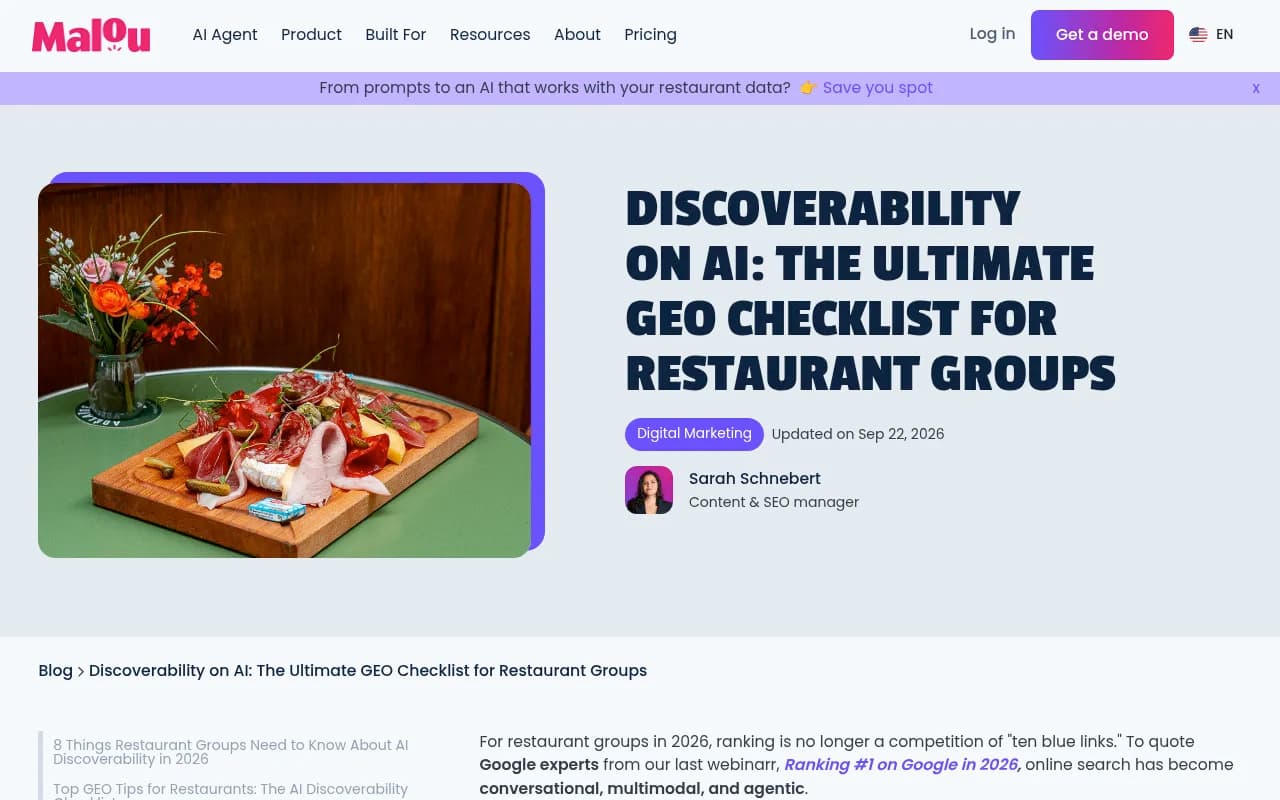
Malou
Malou is probably the most restaurant-native tool on this list. It's built for multi-location groups (think 3+ locations) and syncs presence across 50+ platforms including Google, Facebook, Instagram, TripAdvisor, Uber Eats, DoorDash, and OpenTable. Reviews across 15+ platforms land in one inbox with hospitality-trained AI reply drafts and theme analysis broken down by location. It comes in two tiers: the self-service MalouApp and Copilot, which adds a dedicated restaurant-marketing expert. Pricing is custom, there's no public rate card, and third-party reviewers note the setup overhead isn't worth it for one or two locations. If you're a single independent restaurant, skip this and look elsewhere; if you're running five or more locations, it's worth a demo.
GeoGenie
GeoGenie takes a more structured, almost agency-like approach with what it calls a "3-Pillar framework": a Trust Layer (Hotel/LocalBusiness schema and amenity-level structured data, where GeoGenie claims most hotel groups are missing 40-70% of required markup), a Scale Layer (intent-mapped pages by city, traveler type, and occasion, which the company says typically produces 400-800 net-new high-intent pages in a first audit for a 50-property group), and a Signal Layer (citation outreach to travel editorial sites, destination blogs, and curation lists). It covers restaurant groups too, not just hotels, with "best restaurant for X in [city]" intent mapping.
Pricing is tiered: Mini at $100/month (100 prompts, one brand, two AI models), Lite at $200/month, Standard at $500/month (billed as the best-value tier, 500 prompts, five brands, 100 content briefs), and a custom Enterprise/Managed GEO tier where GeoGenie's own team runs the whole loop. Extra AI models cost $25/month each, except Claude, which is a flat $200/month, worth factoring in if you want full model coverage.
Where general AI visibility platforms like Promptwatch fit in
Hospitality-specific tools are good at managing listings and reviews, but they generally don't give you the same depth on how AI engines actually crawl and cite your content across every model at once. That's where a broader platform like Promptwatch earns its place in a hospitality GEO stack, especially for a hotel group or restaurant brand with its own content operation (blog, press, recipe pages, destination guides) that needs tracking across ChatGPT, Gemini, Claude, Perplexity, and Google AI Overviews simultaneously, with crawler logs showing which bots actually visited which pages.

Promptwatch won't manage your OpenTable listing or reply to Yelp reviews for you, that's not its job. But if your hospitality brand is investing in destination content, press placements, or editorial outreach (the "Signal Layer" work GeoGenie and agencies charge for), Promptwatch's citation trend data and Content Agents can tell you whether that content is actually getting picked up by AI engines and help you publish follow-up content that closes the gaps, something the listing-management tools don't do.
Comparison: hospitality GEO tools at a glance
| Tool | Best for | Pricing | What it actually does |
|---|---|---|---|
| Malou | Multi-location restaurant/hospitality groups (3+ locations) | Custom, contact sales | Syncs 50+ listing platforms, unified review inbox with AI replies |
| GeoGenie | Hotel groups and restaurant brands wanting structured content rollout | $100-$500/mo, custom above | Schema audits, intent-mapped page generation, editorial citation outreach |
| Promptwatch | Hospitality brands with content/press operations needing cross-model tracking | $95-$579/mo, agency tiers from $199/mo | Prompt tracking, crawler logs, citation trends, automated content publishing |
| BrightLocal | Budget multi-location citation management | $8/location/mo | Cheapest option, less restaurant-specific, lower citation accuracy |
| Whitespark | Citation accuracy specialists | $33-$149/mo (citations), $14-$200/mo (rank tracking) | Hand-built local citations vs auto-filled, strong for local pack ranking |
| Restaurant Velocity | Single-location independent restaurants | $50/location/mo founding rate, moving to $99 | AI review replies, weekly GBP posts, photo scheduling, Maps grid scans |
Hiring a GEO agency instead of a platform
If you don't want to run any of this yourself, a growing number of agencies now specialize in hospitality GEO. Worth being skeptical here: Onely's own audit of seven published "best hospitality GEO agency" lists found that all seven were published by agencies selling GEO services, six of seven ranked themselves first, and zero of the seven showed a verifiable hospitality client actually appearing in a real AI answer. Treat any "top 10 agencies" list, including this section, as a starting point for your own due diligence, not gospel.
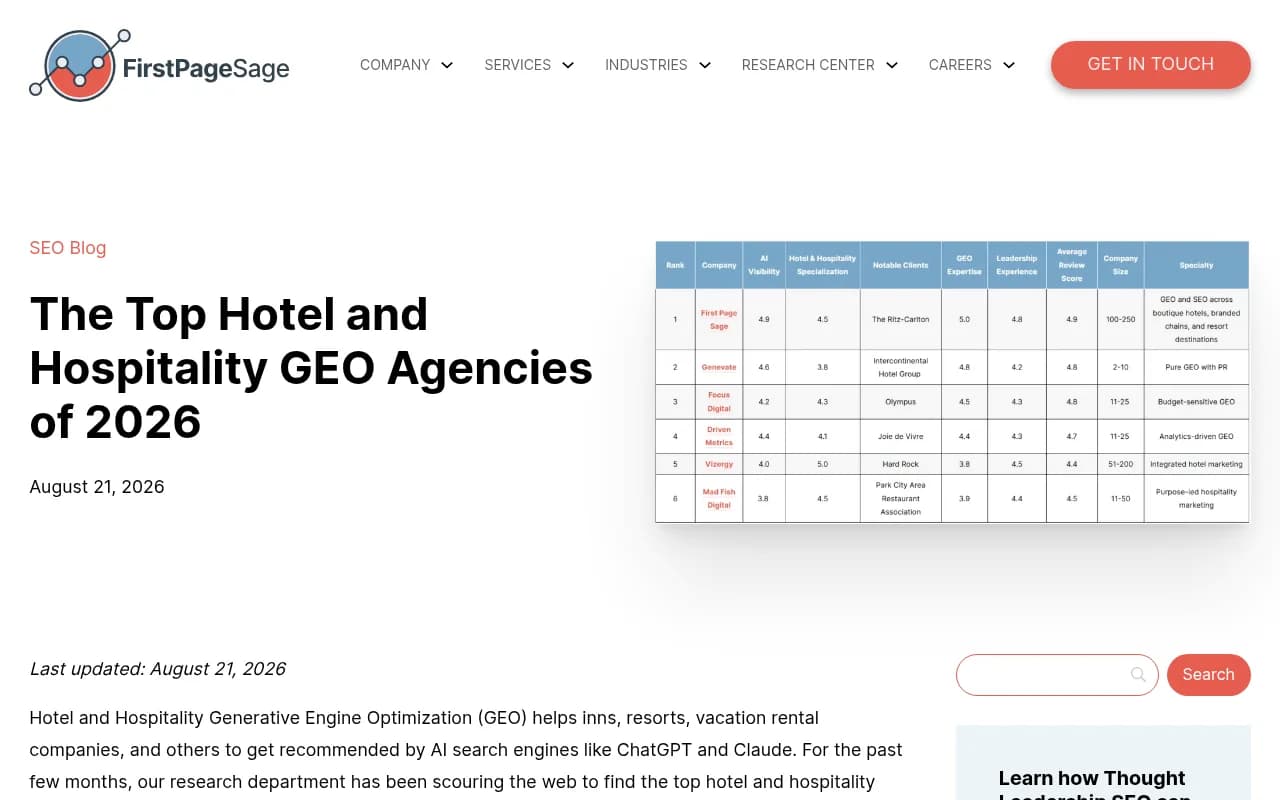
First Page Sage's August 2026 ranking scores agencies on seven weighted factors including AI visibility, hospitality specialization, and GEO expertise. Their top names include First Page Sage itself, Genevate (described as "pure GEO with PR," working with Intercontinental Hotel Group), Focus Digital (positioned for budget-sensitive GEO work), Vizergy (an integrated hotel marketing platform that clients praise for "deep hospitality fluency," with Hard Rock as a client, though reviewers note enterprise-level pricing), and Mad Fish Digital (purpose-led hospitality marketing, with the Park City Area Restaurant Association as a client).
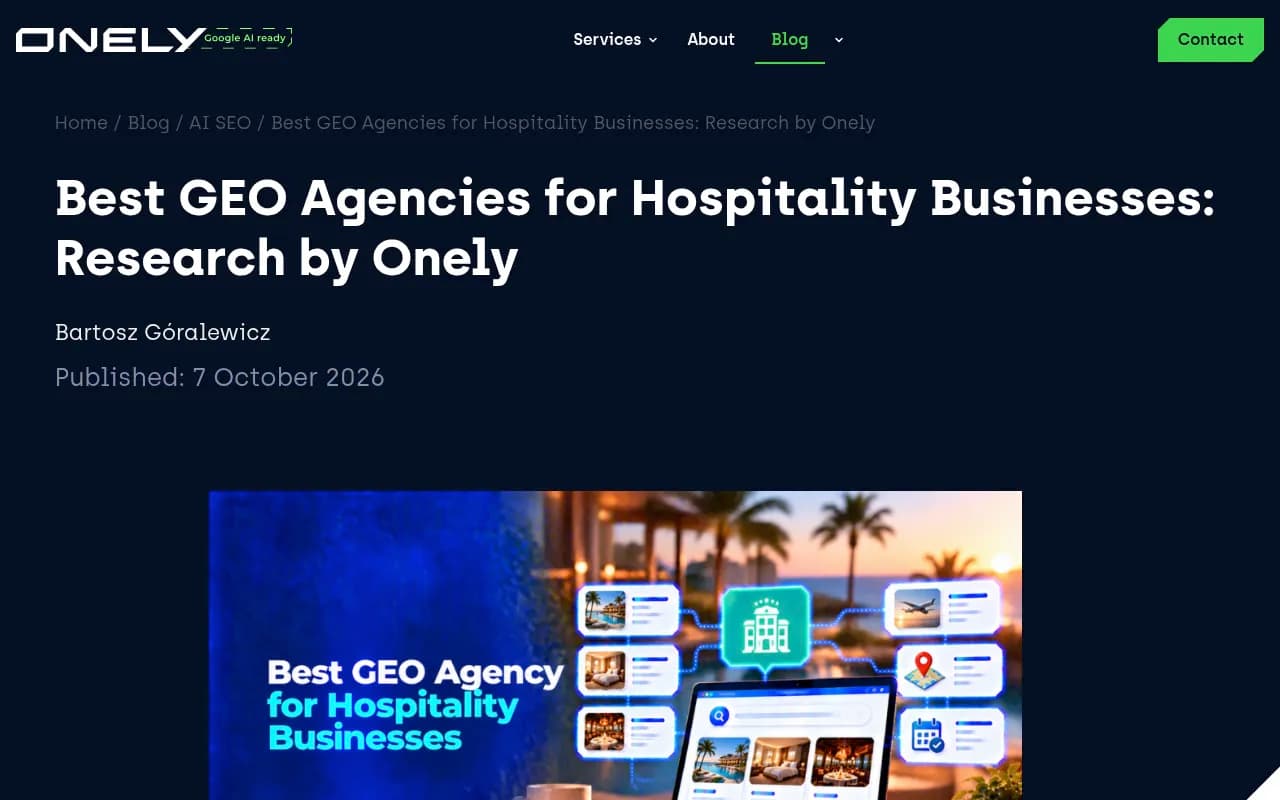
Onely's own take is more useful for segmenting by business size: they argue there's no single best hospitality GEO agency, and that the right choice depends on whether you're a single restaurant needing local diners or a hotel group needing international travelers. Their honest self-assessment is that Onely itself is a fit for enterprise, multi-country hospitality brands, hotel groups, resort chains, and explicitly not the right fit for a single restaurant, hotel, or bar serving a local town audience, which should hire a local-search specialist instead.
Separately, Bluelinks' August 2026 list of restaurant-specific AEO/GEO agencies (reviewed from 69+ firms) names Bluelinks itself, Brandtailers, Hudson Creative, Gourmet Marketing, The Digital Restaurant, Taptwice Media, Kalicube, Siana Marketing, StriveX Digi Solutions, and Blue Noda, though Bluelinks ranks itself first on its own list, so again, verify independently.
If hiring an agency feels like the right move and you want someone focused purely on execution rather than selling you a tool, 1001 SEO Media runs technical SEO, content, and GEO engagements with senior specialists and no long-term contracts, which is a reasonable alternative if the hospitality-specific agencies above don't fit your budget or market.
What actually moves the needle, regardless of tool
A few tactical points worth acting on no matter which platform you pick:
- Branded prompts behave differently than generic ones. Once someone names your restaurant or hotel in a prompt, reviews jump to 5.6% of citations (3x the overall average) and social posts jump to roughly 3.0% (4x average), according to Promptwatch's content-type data for the week of September 28-October 4, 2026. That means your Google Business reviews and recent social posts carry outsized weight once a guest already knows your name, worth prioritizing over generic SEO content.
- Generic "best restaurant near me" style prompts are crowded: 52.5% of ChatGPT responses to organic prompts cite 10 or more domains. You will never be the only source in that kind of answer, so the goal is presence across many of those sources, not dominance of one.
- Review velocity beats review volume. Sterling Sky's 2025 data found 50 reviews collected in the last six months outrank 200 reviews spread across five years for local ranking purposes. If your review generation has gone stale, that's a bigger problem than your total star count.
- There's a real adoption gap in AI-driven booking. SevenRooms' 2025 survey found 75% of diners say they're comfortable booking via AI, but only 28% of operators have actually deployed AI reservation tooling, worth closing if you want to capture that demand before competitors do.
- Check your crawler access across the board, not just OpenAI's bots. OpenAI accounted for 79.8% of verified AI crawler requests in the week of August 31-September 6, 2026, down from 94.8% in June, meaning Anthropic, Google, Perplexity, and others are taking a growing share, and a restaurant or hotel site blocking the wrong bot in robots.txt could be invisible to a meaningful chunk of AI traffic without knowing it.
Putting it together
For a single independent restaurant or boutique property, start with local citation hygiene (Whitespark or BrightLocal), a review-velocity push, and basic structured data, an enterprise GEO platform is overkill. For a multi-location restaurant group, Malou's listing and review consolidation solves a real operational headache that no generic tool handles as well. For a hotel group or hospitality brand running destination content and PR campaigns across multiple markets, GeoGenie's structured content rollout paired with a cross-model tracker like Promptwatch covers both the content production and the measurement side. And if any of this is more than your team wants to manage in-house, vet an agency against Onely's five checks (off-site work, market-specific prompts, revenue reporting, fit for your business size, and a client result you can verify yourself) before signing anything.
If you want to browse more AI visibility tools outside the hospitality-specific ones mentioned here, the directory at bestgeosoftware.com covers the broader GEO software category.