Key Takeaways
- Rankshift costs 3.4x more at entry level (€69/mo vs €20/mo) but includes significantly higher prompt volumes -- 150 prompts/day vs GeoGen's credit-based system
- GeoGen uses a credits model where each prompt query consumes credits, making actual costs harder to predict compared to Rankshift's straightforward daily prompt limits
- Both platforms track the same core AI models (ChatGPT, Perplexity, Gemini, Copilot) but neither offers the content generation or crawler log features found in platforms like Promptwatch
- Rankshift targets larger teams and agencies with unlimited users on all plans, while GeoGen positions itself for smaller teams and startups with lower entry pricing
- GeoGen's Micro plan at €20/mo is the cheapest entry point in the GEO space, but limited credits may not suit brands running comprehensive monitoring campaigns
- Both are monitoring-focused tools -- they show you where you appear in AI search but don't help you create content or fix visibility gaps
Overview
Rankshift
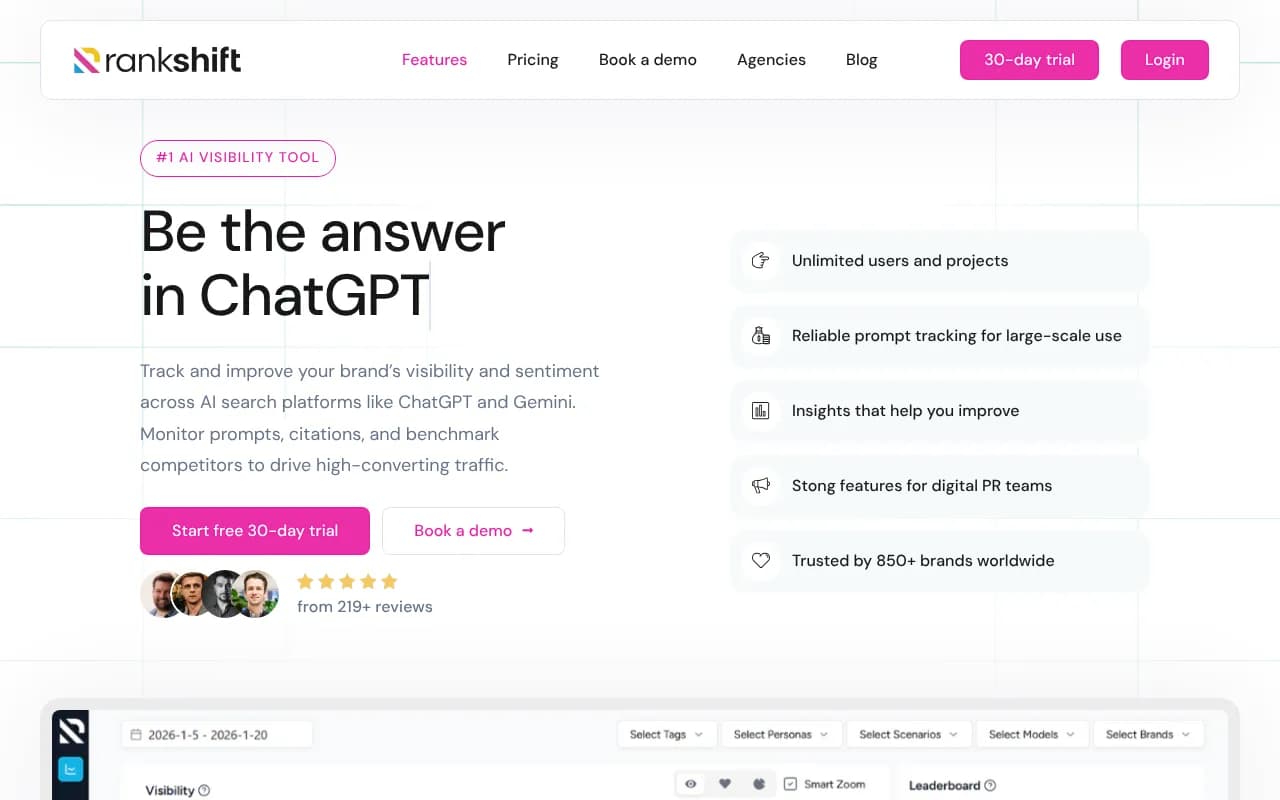
Rankshift positions itself as the "#1 AI visibility tool" for tracking brand mentions across ChatGPT, Perplexity, Claude, Gemini, and AI Overviews. The platform focuses on prompt tracking at scale, with plans ranging from 150 to 850 prompts per day. It targets digital PR teams, agencies, and brands that need reliable monitoring with unlimited team access. The company emphasizes its reliability for large-scale tracking and has 850+ brands using the platform, including recognizable names like Coolblast and Salesflare.
The core pitch: track where your brand shows up in AI answers, benchmark against competitors, and identify citation sources. Setup takes about 3 minutes according to their site -- add prompts, choose AI models, get insights.
GeoGen
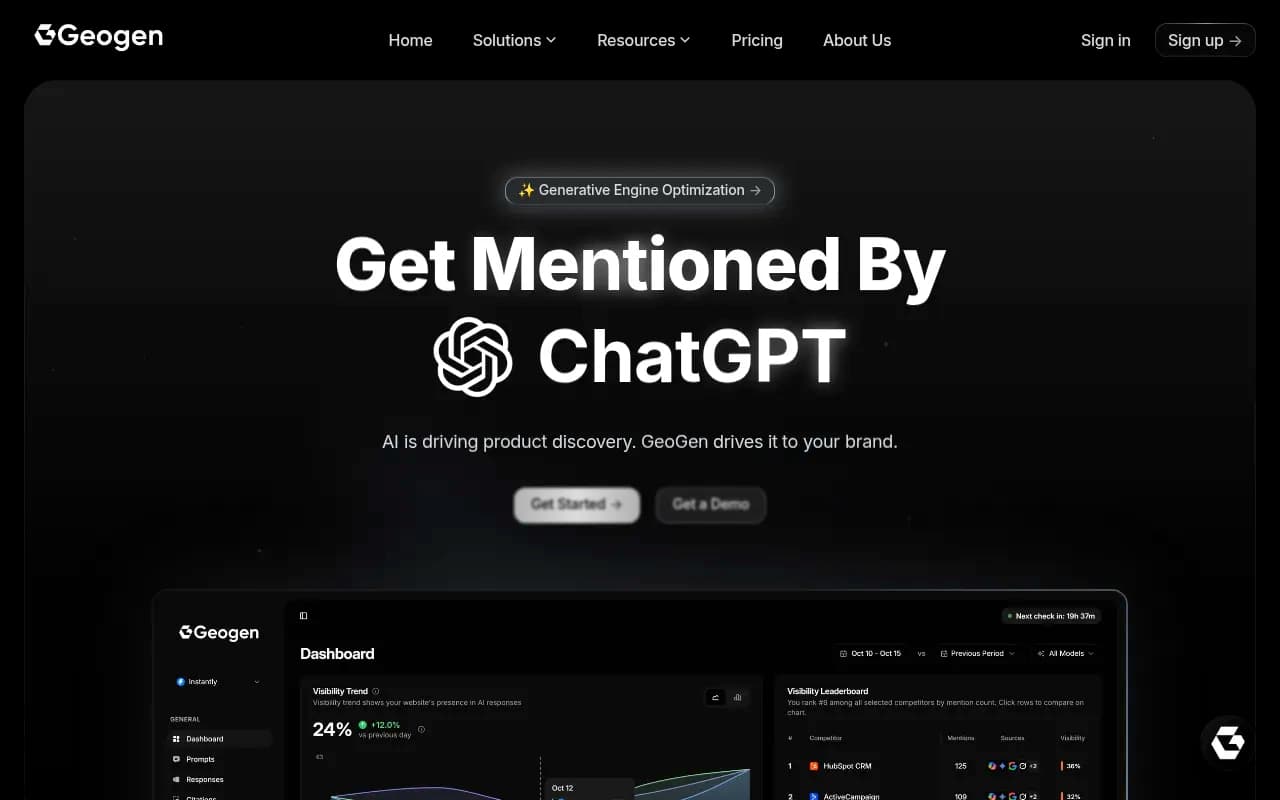
GeoGen takes a different approach with a credits-based pricing model starting at €20/mo. It covers the same major AI engines (ChatGPT, Gemini, Perplexity, Grok, Copilot) and positions itself as a more accessible entry point for companies new to generative engine optimization. The platform emphasizes getting brands "mentioned by ChatGPT" and driving product discovery through AI search.
GeoGen's client roster includes CloudBlast, GdprWise, ProxyScrape, and TextBroker. The platform markets itself as "GEO for AI Visibility analytics and improvement" -- though the "improvement" piece appears to be about insights rather than content creation tools.
Side-by-side comparison
| Feature | Rankshift | GeoGen |
|---|---|---|
| Starting price | €69/mo (Starter) | €20/mo (Micro) |
| Pricing model | Daily prompt limits | Credits-based |
| Entry-level prompts | 150/day (4,500/mo) | Varies by credits |
| AI models tracked | ChatGPT, Perplexity, Claude, Gemini, AI Overviews | ChatGPT, Perplexity, Gemini, Grok, Copilot |
| Users included | Unlimited (all plans) | Limited by plan tier |
| Projects included | Unlimited (all plans) | Limited by plan tier |
| Free trial | 30 days | Not specified |
| Annual discount | 10% | Yes (pricing shown as annual) |
| Top plan price | €359/mo (Business) | €399/mo (Pro) |
| Content generation | No | No |
| Crawler logs | No | No |
| Target audience | Agencies, digital PR teams, larger brands | Startups, smaller teams, budget-conscious brands |
Pricing breakdown
Rankshift pricing
| Plan | Price | Prompts/day | Monthly credits | Users | Projects |
|---|---|---|---|---|---|
| Starter | €69/mo | 150 | 9,500 | Unlimited | Unlimited |
| Growth | €149/mo | 350 | 22,000 | Unlimited | Unlimited |
| Scale | €249/mo | 600 | 37,500 | Unlimited | Unlimited |
| Business | €359/mo | 850 | 53,000 | Unlimited | Unlimited |
All plans include 30-day free trial, 10% discount on annual billing, and custom pricing for agencies/enterprise.
GeoGen pricing
| Plan | Price (annual) | Details |
|---|---|---|
| Micro | €20/mo | Credits-based, entry tier |
| Starter | Not specified | Mid-tier |
| Growth | Not specified | Higher tier |
| Pro | €399/mo | Top tier, custom enterprise available |
GeoGen's pricing page doesn't publicly list credit allocations or prompt limits for each tier, making direct comparison difficult. The credits model means you pay per query executed rather than having a fixed daily allowance.
Prompt tracking and volume
Rankshift's daily prompt model is straightforward: 150 prompts per day on Starter means you can run 150 different queries across your chosen AI models every 24 hours. This resets daily, giving you predictable capacity. For brands running ongoing monitoring campaigns across multiple product categories or competitor sets, this model makes budgeting simple.
GeoGen's credits system works differently. Each prompt query consumes credits, but the exact credit cost per query isn't publicly documented. This makes it harder to predict how many actual prompts you can run per month. The €20/mo Micro plan is attractive for testing or very light monitoring, but brands with serious tracking needs will likely hit credit limits quickly.
Verdict: Rankshift wins on transparency and predictability. The daily prompt model is easier to plan around, especially for agencies managing multiple clients or brands tracking dozens of product categories.
AI model coverage
Both platforms cover the essential AI search engines:
Rankshift tracks:
- ChatGPT (OpenAI)
- Perplexity
- Claude (Anthropic)
- Gemini (Google)
- AI Overviews (Google)
GeoGen tracks:
- ChatGPT
- Perplexity
- Gemini
- Grok (X.AI)
- Microsoft Copilot
Rankshift includes Claude and Google's AI Overviews. GeoGen includes Grok and Copilot instead. Neither covers the full spectrum of AI models that platforms like Promptwatch monitor (which includes Meta AI, DeepSeek, Mistral, and others).

Verdict: Slight edge to Rankshift for including Claude, which has significant market share among power users. But the difference is marginal -- both cover the big players.
Team collaboration and access
Rankshift includes unlimited users and unlimited projects on every plan, including the €69/mo Starter. This is a big deal for agencies or companies with multiple stakeholders who need dashboard access. You're not paying per seat or juggling who gets access.
GeoGen limits users and projects by plan tier, though the exact limits aren't publicly documented. The €20/mo Micro plan almost certainly restricts team access, which makes sense at that price point but becomes a friction point as teams grow.
Verdict: Rankshift wins decisively here. Unlimited users at every tier removes a common SaaS pain point and makes the higher base price more justifiable for teams.
Competitor benchmarking
Both platforms offer competitor tracking -- you can see how your brand's AI visibility compares to competitors for the same prompts. This is table stakes for any GEO tool in 2026.
Rankshift emphasizes "benchmark competitors" as a core feature and shows competitor comparison in their dashboard screenshots. The platform lets you track multiple brands simultaneously and compare visibility scores.
GeoGen also includes competitor analysis but doesn't detail the specific metrics or comparison views available. Their marketing focuses more on brand mentions and citations than head-to-head competitor rankings.
Verdict: Likely similar functionality, but Rankshift's marketing and dashboard previews suggest more robust competitor comparison features.
Citation and source analysis
Both platforms identify which sources AI models cite when mentioning (or not mentioning) your brand. This is critical -- knowing that Reddit threads or specific blog posts drive AI recommendations tells you where to focus your content and outreach efforts.
Rankshift calls out "find key sources" as a step-3 feature in their setup flow. Their dashboard shows citation tracking and source identification.
GeoGen mentions "analyze citations" in their description and includes citation analysis in the platform.
Neither platform appears to offer the depth of citation analysis found in more comprehensive tools -- for example, seeing 880M+ citations analyzed across all tracked prompts, or Reddit/YouTube-specific insights that show which discussions influence AI recommendations.
Verdict: Functionally equivalent. Both identify sources, neither goes deep on citation intelligence.
Content optimization and gap analysis
This is where both platforms show their limits. Rankshift and GeoGen are monitoring tools -- they tell you where you appear (or don't appear) in AI search results, but they don't help you fix it.
Neither platform offers:
- Content gap analysis showing which prompts competitors rank for but you don't
- AI content generation to create articles optimized for AI search
- Crawler logs showing how AI models access your website
- Traffic attribution connecting AI visibility to actual website visits
These are the "action" features that separate monitoring platforms from optimization platforms. If you want to close visibility gaps and actually improve your AI search rankings, you'll need to either do that work manually or use a tool like Promptwatch that includes content generation and gap analysis built in.
Verdict: Neither platform wins because neither offers these capabilities. Both stop at "here's where you rank" without helping you improve.
Ease of use and setup
Rankshift claims 3-minute setup: add prompts, choose AI models, get insights. Their dashboard screenshots show a clean interface with prompt lists, visibility scores, and source breakdowns. The unlimited users/projects model means no friction adding team members.
GeoGen's site shows dashboard previews that look modern and straightforward. The credits-based model adds a layer of complexity -- you need to understand credit consumption and budget accordingly, which is less intuitive than daily prompt limits.
Both platforms appear to have reasonable onboarding, but Rankshift's simpler pricing model and 30-day free trial make it easier to test without commitment.
Verdict: Rankshift edges ahead on simplicity and trial period.
Reporting and integrations
Neither platform publicly details API access, Looker Studio integration, or export capabilities. This is a gap -- agencies and larger brands often need to pull GEO data into custom dashboards or client reports.
More mature platforms in this space offer APIs and data export options. The lack of public documentation here suggests both Rankshift and GeoGen may be limited on the integrations front.
Verdict: Insufficient public information to compare, but likely both are limited.
Customer base and traction
Rankshift claims 850+ brands and shows logos from Coolblast, Salesflare, and others. They emphasize trust from "fastest growing companies" and have 219+ reviews (though the source isn't specified).
GeoGen shows logos from CloudBlast, GdprWise, ProxyScrape, TextBroker, and others. The repeated logo carousel on their site suggests a smaller but growing client base.
Both are relatively young platforms in a rapidly evolving space. Neither has the scale or track record of more established players.
Verdict: Rankshift appears to have more traction based on claimed user numbers, but both are early-stage platforms.
Pros and cons
Rankshift pros
- Unlimited users and projects on all plans (huge for agencies and growing teams)
- Transparent daily prompt limits make capacity planning simple
- 30-day free trial with no credit card required
- Higher prompt volumes at every tier (150-850/day)
- Includes Claude and AI Overviews in model coverage
- Reliable tracking at scale according to their positioning
Rankshift cons
- 3.4x more expensive than GeoGen at entry level (€69 vs €20)
- No content generation or optimization features
- No crawler logs or traffic attribution
- Monitoring-only platform -- doesn't help you improve visibility
- Limited public information on API access or integrations
GeoGen pros
- Lowest entry price in the GEO space at €20/mo
- Covers Grok and Copilot (models Rankshift doesn't track)
- Credits-based model may suit brands with sporadic monitoring needs
- Modern interface based on dashboard previews
- Good option for startups testing GEO for the first time
GeoGen cons
- Credits model makes actual costs unpredictable and harder to budget
- Limited users and projects on lower tiers
- No public documentation of credit allocations per plan
- No free trial mentioned (Rankshift offers 30 days)
- Monitoring-only platform with no content creation tools
- Less transparency overall on features and limits
Who should choose Rankshift
Pick Rankshift if you're:
- An agency managing multiple clients who all need dashboard access (unlimited users is a game-changer)
- A brand running comprehensive monitoring across many product categories or competitor sets (higher daily prompt limits)
- Willing to pay more for predictable capacity and transparent pricing
- Tracking brands that get mentioned in Claude responses (GeoGen doesn't cover Claude)
- A team that values reliability and scale over the cheapest entry price
Rankshift makes sense when you're past the "testing GEO" phase and need a workhorse platform that won't nickel-and-dime you on user seats or hit surprise credit limits.
Who should choose GeoGen
Pick GeoGen if you're:
- A startup or small business testing GEO for the first time (€20/mo is low-risk)
- Running light monitoring on a handful of core prompts (credits model works when volume is low)
- A solo marketer or small team that doesn't need multi-user access
- Interested in tracking Grok or Copilot specifically (Rankshift doesn't cover these)
- Budget-constrained and willing to accept less transparency for lower upfront cost
GeoGen is the "try before you commit" option. It's cheap enough to experiment with, but you'll likely outgrow it as your GEO program matures.
Final verdict
Rankshift is the better choice for most serious GEO programs. The unlimited users, transparent prompt limits, and higher capacity justify the higher price -- especially for agencies and growing brands. You know exactly what you're getting and won't hit surprise limits.
GeoGen wins on entry price and that's about it. The credits model creates uncertainty, and the lack of public documentation on limits and features is a red flag. It's fine for dipping your toes in, but you'll likely migrate to a more robust platform once you're running real campaigns.
That said, both platforms share the same fundamental limitation: they're monitors, not optimizers. They show you where you rank in AI search but don't help you improve. You're left to figure out content strategy, gap analysis, and optimization on your own. For brands serious about AI visibility, consider platforms that close the loop from tracking to action -- tools that identify gaps, generate optimized content, and measure the results.